
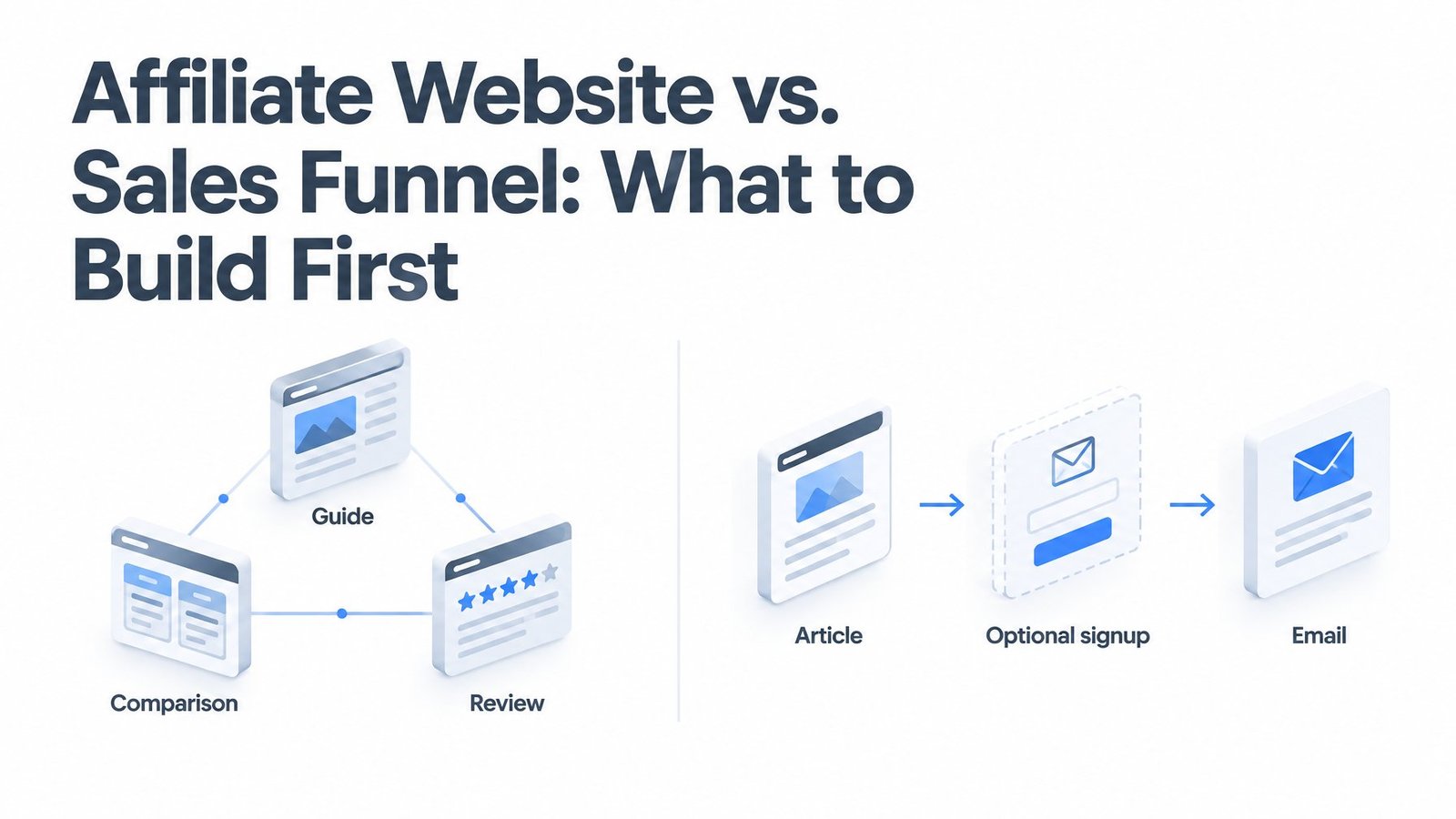
If you want organic search traffic on a small budget, build a content-led affiliate website first so you have a place to publish helpful answers; add a lightweight funnel when you have a useful next action for those readers. Your website provides the publishing foundation, while your funnel guides visitors toward a recommendation or an optional email subscription.
Key Takeaways
- A content-led website publishes discoverable pages that can attract organic search traffic.
- A sales funnel guides existing visitors toward a specific action rather than generating traffic on its own.
- Start with minimal publishing tools and add email follow-up only when you have a useful next step.
- Neither organic search traffic nor affiliate earnings is guaranteed.
Affiliate Disclosure
This article contains no affiliate links.
Your affiliate website vs sales funnel decision starts with your current audience. If you already attract relevant visitors through videos, social posts, or existing articles, a focused landing page and follow-up emails deserve attention sooner.
For an organic-first online business, low cash expenditure still requires substantial work. You need useful content and ongoing updates, and organic traffic might never materialize. Align your affiliate marketing setup with your business goals before committing to recurring software expenses.
What Does Each Component Actually Do?
You use a website to publish connected information and a sales funnel to organize a path toward a specific action. Your customer journey might include both, with a public article answering a question and an optional email sequence continuing the conversation.
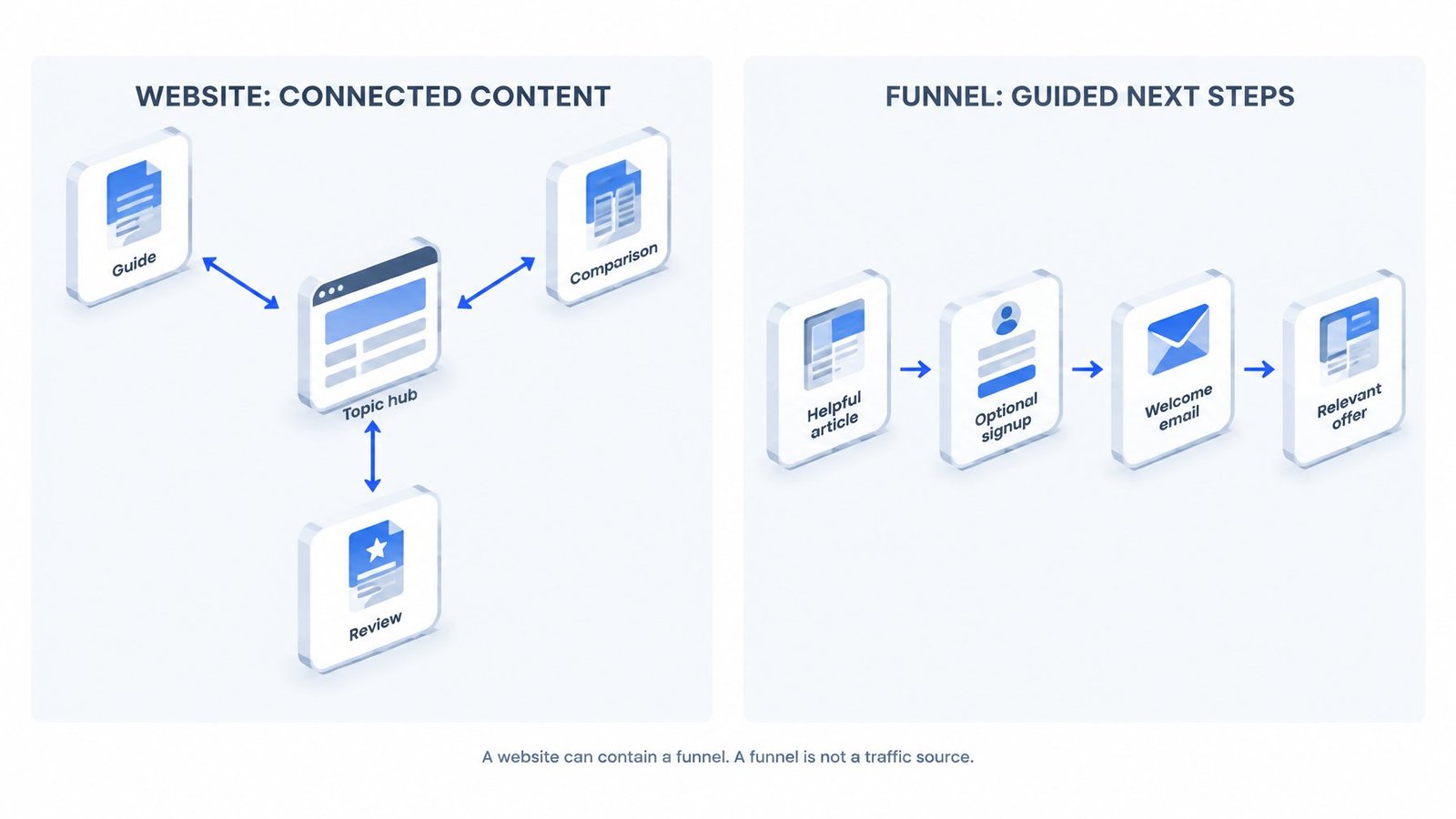
A website organizes useful content; a funnel guides a visitor toward a specific next action. Both can operate together.
How Does an Affiliate Website Help Readers Find Answers?
Your affiliate website is a collection of pages that helps readers solve problems and evaluate products, with disclosed affiliate links where recommendations fit. Think of it as your digital storefront for advice: visitors choose which questions to explore.
You might publish a tutorial about a task, an honest comparison, and a detailed explanation of a product’s limitations. Relevant internal links connect those pages so potential customers have access to supporting information before deciding.
When you create an affiliate website, organize it around a defined audience and its recurring questions. Give each article a useful purpose beyond sending visitors to a merchant.
What Is a Landing Page, and Can It Rank in Search?
You use a landing page as the destination for a particular visit or campaign. In marketing practice, you usually give that page a focused purpose, such as explaining a recommendation or offering an optional download.
Your landing page can rank in search when it is indexable and satisfies the searcher’s intent. A page answering a narrow product question has a different job from a brief signup page offering a checklist.
For search discovery, include enough public information to fulfill the query. A headline and email form leave little room to answer an educational question, regardless of which builder you use.
How Does an Affiliate Sales Funnel Differ From a Merchant Checkout?
Your affiliate sales funnel covers the explanation and follow-up you manage before a visitor reaches the merchant. A short path might run from an article directly to an affiliate link; a longer path might include voluntary lead capture and email marketing.
You influence awareness, interest, desire, and action through your content. Those stages describe a sales process, although your readers will move between them in different orders.
The merchant handles its sales page, checkout, payment, and fulfillment. Your access to purchase information comes through the affiliate program’s reporting, so plan around the information that program makes available.
What Does an Email Nurture Sequence Add?
Your email nurture sequence is a planned set of messages that helps subscribers make progress after signing up. It starts with delivering whatever you promised and continues with relevant advice.
For example, your lead nurturing emails might explain a difficult setup step or answer a recurring objection. A product recommendation belongs where it supports that lesson.
Set expectations before signup, including what you will send and whether promotional recommendations are included. Give subscribers an easy unsubscribe option throughout the sequence.
What Should an Organic-First Affiliate Marketer Build First?
Start with a small content-led website when search discovery is your main growth plan. If your existing online presence already brings you a relevant audience, prioritize the missing step between that content and the action you want readers to take.
|
Criterion |
Content-Led Affiliate Website |
Focused Affiliate Funnel |
|---|---|---|
|
Search discovery |
Multiple useful entry pages |
Page-specific opportunity |
|
Search-intent coverage |
Connected questions |
Narrow task or offer |
|
Internal linking |
Topic-based navigation |
Selected next steps |
|
Content workload |
Articles and updates |
Page copy and emails |
|
Cost categories |
Domain, hosting or builder |
Builder, email, integrations |
|
Measurement |
Visibility and page actions |
Step-by-step actions |
Compare Search Discovery, Intent Coverage, and Internal Linking
With a content-led website, you have room to address different search intents. You might help someone identify a problem, learn a process, or compare solutions before making a purchase.
Your search engine optimization (SEO) work includes making those pages accessible and aligning each one with a clear question. Useful internal links help website visitors continue their research and help search engines discover related pages.
A focused funnel serves a narrower purpose. Build it around the promise that brought someone there, while retaining access to essential details and disclosures. Your website and sales funnel can share the same domain.
Compare Content Workload, Complexity, and Ongoing Maintenance
Your website requires research, writing, and revision. Honest comparisons need updates when product details change, and tutorials need maintenance when instructions become outdated.
Your funnel adds another set of responsibilities: form testing, resource delivery, and email editing. Each additional branch or integration introduces something else to check.
When reviewing affiliate website examples, examine how easily you could maintain their structure. A compact collection of useful pages is a manageable starting point for your content marketing strategy.
Compare Upfront Costs, Recurring Costs, and Email Follow-Up
Your initial website expenses might include a domain and a hosting or website-builder plan. Paid design work and premium templates are optional purchases.
For a content-to-email funnel, account for your signup mechanism and email delivery service. Before purchasing, check contact limits, sending allowances, automation access, and renewal terms directly with the provider.
If you are researching a landing page builder for affiliate marketing, compare its capabilities with your existing editor. You might already have the page-building features required for your first funnel.
Choose Based on Your Content, Audience, and Next Desired Action
Use your current bottleneck to choose what to build:
- You lack useful public content: Publish an article answering a specific audience question.
- You have relevant readers who need help deciding: Improve the explanation and recommendation on that page.
- You receive recurring questions after a visit: Consider an optional resource and email follow-up.
- You already have a trusted audience elsewhere: Create a focused destination that fulfills your existing promise.
Keep brand awareness separate from immediate sales intent. Someone learning a basic process needs a different next step from someone comparing purchase options.
Your digital marketing strategy should identify how visitors will discover the page. A funnel organizes a journey; you still need a distribution plan to bring people into it.
How Can You Start Simply and Know When to Upgrade?
Begin with a readable article and a clear call to action, then add lead capture when you have a useful reason to continue by email. Upgrade your tools when repeated work or delivery problems expose a specific capability gap.
A Minimum Viable Setup Checklist: Essentials and Purchases That Can Wait
For your organic-first website, keep the essentials focused:
- A publishing setup with pages that search engines can access.
- A mobile-friendly article that answers a defined question.
- Clear navigation and relevant internal links.
- Affiliate disclosure near recommendations.
- Appropriate privacy information and a way to contact you.
- Search Console and suitable analytics for the actions you want to measure.
For a lightweight content-to-email funnel, add a relevant checklist, a signup and delivery mechanism, and a simple welcome email. Explain subscription expectations beside the form.
You can defer a dedicated funnel builder, advanced CRM, paid testing suite, and elaborate segmentation. When comparing website builders for affiliate marketing, prioritize publishing and maintenance requirements you already have.
Common Mistakes: Thin Content, Forced Signups, and Unnecessary Complexity
Give readers the essential answer in your public content. A page that promises instructions and immediately demands an email address leaves the original question unresolved.
Keep signup optional and offer something supplementary. When you build an email list, explain the ongoing messages subscribers will receive alongside the immediate download.
Protect your user experience by keeping the next action clear. Competing popups and repeated offers add decision fatigue, while unnecessary integrations increase your maintenance workload.
Measure Search Visibility, Signups, and Affiliate Actions Separately
Use Search Console to inspect search impressions, clicks, queries, and page performance. These help you evaluate whether searchers encounter your content and which searches bring visits.
Use your analytics and email reports to track downstream actions. Define each conversion rate before interpreting it:
- Signup rate: Completed signups divided by relevant page visits.
- Affiliate click rate: Recorded outbound affiliate clicks divided by relevant page visits.
- Email click rate: Use your provider’s stated denominator consistently.
- Reported affiliate outcomes: Qualifying actions or commissions shown by your program.
Your website conversion rate only becomes meaningful when you name the action being counted. Keep signup performance separate from purchase outcomes, and distinguish pending commissions from approved earnings.
A consistent affiliate tracking and reporting setup helps you reconcile those stages. Expect differences between your click counts and program reports because tracking methods and attribution rules vary.
Add Automation When Repeated Tasks or Follow-Up Gaps Justify It
Add automation when you repeatedly send the same promised resource or struggle to deliver welcome messages consistently. Automating a clear, tested process gives you a defined result to check.
Expand your sequence when subscriber questions reveal a recurring need. If readers ask about the same proposal mistake, for example, turn the answer into a focused follow-up email.
Use email segmentation when subscribers have meaningfully different needs and you have suitable content for each group. Consider a CRM when managing individual conversations becomes difficult, such as during a longer service-related buying process.
Hypothetical Example: From Proposal Advice to an Optional Recommendation
You could connect a public proposal article to an optional checklist and a short email sequence for new freelancers learning to find clients. Treat the entire scenario below as hypothetical: it describes a possible setup, with no DiSousa offer, existing asset, client project, affiliate relationship, or actual result attached.
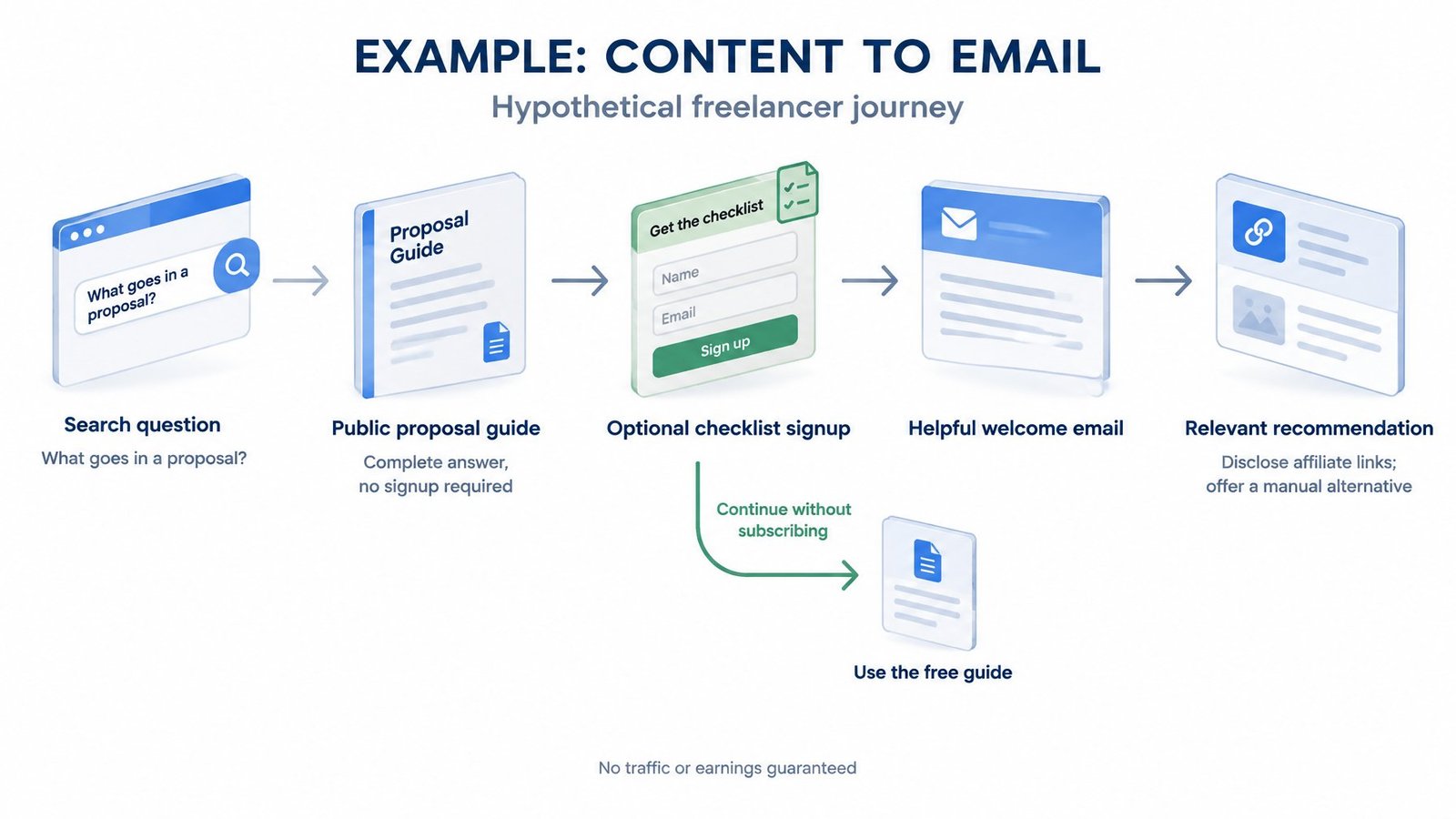
Hypothetical example: readers can use the public guide without subscribing; email follow-up is optional.
Answer a Freelancer’s Proposal Question in a Public Article
Start with a query such as “what should a freelance proposal include?” Your public article should explain the client’s problem, proposed scope, deliverables, timeline, fees, payment terms, revision boundaries, and acceptance process.
Include a usable example of a client-specific opening. You might show how to connect the proposed work to something the prospective client has already said about their needs.
A freelance proposal template gives your reader a structure to adapt. Keep the essential proposal advice accessible without signup so the article fulfills its search promise.
Offer an Optional Checklist With Clear Subscription Expectations
After the explanation, offer a hypothetical freelance proposal checklist as a convenient way to review a draft. Your lead magnet supplements the article with a practical editing aid.
Beside the form, explain that signing up delivers the checklist and subscribes the reader to useful proposal emails, including occasional relevant tool recommendations. State the intended frequency and make the unsubscribe option clear.
Use progressive commitment by letting your reader choose whether continued help is useful. Your lead magnets should match the task the reader is already trying to complete.
Deliver the Checklist and Continue With Useful Proposal Emails
Your welcome email should deliver the promised checklist and suggest a concrete action: rewrite the proposal opening around that specific client’s stated problem.
Follow-up emails could cover vague deliverables, unclear revision terms, and professional follow-up after sending a proposal. Keep each message focused enough for a subscriber to apply the advice to an active draft.
Your minimum setup remains modest: the article, checklist, signup and delivery mechanism, and welcome email. Add scheduled follow-up when you have useful messages ready; extra automation can wait.
Introduce a Relevant Tool With Disclosure and a Manual Alternative
In a later message about managing proposals, introduce a relevant tool category only if it addresses a problem already explained. Describe the features readers should evaluate without inventing a product name or affiliate arrangement.
If you later use an affiliate link, disclose clearly beside the recommendation that you receive compensation for qualifying purchases. Explain who would benefit from the tool and identify any material limitations you know.
Offer a manual alternative: a document template and a spreadsheet tracking the client, proposal date, status, and agreed follow-up date. Your online sales funnel then preserves a useful route for readers who choose to avoid another subscription.
The article creates an opportunity for search discovery, and the emails continue the relationship after voluntary signup. You still need sustained content work, and neither traffic nor affiliate sales is guaranteed.
Related Video
For an additional walkthrough of list building, watch “How To Build An Email List For Affiliate Marketing [5 Simple Steps]” by GetResponse:
This is a vendor-produced supplementary tutorial, not an independent software review or a recommendation to buy the vendor’s product. While the video covers email providers and lead magnets, note that our guide focuses on organic traffic rather than paid channels.
Pro Tips
- Use your existing page-building capabilities before paying for another software subscription.
- Give the essential answer publicly before presenting an optional email signup.
- Label sample projects as hypothetical so readers understand they are educational models.
- Track discovery impressions, opt-ins, and affiliate outcomes as separate metrics.
- Test welcome-resource delivery and unsubscribe behavior before sending campaigns to readers.
Conclusion
For an organic-first affiliate strategy, keep your initial investment centered on useful public content and a relevant next step. Add email capture only when it provides practical value to your readers and gives you a genuine reason to stay in touch.
Evaluate your progress at each stage rather than assuming where problems lie. If you are starting on a tight budget, the most affordable next action is answering one specific reader question thoroughly in a public article before buying extra tools.
Income Disclaimer
This article is for educational purposes and does not guarantee income or business results. Outcomes vary with execution, effort, expenses, market conditions, and other factors. Organic traffic and affiliate commissions are not guaranteed.
Frequently Asked Questions
You can combine public content, focused pages, and optional follow-up within a modest affiliate setup. Keep your traffic plan separate from the path visitors follow after arrival.
Should I have a website for affiliate marketing?
You should prioritize a website if you want to publish educational content for organic search. You can also promote through other permitted channels, subject to each affiliate program’s requirements.
Can I build an affiliate funnel inside my existing website?
Yes, you can build an affiliate funnel using pages and forms within your existing website. A helpful article, optional signup, and welcome email provide a lightweight starting structure.
Can an affiliate landing page rank in Google?
Yes, your affiliate landing page can rank when Google indexes it and its content satisfies the query. Give searchers substantive answers, useful evaluation criteria, and clear explanations of your recommendations.
Do I need paid ads to get visitors into an affiliate funnel?
You do not need paid advertising to bring visitors into an affiliate funnel. You can earn visits through search-focused content or other organic channels, although those approaches require ongoing work and offer no traffic guarantee.
Is funnel marketing outdated for organic-first affiliates?
You still have a use for sales funnels when they connect helpful content to an appropriate voluntary action. Using your existing editor, add a clearly labeled next step to an article already receiving relevant organic traffic; if you have no relevant visits yet, publish that helpful article first.
Resources and References
Further Reading on DiSousa
- How to Create an Affiliate Website
- How to Build an Email List
- Best Landing Page Builder for Affiliate Marketing
Supplementary Video
- “How To Build An Email List For Affiliate Marketing [5 Simple Steps]” by GetResponse: https://www.youtube.com/watch?v=Snmh5fj506c (vendor-produced tutorial; covers email service providers and lead capture concepts).
