

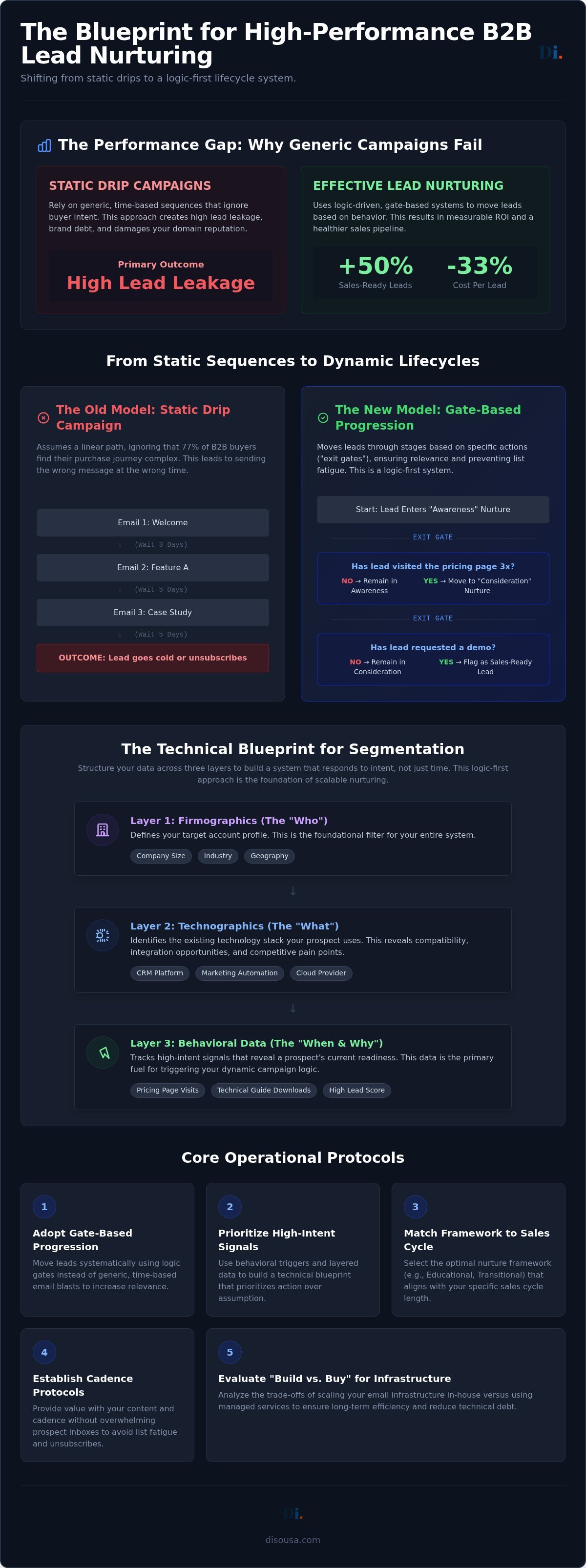
Companies that excel at lead nurturing generate 50% more sales-ready leads at a 33% lower cost. You likely already know that the middle of the funnel is where the most B2B revenue is lost. It’s difficult to maintain momentum when lead nurturing email campaigns rely on generic drip sequences or manual follow-up processes that fail to scale. High lead leakage is usually a result of static messaging logic rather than a lack of interest from the prospect.
I’ve developed this briefing to provide a functional framework for B2B lifecycle management. You’ll learn how to build and scale email nurture systems that move leads from initial awareness to conversion-ready states. We’ll look at the tactical logic required to ensure your sales team receives higher quality leads while you extract measurable ROI from your existing lists. This guide serves as a practical manual for turning your email infrastructure into a repeatable system for lead progression.
Key Takeaways
- Adopt a gate-based progression model to move leads through the funnel systematically instead of relying on ineffective, generic email blasts.
- Use behavioral triggers and firmographic data to build a technical blueprint that prioritizes high-intent signals.
- Learn how to select the optimal framework for your lead nurturing email campaigns by matching your strategy to your specific sales cycle length.
- Establish operational protocols for cadence and content that provide value without overwhelming your prospects’ inboxes.
- Understand the “build vs. buy” trade-offs when scaling your email infrastructure to ensure long-term efficiency and reduced technical debt.
Beyond the Inbox: Lead Nurturing as a Functional Lifecycle System
B2B buyers currently use an average of ten channels during their purchasing journey, often including high-impact event visibility from VIP Outdoor Media. This fragmentation makes the traditional, linear funnel obsolete. Most “one-and-done” email blasts fail because they treat every recipient as if they occupy the same stage of awareness. This approach creates significant brand debt and technical risk. Companies that excel at this process generate 50% more sales-ready leads at a 33% lower cost. If you send irrelevant content to a broad list, your domain reputation suffers and your ROI disappears.
Effective lead nurturing email campaigns function as a core component of broader lead management. They aren’t just a series of messages. They are a functional lifecycle system designed to handle the complexity of modern procurement. In 2026, success depends on shifting from a “content-first” mindset to a “logic-first” strategy. You must build the underlying architecture before you write a single line of copy.
The Failure of Static Drip Campaigns
Linear sequences assume a predictable path that rarely exists in reality. 77% of B2B buyers report that their purchase experience is complex or difficult. When you use static drip campaigns, you ignore non-linear behaviors like a lead revisiting a pricing page three months after a whitepaper download. A sequence that only triggers based on the date of signup will eventually send the wrong message at the wrong time.
Irrelevant messaging does more than just lower your engagement rates. It triggers spam filters. As of 2024, Gmail and Yahoo have strict authentication requirements for bulk senders. If your engagement drops because you’re forcing time-based triggers on uninterested leads, you risk permanent rejection from these providers. You need to move toward intent-based triggers that reflect actual prospect activity. This ensures your technical infrastructure remains healthy while you scale your outreach.
Gate-Based Progression: The Lifecycle Framework
A lifecycle framework moves leads through specific milestones, from cold awareness to a Sales-Ready Lead or Marketing Qualified Lead. This requires “exit gates.” An exit gate is a logic rule that stops a nurture sequence once a lead reaches a specific goal or displays a lack of intent. This prevents list fatigue and ensures your sales team doesn’t receive under-qualified contacts. For a deeper look at modern digital strategies, consider our a functional assessment of online marketing services 2026.
A gate-based nurture system is a logic-driven sequence where progress is determined by specific intent signals rather than arbitrary time intervals. By focusing on these gates, you ensure your system scales without constant manual intervention. This logic-first approach treats the inbox as a tool for progression rather than just a destination for content.
The Technical Blueprint: Segmentation and Behavioral Triggers
Building effective lead nurturing email campaigns requires a technical foundation that prioritizes data over intuition. You can’t rely on broad categorizations if you want to move prospects through a complex B2B cycle. The hierarchy of segmentation must be structured across three specific layers: firmographics, technographics, and behavioral data. Firmographics define the target (company size and industry), technographics identify their existing stack, and behavior reveals their current intent. By layering these data points, you can accurately guide them through the sales funnel without sending irrelevant content.
High-intent signals are the primary fuel for this system. A lead who visits your pricing page three times in 48 hours is in a different state of readiness than one who simply downloaded an introductory whitepaper. Integrating lead scoring into your nurture deployment allows your automation platform to adjust the messaging dynamically. This ensures that your most aggressive “conversion-ready” content only reaches those who have met a specific scoring threshold, protecting your list from premature fatigue.
Intent-Based Segmentation Strategies
Mapping content downloads to specific pain points is the first step in refining your segments. If a prospect downloads a technical implementation guide, they should be moved to a “technical-intent” path rather than a general awareness sequence. You should also use website interaction data, such as time spent on high-value pages, to trigger specific branch logic within your campaigns. Maintaining this level of precision requires rigorous data hygiene. I recommend reviewing the 2026 email list growth strategy checklist to ensure your database remains clean and compliant as you scale. If managing these technical layers becomes an operational burden, a managed email marketing operation can provide the necessary infrastructure.
Automating the Trigger Logic
Automating your trigger logic involves setting up “if-then” statements that respond to prospect actions in real time. For example, if a lead opens an email but doesn’t click the call-to-action, the system should trigger a secondary “educational” follow-up rather than repeating the same offer. This logic-first approach prevents overlapping messages and ensures a clean user experience. You must also implement suppression lists to automatically pull leads out of general nurtures once they enter a high-intent transitional sequence.
Behavioral triggers significantly reduce the manual overhead of your sales team. Because 45% of marketers report efficiency as the primary benefit of AI-driven automation in 2026, shifting to intent-based triggers is no longer optional for competitive B2B brands. This system handles the repetitive follow-up work, allowing your sales reps to focus exclusively on leads that have already passed through your qualification gates.
Comparing Nurture Frameworks: Educational, Transitional, and Re-engagement
You shouldn’t apply the same logic to every lead in your database. The average B2B sales cycle is becoming longer and more complex, with 77% of buyers describing their experience as difficult. To manage this, your lead nurturing email campaigns must utilize specific frameworks based on the prospect’s current stage and your average sales cycle length. If you’re selling a high-ticket service with a six-month window, a rapid-fire transitional sequence will only result in high opt-out rates. You need a hierarchy that matches the buyer’s pace.
Nurtured leads make 47% larger purchases than non-nurtured leads. This isn’t because they were “sold” harder. It’s because they were better educated. I categorize nurture logic into three distinct protocols: Educational, Transitional, and Re-engagement. Each has a specific trigger and a unique exit gate.
The Educational Nurture Protocol
The goal here is problem identification, not product promotion. You should focus on the prospect’s inefficiencies rather than your own features. I recommend using long-form briefings that establish you as an expert peer. This isn’t marketing fluff. It’s tactical information that respects the reader’s intelligence. For instance, providing a functional assessment of online marketing services serves as a high-value middle-funnel asset. It helps the lead benchmark their current operations against industry standards without feeling pressured by a sales pitch.
Transitional and Re-engagement Tactics
Transitional frameworks trigger when a lead hits a specific intent threshold, such as visiting a pricing page or requesting a demo. This is the tipping point where you shift from education to evaluation. If they don’t convert, they eventually fall into a re-engagement or “win-back” sequence. You must be ruthless with your re-engagement logic. If a lead remains dormant after a three-part win-back series, prune them from your active list. Maintaining a clean list is critical for your domain reputation under the 2024 sender requirements from Gmail and Yahoo.
| Framework | Primary Goal | Key Metric | Cadence |
|---|---|---|---|
| Educational | Build Authority | Content Consumption | Weekly |
| Transitional | MQL Conversion | Click-Through Rate | Every 3-5 Days |
| Re-engagement | List Reactivation | Reply / Opt-out Rate | Quarterly |
Selecting the right framework ensures you aren’t over-communicating with leads who aren’t ready to buy or neglecting those who are. Each path should have a clear exit gate to prevent overlap and ensure the lead always receives the most relevant briefing for their current state.
Operational Protocols: Cadence, Content, and Optimization
Running effective lead nurturing email campaigns isn’t a “set it and forget it” operation. You need a rigorous protocol for cadence and content architecture to avoid the list fatigue that kills ROI. Most B2B leads have a high decay rate. If you don’t provide value within the first 48 hours of an interaction, the likelihood of conversion drops. You must balance this visibility with the risk of annoyance. I recommend mapping your content to the specific decision-making journey of your target persona. This means shifting from broad awareness pieces to technical deep dives as the lead progresses through your system.
Deliverability is your silent killer. In 2026, sender reputation is more fragile than ever. Following the Gmail and Yahoo requirements from February 2024 is the bare minimum. You need SPF, DKIM, and DMARC authentication to ensure your messages actually reach the inbox. If your spam complaint rate exceeds 0.3%, your domain reputation will tank. Your sequences will stop delivering entirely regardless of how good your copy is. Understanding the full scope of professional email deployment and campaign execution is essential for maintaining the inbox placement rates your nurture system depends on. You can learn more about how we handle these technical hurdles by exploring our content promotion frameworks.
Cadence and Timing for B2B Operations
Optimal spacing depends on the weight of the content. A high-value, long-form briefing requires more “breathing room” than a short, tactical reminder. I’ve found that a three-day gap between initial high-intent triggers works best, eventually tapering off to a weekly cadence for long-term educational paths. If you’re struggling with the technical implementation of these schedules, check out our reference guide to email marketing automation. It provides a blueprint for technical cadence setups that respect the prospect’s inbox.
The Optimization Loop
Stop obsessing over open rates. In 2026, privacy features often inflate these numbers, making them unreliable for serious decision-making. You should focus on “progression rate” instead. Progression rate is defined as the percentage of leads that successfully transition between lifecycle gates after receiving a specific series of emails. This is the only MOFU metric that actually correlates with revenue. You should also test content formats. I’ve seen text-only briefings out-perform flashy, visual reports in 2.09% of cases where the audience values a direct, consultant-style delivery. For a complete operational framework on managing email marketing as a high-performance infrastructure rather than a broadcast channel, that resource covers the technical blueprint in full detail. If your internal team can’t keep up with this level of testing, you might want to consider managed email marketing to bridge the gap.
Scaling Performance with Disousa’s Managed Email Operations
Scaling lead nurturing email campaigns is rarely a matter of just adding more contacts to a list. It’s a technical scaling problem. Most B2B organizations eventually face a “build vs. buy” dilemma as their automation needs become more complex. Building a sophisticated lifecycle system in-house requires dedicated technical resources that many marketing departments simply don’t have. If you don’t have a team focused exclusively on trigger logic and data hygiene, you’ll likely accumulate technical debt that eventually degrades your deliverability and ROI. Before committing to either path, reviewing a detailed email marketing agency vs in-house operational comparison can help you evaluate the true cost and complexity of each option.
Disousa functions as a technical partner for deploying these complex frameworks. We focus on measurable results and conversion optimization for global brands. By treating email as a functional infrastructure rather than just a marketing channel, we reduce the operational burden on your internal teams. This approach also allows for seamless integration with broader growth strategies, such as affiliate marketing for brands. We ensure that your email operations work in tandem with your other performance channels to create a unified ecosystem.
Reducing Operational Complexity
In-house teams often struggle with the complexity of gate-based progression logic. It’s one thing to set up a basic drip sequence; it’s another to manage multi-branch sequences that respond to real-time behavioral data across different channels. We serve as an extension of your growth and performance team, taking over the heavy lifting of list hygiene, sender authentication, and deliverability auditing. This ensures your domain reputation stays protected while your leads move toward conversion-ready states without manual intervention.
Next Steps: Auditing Your Current Nurture System
Your first step should be a candid assessment of your current funnel. You need to identify where leads are dropping off and where your manual follow-up processes are failing to scale. Set clear benchmarks for 2026 conversion performance that reflect the current B2B landscape. If your progression rate is stagnant, your underlying logic likely needs a reset. You can audit your email operations with Disousa to identify these leaks and deploy a functional lifecycle framework that actually moves the needle for your sales team.
Operationalizing Your B2B Lifecycle Strategy
Building a scalable system requires a shift from arbitrary content blasts to a logic-first framework. Success in 2026 depends on gate-based progression and intent-based triggers that respond to actual prospect behavior. By focusing on the progression rate rather than unreliable open rates, you can ensure your sales team receives leads that are truly conversion-ready. These lead nurturing email campaigns serve as the technical backbone of your B2B growth, reducing manual follow-up while protecting your sender reputation.
Managing this level of operational complexity often requires a specialized partner to avoid internal technical debt. We focus on performance-based growth strategies and global digital marketing expertise to help you scale your infrastructure efficiently. As specialists in B2B conversion optimization, we bridge the gap between initial awareness and measurable ROI by deploying frameworks that work in the real world.
Optimize your lead lifecycle with Disousa’s managed email campaigns and start turning your existing database into a predictable revenue engine. You have the blueprint; it’s time to deploy the system.
Frequently Asked Questions
What is the primary goal of a lead nurturing email campaign?
The primary goal is to move prospects through defined lifecycle milestones until they reach a sales-ready state. In a B2B context, this involves establishing authority and addressing specific pain points so the sales team receives higher-quality leads. It’s a functional process designed to reduce lead leakage and maximize the ROI from your existing email list.
How many emails should be in a lead nurturing sequence?
Most effective sequences contain between three and five emails per lifecycle stage. Sending too few fails to establish sufficient authority, while sending more than five without a new intent trigger often leads to list fatigue. You should focus on the quality of the briefing rather than the volume of messages. Each sequence must have a clear exit gate to prevent redundant communication.
What is the difference between a drip campaign and a lead nurture campaign?
A drip campaign is a linear, time-based sequence, whereas lead nurturing email campaigns use behavioral logic to determine the content and timing of messages. Drips follow a rigid schedule regardless of lead activity. Nurture campaigns respond to triggers like specific content downloads or pricing page views. This ensures the messaging remains relevant to the lead’s current stage of awareness.
How do you measure the success of a lead nurturing campaign in B2B?
Success is measured by the progression rate and the volume of Sales Qualified Leads (SQLs) generated. While open rates are often inflated by privacy features, tracking how many leads move from one lifecycle gate to the next provides a more accurate view of ROI. You should also monitor the conversion rate of nurtured leads into closed deals to verify the quality of the system.
What are the most effective triggers for a nurture email?
High-intent website actions are the most effective triggers for any automated sequence. Visits to pricing pages, multiple views of a technical case study, or attending a specific webinar indicate a shift from research to evaluation. These signals should trigger a transitional sequence immediately to capitalize on the lead’s active interest before it begins to decay.
How do you handle leads that do not engage with your nurture sequence?
Leads that stop engaging should be moved to a specific re-engagement framework before being pruned from your active database. You should attempt a three-part win-back series that offers a high-value resource or asks a direct question about their current needs. If they remain inactive after this, removing them is necessary to protect your domain reputation and ensure high deliverability.
Can lead nurturing be automated without losing a personal touch?
You can automate lead nurturing without losing a personal touch by using advanced segmentation and dynamic content tags. By grouping leads by firmographics or technographics, you can tailor the briefings to their specific industry challenges. Automation handles the delivery logic while your data ensures the content feels like a one-to-one consultation rather than a generic marketing blast.
What is the best time and frequency for sending nurture emails in 2026?
Mid-morning on Tuesday, Wednesday, or Thursday remains the optimal window for B2B engagement in 2026. Frequency should be determined by the technical weight of the content. A deep-dive briefing needs about five to seven days of breathing room, while a tactical reminder can be sent every three days. Always test these intervals against your specific audience’s progression rate.
Disclaimer
**Disclosure:** Some articles on this website may contain affiliate links. This means we may earn a commission if you purchase a product or service through certain links, at no additional cost to you. We only recommend products, tools, and services that we believe provide value to our readers.
**Disclaimer:** The information provided on this website is for educational and informational purposes only and should not be considered financial, legal, tax, or professional advice. While we strive to keep our content accurate and up to date, we make no guarantees regarding completeness, reliability, or results obtained from using the information provided. Always conduct your own research and consult qualified professionals before making business, financial, or investment decisions.
