
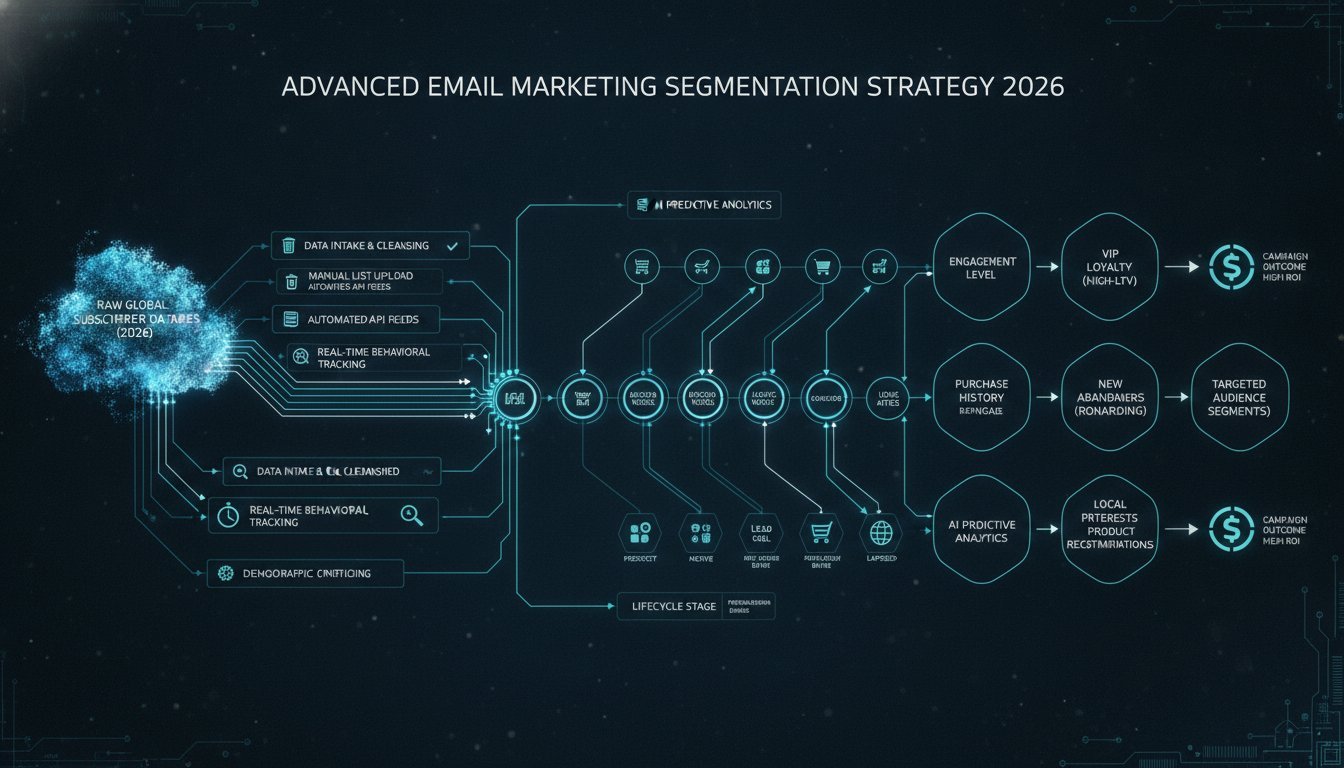
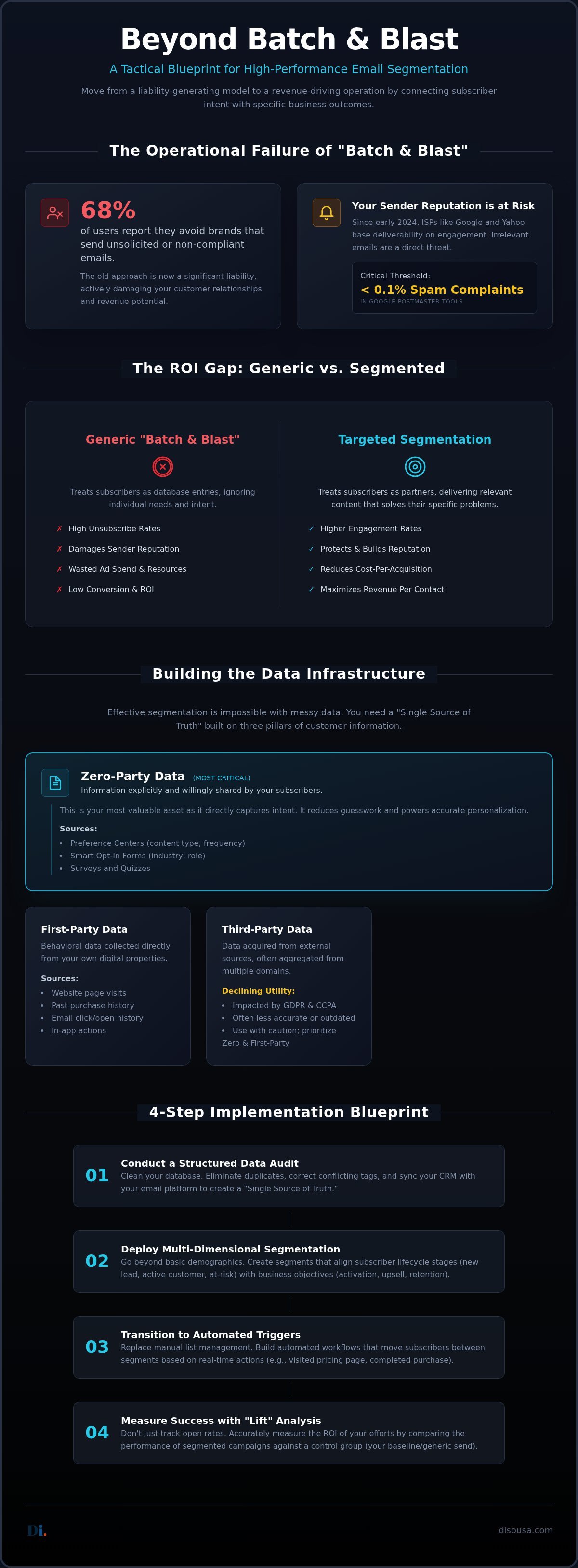
68% of users report they avoid brands that send unsolicited or non-compliant emails. This shift in consumer behavior means that the old “batch-and-blast” approach is now a significant liability. You likely see this reflected in your declining engagement rates. I understand that messy customer data makes advanced email marketing segmentation strategies feel like an unreachable goal. You might also fear that segmenting too deeply will create an unsustainable workload for your team.
I’ve developed this tactical briefing to solve those specific operational bottlenecks. We will move beyond the theory of list management and into a high-performance blueprint. This plan focuses on connecting subscriber intent with specific business outcomes. You’ll learn how to build automated systems that handle the heavy lifting of sorting subscribers. We will also outline a clear roadmap for scaling your email operations to drive higher conversion rates per message sent. This approach prioritizes clarity and measurable ROI over complex manual processes.
Key Takeaways
- Understand why “batch-and-blast” methods have become a liability for sender reputation and how to mitigate the risk of rising unsubscribe rates.
- Identify the non-negotiable data requirements, specifically how to leverage zero-party and first-party data as the foundation for your operations.
- Learn to deploy multi-dimensional email marketing segmentation strategies that align subscriber lifecycle stages with your primary business objectives.
- Follow a tactical blueprint to transition from manual list management to automated triggers using a structured data audit.
- Master the “Lift” analysis method to accurately measure the ROI of segmented campaigns against your baseline performance metrics.
The Operational Failure of Batch-and-Blast Marketing
Batch-and-blast is no longer a viable growth tactic. In a B2B context, sending the same message to your entire list is an operational liability that actively damages your digital infrastructure. When you ignore subscriber intent, you create irrelevance. This irrelevance is expensive. It manifests as high unsubscribe rates and a steady decline in sender reputation. Modern market segmentation principles must be applied to your list to ensure that your communications remain a tool for conversion rather than a source of friction. Segmentation serves as the functional bridge between the moment a lead is generated and the final conversion event. Without it, you’re simply wasting the traffic you worked so hard to acquire.
Why Sender Reputation Depends on Segmentation
ISPs like Google and Yahoo have tightened their filtering criteria significantly since early 2024. Your deliverability now depends heavily on engagement metrics rather than just technical authentication. If your emails are consistently ignored, your domain reputation suffers. To maintain a healthy sender status, you must keep spam complaints below 0.1% in Google Postmaster Tools. Targeted sends are the only way to meet this threshold consistently.
When you use specific email marketing segmentation strategies, you ensure that the recipient actually wants the content. This leads to higher open rates and fewer “report spam” clicks. It’s about establishing a baseline for healthy engagement by only sending what is relevant to each group. If your engagement drops, ISPs will begin routing your messages to the junk folder, which effectively kills your ROI. Protecting your sender reputation is a logistical reality that requires precise targeting.
The ROI Gap: Generic vs. Segmented Campaigns
The performance difference between generic blasts and segmented campaigns is stark. Generic emails treat subscribers as entries in a database. Segmented campaigns treat them as individual partners with unique needs. This psychological shift is what drives higher conversion rates. When a subscriber feels you understand their specific problem, they’re much more likely to take action.
We’ve seen that moving to a functional, intent-based model drastically reduces the cost per acquisition. You can find more details on evaluating these types of performance gaps in our A Functional Assessment of Online Marketing Services (2026). Implementing sophisticated email marketing segmentation strategies isn’t just about being organized. It’s about maximizing the revenue potential of every contact on your list while protecting your ability to reach the inbox. Moving away from a one-size-fits-all model is the first step toward a high-performance operation.
Building the Data Infrastructure for Effective Segmentation
Messy data is the technical debt that kills even the most sophisticated email marketing segmentation strategies. If your database contains duplicate entries, conflicting tags, or outdated records, your automation triggers will misfire. You can’t build a high-performance system on a broken foundation. You need a “Single Source of Truth” where your CRM and email platform communicate in real-time. This ensures that when a lead moves from a prospect to a customer, their segment updates immediately. Without this synchronization, you risk sending introductory offers to long-term partners, which erodes trust.
You must categorize your data into three distinct pillars to maintain an organized operation. First-party data includes the actions users take on your own properties, such as website visits or past purchases. Third-party data comes from external sources, though its utility is declining due to increased privacy regulations like the GDPR and CCPA. The most critical pillar is zero-party data. Collecting this information requires you to operationalize your forms and preference centers to capture intent without adding unnecessary friction to the user experience.
Establishing this infrastructure is a prerequisite for scaling your digital marketing. If you’re looking to refine your overall approach, it helps to review a strategic framework for performance growth to see how data flows through the entire sales funnel.
Capturing Zero-Party Data at the Point of Entry
Preference centers are your best tool for reducing guesswork. Instead of assuming what a subscriber wants, let them self-segment during the sign-up process. Use smart opt-in forms that ask for their industry or specific professional role. This allows you to route them into the correct lifecycle track from day one. You should keep these forms brief to avoid dropping your conversion rates; one or two well-placed questions are usually enough. Zero-party data represents the explicit preferences and intentions shared directly by the subscriber, making it the most valuable asset for 2026.
Behavioral Tracking and First-Party Signals
While zero-party data tells you what they want, first-party signals show you what they’re actually doing. You should integrate your website behavior tracking directly with your email marketing platform. If a subscriber visits a specific service page three times in one week, that’s a high-intent signal. This action should trigger an immediate segment shift or a targeted follow-up. Tracking content consumption allows you to infer current pain points and adjust your messaging accordingly. This level of automation handles the heavy lifting of sorting subscribers, allowing your team to focus on strategy rather than manual list management.
Core Segmentation Frameworks for Performance Growth
Most ecommerce-focused advice centers on abandoned carts and birthdays. If you’re running B2B operations, those tactics don’t move the needle. You need a multi-dimensional model that accounts for professional roles and complex decision-making cycles. Effective email marketing segmentation strategies for B2B prioritize firmographic data like company size and industry alongside individual behavioral signals. We aren’t just managing a list; we’re managing a professional relationship that evolves over time. Your framework must be flexible enough to respond to these changes in real-time without requiring constant manual oversight.
The Lifecycle Stage Framework
You should categorize every subscriber based on their current position in the buyer journey. A “Cold Lead” in the awareness stage needs educational content that defines the problem they’re facing. Conversely, someone in the decision stage requires specific proof points, such as case studies or technical specifications. Moving leads through the funnel with precision requires you to tailor your messaging to these distinct phases. If you send a “hard sell” pitch to a subscriber who just joined your list, you’ll likely see an immediate unsubscribe. A functional framework for lifecycle management ensures that your communication matches the subscriber’s current level of commitment.
Engagement-Based Tiering
I recommend using the Recency, Frequency, and Monetary (RFM) value model to tier your subscribers. This operational approach helps you identify your most valuable accounts and brand advocates. You can create a “VIP” segment for those who consistently engage with your high-value content. These individuals should receive early access to new briefings or exclusive insights. On the other end of the spectrum, you need a clear strategy for “Lapsed” or “At-Risk” subscribers. Instead of continuing to send them standard updates, move them into a specific re-engagement track. If they don’t respond after a set period, remove them to protect your sender reputation.
Intent and Interest-Based Sorting
Click-through data is your most reliable indicator of what a subscriber actually cares about. If a user clicks on three consecutive links regarding performance metrics, you should automatically move them into a “Performance Growth” interest segment. This applies directly to affiliate marketing for brands, where understanding specific niche interests is the only way to drive high-volume conversions. Building dynamic interest segments allows your system to update in real-time. This ensures your content remains relevant even as a subscriber’s professional focus shifts, keeping your engagement rates high and your conversion path clear.
Implementation Blueprint: From Manual Lists to Automated Triggers
Transitioning from manual list management to automated triggers is an operational necessity for any B2B organization. To scale your email marketing segmentation strategies, you must follow a structured implementation blueprint. This process ensures that your efforts result in measurable ROI rather than just increased administrative work. You’re building a system that reacts to subscriber behavior in real-time, which requires a shift from static planning to dynamic execution.
- Step 1: Define Objectives. Every segment needs a specific business purpose. If a segment doesn’t have a clear goal, such as increasing demo requests or reducing churn, it shouldn’t exist.
- Step 2: Audit Data. Verify what data points you currently possess. You can’t segment by industry if that field is empty for half your list. You can use A Functional Assessment of Online Marketing Services (2026) to help evaluate your current technical readiness.
- Step 3: Map Flows. Connect your data points to automated triggers. When a subscriber meets a specific rule, they should move into the corresponding email flow automatically.
- Step 4: Content Variations. Use modular content blocks. Instead of writing entirely new emails, swap out specific sections to address a segment’s unique pain points.
- Step 5: Refine. Use performance data to adjust your rules. If a segment isn’t performing, merge it back into a broader group.
Automating the Segmentation Process
You should move away from static lists as quickly as possible. Dynamic, rule-based segments are the only way to maintain accuracy as your database grows. This relies on the consistent use of tagging and custom fields. When a user downloads a specific whitepaper, your system should automatically tag them with that interest. Automation is the only way to avoid segmentation burnout and keep your messaging relevant without constant manual intervention.
Avoiding the Trap of Over-Segmentation
There is a threshold of diminishing returns where more segments don’t equal more revenue. You must set a minimum segment size for operational efficiency. If a segment contains fewer than 100 subscribers, the resources required to create custom content for them likely outweigh the potential lift. Keep your workload manageable by using modular design. This allows you to personalize the experience for larger groups without needing a massive creative team. If you’re ready to scale these operations globally, explore our strategic framework for performance growth.
Measuring Success and Optimizing for Performance
If you can’t measure the performance of your email marketing segmentation strategies, you’re just guessing. Success in 2026 isn’t defined by vanity metrics like open rates. It’s defined by how much revenue each segment contributes to your bottom line. You must conduct a ‘Lift’ analysis to prove the value of your work. This involves comparing the performance of a segmented group against a non-segmented control group. If the segmented group doesn’t show a statistically significant increase in conversions, your strategy needs adjustment. We prioritize this empirical approach to ensure continuous global performance growth for our partners.
A/B testing within specific segments is another critical tool for refinement. Don’t test generic variables like subject line colors. Instead, test high-value elements like offer structure or call-to-action alignment. For example, does a “Request a Demo” button perform better than “Download the Technical Brief” for your “Decision Stage” segment? These insights allow you to fine-tune your messaging based on actual behavior rather than assumptions. This level of detail is what separates a standard campaign from a high-performance operation.
Beyond Open Rates: Tracking Conversions and ROI
Tracking downstream behavior is essential. What happens after the click is just as important as the click itself. Do they download the whitepaper, or do they bounce immediately? You should attribute every lead and dollar to specific segments to understand their true value. This data is what justifies the operational cost of building complex infrastructure. If you’ve read A Functional Assessment of Online Marketing Services (2026), you know that every marketing dollar must be defensible. Use conversion tracking to prove that your segmentation is actually driving revenue.
Iterative Refinement: The 90-Day Audit
Segments shouldn’t be treated as “set and forget” assets. I recommend a 90-day audit of your entire system to identify segments that are underperforming or have become redundant. Professional services and B2B markets change quickly; your segments must keep pace. If two segments are behaving identically, merge them to save on content production costs. Conversely, if a specific strategy is driving massive ROI in one segment, scale it across others. This iterative refinement prevents your operations from becoming bloated. It ensures that your team stays focused on the triggers and flows that actually move the needle.
Operationalize Your Email Strategy Today
Moving from a generic blast model to a functional, data-driven operation is the only way to maintain a competitive edge in 2026. The cost of irrelevance is too high. It leads to damaged sender reputations and lost revenue. By establishing a clean data infrastructure and mapping your subscribers to specific lifecycle stages, you create a system that drives measurable ROI. This methodical approach ensures every message sent serves a specific business objective.
Automation is no longer a luxury; it’s the core requirement for scaling your global reach without burning out your team. Implementing high-performance email marketing segmentation strategies requires a methodical approach to data hygiene and behavioral triggers. We specialize in B2B performance marketing and measurable conversion optimization to ensure your digital infrastructure stays productive. Our focus is on providing a tactical advantage through operational expertise and global reach.
Scale your email operations with Disousa’s expert marketing services. You have the tactical blueprint; now it’s time to execute.
Frequently Asked Questions
What is the difference between email segmentation and personalization?
Segmentation involves grouping subscribers by shared traits; personalization applies individual data points to those groups. Think of segmentation as the strategy and personalization as the execution. You use segmentation to decide what message to send and personalization to make that message feel unique to the recipient. Both are required for high-performance operations that respect the subscriber’s time and intelligence.
How many segments should a B2B email list have?
Most B2B operations should start with three to five core segments based on the buyer journey. Attempting to manage dozens of segments immediately leads to content production bottlenecks. Focus on broad categories like lifecycle stage and industry first. You can add granular layers as your automation maturity grows and your data becomes cleaner through regular technical audits.
Can I segment my email list if I don’t have much data?
You can start segmenting immediately by tracking behavioral signals. Even without a detailed CRM, you can tag subscribers based on the links they click in your initial welcome sequence. This allows you to infer their interests and pain points. Behavioral data often provides a more accurate picture of intent than the information provided during sign-up, allowing for rapid categorization.
Does email segmentation improve deliverability?
Segmentation significantly improves deliverability by maintaining high engagement metrics. ISPs like Google and Yahoo use open and click rates to determine if your emails belong in the inbox. When you use targeted email marketing segmentation strategies, your relevance increases. This leads to fewer spam complaints and a stronger sender reputation, which is critical for reaching your audience in 2026.
What are the most effective segments for a B2B service business?
Lifecycle stage and professional role are the most effective segments for B2B services. A CEO needs a high-level ROI summary; a manager needs tactical implementation details. By aligning your content with their specific responsibilities and their current position in the funnel, you increase the likelihood of a conversion. This approach ensures your messaging remains practical and outcome-focused for every recipient.
How often should I update or refine my segments?
I recommend a formal audit of your segmentation rules every 90 days. This timeframe allows you to gather enough data to see patterns without letting your list become disorganized. Use these audits to merge segments that show identical behavior or to split groups that have developed distinct needs. Regular refinement prevents your system from becoming bloated with redundant or underperforming rules.
Is it possible to over-segment an email list?
Over-segmentation occurs when the administrative effort of managing a group outweighs the revenue it generates. If a segment is so small that it requires hours of custom work for minimal return, it’s a liability. You should aim for the largest possible segments that still allow for meaningful relevance. Focus on groups that have clearly different pain points and require unique value propositions.
What tools do I need to implement advanced segmentation?
You need an email service provider that supports dynamic tagging and a CRM that serves as your single source of truth. Advanced email marketing segmentation strategies rely on real-time data flow between your website and your marketing stack. Without this integration, your segments will remain static. You must ensure your technical infrastructure can handle automated triggers based on real-time behavioral signals.
Disclaimer
**Disclosure:** Some articles on this website may contain affiliate links. This means we may earn a commission if you purchase a product or service through certain links, at no additional cost to you. We only recommend products, tools, and services that we believe provide value to our readers.
**Disclaimer:** The information provided on this website is for educational and informational purposes only and should not be considered financial, legal, tax, or professional advice. While we strive to keep our content accurate and up to date, we make no guarantees regarding completeness, reliability, or results obtained from using the information provided. Always conduct your own research and consult qualified professionals before making business, financial, or investment decisions.
