

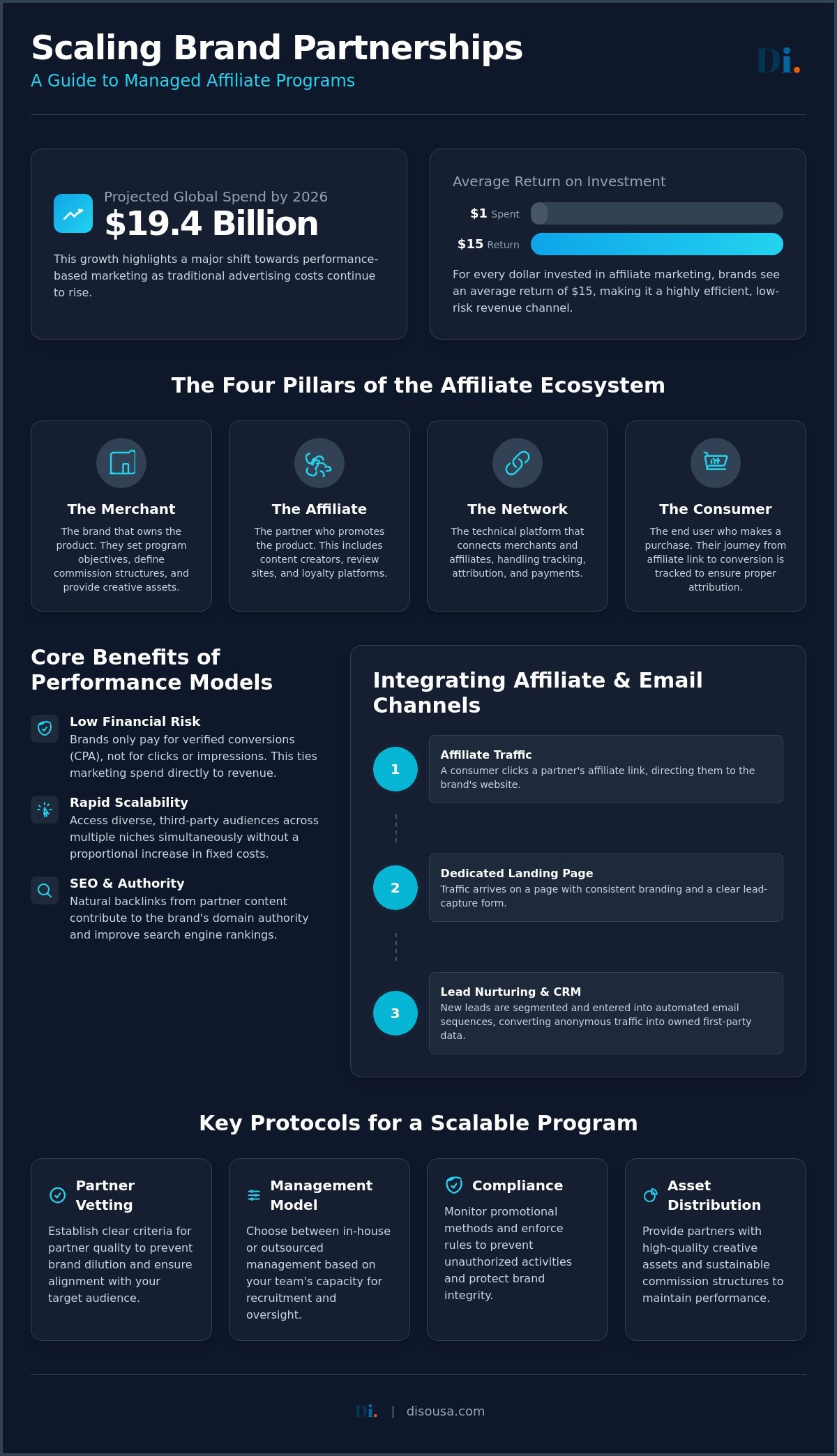
Global spending on affiliate marketing is projected to reach $19.4 billion in 2026. This growth indicates a reliance on performance-based models as traditional advertising costs increase. Establishing affiliate marketing for brands involves the creation of a structured partnership framework. Many organizations report concerns regarding partner quality and potential brand dilution. These logistical challenges often prevent the realization of a scalable revenue channel.
It’s understood that the management of diverse partner networks requires significant oversight. There is a need for systems that automate processes while ensuring strict brand alignment. Research indicates that brands see an average return of $15 for every $1 spent on this channel. This article provides a professional analysis of how to implement and scale managed affiliate programs. The content covers the technical requirements for partner vetting and revenue tracking. The following sections detail the transition to a low-risk, predictable revenue model.
Key Takeaways
- Affiliate marketing for brands operates as a low-risk framework for customer acquisition through performance-based revenue sharing.
- Integration with email marketing and performance channels facilitates the conversion of referral traffic into measurable revenue.
- The selection of a management model determines the administrative capacity for partner recruitment and program oversight.
- Compliance protocols ensure brand alignment by monitoring promotional methods and preventing unauthorized partner activities.
- Scalability is maintained through the distribution of high-quality creative assets and the implementation of sustainable commission structures.
The Structural Role of Affiliate Marketing for Modern Brands
Affiliate marketing is defined as a performance-based customer acquisition framework. It functions through a revenue-sharing model where external partners receive compensation for verified conversions. This approach represents a shift from traditional advertising methods that rely on upfront payments for impressions or clicks. In 2026, global spending on this channel is projected to reach $19.4 billion. This growth is driven by the need for low-risk marketing strategies. For a foundational Affiliate marketing overview, it’s useful to examine the historical development of these digital partnerships. Affiliate marketing for brands provides a structured way to manage external sales forces without the overhead of fixed salaries.
There’s a distinction between influencer marketing and professional affiliate partnerships. Influencer campaigns often focus on brand awareness and reach. Professional affiliate programs prioritize measurable revenue and direct attribution. Partners in this ecosystem are typically evaluated on their ability to drive specific actions, such as sales or lead generation. Established brands are prioritizing these channels because they offer protection against rising PPC costs. The model ensures that marketing expenditure is directly tied to realized income. It’s a logistical solution for maintaining margins while expanding market presence. Organizations seeking to grow brand through affiliate partnerships must transition from tactical recruitment to a functional operational framework that supports measurable, long-term revenue growth.
The Four Pillars of the Affiliate Ecosystem
- The Merchant: The brand establishes the objectives and margin requirements. It defines the commission structures that remain sustainable for the business.
- The Affiliate: This category includes content creators, review websites, and loyalty platforms. These partners utilize their existing audiences to promote brand offerings.
- The Network: Technical infrastructure is provided by affiliate networks. These platforms handle tracking technology, attribution, and payment processing for all parties.
- The Consumer: The referral-to-purchase journey begins when a consumer interacts with an affiliate link. Tracking cookies or first-party data ensure the transaction is recorded accurately.
Core Benefits of Performance-Based Models
Fixed cost-per-acquisition (CPA) models offer more predictability than CPM or CPC methods. Brands don’t pay for traffic that fails to convert. This structure allows for rapid scalability. A brand can access third-party audiences across multiple niches simultaneously. Implementing affiliate marketing for brands reduces the financial risk associated with testing new markets. There are also secondary benefits related to search engine optimization. Natural backlink profiles are established through partner content. These signals contribute to the overall authority of the brand’s digital presence. Performance-based marketing provides a stable framework for long-term growth.
Integrating Affiliate Operations with Email and Performance Channels
The integration of affiliate traffic into existing marketing stacks is a logistical requirement for growth. Many organizations treat affiliate channels as isolated silos. This practice limits the potential for long-term customer retention. Dedicated landing pages are utilized to capture referral traffic effectively. These pages maintain brand consistency and facilitate tracking. Understanding how affiliate marketing works within a multi-channel environment is essential for structural alignment. It’s a method for diversifying traffic sources while maintaining control over the user experience. Affiliate marketing for brands becomes more effective when it’s treated as a component of the broader performance ecosystem.
Affiliate Traffic and Lead Nurturing
Protocols are established to convert one-time clicks into subscribers. Traffic from affiliate links is directed to landing pages featuring lead capture forms. These leads are segmented based on the referring partner’s niche or interest category. Automated email nurturing sequences are then triggered to maintain engagement. This process ensures that the value of the referral extends beyond the initial interaction. It’s a strategy for building first-party data in an environment where third-party cookies are less reliable. The conversion path from referral to email list growth is defined by the transition of anonymous visitors into owned data points within the CRM. Organizations that invest in structured lead nurturing email campaigns are better positioned to convert affiliate-referred prospects into sales-ready leads through systematic lifecycle management.
Data Sharing Across Marketing Departments
Conversion insights from affiliate partners are shared with paid search teams. High-performing creative assets used by affiliates are identified and repurposed for PPC campaigns. This cross-departmental data sharing optimizes total marketing spend by using proven messaging. Niche performance data also highlights new market opportunities that were previously overlooked. Aligning affiliate goals with overall brand KPIs ensures that all channels work toward the same organizational milestones.
- Identifying high-performing niches through partner performance metrics.
- Repurposing affiliate ad copy for paid search experiments.
- Adjusting bid strategies based on affiliate conversion trends.
Maintaining a uniform brand voice across diverse partner channels is a priority. Brand guidelines are distributed to all affiliates to prevent visual or messaging dilution. Regular audits are conducted to ensure promotional materials meet internal standards. Successful affiliate marketing for brands relies on this consistency to build trust with the consumer. Organizations often seek professional assistance to manage these complex integrations. For those looking to refine their digital strategy, exploring affiliate marketing services can provide the necessary technical framework. This approach ensures that all performance channels are structurally sound.
Evaluating Program Management: In-house vs. Outsourced Models
The management of an affiliate program involves specific administrative functions. These include partner recruitment, performance tracking, and the distribution of creative assets. The choice between internal and outsourced models affects the scalability of affiliate marketing for brands. In-house management requires a dedicated Affiliate Manager to oversee daily operations. This individual is responsible for vetting partners and ensuring the accuracy of payouts. Decisions are typically based on the availability of internal resources and technical expertise.
Internal Management Requirements
Operational tasks are performed on a daily basis. These include the approval of new partners and the auditing of promotional content. Compliance with FTC guidelines for affiliate marketing is a primary responsibility. Non-compliance results in potential fines exceeding $51,000 per violation. Internal teams often face challenges when attempting to scale recruitment. Limited staff capacity restricts the ability to vet a high volume of partners. Technical integration with existing digital infrastructure is also required for accurate reporting. Software costs and tracking platform fees are factored into the internal budget.
The Value of Managed Affiliate Services
Managed services provide access to established partner networks. Industry relationships are utilized to accelerate program growth. Professional agencies oversee brand safety by monitoring promotional standards. They ensure that all partners adhere to the required disclosure protocols. This model includes the strategic optimization of commission structures. In 2026, the median commission rate for ecommerce is 8.4%. For SaaS products, the median rate is 22.5% of first-year revenue. Managed programs are structured to achieve the industry average ROI of $15 for every $1 spent. A comprehensive understanding of affiliate marketing ROI benchmarks and performance evaluation frameworks is essential for selecting the right management model. It’s a method for accessing specialized expertise without increasing internal headcount.
A cost-benefit analysis is conducted to determine the most efficient model. Internal salaries and recurring software fees are compared against agency retainers. The complexity of affiliate marketing for brands often necessitates specialized technical knowledge. Outsourced models provide immediate infrastructure for partner payouts and performance reporting. This reduces the time required for initial program implementation. Organizations select a management model based on their capacity for long-term partner oversight. For brands evaluating this transition, a detailed functional analysis of outsourced affiliate program management provides the technical framework needed to assess scalable structures and automated reporting systems. Accuracy and readiness are prioritized over rapid, unmanaged expansion.
Key Protocols for Affiliate Recruitment and Compliance
Compliance is a structural requirement for long-term growth. Protocols are established to maintain brand integrity across all external channels. Affiliate marketing for brands requires a methodical approach to partner selection. This ensures that all promotional activity remains within the defined brand parameters. The focus is placed on the logistical reality of partner actions rather than broad marketing reach. Vetting is conducted to ensure that every affiliate aligns with the organization’s professional standards.
Strategic Partner Vetting
Potential partners are evaluated using specific performance metrics. Site authority and audience demographics are analyzed. Content quality is reviewed to ensure it meets internal standards. High-authority review sites are often prioritized for their role in the mid-funnel journey. These partners provide detailed product analysis that assists in the conversion process. Coupon-only affiliates are frequently excluded from professional programs. This decision is made to prevent the dilution of brand value and the erosion of profit margins. Partners are selected based on their ability to provide high-quality traffic that converts at a predictable rate. Organizations looking to systematize this process can reference a practical blueprint for affiliate partner recruitment that treats sourcing as a precision matching exercise rather than a volume-based approach, ensuring that only high-authority contributors are onboarded.
Compliance and Fraud Prevention
Monitoring tools are utilized to detect ad hijacking. These systems identify unauthorized bidding on trademarked keywords. Trademark violations are documented and addressed through the enforcement of affiliate terms. Fraud detection protocols are also implemented for lead verification. Procedures are established to identify abnormal conversion patterns or suspicious IP addresses. Leads that fail to meet verification standards are rejected before payment processing occurs. Regular compliance audits are conducted in 2026 to verify that all active partners are following the latest regulatory requirements for clear and conspicuous disclosure. Privacy regulations and shorter attribution windows have made calculating affiliate marketing ROI with standardized methodologies and data-driven benchmarks an essential component of any compliance-focused program review.
Legally binding terms and conditions are a necessity. These documents outline the specific promotional methods that are permitted. They also define the restrictions regarding the use of discount codes and social media platforms. Clear communication of these rules reduces the risk of brand dilution. Organizations that require assistance with partner oversight can utilize professional affiliate marketing services to maintain strict compliance.
The enforcement of these protocols is a continuous process. It requires regular updates to the partner database and the tracking software. By maintaining a methodical vetting system, brands reduce the risk of fraud and unauthorized promotional activity. This focus on readiness ensures that the affiliate channel remains a reliable source of revenue. Every action is recorded to provide a transparent audit trail for all marketing activities.
Implementation Procedures for Scaling Brand Partnerships
Scaling affiliate marketing for brands requires a methodical approach to resource distribution. A sustainable commission structure is developed to balance partner incentives with brand margins. In 2026, standard commission rates for ecommerce brands are typically 10-15% per sale. SaaS programs often offer 20-30% recurring commissions. These structures are evaluated regularly to ensure they remain competitive. Partners are also provided with high-quality creative assets and automated product data feeds. This technical support allows affiliates to maintain accurate pricing and availability on their platforms. It’s a logistical requirement for maintaining a professional presence across diverse networks. Ecommerce brands seeking to formalize these operations can benefit from a standardized affiliate marketing strategy for ecommerce that introduces a structured compensation framework and data-driven methods for scaling ROI while maintaining brand integrity.
A deliberate communication rhythm is established with top-performing partners. This involves providing essential status updates and performance reports. Methodical engagement ensures that the brand’s primary revenue drivers remain focused on internal milestones. Privacy and exclusivity are maintained by sharing detailed product roadmaps only with vetted partners. High-quality data feeds are updated in real-time to prevent the promotion of out-of-stock items. This logistical readiness is a priority for organizations seeking predictable ROI. Every update is focused on providing the necessary information for partner success. Brands that apply a functional framework to grow brand through affiliate partnerships are better positioned to identify high-value partners and secure measurable revenue growth in 2026. Implementing structured affiliate outreach strategies that automate pipeline management and filter for quality ensures that top-tier contributors are consistently identified and retained at scale.
Optimizing the Affiliate Funnel
Iterative testing is applied to all affiliate-specific offers. A/B testing of landing pages is conducted to improve click-to-sale rates. This process identifies the most effective messaging for different partner niches. Seasonal campaigns are utilized to drive short-term performance spikes during high-demand periods. Partners are provided with exclusive content to increase their engagement levels. These refinements are based on conversion data rather than subjective preferences. The focus remains on the logistical reality of the purchase journey and the accuracy of the tracking data.
Next Steps for Brand Growth
The transition to a managed affiliate model involves an assessment of digital readiness. Current tracking infrastructure is audited for accuracy and compliance. Organizations must decide between internal oversight or professional agency support for global operations. Selecting a management partner provides the necessary technical framework for rapid expansion. It’s suggested to consult with Disousa for professional affiliate management and performance strategies to ensure a successful launch. This approach prioritizes substance and readiness over premature market exposure. The final implementation phase focuses on long-term stability and measurable revenue growth.
Establishing Scalable Affiliate Operations
The implementation of a structured framework is necessary for performance growth. Successful programs prioritize the integration of affiliate data with existing email and performance channels. This synergy allows for the conversion of referral traffic into owned data points within the CRM. Vetting protocols and compliance audits are utilized to maintain brand safety and margin integrity. These logistical steps ensure that the affiliate channel operates as a predictable revenue source. Establishing affiliate marketing for brands involves the coordination of technical infrastructure and diverse partner relationships. It’s a process that requires constant monitoring and iterative testing of creative assets.
Organizations often require specialized oversight to manage complex global operations. Expert affiliate management and performance-driven growth strategies are provided to facilitate this expansion. Global marketing coverage is maintained through methodical partner recruitment and technical support. Tracking systems are audited regularly to ensure the accuracy of all attribution data. Explore Professional Affiliate Management Services at Disousa to access these operational frameworks. Readiness is achieved through the systematic application of these procedures. The transition to a managed performance model supports long-term revenue objectives. Systematic preparation leads to sustainable results.
Frequently Asked Questions
Is affiliate marketing suitable for high-end luxury brands?
Affiliate marketing is suitable for high-end luxury brands when managed through a selective recruitment process. These organizations prioritize content creators and high-authority editorial sites over discount-focused partners. Strict guidelines are established to maintain brand exclusivity. This approach prevents brand dilution while accessing niche audiences. The focus is placed on brand alignment and the quality of the referring environment.
How do brands prevent affiliates from bidding on their own trademarked keywords?
Brands prevent unauthorized bidding by establishing clear restrictions in their affiliate terms and conditions. Monitoring tools are utilized to scan search engine results for trademark violations. Affiliates are required to add the brand’s name to their negative keyword lists. Violations result in the immediate rejection of commissions or removal from the program. This oversight is a standard component of professional program management.
What is the typical commission rate for e-commerce affiliate programs?
In 2026, the typical starting commission rate for affiliate marketing for brands in the ecommerce sector is between 10% and 15% of the sale amount. Some programs utilize a flat rate of $10 to $15 for new customer orders. These rates are based on industry standards verified in April 2026. Commission structures are evaluated regularly to ensure they remain competitive while protecting profit margins.
How long does it take to see results from a new affiliate program?
Results from a new affiliate program are typically observed within three to six months. This period is required for partner recruitment, creative integration, and traffic stabilization. Initial conversions often occur sooner, but a predictable revenue stream requires a longer optimization phase. Progress is monitored through monthly performance reports and partner engagement metrics. The timeline depends on the technical readiness of the organization.
Can affiliate marketing work alongside an existing influencer program?
Affiliate marketing works alongside existing influencer programs by providing a performance-based tracking layer. Influencers are often transitioned into the affiliate model to track direct sales attribution. This integration allows for the measurement of ROI across all social partnerships. Different commission structures are applied based on the partner’s role in the customer journey. It’s a method for diversifying affiliate marketing for brands through various partner types.
What are the most common reasons affiliate programs fail for brands?
Affiliate programs often fail due to a lack of professional management or inadequate commission structures. Programs that don’t provide high-quality creative assets or product data feeds struggle to engage top-tier partners. Failure to monitor for affiliate fraud also results in the erosion of brand trust and ROI. Structural alignment with overall marketing goals is necessary for long-term success. Accurate tracking remains a critical requirement for program stability.
How do you track affiliate sales across different devices and browsers?
Affiliate sales are tracked across different devices through the use of first-party data and server-to-server tracking. Deterministic matching identifies users who are logged into the brand’s platform across multiple browsers. This technical infrastructure ensures that attribution is recorded accurately despite the phase-out of third-party cookies. In 2026, 38% of affiliate programs utilize attribution windows of seven days or less to maintain data accuracy. Organizations seeking to improve measurement precision can reference current affiliate marketing ROI data and attribution optimization strategies to address these tracking challenges.
Disclaimer
**Disclosure:** Some articles on this website may contain affiliate links. This means we may earn a commission if you purchase a product or service through certain links, at no additional cost to you. We only recommend products, tools, and services that we believe provide value to our readers.
**Disclaimer:** The information provided on this website is for educational and informational purposes only and should not be considered financial, legal, tax, or professional advice. While we strive to keep our content accurate and up to date, we make no guarantees regarding completeness, reliability, or results obtained from using the information provided. Always conduct your own research and consult qualified professionals before making business, financial, or investment decisions.

3 responses to “Affiliate Marketing for Brands: A Strategic Framework for Performance Growth”
[…] to overall business stability. For a detailed analysis of these methods, refer to the guide on Affiliate Marketing for Brands: A Strategic Framework for Performance Growth. This framework assists in maintaining operational discipline across all […]
[…] ROI and ensures that marketing channels don’t operate in isolation. A methodical approach to affiliate marketing for brands serves as a useful example of this integrated performance […]
[…] with GDPR and CCPA is managed through these automated workflows. For those focused on scaling, affiliate marketing for brands often requires this level of data […]