
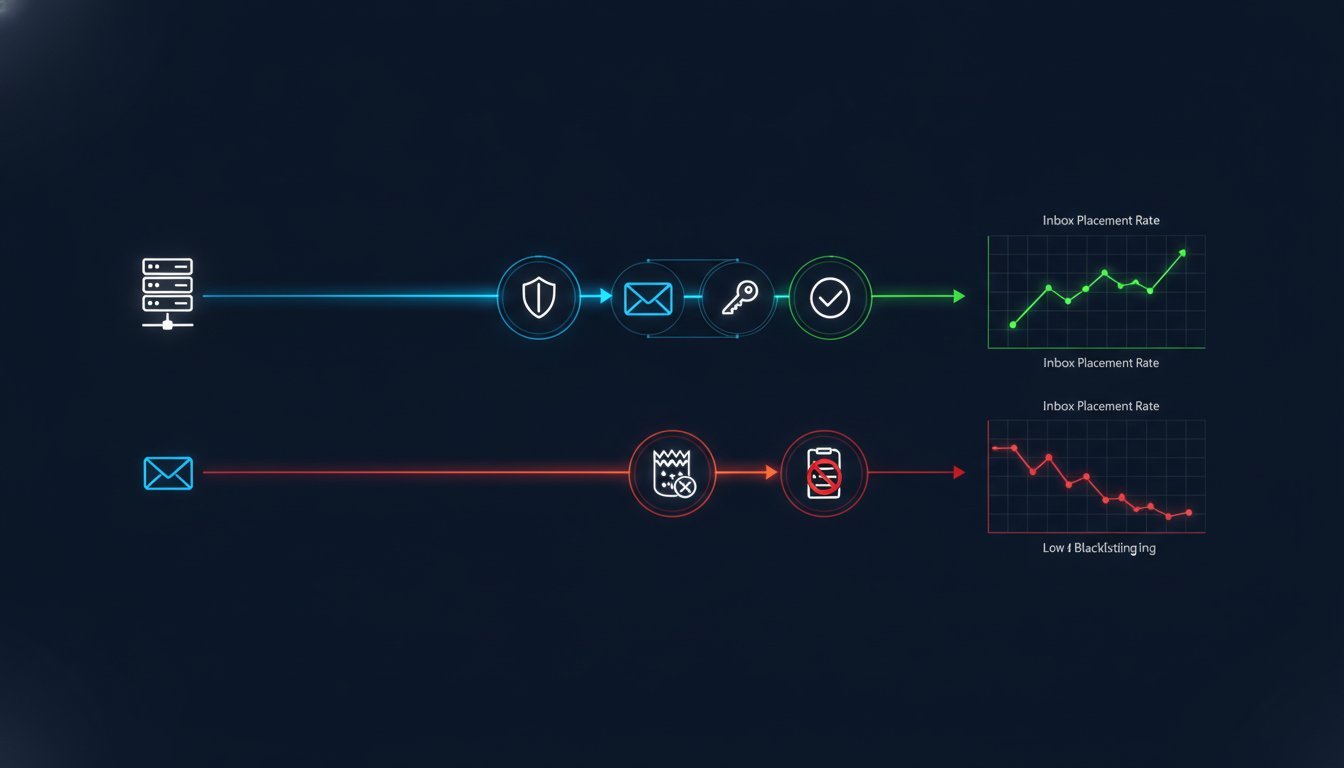
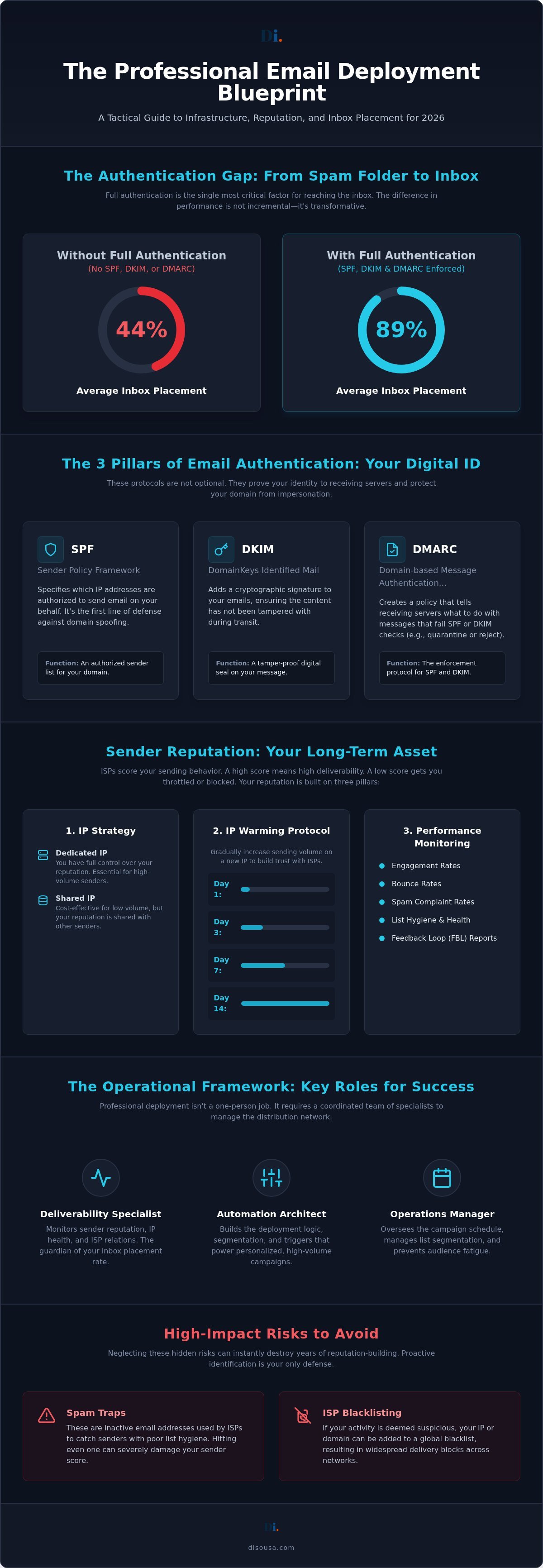
Senders using full DMARC, SPF, and DKIM authentication see an average inbox placement rate of 89%, while those without it struggle at just 44%. You’ve likely spent hours perfecting a B2B campaign only to see it buried in spam folders or ignored because of poor deliverability. It’s a frustrating reality when technical requirements feel like a moving target. Professional email deployment isn’t just about hitting a button; it’s a methodical operation that requires a solid technical foundation to protect your brand’s visibility in 2026.
I’ve put together this briefing to give you a clear blueprint for campaign execution that prioritizes deliverability and sender reputation. You’ll learn the exact operational framework needed to navigate modern infrastructure requirements and achieve measurable results. We’re going to break down the technical deployment infrastructure, explain how to manage your sender score, and provide a tactical roadmap for professional execution that respects your audience’s time and your company’s bottom line.
Key Takeaways
- Implement SPF, DKIM, and DMARC protocols to shift from a 44% average inbox placement rate to nearly 90%.
- Establish a standard email deployment blueprint that prioritizes list hygiene and rendering tests to ensure your B2B messages function correctly on every device.
- Avoid expensive reputation damage by identifying hidden risks like spam traps and ISP blacklisting before they impact your delivery.
- Determine the right time to transition from DIY tactics to managed operations for improved deliverability insurance and conversion optimization.
Defining Email Deployment in a Professional Context
Professional email deployment is the systematic process of transmitting marketing messages to a specific list of recipients through a managed technical infrastructure. It’s helpful to distinguish between “sending” and “deploying.” Sending is a singular, often manual action. Deployment is a high-volume, automated operation that requires strategic oversight. In the context of Email marketing, deployment acts as the engine that moves your content from your database to the recipient’s inbox. If you treat this stage as a mere afterthought, you risk wasting your entire creative budget.
We view deployment as the “last mile” of your marketing strategy. This phase determines whether your message actually reaches the audience or gets blocked by security filters. Your Email Service Provider (ESP) serves as the primary engine for this process. It manages the server connections and protocol requirements necessary for bulk delivery. Without a robust ESP and a clear email deployment plan, your campaigns will fail to capture the average ROI of $36 to $42 for every dollar spent in 2026. Success here depends on technical precision rather than creative flair.
The Operational Shift: From Sender to Operator
Professional operations require you to think like a systems administrator rather than just a writer. You must prioritize logistical reality. This means focusing on server health, list hygiene, and authentication protocols. Your deployment health directly impacts your long-term brand visibility. If you consistently trigger spam filters, your domain reputation will drop. This technical oversight is a core component of modern online marketing services. We don’t just send emails; we manage a digital distribution network.
Key Stakeholders in the Deployment Process
A successful email deployment involves several distinct roles working in coordination. You need a deliverability specialist to monitor sender reputation and IP health. This person ensures your messages aren’t flagged as malicious. Automation architects build the logic and triggers that initiate the deployment based on user behavior. Finally, operations managers oversee the schedule to prevent list fatigue. Each role is critical to maintaining a high-performance environment. When these stakeholders collaborate, your infrastructure remains stable and your open rates stay consistent.
The Technical Infrastructure of Successful Deployment
Your technical infrastructure is the foundation of every campaign. If these settings are misconfigured, your messages will never reach the inbox. Professional email deployment requires more than just a clean list; it requires a verified digital identity. Major providers like Google and Yahoo now enforce strict authentication standards. I’ve seen many businesses lose visibility because they treated these protocols as optional. They aren’t. They are the gatekeepers of your sender reputation.
Authentication Frameworks: Your Digital ID
Authentication protocols prove to receiving servers that you are who you say you are. SPF (Sender Policy Framework) acts as your authorized list of servers. It tells the world which IP addresses have permission to send mail on your behalf. DKIM (DomainKeys Identified Mail) adds a cryptographic signature to your headers. This prevents malicious actors from tampering with your content during transit. DMARC (Domain-based Message Authentication, Reporting, and Conformance) provides the final layer of protection. It tells the receiving server exactly what to do if SPF or DKIM fails. Following these rules is also a key part of staying compliant with the CAN-SPAM Act. Without these three pillars, your deployment health will eventually collapse.
Sender Reputation and Inbox Placement
ISPs use complex algorithms to score your activity. They look at engagement metrics, bounce rates, and how often users mark your mail as spam. If your score drops too low, your email deployment will be throttled or blocked entirely. You must also choose between shared and dedicated IP addresses. Shared IPs are cost-effective for lower volumes, but a dedicated IP gives you total control over your reputation. If you’re launching a new operation, you can’t just send 100,000 emails on day one. IP Warming is the gradual increase in volume to build trust with ISP filters. This methodical approach prevents your new IP from being flagged as a source of spam. We often help clients navigate these technical hurdles through our specialized email marketing services to ensure long-term deliverability.
You also need to listen to what the servers are telling you. Feedback loops allow you to receive reports from ISPs when a recipient marks your email as spam. This data is vital. It allows you to remove unhappy subscribers immediately and protect your sender score. High-volume deployment is a two-way conversation between your infrastructure and the recipient’s mail server. If you ignore the feedback, you’ll eventually find yourself on a blacklist.
Deployment Protocols: A Tactical Execution Blueprint
Successful email deployment is a sequence of technical events, not a single mouse click. We treat every campaign as a high-stakes release that requires a repeatable protocol to ensure the message reaches the target. This blueprint moves your operations from reactive fire-fighting to a controlled, professional standard. If you skip these steps, you’re essentially gambling with your domain’s future.
- Step 1: List Hygiene. We verify the audience before a single packet is sent. This involves removing inactive addresses and validating syntax to protect the sender score we discussed earlier.
- Step 2: Rendering Tests. You must ensure the message functions across all devices. We check for dark mode compatibility and how the layout holds up in legacy versions of Outlook.
- Step 3: Throttling. We manage the speed of the send. Pushing 50,000 emails in one second is a tactical error that triggers ISP alarms.
- Step 4: Monitoring. We track real-time delivery metrics. If bounce rates spike in the first ten minutes, we pause the send to investigate.
- Step 5: Post-Deployment Analysis. We feed the performance data back into the next cycle. This ensures the infrastructure remains optimized for future growth.
The Pre-Deployment Checklist
Before you hit send, you need to verify the functional elements. Check every hyperlink for 404 errors and ensure images have descriptive ALT tags. These tags are vital for accessibility and help prevent spam filters from flagging image-heavy layouts. We also verify that the unsubscribe mechanism is functional and easy to find. If you’re running lead nurturing email campaigns, review the logical flow to ensure the right triggers are in place for the current segment. A broken link in the first email of a sequence can kill the ROI of the entire funnel.
Scheduling and Throttling Strategies
Blasting your entire list at once is a mistake. It creates artificial spikes in traffic that look suspicious to mail servers. We use throttling to spread the load over several hours. This approach also allows for time-zone optimization. You want your message to land at the top of the inbox when your recipient is actually at their desk. For performance marketing, we manage email deployment windows precisely to align with time-sensitive offers. This level of control ensures your infrastructure stays healthy while maximizing engagement. It’s about being methodical, not just fast.
Common Failure Points in High-Volume Deployment
High-volume operations often fail because they lack the technical rigor required to handle the 392.5 billion emails sent daily in 2026. Even a minor oversight in your email deployment process can lead to significant revenue loss. I’ve seen teams invest heavily in content only to be silenced by a single ISP block. You need to identify these failure points before they trigger a permanent domain ban. We focus on four primary areas where professional campaigns typically break down.
First, ignoring the “Reply-To” address is a major tactical error. Using a “no-reply” address signals to both recipients and filters that you aren’t interested in two-way engagement. This hurts trust and can negatively impact your sender reputation over time. Second, rendering failures often occur when teams forget to test for dark mode or mobile responsiveness. If your call-to-action button disappears in dark mode, your conversion path is effectively dead. We always verify these elements during the rendering stage of our blueprint to ensure the user experience remains consistent across all devices.
Navigating Blacklists and Spam Filters
Spam traps are inactive emails used by ISPs to catch “lazy” marketers who don’t clean their lists. If you hit one of these traps, your email deployment will likely be throttled or blocked. You can identify a blacklist issue by monitoring your delivery rates for sudden, sharp drops at specific domains like Gmail or Outlook. Restoring your health requires a formal removal request and a complete audit of your list acquisition methods. Remember that the penalty for a single CAN-SPAM violation in 2026 is up to $53,088. It’s much cheaper to maintain a clean list than to pay for regulatory errors.
Operational Errors: Timing and Frequency
Inconsistent deployment patterns confuse ISP algorithms. If you send nothing for three weeks and then blast 200,000 emails, you look like a compromised account. We avoid “over-deployment” by monitoring subscriber fatigue through engagement metrics. You must also balance automation with human oversight. “Infinite loop” errors in automated sequences can lead to a subscriber receiving the same message dozens of times. This mistake will lead to immediate spam complaints and a collapsed sender score. We help teams avoid these technical pitfalls by managing their professional email marketing operations to ensure every send is technically sound.
Operational health is a core pillar of any functional assessment of online marketing services. If you’re struggling with low open rates or high bounce numbers, it’s time to audit your infrastructure. Don’t let a “lazy” list management strategy destroy your brand’s digital visibility.
Scaling Your Operations with Managed Deployment
Scaling a B2B operation requires a fundamental shift from creative execution to infrastructure management. You’ll eventually reach a point where the DIY approach no longer supports your volume. Professional email deployment becomes a necessity when the technical debt of manual management begins to impact your bottom line. We focus on the logistical reality of campaign execution because that is where your ROI is either secured or lost. If your team is spending more time troubleshooting bounce rates than developing strategy, your current model is broken.
Integrating your sends with a broader performance marketing stack ensures that data flows correctly between your CRM and your ESP. It isn’t just about sending mail; it’s about ensuring your technical framework can handle the load as you grow. Disousa provides the methodical oversight needed to scale without triggering the ISP alarms we discussed earlier. Moving to a managed email marketing operation provides what we call deliverability insurance. It protects your brand’s digital visibility while you focus on high-level business decisions.
The ROI of Managed Deliverability
Consider the revenue lost when a significant portion of your list never sees your offer due to poor inbox placement. Managed deliverability is a strategic investment that pays for itself by capturing that lost engagement. It allows your internal team to focus on high-level strategy while experts handle the technical troubleshooting of SPF records and IP reputation. We’ve managed operations that scaled from 10,000 to 1,000,000 monthly sends without any loss in sender reputation. This level of growth is only possible when you treat email deployment as a disciplined technical operation rather than a creative task.
Building Your Deployment Roadmap
Your roadmap begins with a comprehensive audit of your current infrastructure and sender score. We identify the specific gaps in your authentication and list hygiene before implementing new automation frameworks. These frameworks are designed to improve customer retention through consistent, high-quality delivery. We look at your historical data to determine the best throttling speeds and scheduling windows for your specific audience. This empirical approach removes the guesswork from your marketing operations.
If you’re ready to stabilize your infrastructure and stop fighting with spam filters, you need a tactical plan. You can Contact Disousa for a tactical briefing on your email operations to begin this process. We’ll help you move from manual, high-risk sending to a professional, managed deployment model that delivers measurable results.
Optimizing Your Operational Infrastructure for 2026
Establishing a stable infrastructure is the most effective way to protect your digital visibility. We’ve reviewed the necessity of technical authentication and the operational blueprint required to avoid failure points like spam traps. These logistical realities determine if your B2B campaigns achieve their full ROI potential. Success requires a methodical approach to every send and a focus on long-term sender health.
Disousa specializes in audience engagement and conversion optimization through global operational expertise. We provide professional affiliate and email marketing solutions focused on measurable results and technical precision. Our team handles the complexity of scaling so you can focus on high-level strategy. You can Download the Tactical Blueprint for Professional Email Deployment to begin auditing your current sender health. We’re ready to help you implement a more reliable and transparent strategy.
Frequently Asked Questions
What is the difference between email delivery and email deliverability?
Email delivery measures whether the receiving server accepted the message, while deliverability tracks if that message actually reached the recipient’s inbox. You can have a 99% delivery rate and still have 0% deliverability if every message is routed to the spam folder. Delivery is about the technical handshake between servers; deliverability is about your reputation and content quality.
How long does it take to warm up a new IP for email deployment?
Warming up a new IP for email deployment typically takes four to eight weeks of consistent, increasing volume. You must start by sending small batches to your most engaged subscribers to build a positive reputation with ISPs. If you rush this process by sending high volumes too quickly, filters will likely flag your new IP as a source of spam.
Why are my emails going to spam even though I have permission to send?
Permission doesn’t exempt you from technical filters that look for authentication records, high bounce rates, or low engagement signals. If your SPF, DKIM, or DMARC records are misconfigured, ISPs will treat your mail as suspicious regardless of your opt-in status. Filters also monitor how often users open or delete your messages to determine where future sends should land.
What technical records do I need to set up for professional deployment?
You need to configure SPF, DKIM, and DMARC records within your DNS settings to establish a verified sender identity. These records act as digital credentials that prove your deployment infrastructure is authorized to send mail for your domain. Without these three pillars, your messages lack the basic trust required to pass through modern security gates.
Is a dedicated IP better than a shared IP for high-volume deployment?
A dedicated IP is superior for high-volume email deployment because it gives you total control over your sender reputation. On a shared IP, your deliverability can be damaged by the poor practices of other companies using the same address. However, you should only move to a dedicated IP if you send enough volume, usually over 50,000 messages per month, to keep the IP “warm.”
How often should I clean my email list to maintain deployment health?
You should perform list hygiene at least every three to six months to remove inactive addresses and potential spam traps. Regular cleaning prevents high bounce rates and protects your sender score from being dragged down by “dead” data. If you notice a sudden drop in engagement, an immediate audit of your subscriber list is usually necessary.
What is an email deployment service and do I need one?
An email deployment service is a managed operation that handles the technical infrastructure, delivery protocols, and reputation monitoring for your campaigns. You need one if your business is scaling beyond the capabilities of basic DIY tools or if you lack internal deliverability specialists. These services provide the technical insurance needed to ensure your messages reach the inbox consistently.
Can I deploy marketing emails from my regular Gmail or Outlook account?
You cannot use personal Gmail or Outlook accounts for professional marketing because they aren’t built for bulk transmission and lack automated unsubscribe mechanisms. Attempting to send mass mail through these platforms will trigger security blocks and likely result in your personal address being blacklisted. Professional operations require specialized infrastructure designed to comply with global anti-spam regulations.
Disclaimer
**Disclosure:** Some articles on this website may contain affiliate links. This means we may earn a commission if you purchase a product or service through certain links, at no additional cost to you. We only recommend products, tools, and services that we believe provide value to our readers.
**Disclaimer:** The information provided on this website is for educational and informational purposes only and should not be considered financial, legal, tax, or professional advice. While we strive to keep our content accurate and up to date, we make no guarantees regarding completeness, reliability, or results obtained from using the information provided. Always conduct your own research and consult qualified professionals before making business, financial, or investment decisions.
