
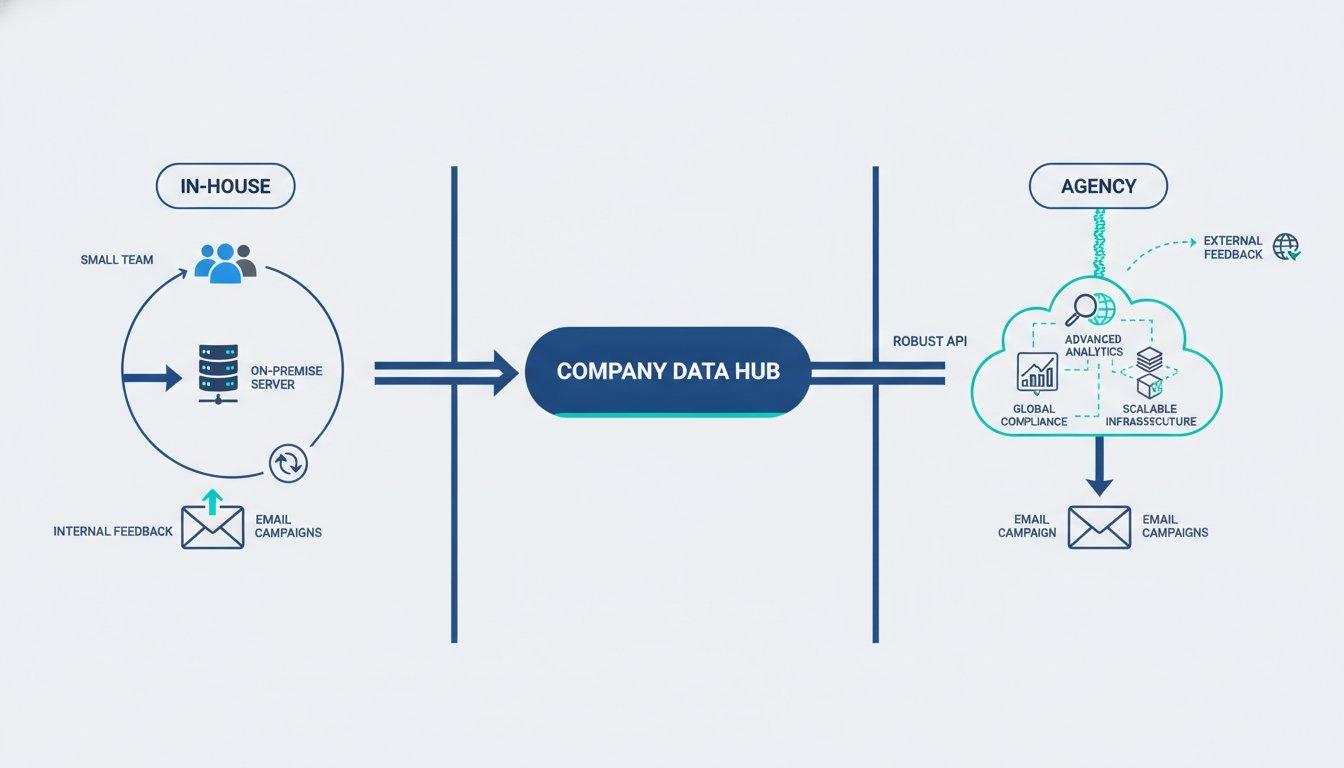
The average return on investment for email marketing sits at $36 for every $1 spent, yet a single compliance error in 2026 can cost your company $53,088 per email. You likely recognize that email is your most reliable revenue driver, but the technical requirements for deliverability and automation are increasingly difficult to manage. Most operations leaders are currently evaluating the email marketing agency vs in-house dilemma to solve for high recruiting costs and inconsistent campaign deployment. It is a choice between building a dedicated internal team or leveraging an external partner to handle complex infrastructure.
I have designed this briefing to provide a tactical comparison that helps you decide which path secures the highest ROI for your specific needs. You will find a decision framework based on your list size and technical complexity to help eliminate operational friction. We will also review the true cost of in-house management versus agency retainers to ensure your choice is grounded in financial reality. By the end of this guide, you will have a clear blueprint for your 2026 email strategy.
Key Takeaways
- Treat your email operations as a technical infrastructure play rather than a creative task to ensure modern deliverability standards.
- Evaluate the email marketing agency vs in-house trade-off by weighing immediate access to senior strategists against the benefits of deep brand alignment.
- Apply a specific decision framework based on your current subscriber list size and the complexity of your lifecycle automation.
- Account for hidden overhead costs like recruitment lag, training, and software licensing when calculating the true ROI of an internal hire.
- Minimize your risk of expensive regulatory fines by prioritizing technical compliance and professional auditing of your current email setup.
The Operational Reality of Email Marketing in 2026
Email marketing has transitioned from a purely creative task into a technical operations role. In 2026, success depends more on your data infrastructure than your copy. When you weigh the choice of an email marketing agency vs in-house team, you’re making a fundamental resource allocation decision. Outsourcing involves leveraging a third-party firm’s specialized infrastructure and talent pool. Conversely, the in-house model relies on internal Full-Time Equivalents (FTEs) to manage the entire marketing stack. Both paths have distinct operational consequences that impact your bottom line.
The Operational Reality of Email Marketing today requires navigating strict technical hurdles. You aren’t just sending newsletters; you’re managing a complex digital asset that requires constant maintenance. The decision to keep this function internal or move it to a partner determines how quickly you can respond to shifting inbox provider requirements and privacy laws.
The Complexity of the Modern Email Stack
2026 deliverability standards require technical precision. Major inbox providers like Gmail now permanently reject bulk senders who don’t have proper SPF, DKIM, and DMARC authentication. Technical compliance is no longer optional. It’s a requirement for survival. Modern operations also demand AI-driven personalization and real-time data syncing across your entire tech stack. If your data doesn’t flow seamlessly between your CRM and your email platform, your automation will fail. This technical burden often exceeds the capabilities of a generalist marketing manager.
Resource Scarcity vs. Specialization
Building an internal team often reveals a significant talent gap. It’s difficult to find a “unicorn” marketer who possesses deep strategic knowledge, professional copywriting skills, and the technical ability to troubleshoot API integrations. Relying on a single internal hire creates a single-point-of-failure risk. If that individual leaves, your entire revenue-generating retention program stalls. Agencies solve this by providing a “plug-and-play” department of specialists. For a deeper look at how these roles fit into your broader growth plan, see our A Functional Assessment of Online Marketing Services (2026). Most B2B leaders at this crossroads are struggling to maintain campaign consistency while technical requirements scale faster than their internal bandwidth.
Evaluating the In-House Model: Control vs. Overhead
When you weigh the choice of an email marketing agency vs in-house operation, the primary draw of an internal team is control. You gain absolute brand alignment. Your staff lives the company values daily and understands the subtle nuances of your messaging better than any external party. This proximity allows for immediate access to internal stakeholders and product updates. If a product feature changes, your team knows instantly. Evaluating the In-House Model requires a look at these soft benefits, but you can’t ignore the logistical weight of managing an internal department.
The hidden costs of an internal team are substantial. Beyond the base salary of a retention manager, which ranges from $90,000 to $120,000, you have to account for benefits, payroll taxes, and recruitment fees. There is also the “tech tax.” ESP subscriptions often charge more for additional user seats or specialized permissions. When you add up a manager, a designer, and a copywriter, the total annual cost can reach $180,000 to $250,000. For many B2B operations, this overhead is a significant barrier to scaling your performance.
The Culture and Agility Advantage
Proximity to your sales team creates a feedback loop that remote partners rarely match. If your sales reps report a recurring objection, your internal team can address it in their next blast. This improves the efficiency of your lead nurturing efforts. Internal teams aren’t just contractors; they’re stakeholders in your success. They can pivot campaigns in real-time based on internal shifts or sudden market changes. This agility is a key reason why large enterprises often prefer keeping core functions close to the chest to maintain a unified voice.
The Talent Retention Challenge
The risk of stagnation is a real threat to internal teams. Because they only work on one brand, they often lack exposure to cross-industry trends and advanced automation tactics. They can become stuck in “the way we’ve always done it.” Digital marketing also has high turnover rates. If your primary email specialist leaves, they take your technical documentation and strategy with them. This creates a knowledge silo that leaves your revenue vulnerable. You also face a 3 to 6 month ramp-up time for any new hire, during which your campaigns may underperform. If you want to avoid these recruitment hurdles, you might consider a managed marketing approach to stabilize your output. Deciding on an email marketing agency vs in-house hire often comes down to whether you can afford the time and cost of this constant talent management cycle.
The Agency Advantage: Specialized Expertise and Scalability
Hiring an agency provides you with a “plug-and-play” marketing department. There’s zero recruitment lag. You don’t have to wait three months to find a candidate and another three to train them. In the email marketing agency vs in-house debate, the agency’s primary edge is immediate access to senior-level strategists. Most mid-sized companies can’t afford a full-time senior strategist, a dedicated designer, and a technical architect on a single payroll. An agency spreads those costs across multiple clients, giving you high-level talent at a fraction of the cost of a single senior hire.
Agencies also bring proven frameworks for email list segmentation. Instead of guessing how to categorize your subscribers, you benefit from systems refined across dozens of industries. This aggregated data is a massive advantage. While an in-house team only sees your data, an agency knows what is working across the market right now. This outside perspective prevents the stagnation mentioned in the previous section. If you’re still unsure about your resource needs, applying a solid Decision Framework can clarify whether your scale justifies a partner.
Technical Mastery and Deliverability
Deliverability is a proactive technical process, not a “set it and forget it” checkbox. Agencies actively manage your sender reputation and maintain direct relations with Internet Service Providers (ISPs). They employ technical architects who understand the nuances of BIMI, DMARC, and evolving Gmail sender requirements. You get a team of specialists without the headache of managing three different freelancers. This includes copywriters who understand conversion psychology and designers who know how to code for every mobile inbox.
Scaling Without Friction
Managed operations allow you to scale your output without HR friction. If you need to ramp up for a seasonal product launch or a major B2B event, an agency can pivot resources immediately. You can effectively outsource email marketing campaigns to handle these spikes without the long-term commitment of new hires. This model also removes the burden of tool management and API integrations from your internal IT team. By leveraging the agency’s existing tech stack, you reduce your own software overhead and avoid the “tech tax” of multiple platform seats. This methodical approach ensures your infrastructure grows alongside your revenue, as outlined in our strategic framework for performance growth.
Decision Framework: When to Outsource Email Marketing Campaigns
Choosing between an email marketing agency vs in-house hire requires a cold look at your operational maturity. You shouldn’t make this decision based on “gut feeling” or brand preference. It’s a calculation of risk, speed, and technical capacity. If your current email setup is essentially a manual newsletter blast, you can likely keep it in-house. If you’re building automated lifecycles that sync with a CRM, you’ve moved into a territory where generalist skills often fail. Use the following four assessments to determine your path.
- Assessment 1: List Size and Complexity. If your list is under 10,000 subscribers and your sequences are linear, an internal coordinator is sufficient. Once you hit 50,000+ subscribers or require behavioral triggers, the technical stakes for deliverability and segmentation increase.
- Assessment 2: Budget Predictability. Agency retainers typically range from $2,500 to $10,000 per month. This is a fixed cost. In-house teams carry variable overhead, including benefits, hardware, and the “tech tax” of software seats that can push total costs to $250,000 annually.
- Assessment 3: Speed to Market. Agencies are ready to deploy in weeks. Hiring and onboarding a competent internal specialist takes months. If you need to fix a revenue leak now, an agency is the faster tool.
- Assessment 4: Technical Debt. Evaluate your internal team’s understanding of DMARC, SPF, and API integrations. If your team treats email as “writing copy,” you have a technical debt problem that an agency can audit and resolve.
The “Threshold” Test
You need to define the point where your volume justifies specialized oversight. An agency costing $5,000 a month totals $60,000 a year. A single senior retention manager costs between $90,000 and $120,000 before you even buy a single software license. If you lack a dedicated designer and a technical architect, you aren’t really “in-house.” You’re just understaffed. You should only commit to an internal hire if you have the volume to keep three separate specialists busy full-time. Otherwise, you’re paying a premium for a generalist who may not be able to prevent a $53,088 CAN-SPAM violation.
Hybrid Models: The Middle Ground
You don’t have to choose 100 percent in-house or 100 percent outsourced. Many B2B operations keep brand strategy and creative direction internal while they outsource email marketing campaigns for technical deployment. This allows you to maintain your brand voice while a partner handles the “plumbing” of deliverability and automation. It’s a methodical way to scale without the friction of a massive hiring spree. If you’re ready to see how this fits your specific growth plan, you can request a functional assessment to identify your current infrastructure gaps.
Transitioning to a Managed Email Operation with Disousa
Disousa approaches email not as a creative outlet, but as a performance-driven infrastructure. When you move past the email marketing agency vs in-house debate and choose to partner with us, the transition is handled with technical precision. We begin by auditing your existing email infrastructure to identify leaks in your deliverability or gaps in your automation. This process focuses on performance-based growth and conversion optimization rather than superficial metrics. We eliminate the “black box” typical of marketing vendors by providing transparent, logistical updates that prioritize substance over flash.
Our methodology integrates your email efforts with your broader online marketing and affiliate marketing strategies. We ensure your messaging is consistent across all channels without the overhead of an internal department. By focusing on measurable results, we help you scale your operations while keeping your internal team focused on their core competencies.
The Disousa Onboarding Protocol
The first 30 days of our engagement are dedicated to stabilization. We perform a deep technical audit of your DMARC, SPF, and DKIM records to ensure you meet the 2026 standards set by major inbox providers. We protect your sender reputation during this transition by managing volume ramps and monitoring real-time feedback loops. You won’t receive vague status updates; our communication is strictly functional and direct. We value your time and prioritize the delivery of essential milestones over marketing jargon. This methodical approach ensures that your transition is seamless and your revenue remains protected.
Long-term Growth and Lifecycle Management
Once your infrastructure is stable, we move beyond basic batch-and-blast tactics. We implement sophisticated automation that responds to specific user behaviors. This involves building and optimizing drip campaign services that nurture leads and maximize customer lifetime value. We use empirical data to refine your strategy, ensuring every campaign is grounded in reality. We don’t rely on guesswork; we rely on continuous optimization based on user behavior and conversion data. If you’re ready to reduce your operational friction and secure a higher ROI, you can schedule an operational briefing with Disousa to evaluate your current setup.
Future-Proofing Your Email Infrastructure
Your decision regarding an email marketing agency vs in-house operations determines how quickly your business adapts to technical shifts. Internal teams provide cultural proximity. However, they often lack the specialized bandwidth required for complex lifecycle automation and 2026 deliverability standards. Outsourcing these functions allows you to access a senior-level tech stack. You gain aggregated industry data without the overhead of additional software seats or recruitment lag.
Success in modern B2B email requires moving beyond simple newsletters. You need a data-driven, methodical infrastructure. We utilize performance marketing and specialized lifecycle expertise to ensure your campaigns are grounded in empirical reality. We don’t rely on guesswork. If you want to eliminate the “black box” of your current marketing operations, we can help you identify exactly where your revenue is leaking. We provide transparent, status-driven reporting to keep your operations moving forward.
Request an Email Operations Audit from Disousa to receive a functional assessment of your technical infrastructure. You have the framework to make an informed decision. Now it’s time to build the system that supports your 2026 growth.
Frequently Asked Questions
Is it cheaper to hire an in-house email marketer or an agency?
Deciding between an email marketing agency vs in-house hire often comes down to total cost of ownership. An agency is typically more affordable for companies that don’t need three full-time specialists. You avoid the expenses of benefits, equipment, and the training time required for a new employee. This model allows you to convert variable recruitment costs into a predictable monthly retainer.
Can an agency really capture my brand’s unique voice?
Agencies use a methodical onboarding process to replicate your brand voice accurately. We rely on your existing content, style guides, and feedback loops to ensure alignment. While an internal hire lives the brand daily, a professional partner uses a structured approach to maintain consistency across every campaign. This process ensures that your messaging remains professional and aligned with your operational goals.
How much control do I lose when I outsource email marketing campaigns?
You maintain strategic control while delegating the technical execution of your campaigns. You still approve every subject line, segment, and automation logic before any emails are sent. Outsourcing simply shifts the burden of technical maintenance and deliverability management to experts. This allows your internal team to focus on high-level business decisions while we handle the logistical reality of deployment.
What is the typical ROI of a managed email marketing program?
ROI increases when technical errors are reduced and deliverability is prioritized. Managed programs typically outperform internal efforts by implementing advanced segmentation and behavioral triggers that generalists might overlook. We focus on measurable conversion growth rather than surface-level metrics like open rates. By optimizing your lifecycle flows, we help recover revenue that is often lost to inconsistent or generic email blasts.
Do I still need to pay for my own ESP if I hire an agency?
You should typically maintain ownership of your own Email Service Provider (ESP) account. This ensures you keep control of your subscriber data and sender reputation regardless of your agency relationship. While some partners offer their own platforms, we recommend owning your stack to ensure long-term data portability. This arrangement provides transparency and protects your digital assets if you decide to change models later.
How long does it take to see results after switching to an agency?
Technical improvements to your deliverability and sender reputation are usually visible within the first 30 days. We focus on fixing broken automation flows and auditing your authentication records immediately. Significant revenue growth from new lifecycle strategies typically stabilizes after 90 days of continuous optimization. This timeframe allows us to gather enough empirical data to refine your segments and improve overall performance.
What happens to my data and list if I stop working with an agency?
Your data and subscriber list remain your exclusive property. Because you own the ESP account, all historical data and automation setups stay with your company if the partnership ends. A professional transition involves a full handover of technical documentation and strategy logs. This ensures your next internal hire or partner can continue the work without any loss of operational momentum.
Which model is better for B2B lead nurturing?
The email marketing agency vs in-house decision for B2B lead nurturing depends on your CRM integration needs. Agencies bring specialized experience in building complex, automated sequences that sync with your sales pipeline. If your nurturing strategy requires deep technical logic and multi-channel attribution, an agency is usually the more reliable choice. Internal teams are better suited for daily, manual interventions from your sales department.
Disclaimer
**Disclosure:** Some articles on this website may contain affiliate links. This means we may earn a commission if you purchase a product or service through certain links, at no additional cost to you. We only recommend products, tools, and services that we believe provide value to our readers.
**Disclaimer:** The information provided on this website is for educational and informational purposes only and should not be considered financial, legal, tax, or professional advice. While we strive to keep our content accurate and up to date, we make no guarantees regarding completeness, reliability, or results obtained from using the information provided. Always conduct your own research and consult qualified professionals before making business, financial, or investment decisions.
