

Online marketing services are functional infrastructures rather than creative products. They require methodical deployment and technical management to remain effective. It’s often difficult to define these services clearly across different agencies. Ambiguity in these definitions creates challenges for organizations that need to scale. Many operations lack transparent, performance-based frameworks. This leads to difficulty in identifying the technical requirements for growth. Current service models often fail to provide the transparency needed for performance-based evaluation.
This assessment provides a technical overview of the structural components and deployment strategies required for 2026. A clear map of service categories is established. The infrastructure necessary for performance growth is identified. Neutral criteria for service evaluation are presented to ensure logistical reality is prioritized. The shift toward first-party data and AI-driven automation is addressed within a functional context. These components are essential for maintaining compliance with updated regulations like the CCPA. This guide outlines the necessary steps for a stable and scalable marketing operation.
Key Takeaways
- Distinguish between performance-based and visibility-based models to define digital interventions accurately.
- Identify the technical requirements for tracking and attribution within affiliate and email marketing frameworks.
- Assess internal data readiness and the role of CRM platforms in scaling online marketing services.
- Utilize neutral criteria to evaluate the technical capabilities and service agreements of external agencies.
- Establish standard operating procedures to manage the transition from strategic planning to functional deployment.
The Functional Components of Online Marketing Services
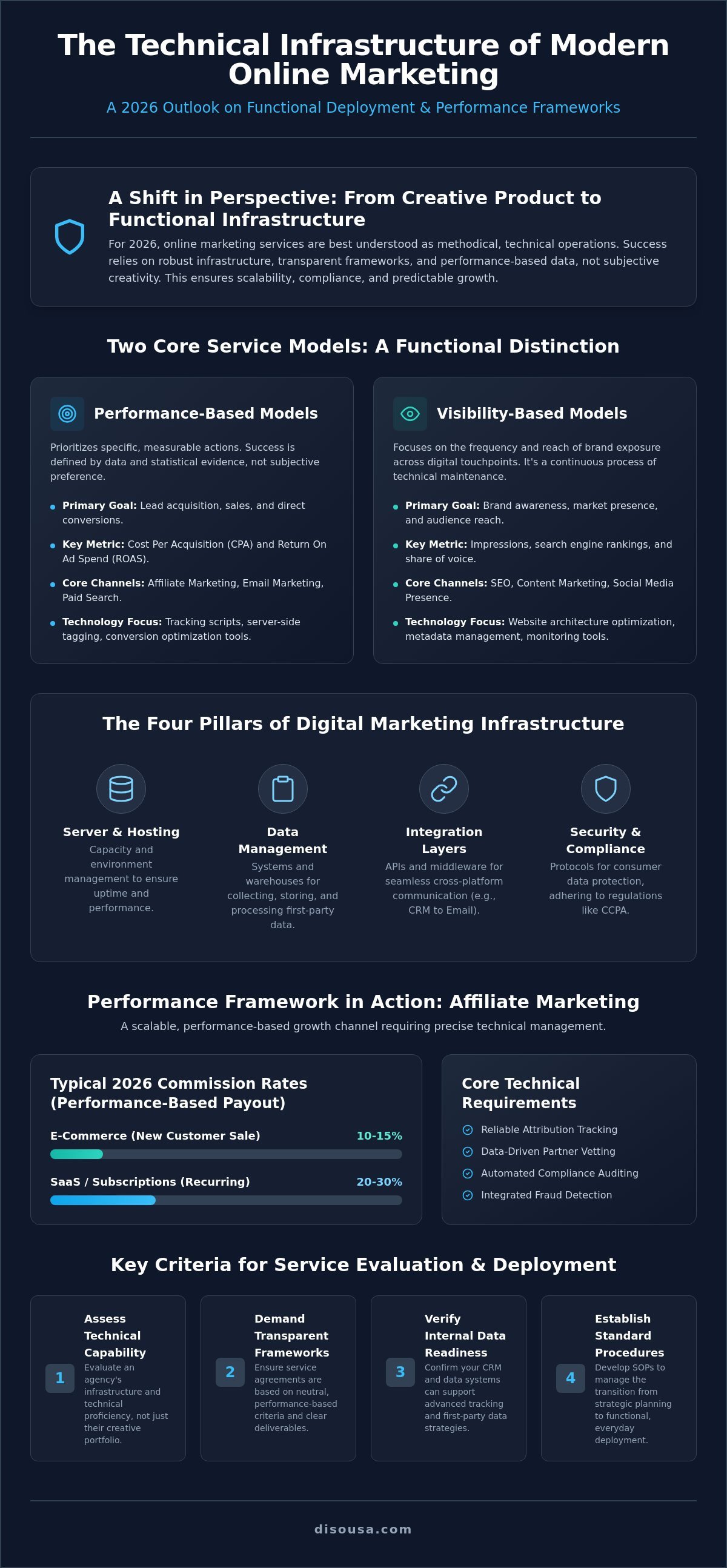
Online marketing services are defined as a series of managed digital interventions. These interventions facilitate the exchange of data and value between an organization and its target audience. A comprehensive Digital Marketing Overview shows that these processes are increasingly standardized. In 2026, service delivery protocols are governed by specific technical requirements. These protocols ensure consistency across different digital environments. Digital infrastructure is required to support brand growth. This infrastructure typically includes several core components:
- Server capacity and hosting environments
- Data management systems and warehouses
- Integration layers for cross-platform communication
- Security protocols for consumer data protection
It’s a logistical operation. A distinction is made between performance-based and visibility-based service models. Performance-based models prioritize specific actions such as lead acquisition or sales. Visibility-based models focus on the frequency and reach of brand exposure. Both models rely on a stable technical foundation. Without this foundation, marketing efforts lack the necessary data for optimization. The 2026 market requires the standardization of online marketing services protocols. This standardization reduces ambiguity. It allows for a more accurate assessment of agency performance. Digital infrastructure serves as the connective tissue between these models. It enables the flow of information across various marketing channels.
Performance Marketing and Direct Response
Lead generation is treated as a primary administrative goal within performance frameworks. Specific mechanisms are utilized for conversion optimization. These mechanisms involve the systematic testing of landing pages and user paths. The utility of measurable metrics is central to performance assessment. Metrics such as cost per acquisition (CPA) provide a neutral basis for evaluating service efficiency. Data is collected through tracking scripts and server-side tagging. These technical components must be configured correctly to ensure data integrity. Performance marketing doesn’t rely on subjective preferences. Adjustments are made based on statistical evidence.
Brand Visibility and Market Presence
Structural approaches are used to enhance online search presence. This involves the technical optimization of website architecture and metadata. Content serves the function of maintaining digital relevance within search engine algorithms. Cross-channel visibility standards require technical alignment between social platforms and search engines. These standards ensure that brand information is displayed accurately across all touchpoints. Automated monitoring tools are often deployed to verify this accuracy. Maintaining visibility is a continuous process of technical maintenance. It requires regular updates to reflect changes in platform requirements. This functional approach ensures that brand assets remain accessible to the target audience.
Performance Frameworks: Affiliate and Email Management
Affiliate marketing is a scalable growth channel within the scope of online marketing services. It operates on a performance-based model where commissions are paid only after a specific action is completed. For e-commerce, a typical commission rate is 10-15% of the sale for new customers. SaaS and subscription-based products often offer a 20-30% recurring commission as of 2026. Technical tracking systems are required to manage these transactions. These systems utilize cookies or server-to-server tracking to ensure accurate attribution. Organizations often review various Digital Marketing Strategies to determine which performance frameworks align with their infrastructure. Reliable attribution is the foundation of any scalable affiliate operation.
Affiliate Program Management Infrastructure
Partner recruitment follows standard administrative procedures. Potential partners are vetted to verify the quality of their traffic sources. Data-driven evaluation is used to monitor partner performance over time. This includes the tracking of conversion rates and average order values. Protocols are established to maintain program integrity and regulatory compliance. Compliance with terms of service is monitored through automated auditing tools. Fraud detection systems are integrated to prevent unauthorized activity. A methodical approach to affiliate marketing ensures the long-term stability of the growth channel. Integrity is maintained through consistent technical oversight.
Email marketing serves as a primary tool for audience retention and nurturing. It allows for direct communication with a verified user list. The global email user base reached 4.6 billion in 2025 and continues to expand. This scale requires specialized technical infrastructure for campaign deployment. Retention is achieved through the delivery of systematic updates and transactional information. Automation is integrated to handle high-volume distribution without manual intervention. This reduces the administrative burden of managing large-scale communications.
Email Campaign Automation and Segmentation
Email lifecycle systems are analyzed based on their structural components. These systems manage the progression of a user from initial sign-up to retention. Audiences are segmented using technical data points. These points include previous purchase history and engagement frequency. List health is maintained through regular cleaning procedures. Delivery standards are monitored to ensure emails reach the intended inbox. Compliance with the CAN-SPAM Act is a critical operational requirement. The maximum penalty for a violation is $53,088 per email. Standard operating procedures are followed to honor opt-out requests within 10 business days. Effective email marketing relies on these technical safeguards to maintain deliverability. Data readiness determines the success of automated segmentation strategies.
Technical Requirements for Scaling Digital Operations
Scaling digital operations is a technical exercise. It requires a thorough assessment of internal data readiness. Data must be structured and accessible across all departments. Without this readiness, online marketing services cannot be scaled efficiently. Organizations utilize Customer Relationship Management (CRM) and marketing automation platforms to manage growth. These platforms serve as the system of record for all digital interactions. In 2026, advanced marketing automation and CRM platforms are standard. They provide the infrastructure needed for multi-channel coordination. Predictive analytics are integrated into these systems to forecast performance trends.
Resource allocation is shifted toward technical management. Managing multi-channel strategies requires dedicated personnel for platform maintenance and data analysis. Budgeting must account for software licensing and API integration costs. Standardized reporting protocols are established for global initiatives. These protocols ensure that performance data is comparable across different market segments. Unified naming conventions for campaigns and assets are mandatory. This level of organization is necessary when deploying broad online marketing services across diverse territories. Organizations that operate without a unified performance engine often find that engaging a digital growth strategy agency resolves the data silos and reporting gaps that emerge at scale.
Data Integration and Reporting Standards
Performance data must be centralized from all active channels. This includes data from affiliate programs, email campaigns, and search platforms. Real-time reporting allows for immediate adjustments to deployment strategies. Technical barriers often impact data accuracy in complex ecosystems. These barriers include cross-domain tracking limitations and the decline of third-party cookies. Inconsistent data formats between different platforms can lead to reporting errors. Consistent data schemas and server-side tagging are required to mitigate these issues. Accuracy is prioritized over reporting speed.
Infrastructure for Global Marketing Deployment
Digital assets are managed through centralized repositories. This ensures consistency across multiple regions and languages. Global affiliate and email systems must account for localized technical requirements. These include currency conversion protocols and regional data privacy regulations. The California Consumer Privacy Act (CCPA) amendments of 2026 require mandatory privacy risk assessments. New rules for automated decision-making technology also apply. Centralized management allows for the enforcement of these standards in decentralized markets. It provides a single point of oversight for global operations. This structure is necessary for maintaining operational integrity at scale. Deployment is executed through local nodes that report back to a central hub.
Criteria for Evaluating Online Marketing Services
Evaluation is conducted through a methodical assessment of technical capabilities. This process moves beyond social proof and surface-level reviews. Instead, it focuses on the underlying infrastructure of online marketing services. A technical audit of an agency’s data management and integration protocols is required. This audit verifies the ability to handle high-volume data streams without loss of integrity. It also assesses the agency’s proficiency with the CRM and automation platforms identified in previous sections. Structural fit is identified by comparing the agency’s technology stack with internal business systems. Compatibility between these systems is necessary for seamless data transfer.
Agreements for service are categorized into performance-based and retainer-based models. Performance-based agreements are structured around specific milestones. These may include lead volume or verified acquisition targets. Retainer-based models prioritize a set allocation of labor hours or ongoing maintenance tasks. A choice between these models depends on the organization’s growth stage and risk tolerance. Transparency is evaluated through the level of direct data access provided. Reporting must be objective and verifiable through third-party platforms. Agencies are required to provide raw data logs to ensure reporting accuracy. This level of access prevents the ambiguity often found in summarized reports.
Agency vs. In-house Management
Comparing internal resource allocation to the managed service model is a critical administrative step. In-house management allows for direct control over every operational detail. However, it requires a high level of technical expertise and ongoing training for staff members. Specialized agencies are often utilized for complex affiliate and email functions. These agencies maintain the infrastructure needed for high-volume deployment and compliance monitoring. A cost-benefit analysis shows that outsourcing can reduce the administrative burden of platform maintenance. Organizations seeking to optimize their budget should evaluate online marketing services based on these functional requirements.
KPIs and Performance Benchmarking
Selecting metrics is a process that must align with functional business goals. Vanity metrics are excluded from the evaluation process to maintain a focus on logistical reality. The role of ROI is central to long-term service evaluation. It provides a neutral baseline for comparing different service providers. Performance expectations are standardized to ensure consistency across all marketing channels. This standardization allows for the identification of inefficiencies within the service ecosystem. Benchmarking is performed against historical internal data and verified industry standards. This methodical approach ensures that expectations remain grounded in data rather than projections. Regular audits are scheduled to verify that these benchmarks are being met consistently.
Implementation and Deployment of Growth Strategies
Strategic planning is followed by functional execution. This transition involves the conversion of high-level objectives into specific technical tasks. A deployment roadmap is utilized to identify the necessary infrastructure for each campaign. This roadmap ensures that all required software integrations are active. Standard operating procedures are followed for initial campaign deployment. These procedures include pre-launch checklists to verify server readiness and data tracking accuracy. Online marketing services require this methodical approach to maintain operational stability. Growth is achieved through a series of controlled increments rather than sudden shifts in strategy.
Continuous optimization is required for performance maintenance. Data is monitored in real-time to identify variances from expected results. Adjustments are made based on statistical significance. This process prevents the degradation of campaign efficiency over time. Methodical growth relies on the documentation of every intervention. This documentation provides a historical record for future strategic planning. It ensures that successful configurations can be replicated across different market segments. It’s a logistical necessity to maintain these records for audit purposes.
Managed Email and Affiliate Deployment
Launch procedures for performance campaigns are executed in distinct stages. These stages ensure that all technical components are operational before full-scale deployment:
- Technical environment configuration: Email DNS records such as SPF, DKIM, and DMARC are verified. Affiliate tracking pixels and server-to-server postbacks are tested for accuracy.
- Small-scale testing: Attribution systems are tested across multiple devices to confirm data integrity.
- Benchmark monitoring: Initial results are compared against the performance targets established during the evaluation phase.
Technical verification is a mandatory step before any significant resource allocation occurs. If the initial data aligns with expectations, the campaign is scaled to full capacity. This prevents the waste of administrative resources on non-functional deployments.
Strategic Alignment and Future Readiness
Marketing infrastructure must be adapted to evolving digital standards. In 2026, compliance with updated AI-driven automation policies is necessary. Google Ads updated its Terms of Service on July 1, 2026, to expand the use of automation. Meta introduced location-based fees for certain European countries in July 2026 to cover digital services taxes. Businesses must also prepare for the removal of certain opt-out features on Meta technologies. Disousa provides the technical marketing foundations required to manage these changes. These foundations include the setup of compliant data collection systems and automated reporting layers. Final considerations for the 2026 market include a focus on first-party data and privacy risk assessments. Organizations that prioritize technical readiness will maintain a stable market presence. Online marketing services remain effective when managed through a centralized and methodical framework.
Establishing Technical Readiness for 2026
The successful deployment of online marketing services depends on a stable technical foundation. Strategic planning is only effective when it’s followed by functional execution and continuous optimization. Organizations must prioritize the integration of standardized protocols to manage growth. This assessment has identified the necessary structural components for modern digital operations. Methodical affiliate management frameworks and technical email marketing operations are required to maintain performance standards. Organizations looking to grow brand through affiliate partnerships must ensure that their tracking infrastructure and partner vetting protocols are aligned with 2026 compliance requirements before scaling. A professional digital infrastructure assessment ensures that all systems are aligned with current regulatory requirements. Data integrity and transparent reporting remain the primary indicators of operational health. Organizations can now move forward with a clear map of service categories and evaluation criteria. Readiness is achieved through the systematic application of these technical standards. It’s a logistical necessity to verify all tracking and automation systems before scaling. Access the Disousa functional assessment of digital marketing to begin the implementation process. Methodical preparation ensures long-term stability in a complex market. A focus on substance and readiness facilitates sustainable growth.
Frequently Asked Questions
What are the primary categories of online marketing services?
Online marketing services are categorized into performance-based and visibility-based interventions. Performance models focus on lead acquisition and sales conversions. Visibility models improve search engine presence and brand frequency across channels. These categories utilize managed digital infrastructure to facilitate value exchange. Standardized protocols ensure that each service category remains consistent across different digital environments. It’s a logistical framework designed for operational clarity.
How does affiliate management contribute to performance marketing?
Affiliate management provides a scalable growth channel by linking costs directly to verified actions. It operates on a commission structure where payments are issued only after a sale or lead is confirmed. For e-commerce, commissions typically range from 10% to 15%. SaaS products often utilize a 20% to 30% recurring commission model. This framework reduces financial risk for organizations during scaling phases.
What technical infrastructure is required for automated email campaigns?
Automated email campaigns require a robust integration of CRM and marketing automation platforms. These systems manage user data and facilitate high-volume distribution. Technical verification of DNS records such as SPF and DKIM is mandatory for deliverability. Lifecycle systems are used to segment audiences based on engagement data points. This infrastructure ensures that communications remain compliant with the CAN-SPAM Act and CCPA regulations.
How should a business evaluate the ROI of online marketing services?
The ROI of online marketing services is evaluated by comparing cost per acquisition against the total value generated. Businesses should utilize neutral, performance-based metrics rather than vanity indicators. Verifiable data logs from third-party platforms provide the necessary transparency for this assessment. Regular audits are conducted to verify that results align with established historical benchmarks. This methodical approach ensures that resource allocation remains efficient.
What is the difference between visibility and performance-based marketing?
Visibility-based marketing focuses on enhancing search presence and the frequency of brand exposure. It utilizes content and technical SEO to maintain digital relevance. Performance-based marketing prioritizes specific, measurable actions such as lead generation or direct sales. While visibility builds a foundation for market presence, performance frameworks drive immediate revenue growth. Both models rely on stable digital infrastructure for effective deployment and tracking.
Can online marketing services be scaled globally?
Online marketing services are scaled globally through centralized management and localized technical nodes. This structure allows for the management of digital assets across multiple regions and languages. Technical considerations include currency conversion protocols and regional data privacy compliance. For example, operations must align with the 2026 CCPA amendments. Centralized oversight ensures that global initiatives remain consistent with core performance standards across all territories.
What is the role of data integration in digital marketing operations?
Data integration centralizes performance information from multiple digital channels into a single system of record. This process is essential for maintaining accuracy in reporting. It allows for the identification of cross-channel attribution and user behavior patterns. Integration layers mitigate technical barriers such as the decline of third-party cookies. Server-side tagging is often deployed to ensure data integrity across complex marketing ecosystems.
Why is a methodical approach necessary for digital growth?
A methodical approach prevents operational instability and the waste of administrative resources. It ensures that every digital intervention is documented and verified against technical benchmarks. This discipline is necessary to maintain compliance with evolving AI policies and platform updates. Growth is achieved through controlled increments rather than unverified strategic shifts. Methodical management provides a historical record for future performance optimization and internal audits.
Disclaimer
**Disclosure:** Some articles on this website may contain affiliate links. This means we may earn a commission if you purchase a product or service through certain links, at no additional cost to you. We only recommend products, tools, and services that we believe provide value to our readers.
**Disclaimer:** The information provided on this website is for educational and informational purposes only and should not be considered financial, legal, tax, or professional advice. While we strive to keep our content accurate and up to date, we make no guarantees regarding completeness, reliability, or results obtained from using the information provided. Always conduct your own research and consult qualified professionals before making business, financial, or investment decisions.

4 responses to “A Functional Assessment of Online Marketing Services (2026)”
[…] are based on actual revenue rather than lead generation alone. Organizations should also consider online marketing services to evaluate the efficiency of their current tracking […]
[…] that marketing spend is optimized based on real-time performance data. You can find more details in a functional assessment of online marketing services 2026 regarding how these systems are […]
[…] the requirement for manual intervention. This technology operates within the broader scope of online marketing services. Standard automation frameworks utilize behavioral triggers to ensure that every message remains […]
[…] and Yahoo Mail inboxes. High spam complaint rates result in immediate domain suppression. A broader functional assessment of online marketing services shows that technical compliance is now the primary driver of campaign success. Domains without full […]