

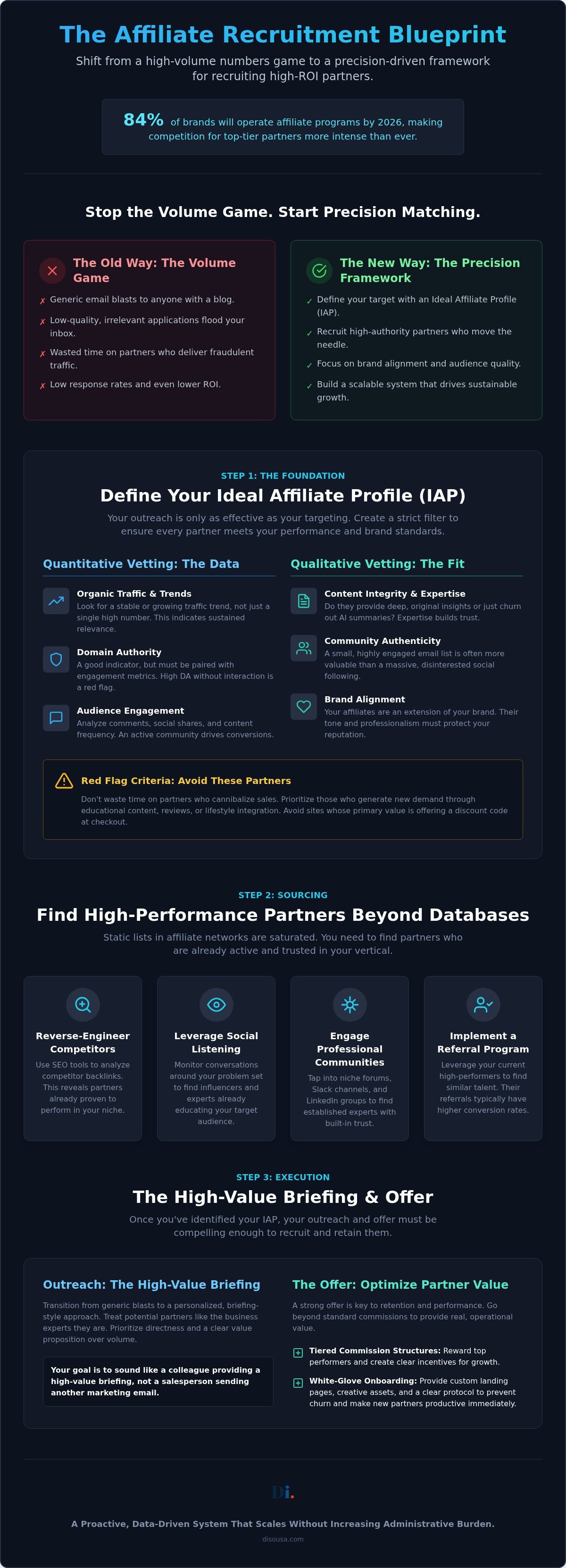
With 84% of brands operating affiliate programs in 2026, the competition for high-authority partners is at an all-time high. You’ve likely noticed that standard affiliate outreach strategies are yielding lower response rates than in previous years. It’s frustrating to spend hours on manual sourcing only to end up with low-quality applications or fraudulent traffic. I’ve found that the primary bottleneck isn’t a lack of potential partners. It’s the absence of a repeatable, operational framework that treats recruitment as a precision matching exercise—similar to the high-touch vetting at itsdatingexplained.com—rather than a volume game.
We agree that a program’s health depends on the quality of its top-tier contributors, not the sheer number of sign-ups. This article provides a practical blueprint for identifying and onboarding the niche leaders who actually move the needle on ROI. I’ll outline the exact steps we use to filter for quality, automate the tedious parts of the pipeline, and maintain compliance with current FTC and GDPR standards. You’ll learn how to transition from a reactive recruitment model to a proactive, data-driven system that scales without increasing your administrative burden.
Key Takeaways
- Define your Ideal Affiliate Profile (IAP) to ensure every partner matches your technical requirements for traffic and audience quality.
- Optimize your affiliate outreach strategies by leveraging competitor backlink profiles and social listening to find active, high-authority niche leaders.
- Transition to a briefing-style outreach approach that prioritizes directness and personalization over high-volume, generic email blasts.
- Increase partner retention and ROI through tiered commission structures and white-glove onboarding assets like custom landing pages.
- Establish a clear recruitment-to-onboarding protocol to prevent churn and ensure new partners are productive immediately.
Establishing Your Recruitment Criteria: The Ideal Affiliate Profile (IAP)
Most affiliate managers fail because they treat recruitment as a volume game. They blast generic emails to anyone with a blog. This approach leads to low response rates and even lower ROI. Successful Affiliate marketing recruitment requires a target. You need to know exactly who you want before you start looking. Your affiliate outreach strategies will only be as effective as the criteria you use to vet your prospects.
The Ideal Affiliate Profile (IAP) serves as the foundational filter for all outreach efforts, ensuring that every recruited partner meets specific performance and brand standards before engagement begins.
To better understand the nuances of partner selection, watch this briefing on common outreach mistakes:
Before you start sourcing, establish your “Red Flag” criteria. This prevents you from wasting time on low-value aggregators or coupon sites that don’t actually generate new demand. If a site’s primary value proposition is offering a discount code at checkout, they’re likely cannibalizing your existing sales rather than finding new customers. Look for partners who provide educational content, reviews, or lifestyle integration; for instance, a culinary media brand like So Yummy uses creative video recipes and kitchen hacks to build the trust that drives sustainable growth.
Quantitative Vetting: Traffic and Engagement Metrics
Data doesn’t lie, but it can be misleading if you look at the wrong numbers. Use standard SEO tools to evaluate a potential partner’s organic search footprint. A high domain authority is a good start, but it isn’t everything. You need to see a stable or growing trend in organic traffic. Analyze their audience engagement by looking at comment sections, social shares, or the frequency of new content. If a site has high traffic but zero interaction, it’s a sign of a passive or potentially low-quality audience. Check for historical alignment by seeing if they already promote competitors or similar brands in your vertical.
Qualitative Vetting: Brand Alignment and Content Integrity
Your affiliates are an extension of your brand. If their tone is unprofessional or their expertise is shallow, it reflects poorly on your product. Assess the quality of their existing content. Do they provide deep insights, or are they just churning out AI-generated summaries? Verify the authenticity of their community. A smaller, highly engaged email list is often more valuable than a massive, disinterested social following. This level of vetting ensures your IAP aligns with a broader strategic framework for performance growth, allowing you to scale with partners who actually protect your brand reputation.
Sourcing High-Performance Partners: Beyond the Databases
Finding high-value partners requires moving beyond the static lists found in affiliate networks. Most recruiters rely on these saturated databases, which leads to high competition and low-quality applications. We need to identify individuals and entities already active in your vertical. Social listening tools allow you to monitor conversations around your specific solution or problem set. When you identify an influencer or expert already discussing these topics, they become a primary target for your affiliate outreach strategies.
Professional communities on LinkedIn, Slack, and niche forums are often untapped resources. These environments house experts who possess established trust with your target audience. You can also implement a “Refer-an-Affiliate” program. This leverages your current high-performers to find similar talent. Since they already understand your program’s value, their referrals typically have higher conversion rates. Understanding the perspective of these partners is vital, as noted in this Definitive Guide To Affiliate Marketing, which highlights what motivates top-tier creators.
Reverse-Engineering Competitor Success
Your competitors have already done the heavy lifting of identifying viable partners. You can use SEO tools to export the backlink profiles of top market players. Focus specifically on sites ranking for “Review,” “Alternative,” or “Best [Product Category]” keywords. Once you have this list, categorize the sources. Separate them into review sites, comparison hubs, and individual content creators. This allows you to tailor your pitch based on their specific content style. If you want to scale these operations effectively, consider a functional assessment of online marketing services to see how external management can streamline this sourcing.
Leveraging Your Existing Customer Data
The best future affiliates might already be in your customer database. Identify power users with high lifetime value. These individuals already understand your product and are likely advocates. Cross-reference your customer list with known industry bloggers or social media influencers. I recommend inviting these top-tier customers to an exclusive partner tier with higher incentives. This turns a standard customer relationship into a performance-based partnership that drives measurable ROI without the cold-start friction of traditional recruitment.
Executing the Outreach Campaign: The High-Value Briefing
Outreach is often where the most sophisticated affiliate programs stall. You’ve identified your IAP and sourced the targets, but the execution often feels like a volume-based numbers game. It shouldn’t. High-value partners ignore generic pitches because they receive dozens every day. Your affiliate outreach strategies must pivot from a “sales pitch” to a “business briefing.” I recommend a direct approach that respects their professional time and highlights the immediate ROI of the partnership. We’ve found that placing the “What’s in it for them” within the first two sentences significantly increases response rates from niche leaders.
A successful campaign doesn’t end with the first email. You need an automated follow-up sequence that provides value in every step. Don’t just send “checking in” reminders. Instead, share a recent industry data point, a conversion tip, or a specific insight about how their audience segment is currently performing. This persistent value-add builds the trust necessary to move from a cold email to a signed agreement. It also signals that you are an organized partner who values logistical reality over marketing fluff.
The Anatomy of a High-Response Outreach Email
Subject lines must be functional and low-hype. Use descriptors like “Partnership Proposal: [Your Brand] + [Their Site Name]” to ensure clarity in a crowded inbox. The hook is your chance to prove you aren’t mass-blasting. Reference a specific piece of their content or a recent achievement to show you’ve done your homework. The offer should follow immediately. Briefly outline your commission structure, such as the standard 10-15% DTC rate for 2026, and mention any exclusive support available, like custom creative assets or dedicated account management. This transparency is critical, especially when ensuring partners understand the FTC’s Endorsement Guides for legal compliance.
Scaling Personalization Without Losing Human Connection
Personalization often breaks when you try to scale. To solve this, use custom CRM fields for “Specific Content Reference” and “Unique Value Prop.” This allows you to utilize templates while keeping the core of the message human and relevant. We recommend limiting automated batches to 50 recipients per day. This protects your sender reputation and allows for manual oversight if a high-value target replies. As a gesture of goodwill, offer them resources on how to promote your content online during the onboarding phase. It demonstrates that you’re invested in their long-term growth, not just a one-off transaction.
Optimizing the Partner Value Proposition: The Offer
Your offer is the leverage point of your entire recruitment pipeline. If you only provide a standard commission, you’re competing on price alone. High-value partners look for a comprehensive value proposition that justifies their time and audience trust. When executing your affiliate outreach strategies, remember that your offer is a reflection of your operational maturity. I recommend providing “White-Glove” onboarding assets from day one. This includes custom landing pages, pre-written copy swipes, and high-resolution graphics. These tools reduce the friction for the partner and ensure your brand is represented accurately.
Transparency in tracking is equally vital. Ensure your systems are technically sound and capable of providing real-time reporting. Partners in 2026 expect to see their impact immediately. If your tracking is opaque or your payments are delayed, you’ll lose your best performers to competitors who prioritize logistical reality over marketing promises. Providing exclusive data or industry insights that partners can share with their audience further cements your position as a valuable collaborator rather than just another vendor.
Beyond Commission: The “Partner-First” Incentive Stack
We use a “Partner-First” incentive stack to differentiate our programs. This includes performance bonuses for hitting specific lead or sale milestones within the first 90 days. It creates immediate momentum and rewards the effort of initial integration. You can also offer early access to product updates or beta features. This allows partners to provide exclusive value to their audience, boosting their own authority. Understanding the Data-Driven Evaluation of Affiliate Marketing ROI in 2026 helps you justify these higher upfront costs by looking at long-term partner lifetime value.
Technical Reliability as a Recruitment Tool
Technical reliability is a recruitment tool in itself. I highlight our 99.9% tracking uptime and prompt payment schedules during the initial briefing. In 2026, tiered commission structures are standard, often ranging from 10-15% for general affiliates to 15-20% for top-tier performers. Provide a dedicated partner dashboard that shows real-time conversion data and attribution. If a partner needs help with pixel implementation or custom API integrations, offer direct technical support. This level of service is rare and builds significant loyalty. If you’re struggling to structure these technical incentives, consider adopting a strategic framework for performance growth to align your offer with your business goals.
Scaling Recruitment Through Managed Operations
Scaling your program is not a simple matter of increasing email volume. If you double your output without refining your internal operations, you will likely see a proportional decrease in partner quality and a rise in administrative friction. Your affiliate outreach strategies must evolve into a managed pipeline that prioritizes the transition from “signed” to “active.” Many programs suffer from a high volume of “ghost” affiliates who complete the registration process but never actually promote the brand. This gap is usually caused by a failure in the recruitment-to-onboarding handoff protocol.
I recommend reviewing your recruitment KPIs on a monthly basis to identify where the pipeline is leaking. You should track three primary metrics: Outreach Volume, Response Rate, and Active Partner Rate. If your response rate is high but your active partner rate is low, your offer or onboarding process is failing to convert interest into action. Expert management is the key to moving your program from an experimental cost center to a profitable, predictable revenue driver. It ensures that the logistical reality of managing hundreds of relationships doesn’t overwhelm your core marketing objectives.
Identifying When to Outsource Affiliate Recruitment
Internal teams often lack the bandwidth for the consistent, high-quality outreach required for sustainable growth. Cold sourcing is time-consuming and requires a specific set of tools and data-mining expertise. You should evaluate whether your team is spending more time on administrative tasks than on strategic optimization. An agency often provides immediate access to an existing network of “warm” partner relationships, which can bypass months of cold outreach. For a deeper dive into the logistical trade-offs, see this functional analysis of outsourced affiliate program management.
The Long-Term Partnership Lifecycle
Recruitment is only the first stage of the partnership lifecycle. To prevent churn, you must move into a “Partner Success” mindset immediately after onboarding. Provide your top-tier contributors with ongoing optimization tips, such as which creative assets are currently seeing the highest click-through rates. I suggest scheduling quarterly business reviews with your most productive affiliates to align on upcoming product launches and seasonal goals. This level of professional engagement separates high-growth programs from stagnant ones. If you are ready to move beyond manual processes, you can contact Disousa to scale your partner recruitment operations and implement a performance-based growth strategy.
Implementing Your Performance Growth Roadmap
Transitioning your program from a manual, high-friction process to a scalable revenue engine requires operational discipline. Success depends on a strict Ideal Affiliate Profile and a shift toward briefing-style communication. By treating partners as professional colleagues rather than just traffic sources, you ensure long-term alignment and higher ROI. Your affiliate outreach strategies should always prioritize quality and logistical transparency to maintain trust in a competitive 2026 landscape.
If you’re ready to move beyond experimental tactics, it’s time to professionalize your program management. You can partner with Disousa to scale your performance marketing strategy. We provide global affiliate management expertise and a dedicated focus on performance-based growth to help you navigate complex B2B digital strategies. Building a sustainable program is an operational challenge, but with the right framework in place, you’re positioned for measurable success.
Frequently Asked Questions
How do I find affiliates for my niche?
You find high-value affiliates by looking where your audience already consumes content. I recommend using SEO tools to identify sites ranking for competitor “review” or “alternative” keywords. Social listening tools also help you find influencers already discussing problems your product solves. This proactive approach ensures you reach partners who have already established trust with your target demographic rather than relying on saturated network databases.
What is the best way to reach out to potential affiliate partners?
The best method is a direct, briefing-style email that respects the recipient’s professional time. You should reference a specific piece of their content to prove your interest is genuine. State the commission structure and the unique value proposition within the first two sentences. This transparency builds immediate credibility and differentiates your message from the high volume of generic pitches they receive daily.
Should I use an affiliate network or a private program for recruitment?
Networks provide immediate access to discovery tools and automated tracking, but private programs offer higher control over partner quality. I suggest using a network for baseline recruitment while maintaining a private, high-incentive tier for your top contributors. This hybrid approach allows you to scale volume through the network while protecting your brand integrity through direct, managed relationships with niche leaders.
What is a typical response rate for affiliate outreach emails?
Response rates typically range from 5% for bulk messages to over 15% for highly personalized affiliate outreach strategies. Your specific rate depends on the alignment between your offer and the partner’s audience. If you see rates below 5%, your initial hook is likely too generic or your commission structure isn’t competitive enough for the current market standards.
How do I vet affiliates to avoid fraud?
You vet affiliates by analyzing their organic search footprint and audience engagement levels. I recommend checking for “Red Flags” like sites that only offer coupons or have a high volume of traffic with zero social interaction. Use technical tools to verify their traffic sources and ensure they aren’t just buying low-quality clicks to inflate their performance numbers before you approve their application.
What incentives should I offer besides commission?
Offer “white-glove” support such as custom landing pages, pre-written copy swipes, and performance-based bonuses for the first 90 days. You can also provide early access to product updates or exclusive industry data. These incentives prove you are invested in their growth, making your program more attractive than those only offering a standard per-sale commission.
How often should I follow up with a potential partner?
I suggest a sequence of three to four touchpoints over a 14-day period. Every follow-up must provide new value, such as a conversion tip or a relevant data point, rather than a generic “checking in” message. If you don’t receive a response after the fourth attempt, it is best to move that prospect to a long-term nurture list and focus your energy on new targets.
Can I use cold email for affiliate partner recruitment?
Cold email is a standard tool for recruitment if you keep the tone professional and the content relevant. It is an effective way to initiate contact with untapped experts who aren’t active in affiliate networks. You must ensure your process complies with FTC and GDPR standards, providing clear opt-out options and maintaining transparency about the performance-based nature of the partnership.
Disclaimer
**Disclosure:** Some articles on this website may contain affiliate links. This means we may earn a commission if you purchase a product or service through certain links, at no additional cost to you. We only recommend products, tools, and services that we believe provide value to our readers.
**Disclaimer:** The information provided on this website is for educational and informational purposes only and should not be considered financial, legal, tax, or professional advice. While we strive to keep our content accurate and up to date, we make no guarantees regarding completeness, reliability, or results obtained from using the information provided. Always conduct your own research and consult qualified professionals before making business, financial, or investment decisions.
