

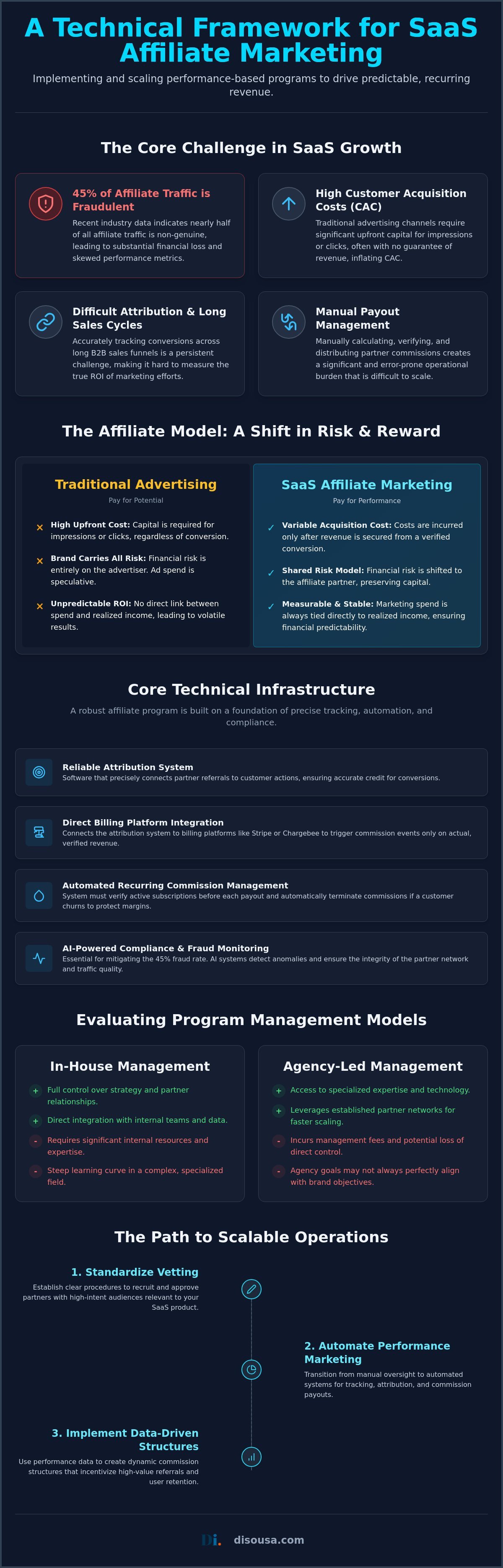
Recent industry data indicates that 45% of affiliate traffic is fraudulent. This results in substantial financial loss for businesses. Many organizations find that traditional advertising channels lead to high customer acquisition costs. It’s often difficult to maintain accurate attribution across a long B2B sales cycle. The manual management of affiliate payouts also creates significant operational overhead.
This article provides a technical analysis of affiliate marketing for SaaS companies. It establishes a functional framework for implementing and scaling performance-based programs to drive recurring revenue. The methodology focuses on the transition from manual oversight to automated systems. These systems are used to track the lifetime value of referred customers with precision.
Operational procedures for partner management are detailed in the following sections. Information is provided on how to develop a predictable lead generation channel. Technical requirements for tracking and payout automation are also addressed. This framework ensures that the affiliate program operates as a stable and measurable component of the digital infrastructure.
Key Takeaways
- Identify how affiliate marketing for SaaS companies functions as a performance-linked channel to reduce customer acquisition costs.
- Determine the technical infrastructure required to manage recurring commission payouts and attribution tracking.
- Analyze the resource requirements for internal versus agency-led program management models.
- Establish standardized vetting procedures to recruit partners with high-intent audiences.
- Scale operations by transitioning to automated performance marketing and data-driven commission structures.
The Functional Role of Affiliate Marketing in the SaaS Growth Lifecycle
SaaS affiliate marketing functions as a performance-linked distribution channel. It relies on third-party partners to generate specific outcomes. These outcomes typically include lead generation or software subscriptions. For a foundational affiliate marketing overview, industry documentation describes the relationship as a commission-based exchange. In this model, the brand pays only when a conversion is verified. This structure is essential for affiliate marketing for SaaS companies that prioritize efficient growth and measurable results.
The transition from traditional customer acquisition cost (CAC) models to variable-cost acquisition is a primary driver for this channel. Traditional advertising requires upfront capital for impressions or clicks. These costs are often high and do not guarantee revenue. Affiliate marketing shifts the financial risk to the partner. The brand incurs costs only after revenue is secured. This approach preserves capital during different stages of the growth lifecycle. It ensures that marketing spend is always tied to realized income.
Affiliate incentives align directly with recurring revenue objectives. Many SaaS programs utilize recurring commission structures to maintain partner engagement. This motivates affiliates to source users with high retention potential. Affiliates also act as technical educators during the software procurement process. Many B2B products involve complex integrations or specific use cases. Partners create documentation, video walkthroughs, and comparison tables to clarify these details. This educational content reduces the burden on internal sales teams and helps prospects move through the funnel independently.
Performance-Based Marketing vs. Traditional Advertising
The distribution of risk is a key differentiator between performance models and traditional ads. Brands do not pay for potential visibility. They pay for realized conversions. This impacts cash flow positively. Capital is not tied up in speculative ad spend. The affiliate channel remains sustainable during market volatility. It scales naturally as the partner network produces results. This model provides a level of financial predictability that is often absent in standard PPC or display campaigns.
Affiliate Marketing for Brands: Strategic Frameworks
Effective affiliate marketing for SaaS companies requires integration into the existing digital infrastructure. Management must define specific protocols for partner onboarding and monitoring. Key performance indicators (KPIs) focus on lead quality and the lifetime value of referrals. These metrics ensure the channel contributes to overall business stability. For a detailed analysis of these methods, refer to the guide on Affiliate Marketing for Brands: A Strategic Framework for Performance Growth. This framework assists in maintaining operational discipline across all partnerships.
Technical Requirements for SaaS Affiliate Tracking and Commissions
Building an internal infrastructure for affiliate marketing for SaaS companies requires a reliable attribution system. This software must connect directly with billing platforms such as Stripe or Chargebee. When a payment event is recorded in the billing system, a corresponding commission event is triggered in the affiliate portal. This synchronization ensures that payouts are based on actual revenue rather than lead generation alone. Organizations should also consider online marketing services to evaluate the efficiency of their current tracking configurations.
Managing recurring commissions adds complexity to the technical stack. The system must verify that a subscription remains active before each payout. If a customer churns, the affiliate commission for that specific account is terminated automatically. This procedure protects the company’s margins and prevents overpayment on non-revenue-generating accounts. Recent data indicates that 45% of affiliate traffic is considered fraudulent. AI-powered compliance monitoring is becoming essential to mitigate this risk and ensure the integrity of the partner network.
Compliance monitoring is a critical operational requirement. The Federal Trade Commission mandates clear disclosures for all affiliate relationships. Regulators focus on transparency to prevent consumer deception. Failure to adhere to FTC disclosure guidelines can result in fines exceeding $50,000 per violation. Automated tools are often utilized to scan affiliate content for these required statements. This process maintains the legal standing of the brand while protecting the interests of the end user.
Commission Structures: Flat Fee vs. Percentage
A first-month-only payout model provides immediate cash-flow stability. This structure pays a one-time flat fee or a high percentage of the initial sale. It is effective for products with low expansion potential. In contrast, the lifetime recurring model offers a percentage of every payment for the duration of the customer lifecycle. This motivates partners to refer high-quality users with long-term retention. Tiered structures are also utilized to reward high-volume partners with increased rates as they reach specific referral milestones.
Attribution Models and Cookie Windows
The choice between first-click and last-click attribution depends on the sales cycle length. First-click attribution rewards the partner who introduced the brand to the customer. Last-click attribution rewards the partner who facilitated the final conversion. B2B SaaS organizations often require longer cookie durations, such as 60 or 90 days, to account for extended decision-making processes. Cross-device tracking is necessary to maintain attribution accuracy as users move between mobile and desktop environments during the purchasing journey.
Evaluating Program Management Models: In-House vs. Agency
Management of affiliate marketing for SaaS companies requires a deliberate choice between internal and external resources. This decision impacts the long-term scalability of the distribution channel. A functional assessment of human capital is necessary to determine the feasibility of an in-house model. Organizations must evaluate if they have the internal bandwidth to handle recruitment and technical oversight. Decisions should be based on logistical reality rather than marketing goals.
The Affiliate Manager serves as the primary point of contact for partners. This role involves vetting applications, monitoring for fraud, and optimizing commission rates. Without a dedicated manager, programs often suffer from low engagement. Manual recruitment of high-intent partners is time-consuming. Performance data must be reviewed regularly to ensure alignment with recurring revenue goals. It’s common for unmanaged programs to experience higher rates of fraudulent traffic.
Scaling an unmanaged in-house program is often difficult. As the number of partners grows, the administrative burden increases. Systems for tracking and payouts require constant maintenance. If internal teams are focused on other marketing channels, the affiliate program may become stagnant. Outsourcing to a specialized firm is a common alternative for organizations seeking rapid growth without increasing headcount. This approach allows the brand to focus on internal milestones while experts manage the external network.
In-House Management Procedures
In-house management allows for direct control over brand messaging. The internal team has immediate access to product updates and roadmap details. This ensures that partners receive accurate information for their promotional content. However, the technical overhead is significant. Teams must manage software configurations and verify recurring payment events manually. For a detailed comparison of operational costs, see A Functional Assessment of Online Marketing Services (2026). This resource outlines the logistical requirements for maintaining internal digital infrastructures.
Agency-Managed Operations
Agency-managed operations provide access to established partner networks. These firms have existing recruitment protocols and standardized reporting systems. They handle the compliance monitoring required by the FTC. This reduces the internal administrative burden on the SaaS organization. Agencies often leverage data from multiple programs to optimize commission structures. This expertise can lead to faster lead generation and improved lifetime value for referrals. The cost-benefit analysis usually favors agencies when the goal is to scale quickly without building an internal department.
Operational Procedures for Affiliate Recruitment and Vetting
The identification of high-intent partners is a primary operational milestone. These partners provide traffic that aligns with the specific technical requirements of the software. Reviewing affiliate applications requires a standardized protocol to ensure quality control. This process prevents the inclusion of low-value traffic sources that don’t contribute to recurring revenue goals. Onboarding protocols involve the distribution of technical assets and tracking links once an application is approved.
Compliance monitoring is used to prevent unethical tactics such as brand-bidding. Brand-bidding occurs when affiliates bid on the company’s trademarked keywords in search engines. This practice increases the company’s own advertising costs and creates internal competition. Automated tools are employed to scan search results for unauthorized ad placements. Communication protocols for onboarding include the delivery of brand guidelines and technical documentation to ensure partner alignment.
For more information on establishing these processes, consult the affiliate marketing easy guide. This resource provides additional context on managing partner relations and optimizing recruitment efforts for affiliate marketing for SaaS companies.
Ideal Partner Profiles for SaaS
Review sites and comparison engines are effective partners in the software niche. These platforms offer technical authority and reach users during the decision-making phase. Industry influencers and content creators provide reach within specific technical communities through specialized content. Complementary SaaS products offer cross-promotion opportunities without direct competition. These partnerships are managed through formal agreements to ensure mutual alignment and shared growth objectives.
The Vetting and Approval Process
Criteria for evaluating traffic quality focus on audience relevance and historical performance data. Audience demographics must match the target user profile for the software. Data privacy compliance is a mandatory legal requirement for all partnerships within the network. Standard Terms of Service documents must be signed before account activation. Procedures for terminating non-compliant partnerships are established to protect the brand’s digital infrastructure. This methodical approach ensures that only verified partners remain active in the network.
Scaling SaaS Affiliate Operations Through Managed Services
Transitioning from manual tracking to automated performance marketing is necessary for long-term scalability. Programmatic systems are utilized to manage large volumes of referral data. These systems reduce the risk of human error in commission calculations. Automated workflows ensure that payouts are processed according to predefined schedules. This level of technical maturity is a requirement for successful affiliate marketing for SaaS companies. It allows the organization to focus on product development while the distribution channel operates independently.
Data-driven insights are leveraged to optimize commission rates. Performance metrics from individual partners are analyzed to identify high-value traffic sources. This data is integrated into broader business intelligence platforms. It provides a clear view of the channel’s contribution to overall monthly recurring revenue. Mapping affiliate IDs to customer records in the CRM allows for the tracking of long-term retention. Lifetime value (LTV) is calculated for each referral source to justify higher commission tiers for partners who deliver high-retention users.
Automated compliance monitoring is also integrated into the system. AI-powered tools scan for fraudulent activities such as cookie stuffing or unauthorized ad placements. This protects the brand’s financial resources and ensures that commissions are paid only for legitimate conversions. It maintains the integrity of the digital infrastructure. Disousa assists organizations in operationalizing these global affiliate strategies. The approach is methodical and focused on internal milestones. Technical readiness is prioritized to ensure a stable and predictable lead generation channel.
Optimization Protocols for Performance Growth
Optimization protocols are used to drive performance growth through systematic testing. A/B testing is conducted on landing pages and creative assets to improve conversion rates. Seasonal promotions are implemented to coincide with market demand cycles. Performance bonuses are utilized to reward partners who exceed specific volume thresholds. Analyzing partner-level ROI allows for the effective allocation of marketing resources. This ensures that the program remains profitable as it scales. Creative assets are updated regularly based on performance data to prevent ad fatigue among the affiliate’s audience.
Next Steps for Program Implementation
The implementation phase requires a structured approach to ensure operational readiness. A technical foundation for tracking and attribution must be established first. This involves integrating the affiliate software with existing billing and CRM systems. A recruitment and outreach plan is then developed based on ideal partner profiles. Organizations can contact Disousa for a functional assessment of online marketing services. This assessment identifies the specific operational requirements and technical configurations needed for the program. Following these steps ensures that the affiliate channel contributes effectively to recurring revenue objectives.
Operationalizing Performance-Based Distribution
The establishment of a functional framework is the final step in securing recurring revenue. This process requires a technical foundation. Standardized management procedures are also necessary. A primary takeaway is the necessity of automated tracking systems for accurate attribution. Implementing these protocols ensures that affiliate marketing for SaaS companies remains a stable lead generation channel. It’s essential to maintain operational discipline as the network expands.
Operational readiness is maintained through continuous monitoring. Global operational coverage is provided to support expanding partner networks. A methodical approach is used to manage these partnerships with precision. Specialized expertise in performance-based marketing is applied to every stage of the growth lifecycle. This ensures that all internal milestones are met with accuracy and transparency.
Organizations are encouraged to Request a Functional Assessment of Your Affiliate Strategy. This assessment utilizes a data-driven approach to partnership management. It identifies logistical requirements for scaling operations effectively. Proper preparation ensures that the distribution infrastructure is ready for long-term growth.
Frequently Asked Questions
How does affiliate marketing differ for SaaS compared to e-commerce?
SaaS affiliate programs prioritize recurring revenue and long-term customer retention over one-time transactions. E-commerce models typically focus on high-volume, single-purchase conversions with short attribution windows. In contrast, affiliate marketing for SaaS companies requires tracking ongoing subscription renewals and managing longer B2B sales cycles. The technical infrastructure must support deep integration with billing systems to ensure accurate payouts over the customer’s lifetime.
What is a typical commission rate for a B2B SaaS affiliate program?
Recurring commissions for SaaS products typically range from 20% to 50% of the monthly subscription fee. Early-stage startups often offer aggressive rates between 25% and 30% to attract initial partners. Mature niches usually provide rates between 10% and 15%. In high-competition sectors such as AI and machine learning, the average commission rate was recorded at 24.5% in late 2025.
Can I track recurring commissions for the lifetime of a customer?
Yes, specialized affiliate software allows for the tracking of recurring payments through direct integration with billing platforms. Systems such as Stripe or Chargebee send payment confirmation signals to the affiliate portal. This enables the automation of commission calculations for the duration of the customer’s active subscription. Some programs limit these payouts to 24 months, while others offer lifetime commissions to incentivize long-term partner engagement.
Which affiliate tracking software is best for SaaS companies?
The selection of software depends on the organization’s budget and technical requirements. Refgrow offers a free plan for single projects, with paid tiers starting at $29 per month. PromoteKit is available starting at $49 per month and includes a lifetime deal option. For enterprise-level needs, Post Affiliate Pro starts at $129 per month. PartnerStack is also a common choice for larger organizations, though it requires custom contract pricing.
How do I prevent affiliate fraud in a software-as-a-service model?
Implementing AI-powered compliance monitoring is the most effective method for preventing affiliate fraud. Industry data indicates that 45% of affiliate traffic is considered fraudulent, which can lead to significant financial loss. Automated tools detect unauthorized tactics such as cookie stuffing and brand-bidding. Standard procedures should also include a manual review of all partner applications to verify the quality and relevance of their traffic sources.
Is it better to join an affiliate network or host an in-house program?
In-house programs offer greater control over technical integrations and data transparency for affiliate marketing for SaaS companies. This model allows for direct relationships with high-authority partners and lower long-term costs. Affiliate networks provide immediate access to a broad pool of partners but often charge additional fees or a percentage of revenue. Most SaaS organizations prefer self-hosted or managed software to maintain better alignment with internal billing systems.
How long does it take to see results from a SaaS affiliate program?
Most programs require three to six months to produce measurable results. This period is used for technical setup, partner recruitment, and content creation by affiliates. It’s common for early traffic to focus on top-of-funnel awareness before converting into paid subscriptions. Once established, the channel typically contributes between 12% and 22% of monthly recurring revenue for successful creator economy tools.
What are the legal requirements for managing an affiliate program in 2026?
The FTC mandates that all affiliates must clearly disclose their material connection to a brand. These disclosures must be conspicuous and placed near the endorsement in all formats, including live streams and short-form videos. Failure to comply with these transparency rules can result in fines exceeding $50,000 per violation. Organizations must include these requirements in their standard Terms of Service and monitor partner content for ongoing compliance.
Disclaimer
**Disclosure:** Some articles on this website may contain affiliate links. This means we may earn a commission if you purchase a product or service through certain links, at no additional cost to you. We only recommend products, tools, and services that we believe provide value to our readers.
**Disclaimer:** The information provided on this website is for educational and informational purposes only and should not be considered financial, legal, tax, or professional advice. While we strive to keep our content accurate and up to date, we make no guarantees regarding completeness, reliability, or results obtained from using the information provided. Always conduct your own research and consult qualified professionals before making business, financial, or investment decisions.
