

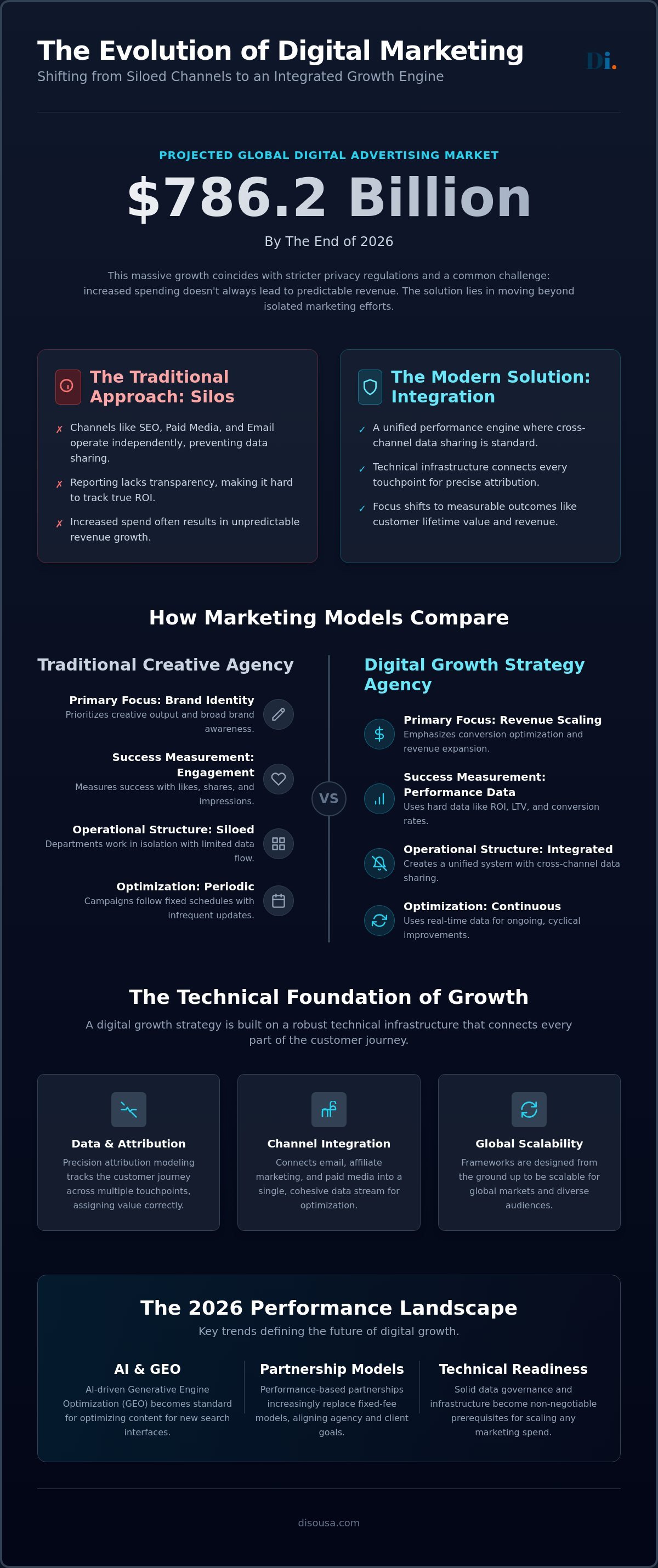
The global digital advertising market is projected to reach $786.2 billion by the end of 2026. This growth occurs alongside stricter privacy regulations across twenty US states. Many organizations find that increased spending doesn’t always result in predictable revenue growth. Marketing channels often operate in silos where data isn’t shared. This lack of integration leads to reporting that lacks transparency. Engaging a digital growth strategy agency can resolve these logistical issues by implementing a unified performance engine.
Scaling performance marketing requires a technical infrastructure that connects every touchpoint. This article provides a methodical assessment of how a digital growth strategy agency builds a functional framework for 2026. The technical requirements for scaling performance-based marketing operations are examined. The text details the integration of affiliate and email systems to facilitate better data sharing. These systems work together to create a measurable increase in customer lifetime value and long-term revenue stability.
Key Takeaways
- The transition from traditional marketing to performance-based growth models is defined by technical and logistical scaling.
- Integrated growth operations utilize cross-channel data sharing to replace siloed marketing structures.
- The combination of proprietary measurement technology and human strategic consulting provides stability for automated systems.
- A digital growth strategy agency is evaluated based on its ability to manage global performance channels and technical infrastructure.
- Functional requirements for scaling include the integration of affiliate marketing and email systems into a single acquisition engine.
Defining the Function of a Digital Growth Strategy Agency
A digital growth strategy agency focuses on the technical and logistical scaling of online revenue. Traditional marketing firms often prioritize creative output or broad brand awareness. In contrast, growth agencies operate through data-driven performance models. Their primary work involves conversion optimization, audience retention, and channel diversification. The shift from traditional digital marketing to growth-focused models is driven by the need for predictable revenue. For a foundational perspective on these concepts, a Digital Marketing Overview describes the core channels that form the basis of these strategies.
In 2026, a digital growth strategy agency is defined as a technical partner that integrates data infrastructure with performance marketing to achieve measurable revenue expansion. This model moves away from siloed activities. It instead creates a unified system where data is shared across all acquisition and retention channels.
To better understand this concept, watch this helpful video:
Key Components of Growth Infrastructure
Growth infrastructure is supported by data acquisition layers and precise attribution modeling. These systems track the customer journey across multiple touchpoints. Technical channel integration is necessary to connect email marketing, affiliate systems, and paid media into a single data stream. These frameworks are built to be scalable for global markets. This logistical approach ensures that marketing spend is optimized based on real-time performance data. You can find more details in a functional assessment of online marketing services 2026 regarding how these systems are maintained.
The 2026 Performance Marketing Landscape
The 2026 landscape is defined by the integration of AI-driven generative engine optimization (GEO). This technical process optimizes content for AI agents and generative search interfaces. Performance-based partnerships are increasingly replacing fixed-fee models. This shift aligns the agency’s incentives with the client’s actual revenue growth. Technical readiness is now a prerequisite for any scaling effort. Organizations must ensure their data governance and infrastructure are prepared before increasing their digital spend. This preparation reduces the risk of unpredictable ROI and ensures that marketing channels don’t operate in isolation. A methodical approach to affiliate marketing for brands serves as a useful example of this integrated performance model.
Traditional vs. Growth-Focused Marketing Models
Traditional marketing models typically organize departments by channel. SEO, paid media, and email marketing are managed as separate silos. This structure prevents the sharing of data between different parts of the customer journey. A digital growth strategy agency replaces this with an integrated operational framework. Information gathered from one channel is used to optimize the performance of another. This cross-channel data sharing has a direct impact on conversion rates. It allows for a more accurate understanding of how specific touchpoints influence the final purchase decision.
Resource allocation also differs significantly between these models. Creative agencies prioritize brand aesthetics and awareness. A growth strategy firm prioritizes performance and technical infrastructure. The focus is placed on activities that generate a measurable return on investment.
| Feature | Creative Agency | Digital Growth Strategy Agency |
|---|---|---|
| Primary Focus | Brand Identity | Revenue Scaling |
| Success Measurement | Engagement Metrics | Performance Data |
| Operational Structure | Siloed Channels | Integrated Operations |
| Optimization Frequency | Periodic Updates | Continuous Cycles |
Operational Differences in Campaign Management
Traditional campaigns often follow fixed-term schedules. These are planned months in advance and have specific end dates. Growth models utilize continuous optimization cycles. Background work is performed constantly to refine targeting and messaging. Budgeting is not fixed at the start of the year. Instead, capital is allocated based on measurable ROI. If a channel demonstrates efficiency, the budget is increased. Technical infrastructure is a prerequisite for this level of agility. Without integrated systems, scaling remains unpredictable.
KPIs that Matter for Growth Scaling
Success is measured through metrics that reflect long-term business health. Customer Acquisition Cost (CAC) is monitored in relation to Lifetime Value (LTV). A healthy ratio ensures that the cost of acquiring a user doesn’t exceed the total revenue they generate. Growth agencies also look for incremental revenue from affiliate partnerships. This involves identifying revenue that wouldn’t have occurred without the specific partnership. Conversion rate optimization (CRO) is implemented as a technical requirement rather than an optional add-on. Organizations can review a functional assessment of online marketing services 2026 to evaluate their current performance benchmarks.
Assessing Agency Models: Technology and Human Intelligence
The operational model of a digital growth strategy agency relies on the integration of proprietary technology and human expertise. Proprietary measurement tools allow for the granular tracking of user behavior in a landscape where third-party cookies are less reliable. These technical systems provide the raw data required for performance scaling. They function as a central repository for cross-channel information. This infrastructure allows for a more comprehensive view of the customer journey. It ensures that every marketing dollar is tracked back to a specific action.
Human strategic consulting functions as a stabilizer for technical automation. Algorithms execute tasks efficiently, but human oversight ensures alignment with long-term business goals. This combination prevents the errors often associated with purely automated systems. Humans interpret complex patterns that AI might misidentify as significant trends. It’s a necessary layer of verification for high-stakes marketing decisions. Organizations should perform A Functional Assessment of Online Marketing Services to determine if their current agency provides this level of scrutiny. This assessment identifies gaps in technical execution and strategic planning.
Data Intelligence and Transparency
Transparency is maintained through real-time dashboarding and multi-touch attribution. The industry is moving away from ‘black box’ reporting where data sources are obscured. Clients now require direct access to raw data streams to verify agency claims. Standard procedures for data verification in 2026 involve cross-referencing platform logs with internal CRM records. This ensures that reporting remains accurate and verifiable. Agencies must also honor universal opt-out signals from browsers to remain compliant with state privacy laws. This technical compliance is a core component of modern reporting protocols. It builds trust through logistical reality rather than marketing narratives.
Consulting vs. Execution
Strategic roadmaps are developed before technical deployment begins. Execution without a clear framework often leads to inefficient resource allocation. Bespoke strategies are necessary because templated solutions fail to account for unique market variables. A digital growth strategy agency manages this complexity by adapting workflows for global digital markets. This approach ensures that technical infrastructure supports specific regional requirements. With the rise of agentic AI platforms like Agentforce Marketing, the role of the consultant has shifted. They now focus on prompting and supervising AI agents rather than manual campaign setup. This shift allows for greater focus on high-level strategy and logistical readiness.
Functional Requirements for Scaling: Affiliate and Email Integration
Establishing a digital growth strategy agency involves the technical alignment of acquisition and retention channels. These channels don’t operate effectively in isolation. A functional framework is required to connect affiliate and email systems to the broader marketing engine. This integration allows for the automated transfer of customer data between platforms. It ensures that the customer journey is tracked from the initial affiliate click to the final email conversion. A digital growth strategy agency provides the technical oversight needed for these complex integrations. Data silos are eliminated through the use of integrated APIs and unified reporting dashboards.
Affiliate marketing is utilized as a scalable acquisition engine. It’s a performance-based model where costs are only incurred upon successful transactions. This reduces the risk of unpredictable ROI from digital spend. The implementation of this channel is detailed in Affiliate Marketing for Brands: A Strategic Framework. It allows brands to leverage external traffic sources without upfront media costs or fixed-fee retainers.
Building a Strategic Affiliate Framework
Partners are recruited based on their ability to reach specific audience segments. Technical tracking is implemented using robust attribution models that account for cross-device behavior. Server-side tracking is prioritized to ensure data accuracy in a privacy-first environment. This prevents the loss of attribution data caused by browser-level tracking preventions. Payout structures are managed through automated systems that calculate commissions based on verified revenue. This logistical approach maintains transparency between the brand and its partners. It also prevents the reporting discrepancies often found in traditional marketing models. Accurate data verification ensures that only valid conversions are compensated.
Email Lifecycle and Lead Nurturing Systems
Email automation is the primary tool for customer retention. Systems are configured to trigger messages based on specific user actions such as sign-ups or purchases. Segmentation strategies ensure that content is delivered to the correct audience based on their previous interactions. For example, customers in different geographic regions receive localized updates and relevant offers. Deliverability standards are monitored to ensure that messages reach the primary inbox rather than being filtered. List hygiene is maintained through automated verification processes that remove inactive or invalid addresses. This ongoing maintenance is a technical requirement for long-term scaling. It ensures that the performance marketing engine remains efficient over time and avoids penalties from service providers. Background processes handle these tasks to maintain the integrity of the communication channel.
Organizations can improve their performance by partnering with a digital growth strategy agency today.
Selecting a Partner for Global Growth Operations
The selection of a digital growth strategy agency requires a methodical assessment of technical and logistical readiness. Organizations must evaluate whether a potential partner can manage the complexities of 2026 digital infrastructure. Worldwide coverage is essential for brands that intend to scale across international borders. This includes the ability to navigate varying regulatory environments, such as the US state privacy laws taking effect in mid-2026. Functional alignment is achieved when agency capabilities are matched to specific business milestones. Disousa provides the technical framework necessary for this alignment. It facilitates measurable growth through the integration of performance marketing systems that prioritize data accuracy and revenue scaling.
A reliable agency acts as a strategic partner rather than a simple service provider. This relationship is built on a foundation of logistical reality and transparent reporting. The focus remains on internal milestones and the delivery of essential status updates. This methodical approach ensures that scaling efforts are supported by a stable infrastructure. Detailed planning precedes any increase in digital spend to avoid unpredictable ROI. It’s a process that values substance and readiness over premature exposure or aggressive self-promotion.
Evaluating Performance History
Case studies are reviewed to determine the level of technical complexity an agency can handle. The assessment prioritizes measurable ROI over creative awards or brand recognition. Expertise in affiliate marketing and email marketing is verified through historical performance data. This verification process involves examining how an agency manages cross-channel data sharing. It’s necessary to confirm that the agency uses proprietary technology to stabilize automated systems. Background work is performed to audit previous campaign structures for efficiency. This ensures that the agency’s execution model is compatible with the client’s existing technical stack.
Implementation and Next Steps
The transition from the initial assessment to full execution follows a standardized onboarding procedure. This process includes the setup of real-time dashboards and attribution models. A methodical communication rhythm is established to ensure all parties are aligned on technical requirements. This static and deliberate pace values accuracy over speed. Onboarding also involves the configuration of AI-agent frameworks to manage ongoing marketing operations. These agents are prompted and supervised by human consultants to maintain strategic focus. A detailed a functional assessment of online marketing services 2026 can be used to guide this transition. This document serves as a roadmap for the integration of performance channels and the deployment of scalable growth engines.
Operationalizing Growth for 2026
Predictable revenue scaling requires a shift from siloed marketing activities to an integrated technical framework. A digital growth strategy agency provides the infrastructure needed to connect data across acquisition and retention channels. This approach ensures that every marketing action is measured against actual revenue outcomes. The integration of proprietary technology and human strategic oversight stabilizes automated systems in complex global markets. It’s a logistical necessity for organizations that value data transparency and operational clarity.
Technical readiness is a prerequisite for scaling in a privacy-first environment. Disousa provides expert affiliate marketing management and performance-based conversion optimization to support these internal milestones. Comprehensive email marketing automation is also implemented to maintain customer lifetime value through data-driven retention. You can request a functional assessment of your digital growth operations at Disousa to identify specific technical requirements. Establishing a methodical framework ensures that your organization is prepared for the logistical realities of 2026. This structured approach facilitates long-term stability and measurable performance outcomes.
Frequently Asked Questions
What does a digital growth strategy agency actually do?
A digital growth strategy agency implements technical frameworks to scale online revenue. It manages the integration of acquisition channels like SEO and affiliate marketing into a unified data system. These agencies focus on conversion optimization and customer retention rather than broad brand awareness. Ongoing background work involves refining data acquisition layers and attribution models to ensure every marketing dollar is tracked. This methodical approach provides a logistical reality for business expansion.
How is a growth agency different from a traditional marketing firm?
A growth agency prioritizes performance data and technical infrastructure over creative aesthetics. Traditional firms often manage channels in silos which prevents cross-channel data sharing. In contrast, a digital growth strategy agency utilizes an integrated operational framework. This allows for continuous optimization cycles based on measurable ROI. The focus is placed on activities that generate a verifiable return on investment rather than engagement metrics.
What are the technical requirements for scaling an affiliate program?
Scaling an affiliate program requires server-side tracking and robust API integrations. These technical requirements prevent the loss of attribution data caused by browser-level privacy preventions. Automated systems are used to manage performance-based payouts and verify revenue in real-time. This infrastructure ensures that only valid conversions are compensated. It also maintains transparency between the brand and its partners through consistent data reporting.
Can a growth strategy agency help with email marketing automation?
Growth strategy agencies configure email lifecycle systems and lead nurturing protocols. These systems use automation to trigger messages based on specific user actions like sign-ups or purchases. Segmentation strategies are applied to deliver relevant content to diverse global audiences. Maintaining list hygiene and deliverability standards is a core technical requirement. This ensures that the communication channel remains efficient and avoids penalties from service providers.
How do I measure the ROI of a digital growth strategy?
ROI is measured by monitoring Customer Acquisition Cost (CAC) in relation to Lifetime Value (LTV). Multi-touch attribution is used to track the customer journey across various platforms. This provides a comprehensive view of how specific touchpoints influence the final purchase. Reporting protocols focus on incremental revenue growth that wouldn’t have occurred without the specific growth interventions. Real-time dashboards provide immediate access to these performance metrics.
Is a performance-based marketing model better for my brand?
A performance-based model aligns the agency’s incentives with the brand’s actual revenue growth. It reduces the risk of unpredictable ROI from digital spend because costs are often tied to successful transactions. This model is useful for brands that require measurable results rather than fixed-fee retainers. It encourages a focus on high-efficiency channels like affiliate marketing. Technical readiness is a prerequisite for this model to ensure accurate tracking.
What role does data intelligence play in digital growth?
Data intelligence functions as the central repository for cross-channel tracking and marketing measurement. It allows for the granular analysis of user behavior in a landscape where third-party cookies are unreliable. This intelligence informs strategic roadmaps and technical deployment. Human strategic consulting uses this data to stabilize automated systems and interpret complex patterns. It’s a necessary layer of verification for high-stakes marketing decisions.
How long does it take to see results from a growth agency?
Results are typically seen in iterative stages after the initial infrastructure is established. Technical onboarding and data integration usually take several weeks to complete. Initial performance benchmarks are established during this period. Measurable gains in conversion rates and revenue scaling occur as optimization cycles are applied. The pace is deliberate to ensure accuracy and readiness before increasing digital spend. Long-term stability is prioritized over immediate, unsustainable spikes.
Disclaimer
**Disclosure:** Some articles on this website may contain affiliate links. This means we may earn a commission if you purchase a product or service through certain links, at no additional cost to you. We only recommend products, tools, and services that we believe provide value to our readers.
**Disclaimer:** The information provided on this website is for educational and informational purposes only and should not be considered financial, legal, tax, or professional advice. While we strive to keep our content accurate and up to date, we make no guarantees regarding completeness, reliability, or results obtained from using the information provided. Always conduct your own research and consult qualified professionals before making business, financial, or investment decisions.

One response to “Digital Growth Strategy Agency: A Functional Framework for 2026”
[…] Organizations that operate without a unified performance engine often find that engaging a digital growth strategy agency resolves the data silos and reporting gaps that emerge at […]