

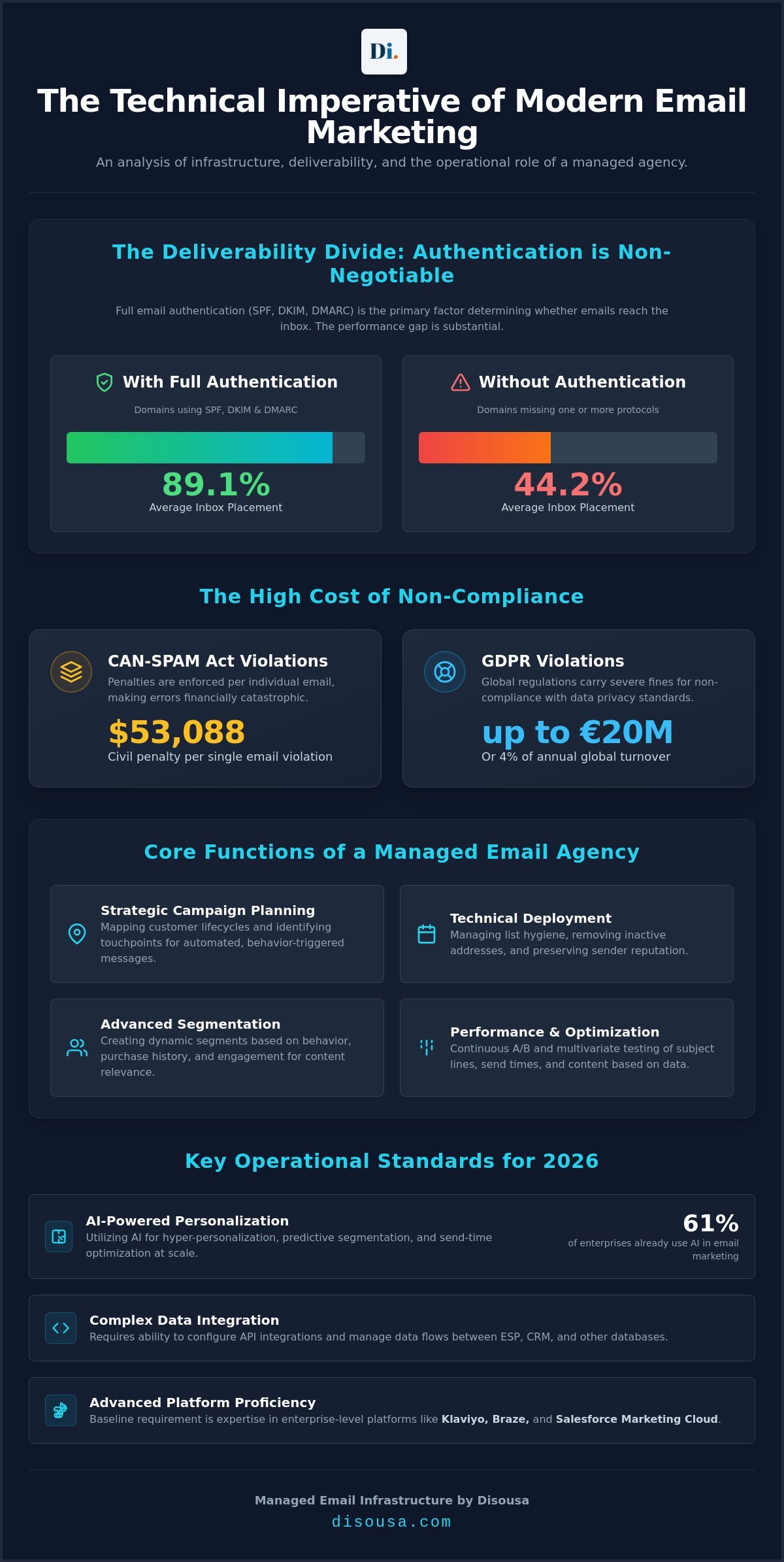
Domains using full SPF, DKIM, and DMARC authentication achieve an average inbox placement rate of 89.1 percent. In contrast, those without these protocols drop to 44.2 percent. Selecting an email marketing agency requires a focus on these technical benchmarks to avoid significant delivery failures. It’s clear that manual campaign management is no longer sufficient for maintaining high deliverability or scaling complex automation. Technical errors lead to substantial financial risk. Individual violations of the CAN-SPAM Act currently result in civil penalties of up to $53,088 per email.
The difficulty of measuring direct ROI from email campaigns is a common operational hurdle as privacy regulations tighten. This guide provides a functional framework for evaluating partners based on their operational infrastructure and their ability to generate measurable conversion growth. We’ll examine technical audit requirements, automation standards for 2026, and specific metrics for tracking direct performance. This information establishes a methodical process for building a scalable customer retention system through professional infrastructure management.
Key Takeaways
- Define the technical requirements for advanced segmentation and data integration to ensure a scalable infrastructure.
- Compare the total cost of ownership between internal resource allocation and the fees of an email marketing agency.
- Utilize a methodical framework for auditing agency technical stacks and platform proficiency.
- Identify the essential operational standards required for managing automated customer retention systems in 2026.
The Operational Role of an Email Marketing Agency in 2026
An email marketing agency functions as an external technical partner responsible for the configuration and execution of digital communication protocols. It’s different from a software provider. Software companies supply the platform infrastructure. A managed service agency provides the personnel required to operate that infrastructure. This distinction is essential for organizations that require advanced automation but lack internal technical staff. The agency acts as the operational layer between the business data and the recipient’s inbox.
Professional management is required for complex automation workflows. These systems rely on precise data triggers and integration with external databases. Current industry standards for 2026 necessitate strict adherence to authentication protocols. Bulk senders must maintain SPF, DKIM, and DMARC records to ensure delivery to Gmail and Yahoo Mail inboxes. High spam complaint rates result in immediate domain suppression. A broader functional assessment of online marketing services shows that technical compliance is now the primary driver of campaign success. Domains without full authentication currently see an average inbox placement rate of only 44.2 percent.
To better understand the operational structure of this business model, watch this helpful video:
Core Functions of Managed Email Services
Strategic campaign planning involves the mapping of customer lifecycles. This process identifies specific touchpoints where automated messages are triggered by user behavior. Technical deployment includes the maintenance of list hygiene. Inactive or invalid addresses are removed to preserve the sender reputation. Advanced segmentation is applied to ensure content relevance for diverse audience groups. Continuous performance monitoring is conducted to track conversion growth. Iterative optimization is applied to subject lines and delivery times based on historical data sets. These functions ensure the infrastructure remains stable and productive.
Why Businesses Outsource Email Operations
Outsourcing provides access to specialized technical talent. This avoids the high overhead costs associated with full-time internal hires. Operational scalability is maintained during peak commercial periods. Resources are adjusted based on campaign volume without long-term personnel commitments. Technical risks are mitigated through professional oversight. This includes compliance with global regulations such as GDPR and the CAN-SPAM Act. Serious violations of GDPR currently result in fines of up to 20 million euros. Each individual email in violation of the CAN-SPAM Act is subject to penalties of up to $53,088. An email marketing agency manages these legal requirements to protect the client from financial penalties. It also ensures the integration of AI tools for hyper-personalization at scale.
Technical Competencies and Infrastructure Requirements
An email marketing agency must demonstrate proficiency in managing complex technical stacks. This involves more than basic template creation. It requires the ability to configure API integrations and manage data flows between the ESP and external CRM systems. Proficiency in platforms like Klaviyo, Braze, or Salesforce Marketing Cloud is a baseline requirement. The agency should provide evidence of successful platform migrations and architectural setups. Reliable agencies maintain a documented process for managing these technical transitions.
Advanced segmentation relies on the processing of first-party data. Agencies must be able to create dynamic segments based on behavioral triggers, purchase history, and engagement levels. Standard protocols for A/B testing should include multivariate analysis. This allows for the simultaneous testing of subject lines, send times, and body copy to determine the most effective combination. Data driven decisions replace guesswork in this operational model. Organizations seeking to improve these technical outcomes should evaluate professional email marketing services that prioritize infrastructure stability.
AI adoption is a fundamental component of modern infrastructure. Research indicates that 61 percent of enterprises currently utilize AI in their email marketing efforts. Agencies use AI for predictive sending to optimize delivery times for individual users. Content optimization tools analyze historical performance to suggest high-converting layouts and language. These tools are used to enhance human expertise rather than replace it. The focus remains on the logistical reality of message delivery and recipient engagement.
Automation and Lifecycle Frameworks
The implementation of behavioral triggers ensures that messages are sent based on specific user actions. These include abandoned cart sequences, post-purchase follow-ups, and re-engagement flows. Integration with CRM and third-party data sources provides a unified view of the customer. Email automation is the programmed deployment of relevant content to existing subscribers to maximize lifetime value and reduce churn. Agencies that manage customer win-back email campaigns as part of their lifecycle frameworks are able to recover lapsed subscribers and increase overall customer lifetime value through automated multi-step sequences.
Deliverability and Compliance Standards
Maintaining high deliverability requires constant monitoring of SPF, DKIM, and DMARC protocols. Since February 2024, Gmail and Yahoo Mail have mandated these authentication standards for bulk senders. Agencies must manage bounce rates and monitor spam complaints to protect the sender reputation. Compliance with GDPR and CAN-SPAM is non-negotiable. Serious GDPR violations can result in fines of up to 4 percent of global annual turnover. Proactive monitoring prevents these financial risks.
Managed Services vs. Internal Platform Management
The total cost of ownership for internal email operations includes several variables. Personnel acquisition costs are high. Recruitment and onboarding require significant administrative resources. Ongoing training is necessary to maintain proficiency in evolving platform technologies. In contrast, an email marketing agency provides an established infrastructure for a predictable fee. This model shifts the financial focus from personnel overhead to operational output. It allows organizations to allocate capital toward strategic initiatives rather than administrative maintenance.
Speed-to-market is a critical metric for commercial success. Internal teams often face bandwidth constraints during high-volume periods. Technical bottlenecks occur when internal staff lack specialized knowledge of complex automation logic. Agencies utilize standardized workflows to deploy new campaigns immediately. They possess pre-configured templates and validated testing protocols. This readiness allows for the rapid execution of seasonal initiatives and reactive market adjustments. The deployment process is managed by dedicated specialists who prioritize accuracy and speed.
Risk management is a primary consideration for in-house operations. Internal systems are vulnerable to staff turnover. The departure of a key technical specialist can halt active automation sequences and disrupt data integrations. Agencies provide institutional stability through redundant staffing models. Technical oversight is maintained by multiple team members to ensure continuity. This professional management minimizes the probability of communication failures. It also protects the organization from the risks associated with domain blacklisting and deliverability errors.
Cost-Efficiency of Outsourced Operations
Outsourcing reduces direct expenditures on software licensing and platform certifications. Managed service providers maintain their own technical stacks and enterprise-level tools. This eliminates the need for businesses to invest in redundant software subscriptions. Recruitment and retention expenses for specialized talent are removed from the balance sheet. There’s a direct link between agency expertise and the consistent achievement of ROI targets. Operational costs remain stable while performance metrics are optimized through professional intervention.
Operational Flexibility and Expertise
Agencies offer access to cross-industry insights and performance benchmarks. They apply data from various sectors to optimize client campaign structures. This allows for the adjustment of strategies based on real-time engagement trends. For businesses seeking a broader strategic framework for performance growth, external partnerships provide the necessary scalability. Operations remain functional regardless of internal resource fluctuations. The ability to pivot strategies based on comprehensive data sets ensures long-term infrastructure health.
Selection Framework: Criteria for Evaluating Agency Performance
The selection of an email marketing agency requires a methodical procurement process. Organizations must move beyond aesthetic preferences to evaluate operational capability. Step one involves the definition of specific business objectives and Key Performance Indicators (KPIs). These metrics provide the baseline for measuring agency success. It’s necessary to align these goals with industry ROI benchmarks. Step two requires an audit of technical capabilities and certifications. This includes verification of platform proficiency and understanding of current delivery protocols. The agency must demonstrate knowledge of the authentication requirements mandated in 2024 to ensure inbox placement.
Step three involves the review of performance based case studies and client references. These documents should provide evidence of previous campaign success. They must include specific data regarding deliverability and conversion rates. Step four evaluates the agency’s communication and reporting frequency. Reports must be presented in a standardized format at regular intervals. They should provide a clear overview of campaign health and technical status. Step five assesses the scalability of the email marketing agency and its proposed service model. The agency must demonstrate the ability to manage increasing volumes and expanded data sets without service degradation. This ensures that the infrastructure remains stable as the business grows.
Key Performance Indicators (KPIs) to Monitor
Conversion rates and revenue per subscriber are the primary indicators of financial performance. These metrics allow for the calculation of direct ROI from email initiatives. List growth and churn rate metrics track the health of the subscriber database over time. Engagement metrics, including open and click through rates, provide data on content relevance. These figures are used to guide iterative optimization efforts. High engagement levels typically correlate with better inbox placement rates.
The Importance of a Functional Assessment
A functional assessment of online marketing services ensures that the agency’s operations align with internal requirements. This process evaluates the cultural and operational fit between the two entities. Transparency in data ownership and reporting is a mandatory requirement. Organizations must retain full access to their subscriber data and campaign history at all times. This prevents vendor lock-in and ensures data security. For organizations seeking to implement these operational standards, email marketing services offer a reliable path to infrastructure stability.
Disousa Email Marketing Solutions: Functional Integration
Disousa provides specialized email marketing solutions focused on campaign strategy and automation. The service model is designed for global brands requiring high performance results. As an email marketing agency, the focus remains on the deployment of measurable growth strategies. This involves the configuration of automated retention frameworks to stabilize customer lifetime value. These frameworks are integrated with broader online marketing efforts to ensure logistical consistency across all digital touchpoints. Global operational coverage allows for the management of diverse audience segments across different time zones and regulatory environments.
The integration of email with affiliate and performance marketing channels is a core competency. This approach allows for the synchronization of messaging across multiple commercial funnels. It ensures that data collected from various sources is utilized to optimize email deployment. Performance is monitored through standardized reporting protocols. This provides transparency regarding conversion rates and infrastructure health. The goal is the creation of a scalable communication system that operates independently of internal resource constraints. Systematic list hygiene and server monitoring are maintained to prevent delivery failures.
Personalized Communication and Lead Nurturing
Developing tailored messaging for specific audience segments is a standard operational requirement. This process uses behavioral data to ensure content relevance for each recipient group. Consistent value delivery is maintained to support customer loyalty and reduce churn. Messaging sequences are programmed to trigger based on specific interactions within the customer journey. This methodology is further detailed in the Affiliate Marketing for Brands: Strategic Framework. These automated systems ensure that lead nurturing remains active and productive without manual intervention. Success is measured by the incremental growth of subscriber engagement over established timeframes.
Next Steps for Operational Engagement
The procedure for initiating a technical consultation involves a comprehensive audit of existing digital infrastructure. This assessment identifies current bottlenecks and deliverability risks. A framework for transitioning existing email lists to managed services is then established. This includes the validation of data integrity and the configuration of new authentication protocols. Establishing a baseline for performance optimization is the final step in the onboarding process. Historical data is used to set realistic KPIs for future campaign cycles. This methodical approach ensures that the email marketing agency can deliver substance and readiness from the start of the engagement. Regular status updates are provided to maintain transparency throughout the transition phase.
Establishing Operational Readiness for 2026
The transition to a professional infrastructure requires a focus on technical benchmarks. Proper authentication and automated lifecycle mapping are necessary for maintaining inbox placement. A methodical selection framework ensures that partners meet these operational standards. Finding an email marketing agency that prioritizes these technical requirements is essential for long-term stability. Organizations must move beyond basic campaign management to implement scalable retention systems. This approach mitigates the risks associated with deliverability failures and regulatory non-compliance. It also provides a clear path for measuring direct ROI from every communication sent.
Disousa provides the necessary infrastructure through global operational capability and technical automation expertise. Our performance-focused strategy is designed to achieve measurable growth across all digital channels. You can consult with Disousa regarding managed email marketing operations to review your current technical status and list health. Establishing these systems now ensures readiness for future commercial requirements and higher conversion rates. The implementation of these frameworks provides the foundation for sustainable digital operations.
Frequently Asked Questions
What is the standard fee structure for an email marketing agency?
Retainers are the most common model for ongoing management. These fees cover strategy, deployment, and technical oversight. Some agencies use project-based pricing for one-time audits or platform migrations. Performance-based models align costs with specific revenue or lead generation targets. This ensures that the agency is incentivized to meet commercial objectives. The structure depends on the complexity of the automation requirements.
How long does it take to see measurable results from a new agency?
Initial performance data is typically available within 30 to 90 days. the first month focuses on technical audits and warming up IP addresses. Subsequent months involve A/B testing and sequence optimization. Long-term stabilization of ROI occurs after full lifecycle frameworks are deployed. Measurable conversion growth is tracked through standardized monthly reports. Patience is required during the initial infrastructure setup phase.
Can an email marketing agency help with deliverability issues?
Technical intervention is the primary method for resolving deliverability issues. An email marketing agency audits the sender reputation and configures authentication protocols. This includes the setup of DMARC and SPF records to meet Gmail and Yahoo requirements. Ongoing monitoring of spam traps and blacklists is conducted to maintain inbox placement. List hygiene procedures are applied to remove invalid data and reduce bounce rates.
What is the difference between a full-service agency and a specialized email firm?
Full-service agencies manage multiple channels such as SEO and social media. Specialized firms focus exclusively on email infrastructure and automation logic. Specialized agencies often possess deeper technical expertise in platform-specific configurations. Full-service providers offer broader integration with other marketing funnels. The choice depends on whether a business requires multi-channel coordination or deep technical specialization in one area.
How does an email marketing agency handle data privacy compliance?
Agencies implement consent-driven data collection and encryption protocols. They ensure adherence to GDPR, CAN-SPAM, and CASL regulations. This involves managing unsubscribe mechanisms and data processing agreements. Professional oversight minimizes the risk of legal penalties for non-compliance. Regular audits are conducted to verify that data storage practices meet global standards. Privacy-first strategies are used to maintain subscriber trust and data security.
Should I choose an agency that specializes in my specific industry?
Industry expertise is beneficial but technical proficiency is more critical. An agency must understand the specific data structures and customer lifecycles of your sector. However, the underlying infrastructure requirements remain consistent across most industries. Functional capability often outweighs niche familiarity. A methodical agency can apply cross-industry benchmarks to optimize your specific campaign performance. Technical readiness is the primary driver of success.
What technical access does an agency require to manage my campaigns?
Agencies require administrative access to the Email Service Provider and the CRM. They also need DNS access to configure domain authentication records. Integration with website analytics is necessary for tracking conversion data and user behavior. Secure access is managed through platform-specific user permissions. This allows the agency to deploy triggers and manage data flows without compromising primary account security. Access is restricted to necessary functions.
How do I measure the ROI of hiring an email marketing company?
ROI is calculated by tracking the direct revenue attributed to email touchpoints. This involves integrating the ESP with ecommerce or CRM data. The calculation must include the cost of the email marketing agency and the platform licensing fees. Measurable conversion growth from automated email marketing campaigns and retention frameworks provides a clear indicator of success. Net profit is determined after all operational expenses are deducted from the attributed revenue.
Disclaimer
**Disclosure:** Some articles on this website may contain affiliate links. This means we may earn a commission if you purchase a product or service through certain links, at no additional cost to you. We only recommend products, tools, and services that we believe provide value to our readers.
**Disclaimer:** The information provided on this website is for educational and informational purposes only and should not be considered financial, legal, tax, or professional advice. While we strive to keep our content accurate and up to date, we make no guarantees regarding completeness, reliability, or results obtained from using the information provided. Always conduct your own research and consult qualified professionals before making business, financial, or investment decisions.
