

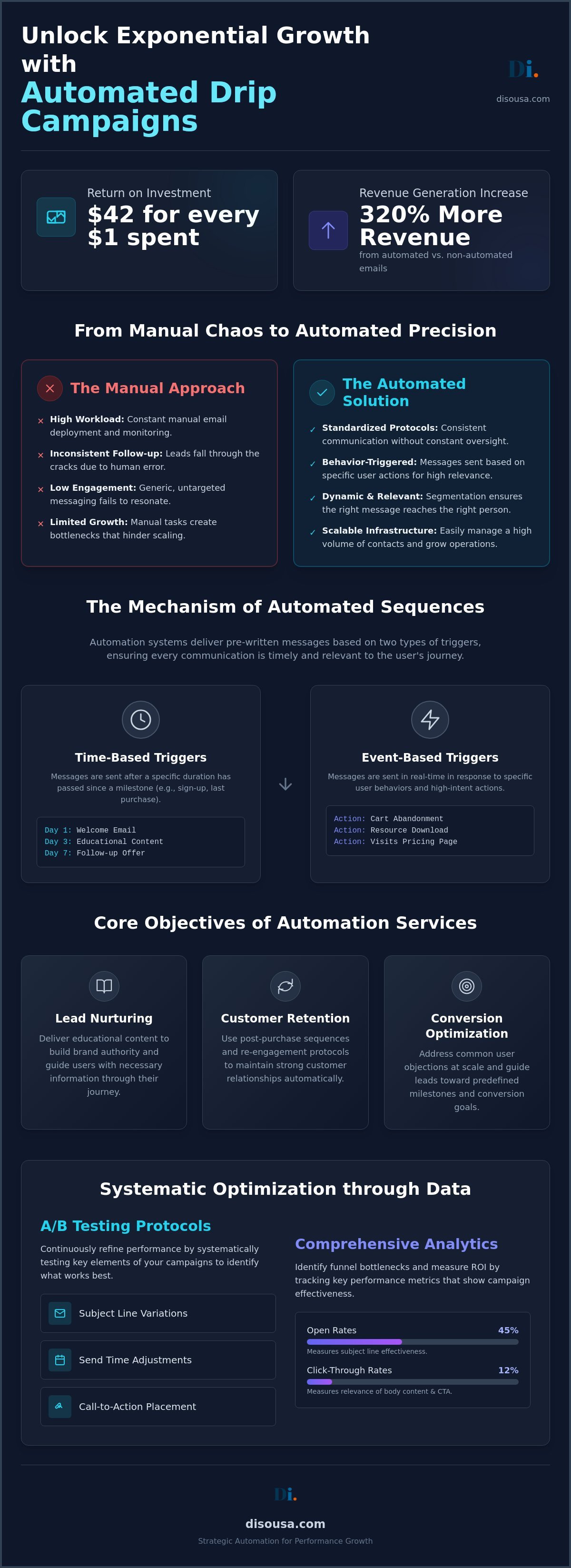
What if your lead nurturing process maintained a return of $42 for every $1 spent while operating entirely in the background? Many organizations find that manual email deployment creates a high workload. This often results in inconsistent follow-up. Utilizing professional drip campaign services allows for the implementation of standardized communication protocols. These systems function without constant oversight. It’s common to experience low engagement when messaging is not specifically triggered by user behavior. Research from 2026 shows that automated emails generate 320% more revenue than non-automated alternatives.
You likely understand that generic messaging and manual tasks limit the growth of your digital infrastructure. This article provides a technical and strategic overview of how managed automation systems optimize performance. We’ll examine the specific requirements for behavioral data integration. The text outlines the operational protocols necessary for a successful automated system. This guide also reviews the logistical reality of managing a high volume of contacts while maintaining compliance with current regulations.
Key Takeaways
- Establish consistent communication protocols through automated message sequences based on specific user actions.
- Implement dynamic segmentation and behavioral trigger mapping to respond to high-intent actions automatically.
- Analyze the resource allocation requirements for in-house automation versus the strategic value of managed drip campaign services.
- Map critical touchpoints in the customer journey to structure effective welcome sequences and lead nurturing frameworks.
- Integrate email automation into standardized procedures to scale digital marketing and affiliate marketing operations.
Defining Drip Campaign Services and Automation Frameworks
Drip campaign services are defined as automated sequences of pre-written messages. These messages are delivered to specific segments based on user actions or predefined time intervals. The primary function of these systems is the maintenance of consistent communication without the requirement for manual intervention. This technology operates within the broader scope of online marketing services. Standard automation frameworks utilize behavioral triggers to ensure that every message remains relevant to the recipient’s current state. For a foundational understanding of the history and etymology of this method, readers may consult What is Drip Marketing? on Wikipedia. This neutral resource provides a clear definition of the concept outside of a marketing context.
The following video provides a functional overview of how these sequences are implemented within a digital strategy:
The Mechanism of Automated Sequences
The operational logic of a professional sequence is divided into time-based and event-based triggers. Time-based triggers initiate a send after a specific duration has passed since a previous milestone. Event-based triggers are more complex and respond to real-time user behaviors such as website interactions or resource downloads. The technical delivery of these messages is supported by an SMTP server and various API integrations. These components work together to ensure that deliverability rates remain high and that data is synchronized across the digital infrastructure. A drip campaign is a functional component of lead lifecycle management that ensures every contact receives standardized information based on their specific journey.
Core Objectives of Automation Services
Lead nurturing is a fundamental objective of drip campaign services. Educational content is delivered to reinforce brand authority and provide the user with necessary information. Customer retention is managed through post-purchase sequences and re-engagement protocols. These sequences are designed to maintain a relationship with the user without additional manual workload. Conversion optimization is achieved by addressing common user objections at scale through targeted messaging. The system focuses on the logistical reality of the customer journey rather than attempting to elicit an emotional response. Every message is a status update that guides the lead toward a predefined milestone within the automation framework.
Technical Components of Email Marketing Automation Services
The technical execution of drip campaign services relies on the integration of multiple data streams. Dynamic segmentation allows the system to categorize users based on real-time interactions. This process ensures that messaging remains relevant to current user states. Behavioral trigger mapping identifies high-intent actions. These actions include cart abandonment or the repeated download of technical resources. Trigger mapping involves the identification of specific URLs that indicate high intent. When a user visits a pricing page multiple times, the system initiates a targeted follow-up sequence.
Systematic optimization is achieved through A/B testing protocols. These protocols involve the following elements:
- Subject line variations are tested to improve open rates.
- Send times are adjusted based on historical engagement patterns.
- Call-to-action placement is evaluated for click-through efficiency.
Bottlenecks within the funnel are identified via comprehensive analytics tracking. Open rates indicate the effectiveness of subject lines, while click-through rates measure the relevance of the body content. This logistical reality allows for measurable ROI. Professionals following email engagement best practices focus on these metrics to refine their strategy.
Data Integration and CRM Syncing
Bi-directional data flow is necessary for maintaining accuracy across platforms. Information must move between the email service and the central CRM database without lag. Managed drip campaign services utilize these syncing protocols to maintain list integrity. This synchronization supports list hygiene by removing inactive profiles automatically. It’s common for list hygiene to involve the verification of email addresses and the suppression of hard bounces. Technical compliance with GDPR and CCPA is managed through these automated workflows. For those focused on scaling, affiliate marketing for brands often requires this level of data precision.
Advanced Personalization Protocols
Personalization extends beyond basic tags. Dynamic content blocks are used to display information based on specific user interests. Conditional logic allows the sequence to branch into different paths. This ensures that a user receives information tailored to their previous behavior. Dynamic segmentation contributes to the fact that automated emails generate 320% more revenue than non-automated emails. This efficiency is a result of precise targeting. Organizations looking to build a compliant and high-performing contact base can reference the 2026 email list growth strategy checklist for advanced email list segmentation strategies that move beyond basic demographics. Organizations can learn more about online marketing services to see how these components fit into a larger strategy.
Evaluating Managed Drip Services vs. Software-Only Solutions
Organizations must choose between purchasing software or contracting managed drip campaign services. Software subscriptions provide access to infrastructure but require internal personnel for execution. Managing these systems in-house necessitates significant resource allocation. This includes hiring or training staff for campaign architecture, copywriting, and technical troubleshooting. A software-only approach assumes the organization possesses the expertise to build an effective email marketing strategy. Without this expertise, the software remains an underutilized tool. Professional services ensure that the technology is applied strategically to meet specific goals.
Managed drip campaign services offer ongoing optimization that static software cannot provide. Agencies allocate specialized staff to manage sequences, ensuring that behavioral triggers remain accurate. This reduces the manual workload for the client’s internal marketing team. The cost-benefit assessment favors managed services when the expense of hiring multiple specialists exceeds the service retainer. For example, an in-house team might require a part-time developer and a dedicated content strategist. Professional services consolidate these roles into a single operational cost. This allows for a focus on logistical reality rather than administrative overhead.
The Managed Service Advantage
Managed services provide access to automation architects and professional copywriters. These individuals focus on creating sequences that align with specific business goals rather than generic templates. Reporting is standardized to focus on business outcomes. This includes measurable ROI on email engagement and conversion attribution. Vanity metrics like total sends are deprioritized. Ongoing technical support is included to handle complex API integrations or CRM syncing issues. This ensures that the system remains functional as the organization’s digital infrastructure evolves. If you’re looking to expand your digital footprint, learning how to make money online through these automated systems is a logical next step.
Criteria for Selecting a Service Provider
Selecting a provider requires an assessment of their experience in performance-based growth. Technical proficiency with major automation platforms is a primary requirement. A provider should demonstrate an understanding of how to integrate email with other channels. This involves knowing how to promote your content online through a multi-channel approach. Evaluation should focus on the provider’s internal milestones and their ability to maintain standardized communication protocols. Reliability and substance are more important than promotional claims. A methodical professional will prioritize accuracy and readiness. Providers should be judged on their ability to deliver essential status updates and maintain calm transparency throughout the process.
Strategic Implementation of Automated Lead Nurturing
Strategic implementation begins with a comprehensive map of the customer journey. This map identifies critical touchpoints where automation is most effective for lead nurturing. Using drip campaign services allows for the deployment of these sequences at scale without increasing manual workload. Each touchpoint represents a specific user state or digital interaction. The primary goal is to move the user to the next logical stage of the lead lifecycle through standardized communication. It’s common to analyze historical data to see where users typically disengage. Automation is then placed at these specific points to maintain momentum.
A welcome sequence is the first automated interaction after a user joins a list. This sequence establishes brand authority and sets expectations for future communication. Initial messages are focused on delivering promised resources to establish a baseline for reliability. Consistency is maintained through a series of scheduled updates. These updates are delivered according to a fixed timeline. It’s a methodical process that ensures every new lead receives the same foundational information.
Educational drips provide value before a direct sale is attempted. These sequences use objective data to inform the reader about specific industry topics. For example, a sequence might utilize an affiliate marketing easy guide to provide foundational knowledge. This builds trust through substance rather than marketing claims. The focus remains on the logistical reality of the subject matter. These emails are designed to be informative and functional.
Re-engagement sequences target dormant segments of the email list. These segments consist of users who haven’t interacted with recent sends. The protocol involves a final series of messages to determine if the user remains interested in the service. If no interaction occurs, the profile is removed to maintain list hygiene and protect deliverability rates. This removal process is automated to ensure accuracy. It’s a necessary step for maintaining the health of the digital infrastructure.
Sequence Architecture and Flow Design
Optimal frequency and timing for sends are determined by historical engagement data. Automated sends shouldn’t overwhelm the recipient. Every sequence requires a logical exit point to ensure the system remains efficient. This prevents the delivery of redundant messages to users who’ve already converted. A logical exit protocol is a technical instruction that terminates a specific workflow once a conversion trigger is detected by the CRM. These protocols are essential for maintaining a professional image. Exit points are mapped during the initial flow design phase.
Content Standards for Drip Sequences
Maintaining a consistent professional tone across all automated messages is mandatory. Direct and functional language improves readability and encourages action. It ensures the core message is delivered without unnecessary ornamentation or stylistic flourishes. Using utilitarian vocabulary helps the reader focus on the logistical reality of the information provided. Standardized communication protocols ensure that every message reflects the brand’s methodical approach. Organizations can improve their lead management by utilizing professional online marketing services.
Disousa Protocols for Email Marketing and Performance Growth
The integration of drip campaign services into a broader affiliate marketing for brands strategy is a standardized procedure. This alignment ensures that performance marketing objectives are supported by automated communication. Scaling digital marketing operations requires the implementation of these specific protocols. The focus remains on the delivery of essential status updates to relevant stakeholders. This methodical approach prioritizes accuracy and logistical reality. It’s a reserved process that values substance and readiness. The system is designed to function as a quiet entity focused on internal milestones.
Standardized procedures are followed to ensure the stability of the digital infrastructure. Performance-based optimization is achieved through the continuous monitoring of automated workflows. Every component of the system is evaluated for functional efficiency. Data is used to inform logistical decisions rather than to build a narrative. The register is low and favors a matter-of-fact delivery of information. This creates a universal accessibility for general business operations. The communication rhythm remains static and deliberate throughout the implementation phase.
Email Automation in Performance Marketing
Drip campaigns are utilized for the recruitment and management of affiliate partners. Automated sequences provide partners with necessary technical documentation and operational guidelines. This reduces the manual workload associated with partner onboarding. ROI is tracked through automated reporting systems that connect email engagement to conversion data. These systems provide a direct view of logistical reality. Strategic alignment between email sequences and online growth objectives is maintained through periodic technical audits. These audits ensure that the system functions within established performance parameters. The focus is on measurable results rather than vanity metrics.
Operational Readiness and Preparation
Setting up technical foundations for clients involves a methodical process. Functional status updates are provided during the campaign rollout phase to ensure transparency. This commitment to professional standards is maintained across all digital channels. The organization focuses on internal milestones to ensure readiness before active engagement. Privacy and exclusivity are preserved by providing only the most necessary information. This reliable approach values substance over premature exposure. The global digital infrastructure is supported through these standardized and scalable workflows. Every step in the process is documented to ensure structural clarity. The result is a methodical and patient pace that prioritizes accuracy over speed.
Optimizing Digital Infrastructure Through Automation
The transition from manual outreach to standardized communication protocols is essential for operational efficiency. Dynamic segmentation and behavioral trigger mapping serve as the primary mechanisms for maintaining message relevance. These technical components ensure that every sequence is delivered based on specific user interactions. Utilizing professional drip campaign services provides the strategic oversight necessary for complex lead lifecycle management. This methodical approach reduces the internal resource allocation required for ongoing campaign maintenance. It allows teams to focus on internal milestones and logistical reality.
Measurable performance optimization is achieved through the continuous monitoring of these automated workflows. A professional automation strategy supports the objective of scaling digital operations across multiple channels. Expertise in global digital growth is applied to ensure that all infrastructure remains compliant and functional. You’re encouraged to Explore Disousa Email Marketing Solutions for comprehensive support in your marketing initiatives. These procedures establish a reliable foundation for transparent and effective communication. These systems provide a functional framework for sustained operational success.
Frequently Asked Questions
What is the primary difference between a newsletter and a drip campaign?
The primary difference is the delivery trigger and the target audience. Newsletters are broadcast-style messages sent to an entire list at a specific date and time. Drip campaigns are automated sequences delivered to individuals based on behavioral triggers or time intervals. This ensures that communication remains relevant to the recipient’s current stage in the customer journey. It’s a methodical approach to maintaining consistent contact through standardized protocols.
How many emails should be included in a standard lead nurturing sequence?
A standard lead nurturing sequence typically consists of four to seven emails. The specific number is determined by the length of the sales cycle and the complexity of the product. Initial messages focus on educational content to establish authority. Later messages transition to functional updates and conversion prompts. This deliberate pace prevents the recipient from being overwhelmed. The sequence is designed to move the lead to the next logical stage.
Can drip campaign services integrate with my existing CRM platform?
Integration with existing CRM platforms is a standard component of professional drip campaign services. Bi-directional data flow is established via API or native connectors to maintain profile accuracy. This synchronization allows behavioral triggers to be mapped directly to CRM data points for real-time response. It ensures that the digital infrastructure remains unified. Technical support is typically provided to manage these complex integrations and ensure ongoing functionality without manual intervention.
Is it possible to automate personalized content for different audience segments?
Personalizing content for different segments is managed through dynamic content blocks and conditional logic. These technical protocols allow the system to display specific information based on user interests or historical engagement. Sequences are branched into different paths to ensure message relevance. This automation removes the need for manual segmentation. It’s a functional way to address specific user states at scale. Content is tailored to meet the logistical reality of each segment.
What technical metrics are most important for evaluating drip campaign success?
Success is measured through technical metrics including open rates, click-through rates, and conversion attribution. Bounce rates and unsubscribe rates are also monitored to maintain list hygiene. These indicators provide a matter-of-fact view of how the automated system is performing. Data is analyzed to identify bottlenecks in the lead lifecycle. Standardized reporting focuses on these business outcomes rather than vanity metrics. It’s a methodical way to ensure measurable ROI on email engagement.
How do professional drip services handle data privacy and compliance?
Data privacy is handled through standardized compliance protocols. Professional services automate the verification of opt-ins and the immediate processing of unsubscribe requests. Systems are configured to align with global regulations such as GDPR and CCPA. This includes maintaining secure data storage and clear processing records. Transparency is prioritized to build trust with the recipient. These protocols ensure that the organization remains legally ready and compliant with all current data requirements for digital infrastructure.
What is the typical timeframe for implementing a new automated sequence?
The typical timeframe for implementing a new automated sequence ranges from two to four weeks. This period is used for journey mapping, technical trigger configuration, and content development. API integrations and CRM syncing are also finalized during this time. A methodical testing phase is conducted to ensure all behavioral triggers function correctly. This patient pace ensures accuracy and readiness before the sequence is launched. It’s a structured process focused on achieving technical stability.
Should I use a managed service or manage my drip campaigns in-house?
The choice depends on internal resource allocation and technical expertise. Managed drip campaign services provide access to automation architects and professional copywriters. This option reduces the manual workload for internal teams. In-house management requires the organization to hire or train staff for campaign architecture and technical troubleshooting. Managed services often provide a more methodical approach to ongoing optimization. This ensures that the system values substance and readiness over time.
Disclaimer
**Disclosure:** Some articles on this website may contain affiliate links. This means we may earn a commission if you purchase a product or service through certain links, at no additional cost to you. We only recommend products, tools, and services that we believe provide value to our readers.
**Disclaimer:** The information provided on this website is for educational and informational purposes only and should not be considered financial, legal, tax, or professional advice. While we strive to keep our content accurate and up to date, we make no guarantees regarding completeness, reliability, or results obtained from using the information provided. Always conduct your own research and consult qualified professionals before making business, financial, or investment decisions.
