
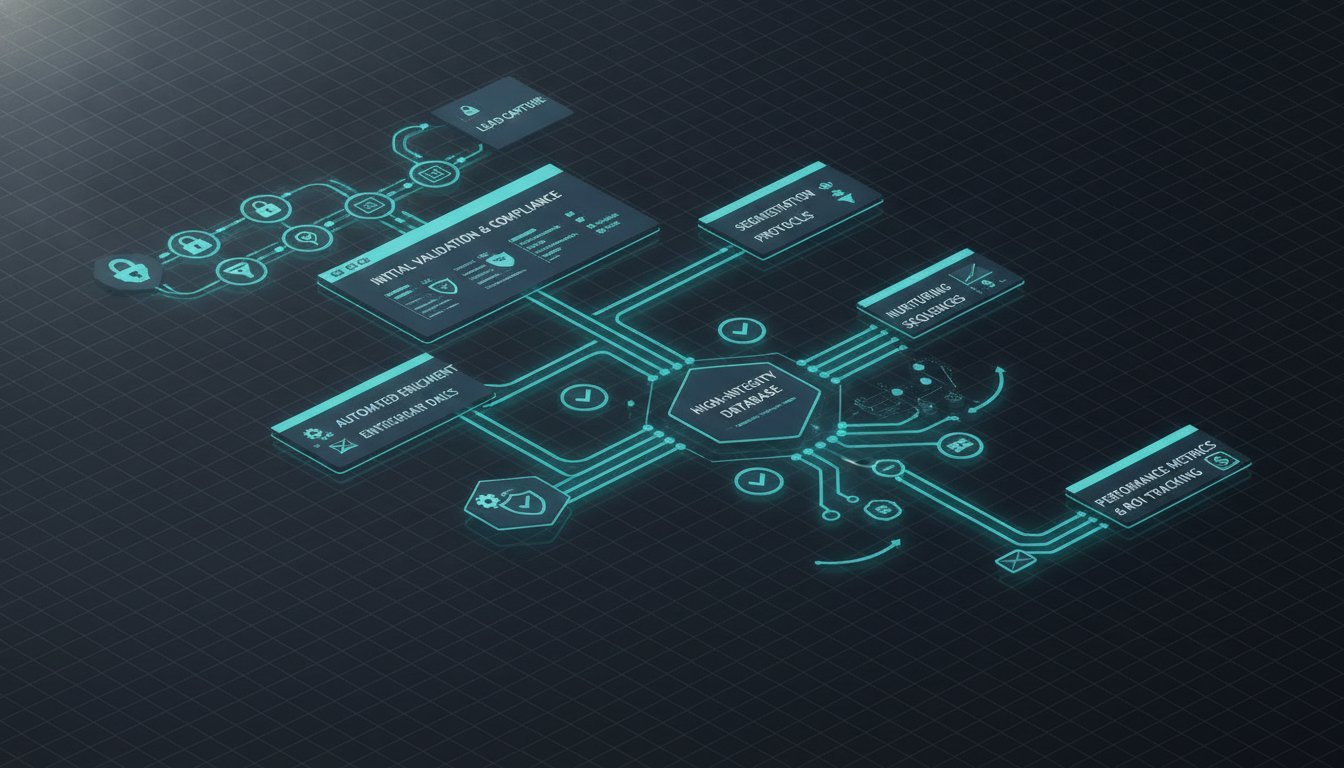
With CAN-SPAM penalties reaching $43,792 per individual email in 2026, a single list hygiene error is no longer just a marketing mistake; it’s a significant financial liability. You’ve likely noticed that traditional lead magnets are losing their edge, and conversion rates on standard signup forms are dropping as B2B buyers become more protective of their data. We agree that building a list is harder than it used to be, especially when you’re trying to balance rapid growth with the complexity of GDPR compliance and shifting deliverability standards.
This briefing provides a comprehensive, blueprint-style checklist to build a high-integrity email list that drives measurable performance. I’ll show you how to implement advanced email list segmentation strategies that move beyond basic demographics to focus on intent and behavioral data. We’ll walk through the technical requirements for inbox placement, the transition to zero-party data collection, and the specific steps needed to transform a stagnant database into a segmented engine for automated nurturing. This is the tactical framework you need to ensure your email operations remain both compliant and profitable.
Key Takeaways
- Secure your sender reputation by authenticating SPF, DKIM, and DMARC protocols to meet 2026 deliverability standards and avoid costly compliance penalties.
- Replace generic ebooks with high-utility tools like ROI calculators and technical audit templates to attract high-intent B2B leads who value immediate utility.
- Implement advanced email list segmentation strategies at the point of entry using hidden fields and source tagging to personalize the nurture lifecycle from day one.
- Protect your inbox placement by deploying automated sunset policies that remove unengaged contacts before they negatively impact your sender metrics.
- Audit your website for high-friction capture points and transition to “smart” forms that improve conversion rates while maintaining data integrity.
Technical Infrastructure and Compliance Protocols (The Setup Checklist)
Before you worry about copy or creative, you must stabilize your infrastructure. High-volume B2B senders often overlook the DNS records that govern their inbox placement. Without proper authentication, your emails will end up in spam folders, regardless of how much you spend on lead generation. I recommend starting with your technical records to ensure SPF, DKIM, and DMARC are fully authenticated. This isn’t just about security; it’s about protecting your financial investment in every lead you acquire.
Foundational deliverability is the silent partner of a sophisticated Marketing Automation Overview. Your email list segmentation strategies won’t yield measurable ROI if your IP reputation is compromised by poor setup. To better understand how technical setup impacts your broader strategy, watch this helpful video:
Authentication and Deliverability Records
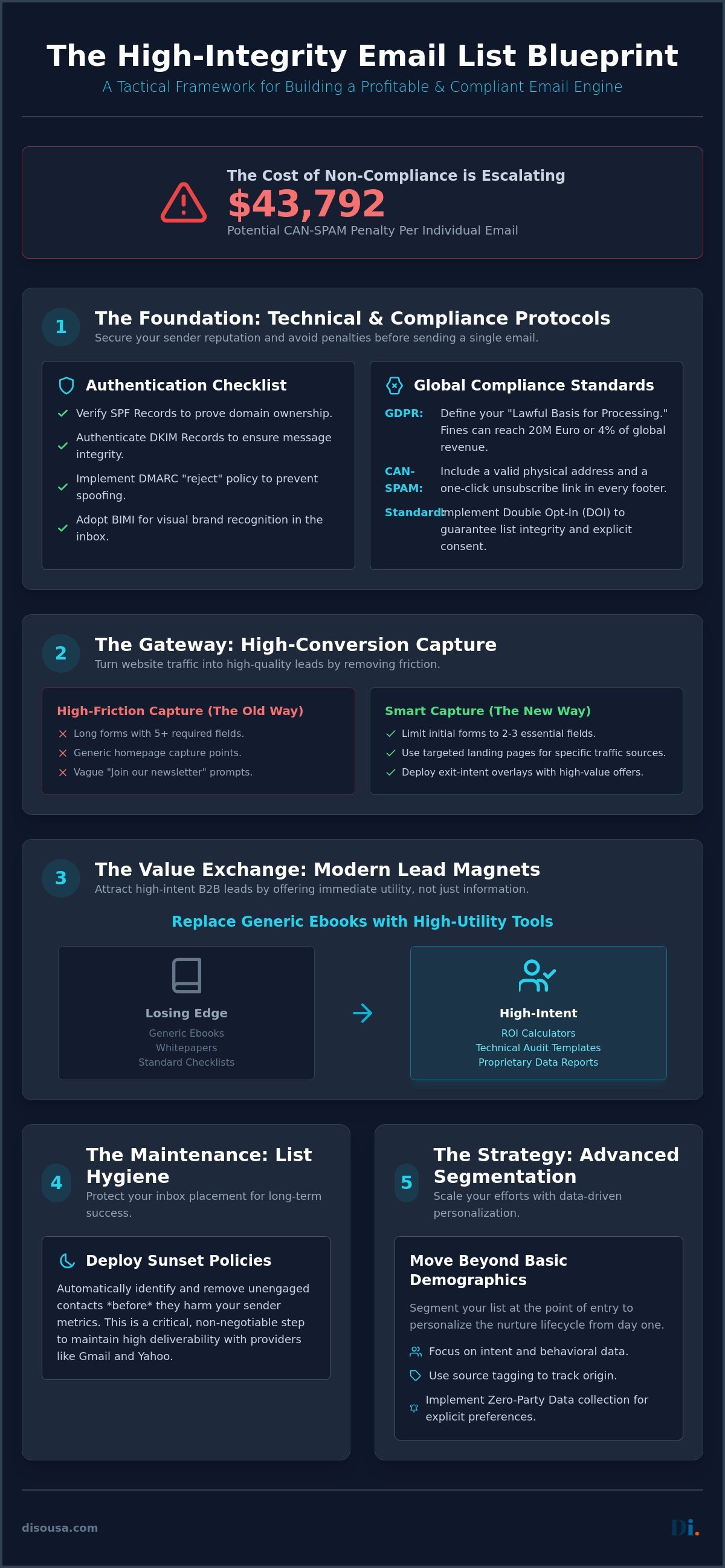
Verify your SPF and DKIM records within your DNS settings to prove you own your sending domain. In 2026, a DMARC “reject” policy is the standard for preventing spoofing and maintaining sender trust. Currently, approximately 35% of domains have a DMARC policy of “reject,” while 25% use “quarantine.” These technical layers provide the data reliability necessary for advanced email list segmentation strategies to function correctly. If you’re a high-volume sender, Brand Indicators for Message Identification (BIMI) is no longer optional. It provides the visual brand recognition needed to maintain high open rates in crowded B2B inboxes.
Global Compliance Standards (GDPR/CAN-SPAM)
Compliance is now a primary deliverability signal for mailbox providers like Gmail and Yahoo. You must implement a Double Opt-In (DOI) process to guarantee list integrity and legal compliance. This ensures every subscriber is a real person who intentionally signed up. Your email footers must include a valid physical address and a transparent, one-click unsubscribe mechanism. As of January 2026, CAN-SPAM violations carry penalties of up to $43,792 per individual email. For international operations, you must define your “Lawful Basis for Processing” under GDPR, where fines can reach 20 million Euro or 4% of global revenue. For a deeper dive into these requirements, see our Functional Assessment of Online Marketing Services. Establish a clear privacy policy now to avoid expensive mistakes later.
High-Conversion Capture Mechanisms and Channel Optimization
Growth is a conversion math problem. If your signup forms require twelve fields of data before a user understands your value, you’re losing leads to friction. I recommend auditing your website for high-friction capture points and moving toward “smart” forms that utilize data enrichment to auto-fill known information. Every capture point must be legally sound; referencing the CAN-SPAM Compliance Guide from the FTC is the best way to ensure your forms meet standard requirements for transparency and consent.
You should also deploy targeted landing pages for specific traffic sources to maintain a tight message match. If a user clicks a link about B2B operations, they shouldn’t land on a generic homepage. Use exit-intent overlays that offer actual value, such as a proprietary data report or a tactical blueprint, rather than a generic “Join our newsletter” prompt. We find it effective to integrate these capture points directly into your content promotion strategy to turn casual readers into long-term subscribers.
On-Site Conversion Optimization
To maximize on-site growth, your forms must prioritize the user experience. I suggest following this checklist for high-performing lead capture:
- Limit initial forms to 2-3 essential fields (e.g., business email and job role).
- Use a clear, action-oriented CTA like “Get the Blueprint” instead of “Submit.”
- Implement “Progressive Profiling” to collect additional data over subsequent visits.
Progressive profiling allows you to build the deep data sets required for high-performance email list segmentation strategies without overwhelming the user during their first interaction. You should also place “In-line” capture forms within your high-performing blog posts. These forms should appear when the reader is most engaged, typically after a key insight or halfway through the technical content.
Multi-Channel Acquisition Strategies
Don’t limit your growth to your website. LinkedIn Lead Gen forms are highly effective for direct B2B list growth because they auto-populate with professional data, reducing the effort for the user. You can also explore affiliate marketing for brands to reach new audiences through trusted third-party partners. This approach helps you scale by leveraging established communities that already align with your target profile. For physical events or direct mail, use QR codes to bridge the offline-to-online gap, sending users directly to a mobile-optimized capture page. If you’re looking to scale your reach through strategic marketing partnerships, focusing on these multi-channel capture points is the first step toward a high-integrity list.
Lead Magnet and Incentive Strategy (The Value Checklist)
High-value B2B growth depends on a fair exchange of information. You’re asking for access to a professional inbox; you must offer something that saves time, reduces risk, or provides a competitive edge. The “Value Exchange” is the core of your growth strategy. If your lead magnet doesn’t provide a tangible shortcut or solve a specific pain point, the lead won’t convert, or worse, they’ll provide a “burner” email address that ruins your data integrity. We need to move beyond generic ebooks and focus on tactical blueprints, checklists, and proprietary data that offer immediate utility.
B2B Asset Development
I recommend using a “Problem-Solution” framework for naming and developing your assets. Instead of a vague title like “2026 Marketing Trends,” use “The 2026 B2B Deliverability Benchmark: How to Beat the 2.3% Industry Bounce Rate.” This identifies a specific problem and promises an immediate solution. To drive high-integrity growth, focus on these three magnet types:
- Industry Benchmarks: Proprietary data that helps leads compare their performance against peers.
- Technical SOPs: Standard operating procedures or implementation checklists that simplify complex tasks.
- Exclusive Webinar Access: Deep-dive sessions that address high-level strategic shifts.
Tool-based magnets, such as ROI calculators or technical audit templates, are especially powerful for 2026. These assets allow you to naturally implement email list segmentation strategies based on the data the user inputs. For instance, a lead using a “GDPR Fine Risk Calculator” can be tagged as a high-priority compliance lead, whereas someone downloading a “Content Calendar Template” is likely in an earlier awareness stage.
Gating vs. Un-gating Strategy
You don’t need to gate every piece of content. In fact, over-gating can stifle your reach and damage trust. Use the “Pillar-Support” model: keep your high-level strategic pillars un-gated to maximize SEO and build authority. Gate the deep-dive technical “how-to” assets that provide the actual implementation steps. If you’re conducting a functional assessment of your marketing services, start by auditing your existing white papers and blog posts to see which can be converted into gated tools.
Before you put a form in front of an asset, ensure it is “worthy” by checking these three criteria:
- Does the asset solve a specific professional problem in under 10 minutes?
- Is the information unique and unavailable through a basic search engine query?
- Does it provide a template, tool, or data set that the reader can apply to their operations today?
By focusing on high-utility incentives, you ensure that your email list segmentation strategies are built on a foundation of high-intent, high-quality subscribers who actually want to hear from you.
List Hygiene and Deliverability Standards (The Maintenance Checklist)
List hygiene is not an administrative chore; it is a defensive growth strategy. If you allow unengaged or “dead” addresses to sit on your list, you’re actively damaging your sender reputation. This leads to lower inbox placement even for your most active leads. As of March 2026, major platforms like ActiveCampaign and Mailchimp have updated their policies to bill for unsubscribed, bounced, and unconfirmed contacts. Cleaning your list is now a direct cost-saving measure as much as it is a deliverability requirement.
Your email list segmentation strategies are only as effective as the data they process. When your list is cluttered with role-based addresses like info@ or support@, your engagement metrics become skewed. I recommend using verification tools to scrub these “disposable” contacts every quarter. Monitoring your complaint rate and hard bounce metrics provides the primary health indicators you need to scale without triggering spam filters.
Automated Scrubbing Protocols
You must implement automated “Sunset Policies” to maintain list integrity. I define a sunset policy as a protocol that automatically removes or archives subscribers after 90 days of total inactivity. While some buyers have long decision cycles, keeping inactive contacts for over six months risks hitting “spam traps.” You should also distinguish between a soft bounce, which is usually a temporary server issue, and a hard bounce, which indicates a permanent delivery failure. Hard bounces must be moved to a suppression list immediately to prevent repeated delivery attempts that signal poor list management to ISPs. For context, the real estate industry currently sees the highest average bounce rate at 2.3%, a benchmark you should aim to stay well below.
Re-engagement and Win-back Campaigns
Before purging inactive leads, run a final re-engagement sequence. This 3-step framework works well: first, send a “We’ve missed you” value-add; second, a “Is this still relevant?” query; and third, a final “We’re removing you” notification. If they don’t engage, let them go. Removing these leads improves your total click rates and ensures your content reaches the people who actually want it. You can find technical setup details for these automated workflows in this Drip Campaign Services reference guide. If you need a tactical partner to audit your current deliverability protocols, you can optimize your email marketing operations to ensure long-term growth and compliance.
Strategic Segmentation and Data Enrichment (The Scaling Checklist)
Segmentation is not a task you perform after building a list; it is a requirement you implement at the point of entry. If you treat every subscriber the same, your engagement metrics will eventually plateau. I recommend using hidden fields in your signup forms to automatically tag leads by their source, such as LinkedIn or organic search. This allows you to track which acquisition channels produce the highest quality leads over time. By capturing this data early, you can ensure your email list segmentation strategies are built on hard evidence rather than assumptions.
Zero-party data is information that users proactively and intentionally share with you. In a 2026 environment where privacy restrictions are standard, this is your most reliable data source. Use simple, one-question surveys during the signup process to identify a lead’s primary challenge. This immediate insight allows you to personalize the first 30 days of their journey, moving them from a generic lead to a qualified prospect based on their specific operational needs. Once that initial segmentation is in place, your next priority is building lead nurturing email campaigns that move these prospects through the funnel with contextual, lifecycle-driven messaging.
Foundational Segment Categories
To scale effectively, you must categorize your B2B leads into four essential segments. These segments help you map your content to the buyer journey stages of awareness, consideration, and decision. Use these categories as your baseline:
- Industry or Niche: Tailor your technical examples to their specific sector.
- Job Role: Focus on the specific KPIs and pain points relevant to their seniority.
- Company Size: Distinguish between the logistical needs of SMEs and enterprise operations.
- Awareness Level: Identify if they are looking for basic education or technical implementation details.
You should also use behavioral triggers to refine these segments. If a lead clicks a link regarding affiliate marketing for brands, they should be automatically tagged as interested in performance growth. Syncing this data with your CRM ensures that any offline interactions, like sales calls or event attendance, are reflected in your automated email workflows.
Data Enrichment for Personalized Growth
Missing data points can stall your automation. I suggest using third-party enrichment tools to fill in company details like annual revenue or tech stack without increasing form friction. In B2B, contextual personalization is far more effective than name-only personalization. Showing a lead that you understand their industry’s current regulatory hurdles or technical standards builds much more trust than simply inserting their first name into a subject line.
Your welcome sequence should adapt based on the initial segment data you’ve collected. Follow this checklist to ensure your sequence drives performance:
- Deliver the promised lead magnet in the first 60 seconds.
- Set clear expectations for future communication frequency.
- Provide a secondary “soft” conversion point, like a link to a related technical briefing.
- Include a direct feedback loop, such as a “Reply to this email” prompt.
If you are ready to move beyond basic list growth and want to build a high-performance engine, you can conduct a functional assessment of your marketing services to identify exactly where your segmentation is failing. High-integrity growth is a result of precise data, not just volume.
Operationalizing Your B2B Growth Framework
Scaling a B2B email list in 2026 requires more than just high-volume traffic. It demands a technical foundation that respects mailbox provider standards and a value exchange that respects the subscriber’s time. We’ve covered why your technical records must be authenticated and how high-utility tools like ROI calculators drive better engagement than generic content. By integrating advanced email list segmentation strategies from the first touchpoint, you build a database that’s ready for automated nurturing rather than a static list of names.
Maintaining list integrity through automated sunset policies and regular scrubbing isn’t just about hygiene; it’s about protecting your sender reputation and your budget. You now have the tactical blueprint to bridge the gap between simple list building and performance-based growth. If you’re ready to move from manual campaigns to a scalable engine, I can help you identify the specific friction points in your current setup.
Request a tactical audit of your email marketing operations to leverage our global digital growth expertise and performance-driven email marketing strategies. We focus on direct, outcome-focused consulting that turns your technical infrastructure into a measurable asset. Let’s get your operations ready for the next phase of growth.
Frequently Asked Questions
How do I grow my email list without buying leads?
You grow your list organically by deploying high-value capture points across your existing digital assets. This includes gating technical SOPs or industry benchmarks rather than generic newsletters. Buying leads often results in high bounce rates and legal risks; we prioritize converting existing traffic through content promotion and strategic partnerships. Focus on turning your current readers into subscribers by offering a specific solution to their operational problems.
What is the best lead magnet for a B2B audience?
The most effective B2B lead magnets are those that solve an immediate operational problem, such as an ROI calculator or a technical audit template. These assets provide immediate utility and allow you to implement email list segmentation strategies based on the data users input. Generic ebooks have lost their value; you should focus on tools that save the user time or provide proprietary data they can’t find elsewhere.
How often should I clean my email list to maintain deliverability?
You should implement automated scrubbing protocols that remove inactive subscribers every 90 days. Waiting for a manual semi-annual clean is often too late to protect your sender reputation. With the 2026 billing changes in major platforms, removing unengaged contacts also prevents unnecessary costs for non-subscribed or bounced addresses. Regular maintenance ensures your metrics reflect actual engagement rather than dead data.
Is double opt-in required for GDPR compliance in 2026?
While the GDPR doesn’t explicitly name “Double Opt-In” as a requirement, it’s the most reliable way to prove “freely given, specific, informed, and unambiguous” consent. It prevents spam traps and ensures your list consists of high-intent subscribers. In 2026, it’s considered an operational standard for both compliance and deliverability. It protects your business from the significant fines associated with unauthorized data processing.
What is a good conversion rate for a B2B email signup form?
A healthy B2B conversion rate for a standard on-site signup form typically sits between 2% and 5%. However, targeted landing pages for specific lead magnets often see rates of 10% to 20% or higher. If your rate is below 2%, you likely have high friction in your form fields or a poor message match with your traffic source. I recommend auditing your capture points for friction regularly.
How can I use LinkedIn to grow my email list?
Use LinkedIn Lead Gen forms to capture professional data directly within the platform without forcing a user to visit your site. This reduces friction because the form auto-fills with their verified profile information. You can then sync this data with your CRM to trigger personalized nurture sequences based on their job role. It’s an efficient way to scale list growth while maintaining high data integrity.
What technical records do I need to set up for a new email list?
You must authenticate your domain using SPF, DKIM, and DMARC records to ensure your emails reach the inbox. I also recommend setting up BIMI to display your logo in the recipient’s inbox for better brand recognition. These records act as a digital passport, proving to mailbox providers that you’re a legitimate sender. Without these records, your deliverability will suffer regardless of your content quality.
How do I segment a small email list effectively?
Segment a small list by focusing on Job Role and Awareness Level first. You don’t need thousands of contacts to benefit from email list segmentation strategies; even two or three distinct buckets allow for more relevant messaging. Use simple survey questions at signup to categorize new leads immediately. This ensures your welcome sequence remains contextual and prevents the “one-size-fits-all” approach that kills engagement.
Disclaimer
**Disclosure:** Some articles on this website may contain affiliate links. This means we may earn a commission if you purchase a product or service through certain links, at no additional cost to you. We only recommend products, tools, and services that we believe provide value to our readers.
**Disclaimer:** The information provided on this website is for educational and informational purposes only and should not be considered financial, legal, tax, or professional advice. While we strive to keep our content accurate and up to date, we make no guarantees regarding completeness, reliability, or results obtained from using the information provided. Always conduct your own research and consult qualified professionals before making business, financial, or investment decisions.
