

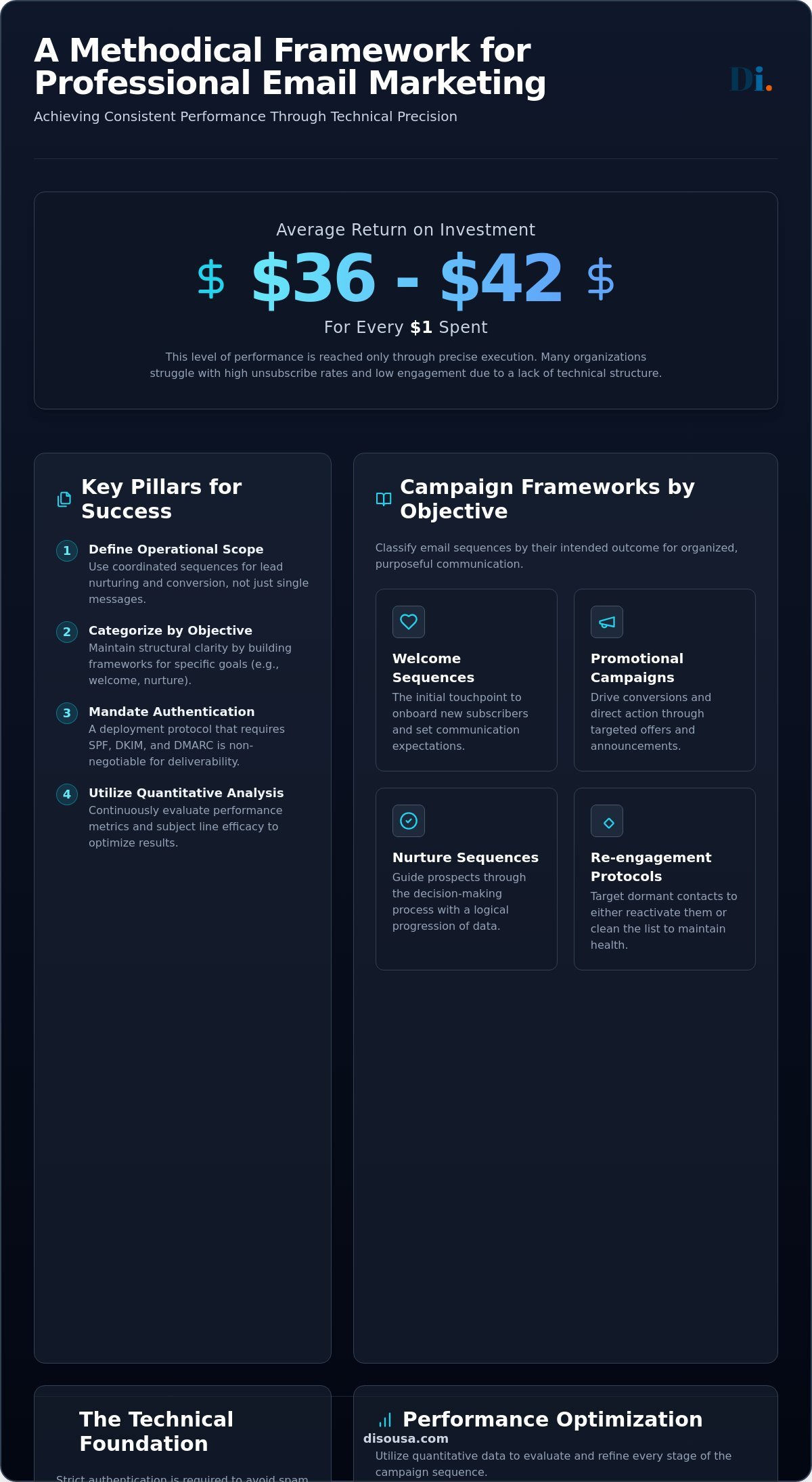
The average return on investment for email marketing remains between $36 and $42 for every dollar spent as of April 2026. This level of performance is reached only through the execution of precise email marketing campaigns. Many organizations experience high unsubscribe rates and low engagement due to a lack of technical structure. The complexity of modern automation and strict authentication requirements often lead to inconsistent results across different segments. It’s recognized that the technical demands of DMARC and SPF compliance add layers of difficulty to standard operations.
Maintaining professional standards in digital communication requires significant logistical oversight and a focus on measurable data. This article provides a methodical framework for the design, deployment, and optimization of professional email sequences. The following sections outline the standard procedures for improving conversion metrics and automating routine engagement tasks. A repeatable system for achieving consistent performance is established through these guidelines. The focus remains on logistical reality and the technical precision required for modern infrastructure. This framework ensures that sequences are both compliant and effective.
Key Takeaways
- Define the operational scope of email marketing campaigns as coordinated sequences for lead nurturing and conversion.
- Categorize campaign frameworks by objective to maintain structural clarity in digital operations.
- Follow a deployment protocol that mandates the setup of SPF, DKIM, and DMARC infrastructure.
- Utilize quantitative analysis to evaluate performance metrics and subject line efficacy.
- Evaluate the transition to professional management for the optimization of technical reliability.
Defining the Operational Scope of Email Marketing Campaigns
Professional email marketing is defined as a coordinated sequence of digital communications delivered to a specific audience. These sequences are structured to move recipients toward a defined business objective. Unlike singular messages, email marketing campaigns rely on a series of interactions that build upon previous data points. The process is methodical and requires a focus on logistical reality rather than creative experimentation. Accuracy in these sequences ensures that the delivery of information remains consistent across all segments.
These campaigns function as a core component of broader online marketing services. The framework prioritizes three primary functional goals: lead nurturing, customer retention, and conversion optimization. It’s necessary to distinguish these sequences from transactional emails. Transactional messages are triggered by specific user actions like password resets or order confirmations. Professional email marketing campaigns are strategically planned sequences designed for engagement and performance. They are scheduled based on internal milestones and audience behavioral triggers.
To better understand this concept, watch this helpful video:
The Role of Email in the Customer Lifecycle
The transition from lead acquisition to active engagement requires a reliable communication channel. Email serves this purpose by providing a direct link that’s independent of third-party social algorithms. It allows for a stationary presence in a subscriber’s inbox. This presence ensures that information is available when the recipient is ready to process it. The lifecycle management process involves moving a user from initial awareness to a state of routine interaction. This is achieved through the systematic delivery of relevant data. The focus is on the process rather than the individuals involved.
Functional Benefits of Coordinated Sequences
Coordinated sequences offer several logistical advantages for professional operations. They allow for the nurturing of leads through a logical progression of information. This process avoids aggressive promotional tactics by focusing on value and relevance. Every interaction within the sequence produces measurable data points. These points include open rates and click-through metrics that allow for performance assessment. The use of automation ensures that these sequences are delivered with technical precision and structural clarity.
- Lead Nurturing: This process guides prospects through the decision-making process using structured information.
- Brand Visibility: A consistent presence is maintained without the need for excessive frequency or flashiness.
- Performance Data: Verifiable statistics are generated for each stage of the campaign sequence to measure efficacy.
- Technical Reliability: Automated frameworks reduce the risk of manual errors during the deployment of communications.
Categorisation of Campaign Frameworks by Functional Objective
Standard operations require the classification of email sequences based on their intended outcome. These frameworks allow for the organized delivery of information. The use of specific email marketing campaigns ensures that each communication serves a distinct purpose within the digital infrastructure. Several standard campaign types are utilized in professional operations:
- Welcome Sequences: These act as the initial technical touchpoint for new subscribers.
- Promotional Campaigns: These sequences drive performance through targeted announcements.
- Nurture Sequences: These provide a logical progression of data over time.
- Re-engagement Protocols: These target dormant contacts to maintain list health.
The welcome sequence is used as the entry point for new subscribers. It is deployed following a successful opt-in event. A communication frequency is established through this sequence. The receipt of requested data is also confirmed. Necessary information is provided to the recipient without stylistic ornamentation.
Promotional campaigns are operated as performance drivers. These consist of stationary announcements about internal milestones or service availability. Compliance with CAN-SPAM Act compliance standards is mandatory for these communications. A valid physical address and a functional unsubscribe mechanism are included in every message to ensure delivery reliability.
Re-engagement protocols are applied to inactive subscribers. Inactivity is typically defined as a six-month period without user engagement. A direct inquiry is sent to verify the subscriber’s status. Inactive contacts are removed from the list if no response is received. This process preserves the integrity of the sender reputation. Organizations seeking a structured approach to recovering lapsed customers can reference the operational blueprint outlined in customer win-back email campaigns for detailed segmentation logic and multi-step sequence design.
Automated Nurture Sequences
Drip campaigns are implemented to provide a consistent flow of information. These sequences are pre-configured to send messages at specific intervals. Trigger-based emails respond to user actions such as link clicks or file downloads. This logic ensures that the communication is relevant to the recipient’s current status. For instance, affiliate marketing for brands utilizes nurture sequences to deliver technical specifications to new partners.
Retention and Loyalty Frameworks
Retention frameworks are designed to reduce subscriber churn. Newsletter updates provide curated information on a static monthly or weekly schedule. Post-purchase sequences deliver logistical support and usage instructions following a transaction. Exclusive updates are used to maintain engagement with high-value segments. Methodical management of these frameworks is required for operational stability. Organizations often utilize professional email marketing campaigns to ensure these sequences are executed with technical precision. Further details on these systems are available through email marketing support resources.
A Step-by-Step Protocol for Campaign Deployment
The deployment of email marketing campaigns requires a static and deliberate sequence of technical actions. A methodical protocol ensures that all communications meet current delivery standards. The process begins with the verification of digital infrastructure. Readiness is prioritized over speed during the preparation phase.
Requirement 1 involves the implementation of SPF, DKIM, and DMARC protocols. As of early 2024, mailbox providers require these authentication methods for bulk senders exceeding 5,000 emails per day. Failure to maintain these records leads to the rejection of communications by major providers. These settings are configured within the DNS records of the sending domain to establish a verified identity.
Requirement 2 focuses on audience segmentation. Verified data points are used to categorize the subscriber list. This step ensures that information is delivered only to relevant segments. Requirement 3 addresses content development. Structural clarity is prioritized over stylistic ornamentation. Requirement 4 involves the deployment and monitoring of delivery metrics. Post-deployment monitoring tracks the success of the transmission of email marketing campaigns.
Audience Segmentation and Data Integrity
Subscribers are categorized by behavioral data and demographic markers. This classification allows for the precise delivery of campaign sequences. List hygiene procedures are executed to remove invalid or inactive addresses. Under CASL regulations, implied consent from a purchase expires after two years. Removing these addresses prevents technical penalties and protects sender reputation. Opt-out requests are processed within 10 business days to maintain CAN-SPAM compliance. CCPA regulations require a response to opt-out requests within 15 business days. Segmentation has a direct impact on open rates. Targeted segments typically show higher engagement levels than generic lists. Data integrity is maintained through regular audits of the subscriber database.
Technical Execution and Deliverability
Inbox placement is influenced by several technical factors. Spam filters evaluate the reputation of the sending domain and the presence of authentication records. The use of dedicated IP addresses is recommended for high-volume operations. This separation prevents the activities of other senders from affecting delivery rates. SMTP servers are configured to handle the specific volume requirements of the organization. A testing procedure is executed before the final deployment. Communications are reviewed across multiple email clients and mobile devices. 64% of emails are opened on mobile devices as of March 2026. This testing ensures that the structural clarity of the message is preserved across all hardware configurations. Accurate testing reduces the risk of rejection by intelligent inboxes.
Quantitative Analysis and Performance Optimization Standards
The evaluation of email marketing campaigns is conducted through the monitoring of specific performance indicators. These metrics provide a logistical view of audience engagement and technical efficacy. Open rates are utilized to measure the initial reception of a communication. Research from Digital Applied in April 2026 indicates an average open rate of 21.33%. This metric is primarily influenced by the accuracy of the sender identity and the relevance of the subject line. Data shows that AI-generated subject lines outperform human-written versions by 26%. This suggests a shift toward automated optimization in standard operations.
Click-through rates (CTR) serve as a metric for content relevance and structural clarity. The average CTR for professional sequences is 2.62% according to April 2026 data. Low CTR values often indicate a disconnect between the subject line promise and the body content. Performance is also measured through unsubscribe rates and bounce frequencies. High bounce rates suggest a failure in list hygiene protocols previously discussed in this framework. Monitoring these data points allows for the maintenance of a healthy sender reputation and ensures continued inbox placement.
A/B Testing Methodology
A single variable is isolated during the A/B testing process to ensure data validity. This variable is typically the subject line, the primary call-to-action, or the delivery time. Two versions of the communication are sent to distinct segments of the audience. A sufficient sample size is required to achieve statistical significance before the winning version is deployed to the remaining list. This methodical approach removes guesswork from the optimization process. The results are recorded and utilized for the refinement of future email marketing campaigns. It’s a standard procedure for maintaining performance levels.
Conversion Tracking and ROI Assessment
Onsite actions are linked to specific email clicks using standardized tracking parameters. This allows for the direct attribution of revenue to individual campaign sequences. The return on investment (ROI) is calculated by comparing total revenue against the logistical costs of the operation. Digital Applied research from April 2026 confirms an average ROI of $36 to $42 for every $1 spent on email operations. This high return is maintained through the long-term management of subscriber lists. Organizations often require technical assistance to maximize these conversion metrics. Professional management of these systems is available through email marketing solutions.
Integrating Professional Management into Email Operations
The transition from internal management to managed email marketing services is a standard progression for scaling organizations. It’s common for internal teams to reach a capacity limit regarding complex technical maintenance. Managed operations provide the technical depth required to handle professional email marketing campaigns. This allows for the continuous monitoring of deliverability standards. The adjustment of authentication protocols is managed by external experts to ensure operational stability. Professional management is a requirement for organizations that prioritize logistical reality over manual execution.
Resource allocation is improved when technical operations are outsourced. Internal focus is shifted toward core internal milestones rather than the management of SMTP servers or DNS records. Professional agencies provide the logistical oversight needed for global scale. This includes the management of dedicated IP addresses and the execution of high-volume transmission protocols. It’s a methodical approach to maintaining performance without increasing internal overhead. Organizations benefit from the specialized knowledge of experts who focus solely on digital infrastructure.
Compliance with global data regulations is a primary function of professional management. Fines for GDPR violations can reach €20 million or 4% of worldwide turnover, whichever is higher. FTC penalties for CAN-SPAM violations are currently $53,088 per individual email as of the January 2025 adjustment. Professional management ensures that all email marketing campaigns meet these legal standards across all jurisdictions. Explicit consent is verified through provable audit trails. Opt-out requests are processed within the mandated 10 business days to avoid technical penalties and protect the sender reputation.
Criteria for Selecting an Email Marketing Agency
A functional assessment of technical capabilities is required during the selection process. Structural requirements include expertise in DMARC implementation and behavioral segmentation. Alignment between email and brand strategy is essential for maintaining a stationary presence in the subscriber’s inbox. Several criteria are used for evaluation:
- Technical proficiency in automation frameworks and API integrations.
- Proven ability to manage global compliance requirements across different regions.
- Focus on measurable conversion optimization rather than stylistic ornamentation.
- Transparent reporting protocols for delivery and engagement metrics.
Detailed evaluation frameworks are provided in the Email Marketing Agency Selection guide. This guide assists businesses in identifying providers that value substance and readiness.
The Disousa Approach to Email Performance
The focus is placed on measurable results and conversion optimization. Email sequences are integrated with performance-based frameworks like affiliate marketing for brands. This creates a unified customer journey across multiple channels. Organizations seeking operational readiness can begin with a technical audit of their current sequences. Professional management provides the necessary infrastructure for sustained digital growth. A methodical transition to managed services ensures that sequences are optimized for long-term subscriber value and technical reliability.
Establishing Operational Readiness in Digital Communication
Operational stability in 2026 is dependent on the technical precision of email marketing campaigns. Success is achieved through the implementation of verified authentication protocols and the use of behavioral segmentation. These standards ensure that delivery metrics remain consistent across global regions. The use of quantitative analysis allows for the continuous refinement of content relevance. Organizations maintain a competitive advantage by prioritizing logistical reality over manual experimentation. A methodical approach to digital growth is established through specialized conversion optimization strategies.
Professional oversight provides the necessary infrastructure for global performance-based frameworks. This level of management ensures that all communications meet current regulatory requirements. Businesses can transition toward a more reliable engagement model by evaluating their current technical setup. Request a Functional Assessment of Your Email Operations to ensure your systems are prepared for scaling. This process identifies specific opportunities for structural improvement. It’s recognized that adherence to these technical standards leads to sustainable results in digital marketing.
Frequently Asked Questions
What are the primary components of email marketing campaigns?
The primary components include a verified subscriber list, a structured sequence of communications, and a technical delivery infrastructure. Each element is managed through a methodical framework to ensure operational readiness. The list is maintained via hygiene protocols to remove inactive addresses. Messages are designed for structural clarity. The infrastructure relies on verified authentication records to ensure consistent inbox placement.
How many emails should be included in a standard nurture sequence?
Standard nurture sequences typically consist of three to five emails delivered over a specific timeframe. This volume allows for the logical progression of information without excessive frequency. The initial message establishes the primary technical touchpoint for the subscriber. Subsequent communications provide data relevant to specific user actions. The focus remains on providing necessary information rather than building a narrative.
What is the industry standard for a successful email open rate in 2026?
The average open rate for email marketing campaigns is 21.33% according to April 2026 research. This data point serves as a benchmark for measuring initial audience engagement across different sectors. Performance levels are influenced by subject line efficacy and sender reputation. Marketers also track click-through rates, which average 2.62% in professional operations. These metrics provide a logistical view of campaign success.
How does email segmentation improve campaign performance?
Email segmentation improves performance by delivering specific information to categorized audience subsets. Subscribers are classified by behavioral data or demographic markers to ensure relevance. This process prevents the delivery of generic content that often leads to high unsubscribe rates. Targeted segments show higher engagement levels because the information matches the recipient’s current status. It’s a standard procedure for conversion optimization.
What technical protocols are required for high email deliverability?
High deliverability requires the implementation of SPF, DKIM, and DMARC authentication protocols. These records verify the sender identity within the domain DNS settings. Failure to maintain these standards leads to the rejection of communications by major mailbox providers. Bulk senders exceeding 5,000 emails per day must adhere to these requirements. These protocols are non-negotiable for maintaining professional sender reputation.
Is it more effective to manage email marketing in-house or through an agency?
The effectiveness of management depends on the technical complexity and scale of the operation. Internal teams often handle routine status updates while agencies manage global compliance and advanced automation frameworks. Professional management is typically required for scaling digital growth. Agencies provide specialized knowledge in conversion optimization and technical reliability that may not be available internally. This choice impacts long-term resource allocation.
How can automation be used to scale email marketing operations?
Automation scales operations by triggering email marketing campaigns based on specific user behaviors. These triggers include link clicks, file downloads, or purchase events recorded in the database. Manual execution is replaced by pre-configured sequences that maintain a consistent communication rhythm. This framework allows for the management of large subscriber lists with technical precision. It reduces the risk of manual errors during deployment.
What are the most common mistakes in email marketing campaign execution?
Common mistakes include the neglect of list hygiene and the failure to implement mandatory authentication protocols. Sending generic content to unsegmented lists results in low engagement and high unsubscribe rates. Another frequent error is the lack of mobile optimization. 64% of emails are opened on mobile devices as of March 2026. Structural errors in the message body often lead to technical rejection by intelligent inboxes.
Disclaimer
**Disclosure:** Some articles on this website may contain affiliate links. This means we may earn a commission if you purchase a product or service through certain links, at no additional cost to you. We only recommend products, tools, and services that we believe provide value to our readers.
**Disclaimer:** The information provided on this website is for educational and informational purposes only and should not be considered financial, legal, tax, or professional advice. While we strive to keep our content accurate and up to date, we make no guarantees regarding completeness, reliability, or results obtained from using the information provided. Always conduct your own research and consult qualified professionals before making business, financial, or investment decisions.
