

Did you know that the average conversion rate for customer win-back email campaigns is currently 2.73%? While that might sound modest, it represents a high-margin recovery of revenue that you have already paid for through your initial acquisition spend. You’re likely seeing your customer acquisition costs climb while a significant portion of your list remains inactive. It’s often unclear whether a customer is simply between purchase cycles or if they’ve churned entirely.
We understand the frustration of managing list decay and the uncertainty of when to stop sending. This briefing provides an operational blueprint for identifying lapsed customers and executing the multi-step sequences required to bring them back. We’ll examine the technical triggers for 2026, the specific segmentation logic used by high-performance teams, and how to automate a system that consistently increases your customer lifetime value without manual oversight.
Key Takeaways
- Calculate your Mean Time Between Purchases (MTBP) to define inactivity based on your specific product lifecycle rather than using arbitrary timeframes.
- Execute customer win-back email campaigns as a high-ROI logistical filter to separate recoverable revenue from list deadweight.
- Segment your audience to prioritize High-Value Lapsed (HVL) customers and prevent margin erosion from habitual discount seekers.
- Implement a tactical 3-step sequence that transitions from soft value reinforcement to direct, high-impact incentives.
- Measure success through empirical data like reactivation rates and incremental revenue instead of relying on unreliable open rate metrics.
The Economics of Customer Win-Back Email Campaigns
Customer win-back email campaigns are a series of automated messages triggered when a user stops engaging with your brand. The primary goal is to reactivate dormant revenue by re-establishing a connection with individuals who have already demonstrated intent. Instead of pouring more budget into the top of your funnel, you’re extracting value from the assets you’ve already acquired. Every list has a natural decay rate, but ignoring that decay is a choice that leaves money on the table.
Win-back efforts serve as a critical component of email marketing for customer retention. Successful campaigns focus on ‘at-risk’ segments before they reach the point of permanent churn. By the time a customer has ignored your communications for a year, the cost to bring them back spikes. Success lies in catching them during the transition from active to lapsed.
Retention vs. Acquisition ROI
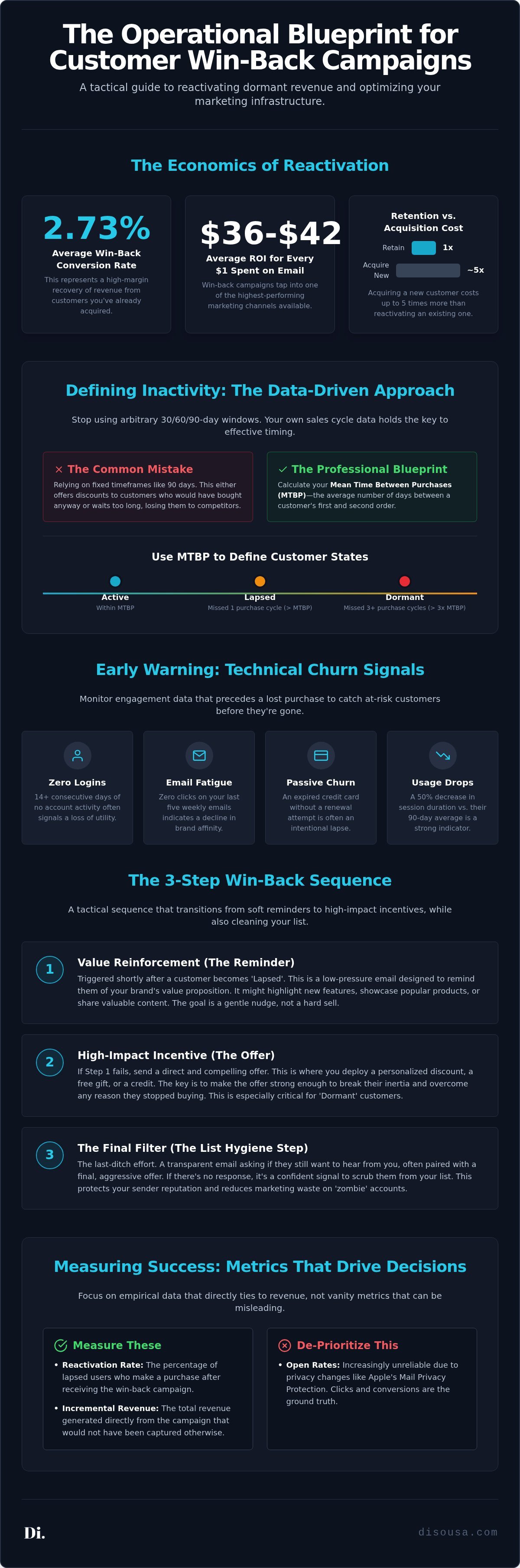
The financial logic for these sequences is clear. Industry data from 2026 shows that email marketing generates an average ROI of $36 to $42 for every $1 spent. In contrast, acquiring a new customer often costs significantly more than retaining an existing one, sometimes up to five times as much. While the average conversion rate for win-back sequences is approximately 2.73%, these are high-margin wins because the initial barriers to trust have already been cleared. These customers know your fulfillment process and your product quality. This stability directly impacts business valuation; a company with a high retention rate is viewed as a more reliable asset than one that must constantly replace its entire user base.
Deliverability and List Hygiene
Beyond immediate revenue, these campaigns serve a functional purpose for your technical infrastructure. Inactive subscribers are a liability for your sender reputation. If a large percentage of your list never opens an email, ISPs like Gmail and Outlook may begin flagging your content as spam; this hurts your inbox placement for active buyers. Domains with full authentication like DMARC and SPF see higher open rates, but even the best tech can’t save a list full of disinterested users.
You can use customer win-back email campaigns as a final filter for your list. Think of it as a logistical audit. If a user does not respond to a high-value re-engagement sequence, they’re likely a ‘zombie’ account. These are addresses that are either abandoned or permanently disinterested. Identifying these users allows you to scrub them from your list with confidence. It ensures your deliverability remains high and your marketing costs remain low. It’s a necessary step to keep your digital infrastructure lean and effective.
Defining Inactivity: When is a Customer Actually Gone?
Most marketers rely on arbitrary 30, 60, or 90-day windows to trigger their customer win-back email campaigns. This is a mistake. These fixed timeframes don’t account for the reality of your specific sales cycle. If you trigger a sequence too early, you’re effectively cannibalizing your margins by offering discounts to people who were going to buy anyway. If you wait too long, the customer has likely already established a new habit with a competitor. You need a definition of inactivity grounded in your own data.
You must calculate your Mean Time Between Purchases (MTBP). This baseline represents the average number of days between a customer’s first and second order across your entire database. If your MTBP is 45 days, a customer at day 50 is officially ‘lapsed’. They’ve missed exactly one expected cycle. By day 135, they’ve missed three full cycles and are categorized as ‘dormant’. This distinction is vital for your budget. Lapsed customers often just need a reminder of your value proposition. Dormant customers likely have a new provider, meaning they require a high-impact incentive to return.
Identifying churn signals requires monitoring engagement data that precedes the purchase. Look for these technical indicators:
- Zero logins: For SaaS or membership sites, 14 consecutive days of no activity often indicates a loss of utility.
- Email fatigue: Zero clicks on your last five weekly newsletters shows a decline in brand affinity.
- Passive churn: An expired credit card on file without a renewal attempt suggests the customer is letting the service lapse intentionally.
- Usage drops: A 50% decrease in session duration compared to a user’s 90-day historical average.
Setting Thresholds for B2B vs. B2C
B2B models require longer observation windows because buying cycles often involve multiple stakeholders and annual budget reviews. You might wait six months before flagging a B2B account as lapsed. In contrast, B2C consumables like vitamins or pet food require tight windows based on product depletion rates. For instance, brands that explore Direct-to-consumer product sales for performance supplements must track usage closely to trigger reminders before the customer runs out. The point of no return for most industries is reached when inactivity exceeds three times your standard MTBP.
Behavioral Triggers for Automation
Effective re-engagement relies on the integrity of your data pipeline. You need real-time ‘last active’ timestamps to trigger sequences without manual intervention. Don’t just watch for positive actions; monitor the absence of activity. Systems that track ‘negative’ behaviors, such as a user suddenly stopping their weekly report downloads, allow for early-intervention campaigns. These are more effective than waiting for the customer to disappear entirely. If your current tech stack isn’t providing this level of visibility, it might be time for a functional assessment of marketing services to fix your data flow.
Segmentation Strategies for Effective Re-engagement
Once you’ve established your MTBP, you cannot treat every silent customer as a single monolithic block. Sending a generic “we miss you” message to your entire inactive list is an inefficient use of resources that often leads to high unsubscribe rates. You need a logistical filter to categorize your audience based on their previous behavior and future revenue potential. Effective customer win-back email campaigns rely on precise segmentation to ensure that your incentives match the customer’s historical value.
I recommend starting with four primary segments to organize your recovery efforts:
- High-Value Lapsed (HVL): These are your former VIPs who contributed the most to your top-line revenue. They deserve your most aggressive recovery offers and perhaps even a personal reach-out from a success manager.
- Discount Seekers: These customers only engage when a coupon is present. You should identify them to avoid unnecessary margin erosion; if they never buy at full price, don’t send them your standard value-reinforcement content.
- Product-Specific Churn: Segment users based on the last category they purchased. If a customer bought a 30-day supply of a specific supplement and hasn’t returned, your messaging should focus on that specific product’s benefits rather than the brand as a whole.
- Feedback-Driven: This is where most brands fail. You must separate customers who left a negative review or filed a support ticket from those who simply drifted away. A customer who had a bad experience needs an apology and a resolution, not a sales pitch.
The RFM Model (Recency, Frequency, Monetary)
The RFM model is the industry standard for ranking win-back potential. You assign a numerical score to every subscriber based on how recently they purchased, how often they buy, and how much they’ve spent. Your focus should remain on ‘Champions’ and ‘Loyal Customers’ who have recently gone quiet. These segments have the highest probability of reactivation. You should also flag ‘About to Sleep’ segments; these are users who are approaching your MTBP threshold but haven’t crossed it yet. Proactive engagement here can prevent the lapse before it happens.
Engagement-Based Segmentation
You must also differentiate between ‘never-opens’ and ‘clicked-but-didn’t-buy’ cohorts. If a user is opening your emails but not purchasing, the issue is likely your offer or a friction point on your landing page. If they aren’t opening at all, you have a deliverability or subject-line relevance problem. Tailoring your content to these specific lifecycle stages is a core pillar of a sophisticated digital growth strategy. By aligning your technical triggers with behavioral data, you ensure that your win-back system remains a high-ROI asset rather than a source of list fatigue.
The 3-Step Win-Back Sequence: A Tactical Blueprint
I’ve seen many brands send a single “we miss you” email and wonder why their reactivation rates are stalled. One message is easily ignored; a 3-step sequence, delivered over 10 to 14 days, provides the necessary touchpoints to overcome friction without becoming a nuisance. You’re building a logistical bridge back to your brand. Each email in your customer win-back email campaigns must have a clear, singular call-to-action (CTA). Don’t ask them to read a blog post and buy a product in the same message. Pick one objective and stick to it.
Email 1: The Value-First Approach
Your first touchpoint should focus entirely on utility and value reinforcement. Remind the customer of the specific benefits they’ve enjoyed in the past. If you’ve launched new features, expanded your service offerings, or added new inventory since they last logged in, lead with those updates. For example, a boutique might feature its latest seasonal collection; you can learn more about Dutchess Martha to see how a curated lifestyle brand presents its updated inventory. I recommend avoiding the “we miss you” cliches that dominate the industry. They don’t care that you miss them; they care about what you can do for them today. Use a subject line that highlights a specific improvement to your service. Data shows that using AI to optimize these subject lines can increase your open rates by up to 26%, so it’s worth testing variations that focus on “New for you” rather than “Where did you go?”
Email 2: The Strategic Incentive
If the first email doesn’t trigger a click, you need to introduce a direct incentive. Use your CRM data to offer something personalized, such as a credit based on their previous purchase history. This is where you apply the psychological principle of loss aversion. Instead of a generic coupon, try a subject line like “Your $20 loyalty credit expires in 48 hours.” This creates a tangible sense of urgency. You must be careful not to devalue your brand by offering deep discounts too frequently; consider offering exclusive access or a “gift with purchase” if you want to protect your margins. You’re looking for a re-entry point, not a race to the bottom.
Email 3: The Permission-Based Break-up
The final step is the “pull-away” message. Explicitly state that you’ll stop emailing to preserve their inbox space. Ironically, this psychological “break-up” often results in the highest engagement of the entire series. You’re giving them a final chance to stay on the list while demonstrating that you respect their time. I suggest offering a “snooze” or “monthly frequency” option as an alternative to a full unsubscribe. This hygiene step is a mandatory requirement for executing email marketing campaigns that maintain high deliverability. If they don’t respond to this third message, they’ve transitioned from “dormant” to “deadweight.” You should remove them from your active list immediately to protect your sender reputation.
If your current automated sequences aren’t hitting these benchmarks, you can request a functional assessment of your marketing services to identify where your revenue is leaking.
Measuring Success: Metrics Beyond the Open Rate
Open rates are a vanity metric in 2026. With Apple’s Mail Privacy Protection and various ISP filters, an “open” often reflects a technical trigger rather than a human reading your message. To evaluate the true performance of your customer win-back email campaigns, we must focus on behavioral outcomes that impact your balance sheet. You’re looking for evidence of revenue recovery, not just digital signals.
I recommend tracking these four functional KPIs to measure your results:
- Reactivation Rate: The percentage of your lapsed segment that performed the primary action, like a purchase or renewal.
- Incremental Revenue: Use a hold-out control group that receives no win-back emails. Compare the revenue from the campaign group against this control to verify the emails actually drove the sales.
- List Attrition: A successful campaign identifies “lost causes.” Tracking how many non-responders were successfully purged from your system is a win for your operational efficiency.
- Deliverability Impact: Monitor your sender score and inbox placement before and after the campaign. Removing inactive addresses typically results in a measurable lift in delivery rates across your entire list.
The Reactivation ROI Calculation
You need to be blunt about the costs involved. Your ROI calculation must include the software overhead, the labor to manage the sequences, and the value of any discounts provided. Determine your break-even point early. If you offer a 20% discount to reactivate a customer, ensure their subsequent lifetime value justifies that initial margin hit. We’ve seen cases where recovered customers churn again immediately after using a discount; these are “serial switchers” who lower your overall profitability. Your goal is long-term recovery, not a one-time spike in low-margin orders.
Optimization Protocols
Optimization is an ongoing process of refinement. Start by A/B testing the subject lines of your final break-up email. Since this message often generates the highest engagement, testing different psychological triggers can provide significant variance in your recovery numbers. You should also test different incentive levels, like free shipping versus a flat discount. If you find that managing these complex automated sequences is taxing your internal resources, I suggest reviewing our functional assessment of online marketing services. It provides a framework for selecting the right professional management to scale these operations effectively.
Operationalizing Your Retention Strategy
You’ve seen the data. Rising acquisition costs make it impossible to ignore the revenue sitting in your inactive list. Successful customer win-back email campaigns aren’t about emotional appeals; they’re about technical precision and data-driven timing. You must transition from arbitrary 30-day triggers to a framework based on your specific Mean Time Between Purchases. By treating your re-engagement sequence as a logistical filter, you protect your sender reputation while recovering high-margin revenue that you’ve already paid for through your initial marketing spend.
Managing these multi-step sequences requires constant oversight and granular segmentation. You need to verify that your incentives are driving incremental revenue rather than just cannibalizing existing margins. If you’re ready to move beyond basic automation, you can scale your retention strategy with Disousa’s managed email services. We provide data-driven lifecycle management, expert deliverability monitoring, and performance-focused campaign execution to ensure your list remains a productive asset. It’s time to stop letting dormant accounts drain your resources and start turning them back into active buyers. We’re here to help you build a system that works.
Frequently Asked Questions
What is the best subject line for a win-back email?
The best subject line is one that highlights a tangible update or value reinforcement rather than emotional appeals. I recommend avoiding cliches like “we miss you” in favor of “here’s what’s new for you.” When executing customer win-back email campaigns, using AI to generate and optimize your subject lines can increase open rates by 26%. It’s more effective to focus on specific product improvements or a personalized credit that applies to their previous purchase history.
How long should I wait before starting a win-back sequence?
You should wait until a customer exceeds your Mean Time Between Purchases (MTBP) baseline. If your average customer buys every 45 days, day 50 is the optimal time to trigger the first email. Don’t rely on arbitrary 30 or 60-day windows. Waiting too long allows competitors to establish new habits, while starting too early cannibalizes margins from customers who would have purchased anyway regardless of the email.
Is it better to offer a discount or a free gift in a win-back campaign?
It depends on your specific customer segments and profit margins. For “Discount Seekers” who only buy during sales, a direct discount is often the only way to trigger a reactivation. For higher-value segments, a free gift or exclusive access protects your brand value and prevents margin erosion. You should always test which incentive provides the highest incremental revenue compared to a control group before rolling it out list-wide.
Should I send win-back emails via SMS or just email?
You should lead with email but consider SMS for your high-value lapsed (HVL) segments. Email remains the primary driver for customer win-back email campaigns due to its high ROI of $36 to $42 for every $1 spent. SMS can be effective for urgent “final break-up” messages, but it carries a higher risk of being perceived as intrusive if the customer has already gone quiet for several months.
How do I know if a win-back campaign is hurting my deliverability?
You’ll know if your sender score drops or if you see a spike in hard bounces and spam complaints. High volumes of inactive subscribers are a liability for your inbox placement. If your open rates for active segments begin to decline, it’s a sign that ISPs are flagging your domain due to your interaction with “zombie” accounts. Monitoring these technical indicators is a mandatory part of your operational hygiene.
What should I do with customers who don’t respond to the break-up email?
You must remove them from your active mailing list immediately. Customers who ignore a three-step sequence, including a “break-up” email, are officially deadweight. Keeping them on your list increases your costs and actively damages your deliverability score. You can move them to a separate “dormant” archive for occasional re-validation, but they should no longer receive your regular marketing or performance-based communications under any circumstances.
Can I use win-back campaigns for B2B lead nurturing?
Yes, but you must adjust your observation windows for longer B2B buying cycles. B2B win-back campaigns should focus on high-value content like white papers or case studies rather than simple discounts. Since these decisions often involve multiple stakeholders, your goal is to re-establish your firm as a thought leader. It’s an effective way to re-engage leads who went quiet during a previous procurement cycle or budget year.
What is a typical reactivation rate for an email win-back campaign?
The average reactivation rate for re-engagement sequences is currently 2.73%. While this number seems low, it represents high-margin revenue because you aren’t paying for new lead acquisition. A successful campaign can recover between 12% and 25% of lapsed customers over the long term. You should focus on the incremental revenue generated rather than just the raw percentage of users who clicked on a specific message. For a broader operational framework, reviewing a comprehensive email marketing briefing for 2026 can help you build the technical foundation that supports sustained list performance.
Disclaimer
**Disclosure:** Some articles on this website may contain affiliate links. This means we may earn a commission if you purchase a product or service through certain links, at no additional cost to you. We only recommend products, tools, and services that we believe provide value to our readers.
**Disclaimer:** The information provided on this website is for educational and informational purposes only and should not be considered financial, legal, tax, or professional advice. While we strive to keep our content accurate and up to date, we make no guarantees regarding completeness, reliability, or results obtained from using the information provided. Always conduct your own research and consult qualified professionals before making business, financial, or investment decisions.
