
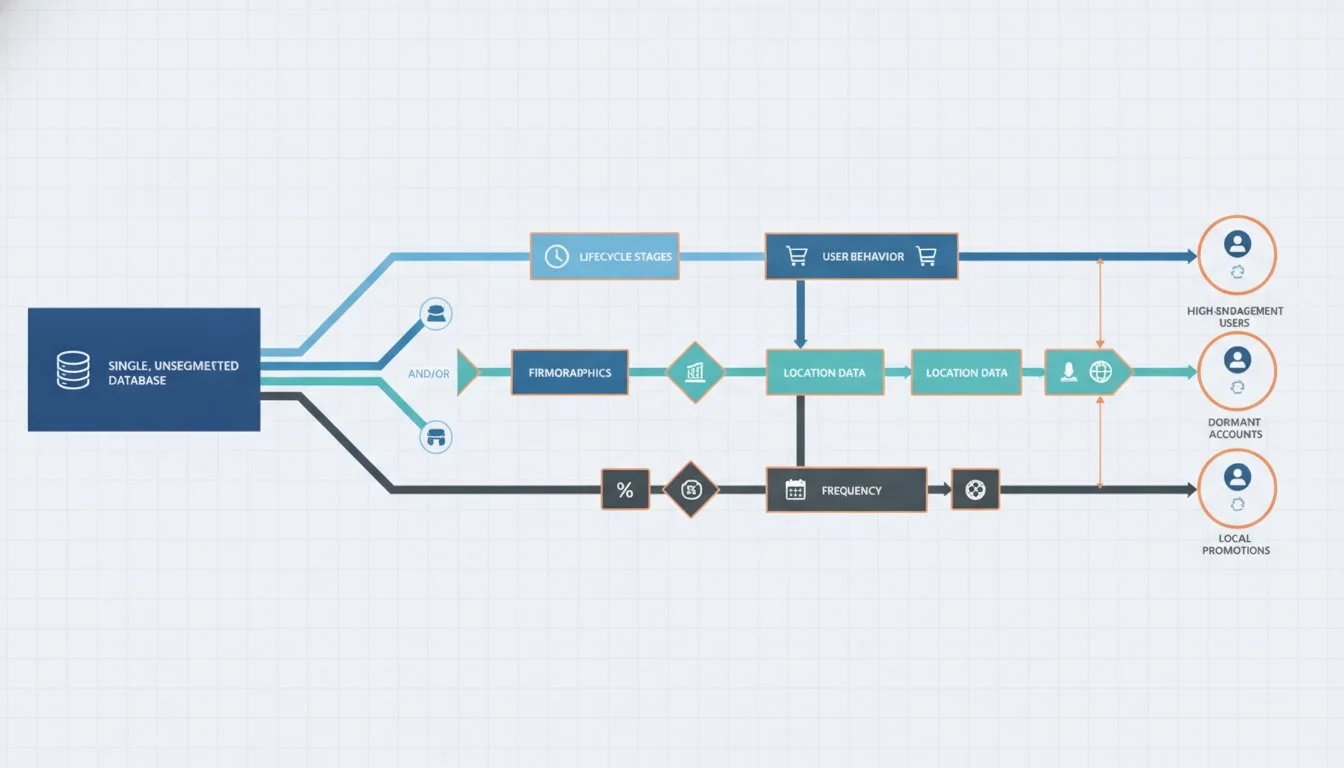
Segmented email campaigns generate 760% more revenue than non-segmented broadcasts, yet many marketing teams still treat their database like a single, monolithic block. It’s an expensive mistake. If you’re seeing low open rates from generic blasts or struggling to sync CRM data, you’re likely leaving significant money on the table. Implementing sophisticated email list segmentation strategies doesn’t have to be a management nightmare that breaks your daily workflow.
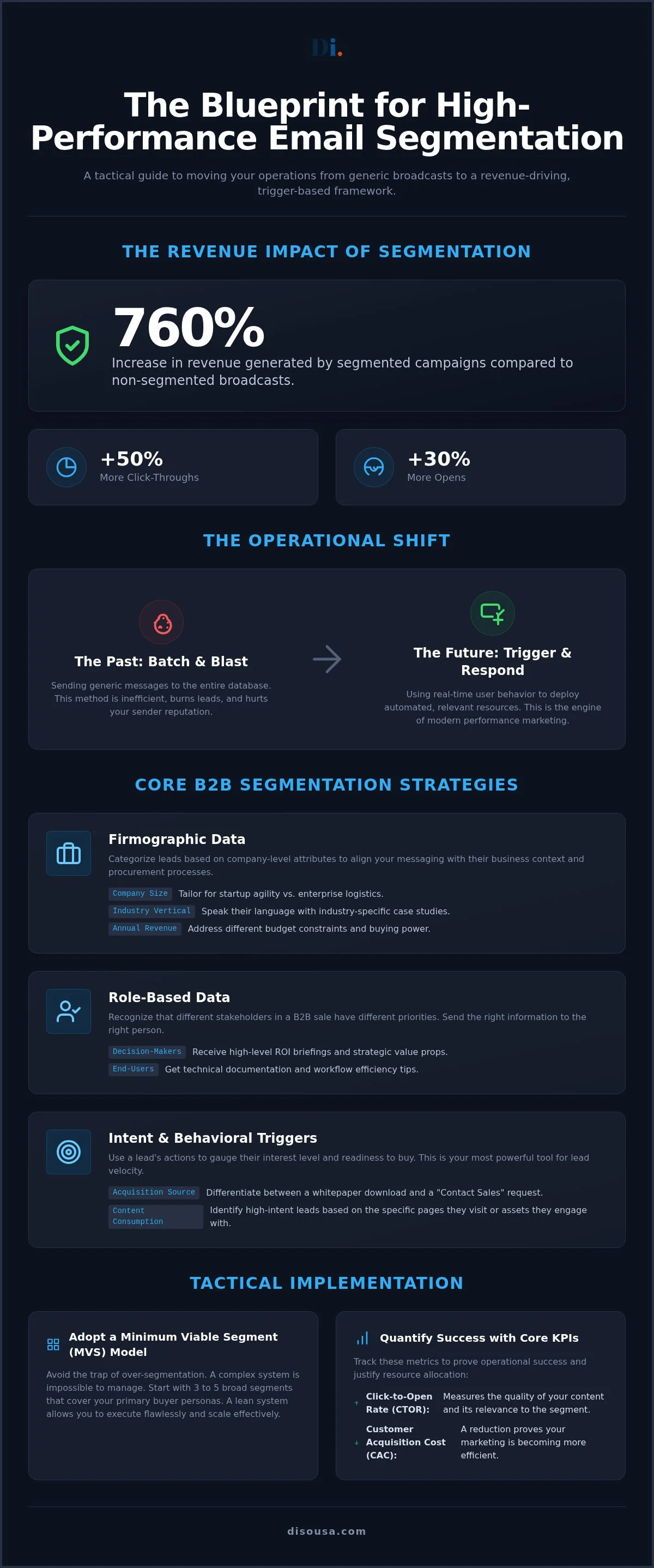
We agree that the primary barrier to better performance isn’t a lack of data; it’s the fear of over-complicating the system. This briefing provides a tactical blueprint to move your operations from “batch-and-blast” to a high-performance framework designed for the 2026 landscape. You’ll learn how to build a repeatable system for lead categorization that has been shown to drive 50% more click-throughs and 30% more opens. We’re moving past theory to give you an operational plan that lowers unsubscribe rates and secures your inbox placement in an increasingly strict regulatory environment where deliverability is no longer guaranteed.
Key Takeaways
- Learn to partition your database into actionable clusters to transition from generic broadcasts to a high-velocity performance model.
- Implement core email list segmentation strategies for B2B by categorizing leads based on firmographic data and specific stakeholder roles.
- Identify high-intent leads ready for sales intervention through advanced behavioral triggers and content consumption patterns.
- Follow a tactical audit process to sync your CRM data with your email platform and define clear conversion milestones.
- Quantify your operational success by tracking Click-to-Open Rate (CTOR) improvements and the reduction in your Customer Acquisition Cost (CAC).
What is Email List Segmentation in a Performance Context?
Email list segmentation is the process of partitioning your database into actionable clusters based on specific data signals. In a performance context, we don’t view segments as static categories. We view them as dynamic groups that dictate how and when we deploy resources. Performance-driven firms prioritize these strategies because they directly influence deliverability, ROI, and lead velocity. By 2026, the industry has moved entirely away from batch-and-blast methods. We now operate in a trigger-and-respond environment. This means your email list segmentation strategies are the engine behind every automated workflow you run. Instead of deciding when to send an email, you design the segments that decide for you based on real-time user behavior.
In a performance-driven environment, every email sent has a cost. It’s not just the literal cost of the delivery platform, but the opportunity cost of an unsubscribed lead. If you send a generic message to your entire list, you risk burning through leads that aren’t ready for that specific offer. By partitioning the list, you ensure that high-intent leads get the direct sales push while earlier-stage leads receive nurturing content. This increases lead velocity by keeping the conversation relevant at every stage of the funnel. It stops you from wasting your best leads on your worst-performing content.
The ROI of Targeted Communication
There’s a direct correlation between how specific your segments are and your resulting click-through rates. Broad emails are ignored. Targeted ones are engaged with. This engagement does more than just drive sales; it protects your sender reputation. When subscribers consistently open and click your messages, mailbox providers like Google and Yahoo recognize your domain as a high-value sender. This keeps your emails out of the spam folder and ensures your infrastructure stays healthy. Segmentation is a critical operational asset for performance marketing that transforms a passive list into a measurable revenue driver.
Email Segmentation vs. Personalization
People often confuse these two, but they serve different functions. Think of segmentation as the “who” and personalization as the “what.” You use segmentation to identify a group of decision-makers in the manufacturing sector. You use personalization to insert their specific company name or recent project details into the copy. You can’t have effective personalization without a robust segmentation framework in place. This level of precision is usually managed through Marketing Automation platforms that sync your CRM data with your email delivery service. Without the segment, your personalized tags are just hollow placeholders. For a broader look at how these tools fit into your stack, see our online marketing services briefing. Implementing these email list segmentation strategies ensures your messaging is grounded in the actual needs of your audience rather than generic assumptions.
Core Email List Segmentation Strategies for B2B
B2B sales cycles are rarely linear. You’re dealing with multiple stakeholders, each with different priorities and technical requirements. To manage this complexity, we start with firmographic segmentation. This involves categorizing your leads by company size, industry vertical, and annual revenue. A startup founder has different procurement hurdles than a procurement officer at a Fortune 500 firm. Your messaging must reflect these logistical realities. We also prioritize role-based segmentation. We send the high-level ROI briefings to decision-makers while providing end-users with technical documentation and workflow efficiency tips. This ensures your content is useful to the person reading it, which is the only way to maintain high engagement over a six-month sales cycle.
Intent-based segmentation is your most powerful tool for the first 30 days of a lead’s lifecycle. We look at the acquisition source to determine what the user actually wants. A lead who downloads a technical whitepaper is in a different mental state than one who signs up via a “Contact Sales” button. You should tailor your automated sequences to match this initial signal. However, I often see teams fall into the trap of over-segmentation. If you have a smaller list, creating 50 different micro-segments will make your operations impossible to manage. We recommend a Minimum Viable Segment (MVS) approach. Focus on 3 to 5 broad buckets that cover your primary buyer personas. You can find more about these fundamentals in the Email Marketing Basics guide provided by the SBA. Keeping your system lean allows you to actually execute on your data rather than getting paralyzed by it.
Segmenting by Funnel Stage
We categorize leads into three primary stages to ensure the content matches their current needs. Top-of-Funnel (TOFU) leads receive educational briefings that focus on problem awareness. Middle-of-Funnel (MOFU) leads get solution comparisons and technical requirement lists. By the time a lead reaches the Bottom-of-Funnel (BOFU) stage, our email list segmentation strategies shift toward direct ROI data and specific case studies. This progression respects the subscriber’s time and prevents you from asking for a sale before you’ve established trust.
Geographic and Cultural Nuances
Global performance campaigns require a layer of geographic filtering. We optimize send times based on local business hours to ensure your message hits the inbox when the recipient is actually working. Compliance is another critical filter. We use segmentation to separate subscribers in GDPR or CASL jurisdictions from those in the US to ensure we meet specific legal requirements for consent and data processing. If you are looking to scale, identifying high-value regions is essential for prioritized recruitment. We’ve seen this drive significant results when building an affiliate marketing framework for brands. By focusing your resources on regions with the highest conversion potential, you maximize your operational efficiency and lower your overall acquisition costs.
Advanced Behavioral and Lifecycle Triggers
Static data tells you who a lead is, but behavioral triggers tell you what they intend to do next. To maximize your email list segmentation strategies, we implement lead scoring models that assign numerical values to specific actions. If a contact visits your pricing page three times in 48 hours, they aren’t just a lead; they’re a priority. We use these engagement signals to trigger direct sales intervention or high-conversion “fast-track” sequences. This ensures your sales team spends time on leads with high intent rather than chasing cold contacts who only downloaded a single PDF months ago.
We also track content consumption patterns to refine our segments. If a subscriber consistently interacts with your technical SEO briefings but ignores your social media tips, their segment should reflect that preference. By partitioning your list based on the specific topics a user interacts with most, you ensure that every subsequent email feels like a continuation of a relevant conversation. This approach reduces the “noise” in their inbox and significantly lowers your unsubscribe rates. We also monitor for predictive churn. By identifying subscribers who have stopped engaging before they actually hit the unsubscribe button, you can deploy automated re-engagement flows to protect your database health.
The ‘Invisible’ Signals: Technical Engagement
Effective performance marketing requires attention to the technical environment of your subscribers. We segment by device type because a user on a mobile device has different interaction constraints than one on a desktop. Similarly, we segment by email client to ensure technical deliverability. Outlook renders HTML differently than Gmail, and ignoring these nuances can break your layout and destroy your conversion rates. For a deeper dive into protecting your reputation, review our email deliverability best practices. These technical filters ensure your message actually reaches the recipient in a readable format.
Affiliate and Partner-Sourced Segments
Not all lead sources are equal. Leads from different affiliate partners require unique onboarding flows because their initial expectations vary. A lead sourced from a high-authority review site has a different level of trust than one from a generic social media campaign. We track the Lifetime Value (LTV) of each segment to optimize affiliate payouts and partner recruitment. This data-driven approach is a core part of our affiliate marketing for brands framework. By segmenting by partner source, you can tailor your messaging to bridge the gap between the partner’s content and your own value proposition, ensuring a seamless transition for the new subscriber.
Implementation: How to Build Your Segmentation Infrastructure
Building a functional infrastructure for email list segmentation strategies requires more than just choosing a platform. It’s an operational process that starts with a comprehensive audit of your data sources. You need to map where your subscriber information originates, whether it’s from your CRM, website forms, or third party affiliate partners. Once you’ve identified these sources, you must define your primary conversion milestones. These are the specific actions that move a lead from one lifecycle stage to the next, such as a demo request or a high value content download. By mapping your data signals to these milestones, you create “Seed Segments” that act as the foundation for all future automation.
After your segments are active, you must establish a cleaning protocol. Data decays quickly in the B2B sector as people change roles and companies. We recommend a monthly scrub to remove invalid addresses and unengaged users who haven’t interacted with your content in over 90 days. Testing is the final step. You shouldn’t assume your segments are perfect on day one. Analyze your open and conversion rate data to see if your partitions are too broad or too narrow. If a segment isn’t performing, it’s usually because the data signal you used doesn’t actually correlate with the user’s intent. You can find more detail on this in our email segmentation strategy briefing.
Data Hygiene: The Foundation of Segmentation
Segmentation fails without regular list scrubbing. Dirty data, like hard bounces or spam traps, destroys your sender reputation and wastes your marketing budget. We automate the removal of hard bounces immediately. For unengaged users, we implement “Sunset Policies” that gradually reduce send frequency before eventually removing them from the active list. This keeps your engagement rates high and ensures your infrastructure stays healthy. If you want to improve your overall performance, you should consider a functional assessment of online marketing services to identify gaps in your data collection.
The Role of Automation in Scaling
Manual list exports are a bottleneck you can’t afford. Modern email platforms allow for dynamic, real-time segments that update automatically as user behavior changes. We prefer using “Tags” over static “Lists” for this purpose. Tags allow for a more granular approach, as a single subscriber can hold multiple tags representing different interests or behaviors without cluttering your database. This flexibility is essential for scaling complex B2B campaigns where a lead might belong to several categories simultaneously.
Measuring Success: KPI Alignment for Segmented Campaigns
Measuring the impact of your email list segmentation strategies requires a shift from vanity metrics to hard performance data. We focus on the Click-to-Open Rate (CTOR) because it isolates the effectiveness of your content within a specific segment. While open rates tell you if your subject line worked, CTOR tells you if the message inside was actually relevant to that group. If your “Technical End-User” segment shows a 20% lift in CTOR compared to your general list, your partitioning logic is sound. We also track the reduction in Customer Acquisition Cost (CAC). By delivering the right message at the right time, you reduce friction in the sales process and lower the resources required to close a deal.
Subscriber Lifetime Value (SLTV) is another critical metric for performance-driven teams. Segmented lists allow for more precise cross-selling and up-selling, which extends the revenue potential of every contact in your database. You’re no longer hoping for a random purchase; you’re engineering it through targeted lifecycle triggers. Finally, we monitor deliverability health scores per segment. This allows us to identify and isolate low-engagement pockets before they damage your overall domain reputation. If a specific partner-sourced segment shows high bounce rates, you can pause those sends without affecting your primary business communications.
Attribution and Performance Tracking
You can’t optimize what you don’t measure. We use UTM parameters to track every segment’s performance inside Google Analytics. This allows you to see which segments drive the most website traffic and, more importantly, which ones convert into revenue. Closing the loop means connecting these email clicks to your final CRM sales data. This is the only way to calculate the true affiliate marketing ROI for leads sourced through external partners. It moves the conversation from “how many people clicked” to “how much revenue did this segment generate.”
Scaling Your Strategy for Global Growth
Scaling your strategy is a balancing act. There is a point of diminishing returns where moving from 3 segments to 30 creates more operational overhead than revenue lift. We recommend a tiered resource allocation model. Your highest-value segments deserve custom-crafted content and deep research. Your broader, lower-intent segments can be managed with automated templates and dynamic content blocks. The goal is to maintain a lean, high-performance operation that prioritizes accuracy over volume. By focusing your energy on the segments that move the needle, you ensure your email list segmentation strategies remain a scalable asset rather than an administrative burden. Pairing this approach with a disciplined targeted traffic generation strategy ensures that the leads entering your segments are already pre-qualified, lowering your CAC from the point of first contact.
Operationalizing Your Data for 2026
Implementing these email list segmentation strategies transforms your database from a static list into a high-performance revenue asset. We’ve established that success in the 2026 landscape requires moving away from generic broadcasts toward specific, trigger-based communication. You now have the tactical blueprint for auditing your data sources, establishing strict hygiene protocols, and aligning your KPIs with actual business outcomes like lower acquisition costs. A lean, data-driven infrastructure is the only way to maintain deliverability and relevance as inbox standards become more demanding. It stops the waste of high-value leads and ensures your messaging remains relevant across complex B2B sales cycles.
Focus on the behavioral signals that correlate with high intent and let automation handle the logistical load. If you’re ready to move past manual list management, scale your performance with professional email marketing operations at Disousa. We provide expert affiliate management and conversion-focused lifecycle strategies that produce measurable digital growth results for our partners. It’s time to stop treating your list as a single block and start treating it as a collection of unique conversion opportunities. Your operational readiness today dictates your ROI tomorrow.
Frequently Asked Questions
What is the most effective email segmentation strategy for a small list?
The most effective approach for a small list is the Minimum Viable Segment (MVS) model based on funnel stage. You don’t need dozens of buckets when your database is small. Focus on separating new leads who need education from high-intent leads ready for a sales conversation. This ensures your resources go where they have the highest conversion potential without creating unnecessary operational drag or complexity in your daily workflow.
How do I avoid over-segmenting my email list?
You avoid over-segmenting by setting a minimum threshold for segment size and measuring the performance lift. If a new segment doesn’t show a measurable increase in click-through rates compared to a broader group, it’s likely too granular. We recommend keeping your primary email list segmentation strategies focused on three to five core personas. This maintains manageable workflows and ensures your data signals remain statistically significant for decision-making.
Can email segmentation improve my deliverability rates?
Segmentation directly improves deliverability by increasing engagement signals like opens and clicks. Mailbox providers like Google and Yahoo use these signals to determine if your domain is a high-value sender. By sending relevant content to specific groups, you reduce the likelihood of being marked as spam. High engagement rates protect your sender reputation and ensure your infrastructure remains healthy, keeping your messages out of the junk folder.
How often should I update or refine my email segments?
You should perform a data hygiene scrub monthly and a deep strategic review of your segments quarterly. Monthly scrubs remove invalid addresses and unengaged users to protect your deliverability. Quarterly reviews allow you to analyze conversion data and adjust your logic based on shifting market trends or changes in your product offerings. Regular iteration prevents your segments from becoming stale as lead behavior and professional roles evolve.
What data points are most important for B2B email segmentation?
The most critical data points for B2B are firmographics and behavioral intent signals. You need to know the company size and industry to align with their specific procurement realities. Equally important is tracking which whitepapers or pricing pages a lead interacts with. These points allow you to execute email list segmentation strategies that address both the professional role of the subscriber and their current stage in the buying journey.
Do I need expensive software to start segmenting my email list?
You don’t need enterprise-level software to begin segmenting; most standard email service providers (ESPs) offer built-in tagging and dynamic list features. Tools like Mailchimp or HubSpot include basic segmentation tools even in their entry-level tiers. The key isn’t the cost of the software but the logic of your framework. Start with the data you already have in your CRM and build your infrastructure as your list grows.
How does segmentation affect lead nurturing campaigns?
Segmentation transforms lead nurturing from a generic sequence into a targeted conversion path. It allows you to tailor the content of your nurturing flows to the specific pain points identified during the segmentation process. Instead of a one-size-fits-all approach, you provide decision-makers with ROI data and end-users with technical guides. This relevance keeps leads engaged longer and increases the velocity of your sales funnel by building trust faster.
Disclaimer
**Disclosure:** Some articles on this website may contain affiliate links. This means we may earn a commission if you purchase a product or service through certain links, at no additional cost to you. We only recommend products, tools, and services that we believe provide value to our readers.
**Disclaimer:** The information provided on this website is for educational and informational purposes only and should not be considered financial, legal, tax, or professional advice. While we strive to keep our content accurate and up to date, we make no guarantees regarding completeness, reliability, or results obtained from using the information provided. Always conduct your own research and consult qualified professionals before making business, financial, or investment decisions.
