

High volume traffic is an operational liability if it doesn’t convert. Most marketing departments are still chasing vanity metrics while their customer acquisition costs continue to rise. If you’re seeing high bounce rates from visitors who have no intention of buying, your current strategy is likely misaligned with your sales goals. This briefing focuses on targeted traffic generation as a precise operational exercise rather than a broad awareness play. I’ll show you how to stop wasting budget on generic reach and start capturing the specific segments that drive measurable revenue.
You probably agree that a smaller pool of high-intent visitors is more valuable than a massive audience of window shoppers. I’ve designed this guide to help you transition from broad marketing to a tactical lead acquisition system. You’ll learn how to leverage search intent and affiliate partnerships to lower your CAC and improve your conversion rates. We’re moving away from the guesswork of the past. This blueprint provides the exact steps you need to build a scalable system for acquiring high-intent leads. We’ll examine the specific channel alignments and email automation strategies that will define growth in 2026.
Key Takeaways
- Learn why high-intent alignment is the only metric that matters in a post-volume era, moving your focus from simple clicks to qualified leads.
- Identify the four pillars of search intent to ensure your content reaches your ideal customer profile at the exact moment they are ready to engage.
- Develop a balanced strategy for targeted traffic generation using sustainable organic SEO alongside the granular precision of paid search and social channels.
- Follow a two-step operational blueprint to audit your current performance and build a centralized content hub that solves specific user pain points.
- Scale your acquisition efforts by integrating managed performance models and automated lead nurturing systems to maximize the lifetime value of every visitor.
Defining Targeted Traffic Generation in a Post-Volume Era
In the current B2B landscape, chasing raw volume is a failed strategy. Effective targeted traffic generation focuses on the quality of the visitor rather than the size of the crowd. We define this as the process of attracting users whose specific search intent or behavioral patterns align perfectly with your defined conversion goals. It’s the difference between a crowded room and a room full of buyers.
When we look at the evolution of Web traffic, metrics used to be simple. You wanted more clicks. Today, those clicks are often vanity metrics that mask underlying inefficiencies. For a B2B organization, 100 targeted visitors who are actively seeking a solution are worth significantly more than 10,000 generic hits from irrelevant sources. The latter only serves to inflate your server costs and cloud your decision-making.
To better understand the shift from volume to intent, watch this helpful video:
The Quality vs. Quantity Trade-off
If you focus on high-intent visitors, your Customer Acquisition Cost (CAC) naturally drops. You aren’t paying to educate people who don’t need your service. Instead, you’re capturing demand that already exists. Noisy traffic is more than just a waste of money; it actively damages your ability to optimize. When your analytics are flooded with irrelevant data, your A/B testing becomes statistically insignificant. You can’t tell if a landing page failed or if the audience was simply wrong. Targeted traffic is the precise alignment of a user’s specific problem with your brand’s unique solution.
Operational Risks of Low-Quality Sources
The market is full of automated “traffic generators” promising thousands of hits for a low flat fee. These are almost always bot-driven traps. Using these services creates a massive technical fallout. Search engine algorithms track user engagement signals like dwell time and bounce rates. If thousands of bots land on your site and leave in seconds, it signals to Google that your content lacks value. This leads to a drop in domain authority that can take months to repair. We’ve seen this in our a functional assessment of online marketing services; the most expensive traffic is often the “cheap” kind that breaks your attribution models and triggers algorithmic penalties. Focus on performance-based channels that prioritize human interaction over automated scripts.
Mapping Search Intent to High-Value Traffic Channels
Understanding the four pillars of intent is the first step in a successful targeted traffic generation strategy. These pillars are Informational, Navigational, Commercial, and Transactional. If you don’t categorize your traffic sources by these intents, you’re essentially guessing where your leads are in their journey. Most organizations fail because they treat all visitors as if they are ready to buy immediately. In reality, a user looking for a definition has a completely different set of needs than a user comparing two specific service providers.
Data-driven research allows us to pinpoint where your ideal customer profile (ICP) spends their time. We don’t just look at search volume; we look at behavioral data to see which channels provide the highest signal of intent. Using professional online marketing services helps bridge the gap between high-level interest and specific conversion actions. It ensures your brand appears exactly when the user shifts from learning to buying. Aligning your content formats with the specific questions your audience is asking prevents you from delivering the wrong message at the wrong time.
Intent Segmentation Strategies
Top-of-funnel (TOFU) awareness is best captured through “how-to” queries and educational resources. These visitors are identifying their problems but aren’t yet looking for a specific vendor. As they move into the middle-of-funnel (MOFU) consideration stage, their searches shift to “best [service]” or “vs” queries. By mapping your content to these specific stages, you eliminate the high costs associated with bidding on irrelevant, broad-match terms. This level of precision ensures that your budget is reserved for visitors who show a clear path toward a transaction. It’s about meeting the user where they are, rather than forcing them into a funnel they aren’t ready for yet.
Technical Foundations for Visibility
Your site infrastructure must support these high-intent journeys. If a user lands on a page that doesn’t answer their specific query, they will bounce, regardless of how “targeted” your traffic was. We use schema markup to help search engines categorize your content accurately, which increases the likelihood of appearing in rich snippets and relevant results. Proper internal linking also guides the user from informational content to commercial solutions. You should review my briefing on how to promote your content online to understand how distribution channels impact these technical foundations. If you’re looking to scale these efforts through partnerships, check out our strategic framework for performance growth to see how intent mapping applies to affiliate models.
Evaluating Traffic Sources: Organic, Paid, and Performance Channels
Organic SEO remains the most sustainable asset for targeted traffic generation. It builds long-term equity in your domain, which eventually lowers your average cost per lead. While it requires a significant time investment, the visitors it attracts are often the most qualified because they’re seeking solutions to specific problems. However, organic growth is a slow process. If you need to test a new offer or capture immediate demand, you can’t rely on search rankings alone. You need a mix of channels that balance speed with sustainability.
Paid search and social media act as precision tools for immediate, granular audience targeting. These platforms allow you to filter visitors by job title, industry, and specific behavioral triggers. The drawback is the cost; once you stop the spend, the traffic disappears. This is why we advocate for performance marketing. By leveraging affiliate marketing for brands, you shift the financial risk to your partners. You only pay for measurable results, such as a verified lead or a completed sale. It’s an operational pivot from buying clicks to buying outcomes.
The Power of Performance-Based Partnerships
Affiliate partners act as third-party validators for your brand. When a niche-specific publisher or industry influencer recommends your service, they’re transferring their established trust to your organization. This is far more effective than a traditional cold ad. You aren’t just buying reach; you’re tapping into an existing relationship. We’ve found that scaling through these partnerships allows you to penetrate micro-niches that are often too expensive for broad-match paid campaigns. For a deeper look at how these partnerships function, refer to our affiliate marketing guide to understand the mechanics of performance-based growth.
Email as a Traffic Retention Engine
Email marketing is your most reliable tool for converting one-time visitors into a recurring source of targeted traffic. Unlike search engines or social media platforms, you own the channel and the data. You don’t have to worry about an algorithm change cutting off your access to your audience. We use automated lifecycle emails to keep high-intent leads engaged throughout their decision-making process. This prevents “leaky funnels” where expensive traffic lands once and never returns. Technical deliverability is a necessity here; if your emails don’t reach the inbox, your retention engine fails. Consistent, value-driven communication ensures that your brand remains the primary solution when the lead is finally ready to transact.
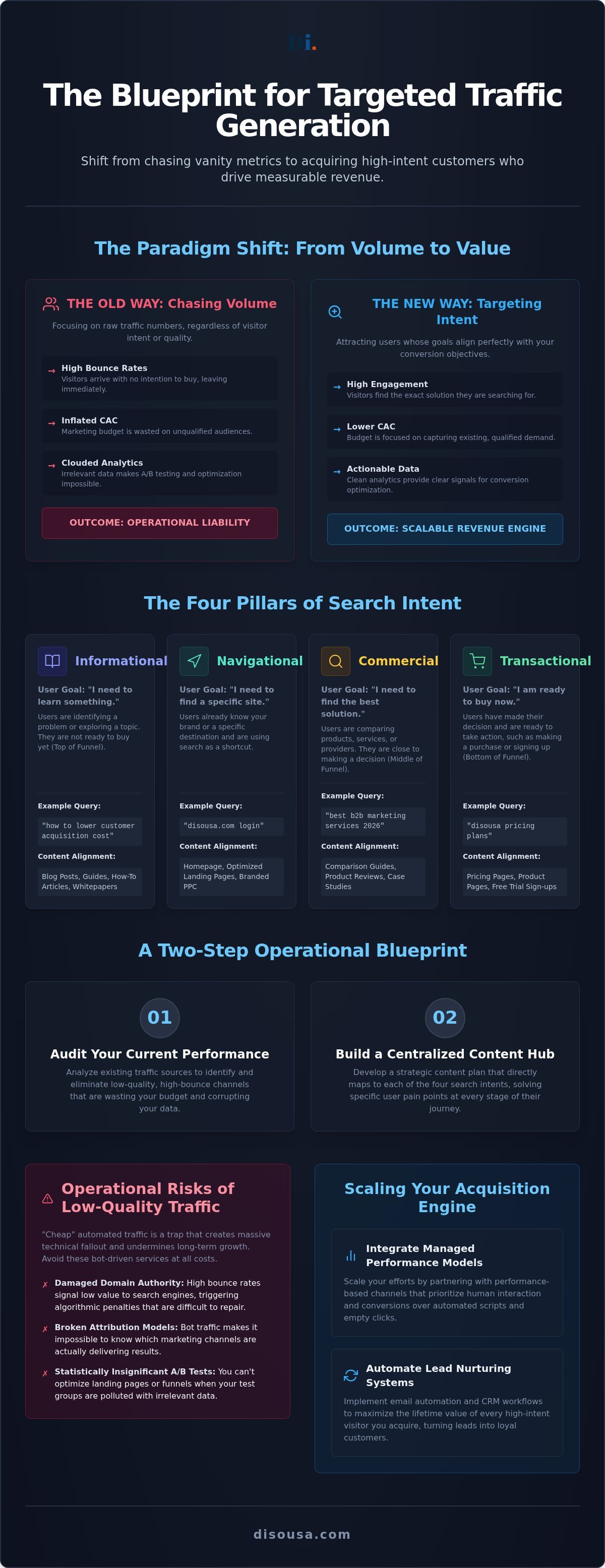
A Tactical Blueprint for Building Your Traffic Engine
Building a sustainable traffic engine requires a structured sequence of operational steps. We aren’t looking for a one-off spike in hits; we’re building a system for targeted traffic generation that functions reliably over the long term. This process begins with an audit of your existing data to see which channels already deliver the highest conversion rates. Once you identify these winners, you can double down on the strategies that actually move the needle. Follow these five steps to align your acquisition efforts with your revenue goals:
- Step 1: Audit current analytics to identify existing high-converting channels and user paths.
- Step 2: Create a content hub that solves specific user pain points and establishes your authority.
- Step 3: Deploy targeted outreach to industry-aligned affiliate partners to leverage their established trust.
- Step 4: Implement strict tracking protocols to measure the quality and intent of incoming traffic.
- Step 5: Continuously optimize landing pages based on the specific behavior of different traffic sources.
Auditing for Intent and Conversion
I recommend using Google Analytics 4 to track the complete user path from entrance to conversion. You need to know exactly which touchpoints influenced the final decision rather than just looking at the last click. Look specifically for “leaky” pages where high-intent visitors are dropping off in large numbers. This often happens when the page content doesn’t match the promise made in the search result or ad. Your primary KPIs should focus on traffic quality assessment, such as goal completion rate and average engagement time, rather than raw session counts.
Content Promotion and Distribution
A multi-channel distribution strategy ensures your content reaches your ideal customer profile wherever they are active. We don’t just post and hope; we actively push content through social, search, and partner networks. For those just starting to build these networks, our affiliate marketing easy guide provides the necessary groundwork for initial setup. Your ad copy must explicitly mirror the specific search query used by the visitor to ensure a zero-friction transition to your landing page. If you’re ready to scale these results through a managed partnership model, you should examine our strategic framework for performance growth to see how to align your channels with your sales goals.
Scaling Results Through Managed Performance Marketing
Scaling targeted traffic generation requires a shift from manual acquisition to a managed, performance-based model. Manual campaigns are useful for testing intent, but they eventually hit a ceiling of efficiency. We’ve found that the most effective way to scale is to move toward partnerships where you pay for outcomes rather than impressions. This operational pivot allows you to maintain a stable CAC while significantly increasing your lead volume. Professional management is essential here; without it, you risk common affiliate mistakes like brand bidding or traffic from low-quality sources that don’t align with your ICP.
We don’t just focus on the click. We maximize the value of every visitor through lead nurturing email campaigns. This framework ensures that high-intent traffic from your partners is immediately funneled into an automated lifecycle. It’s a waste of budget to pay for a targeted visitor only to let them leave without a follow-up. By integrating these systems, we’ve seen that the traffic you acquire today becomes a recurring source of revenue through your owned email lists. It’s a continuous operational process, not a one-time setup.
Integrating Affiliate and Email Systems
You need a tight feedback loop between your affiliate-sourced traffic and your email nurture sequences. We use data from partner conversions to refine our email messaging in real-time. If a specific partner sends leads that close at a higher rate, we analyze their audience’s pain points to adjust our ad spend and partner recruitment. This data-driven approach allows us to double down on what works while cutting underperforming sources. Maintaining strict brand standards across all external traffic sources is non-negotiable. Your partners are an extension of your sales team, and their messaging must reflect your internal quality benchmarks.
Next Steps for Performance Growth
Before you scale, evaluate your internal infrastructure. Can your sales team or CRM handle a sudden surge in lead volume? Scaling too fast without the right technical foundations leads to missed opportunities and wasted spend. You might reach a point where managing dozens of individual affiliate relationships becomes a full-time operational burden. In those cases, evaluating the need for an external performance marketing agency is a logical next step. We suggest you review our functional assessment of online marketing to determine which services align with your 2026 growth targets. Start by auditing your current conversion data and preparing your stack for a high-intent traffic surge.
Transitioning to a Performance-First Growth Model
Success in 2026 requires moving beyond the vanity of raw click counts. We’ve established that high-intent alignment is the only sustainable way to lower your customer acquisition costs. By mapping search intent to specific channels and building a tactical content hub, you create a system that attracts buyers rather than browsers. The integration of affiliate partnerships and email automation ensures that your targeted traffic generation efforts aren’t just one-off experiments but part of a scalable, revenue-focused engine.
Operational excellence in marketing is about measurable B2B outcomes and technical precision. You don’t have to navigate these technical complexities alone. We provide a path toward growth through our expertise in affiliate networks and email marketing automation. If you’re ready to shift from generic traffic to high-converting leads, it’s time to execute your performance strategy with Disousa. Let’s start building a traffic model that actually moves your bottom line. You have the blueprint; now it’s time to put it into practice.
Frequently Asked Questions
What is the difference between targeted traffic and organic traffic?
Organic traffic refers to visitors who arrive via unpaid search results, while targeted traffic describes a specific audience segment with high conversion intent. You can acquire targeted visitors through organic SEO, paid search, or affiliate partnerships. The distinction lies in the visitor’s purpose rather than the acquisition channel itself. I focus on intent because a visitor who needs your specific solution is valuable regardless of how they found your site. Intent is the primary driver of ROI.
Is buying targeted traffic safe for my website SEO?
Buying traffic is safe when you use legitimate advertising platforms or performance-based affiliate networks. It becomes a risk only if you utilize bot-driven services or low-quality traffic generators that trigger negative engagement signals. High bounce rates from irrelevant visitors can damage your domain authority over time. I recommend sticking to verified human sources to ensure your targeted traffic generation efforts support your long-term search rankings. Quality sources protect your infrastructure.
How do I measure the quality of my website traffic?
You should measure quality by tracking goal completion rates and average engagement time instead of raw session volume. High-quality traffic demonstrates a clear path from entrance to conversion in your analytics. If visitors land and immediately exit, the traffic is likely misaligned with your content. I use conversion tracking to identify which specific sources deliver the highest return on ad spend and lowest customer acquisition costs. Data doesn’t lie.
Which channel provides the highest quality targeted traffic for B2B?
Search engines and niche affiliate partnerships typically provide the highest quality traffic for B2B organizations. These channels capture users when they’re actively researching a problem or seeking a professional recommendation. While social media offers broad reach, search and performance-based models allow for much more granular intent targeting. We’ve found that leveraging third-party validators through affiliate programs often results in leads that are further along in the buying cycle; to explore how AI-driven influencer alignment can further boost these results, learn more about Advocators.
Why is my targeted traffic not converting into sales?
Your traffic may not be converting because of a messaging mismatch between the source and your landing page. If your ad promises a solution that your page doesn’t immediately deliver, the user will leave. Technical friction, such as slow load times or complex lead forms, also kills conversion rates. I suggest auditing your user journey to ensure your offer directly addresses the specific search intent that brought the visitor to your site. Friction is the enemy of conversion.
Can affiliate marketing help generate targeted traffic for new brands?
Affiliate marketing is highly effective for new brands because it allows you to borrow the authority of established publishers and influencers. You gain immediate access to a pre-qualified audience without the long lead time required for organic SEO. It’s a low-risk way to scale targeted traffic generation since you only pay for verified results. This performance-based model ensures your early marketing budget is spent on actual outcomes rather than just brand awareness. It builds trust quickly.
How much should I budget for targeted traffic generation in 2026?
Your budget should be determined by your target customer acquisition cost and your revenue goals rather than a fixed industry average. I recommend allocating a portion of your spend to performance-based channels where your costs are directly tied to conversions. This protects your margins while you test different acquisition sources. You should prioritize investment in channels that offer measurable data, allowing you to scale up your spending as you identify high-performing segments. Focus on efficiency over volume.
What are the most common mistakes in targeted traffic generation?
The most common mistake is prioritizing visitor volume over search intent. Many businesses waste budget on broad keywords that attract window shoppers instead of buyers. Another error is failing to implement lead nurturing systems, like email automation, to capture the value of visitors who don’t convert on their first visit. You must also avoid “cheap” traffic traps that provide bot-driven hits, as these disrupt your data and provide zero operational value. Precision is more profitable than reach.
Disclaimer
**Disclosure:** Some articles on this website may contain affiliate links. This means we may earn a commission if you purchase a product or service through certain links, at no additional cost to you. We only recommend products, tools, and services that we believe provide value to our readers.
**Disclaimer:** The information provided on this website is for educational and informational purposes only and should not be considered financial, legal, tax, or professional advice. While we strive to keep our content accurate and up to date, we make no guarantees regarding completeness, reliability, or results obtained from using the information provided. Always conduct your own research and consult qualified professionals before making business, financial, or investment decisions.
