

Google and Yahoo enforced strict authentication requirements for bulk senders starting in February 2024. Implementing email deliverability best practices is a technical necessity for organizations sending over 5,000 messages daily. Failure to maintain a spam complaint rate below 0.3% results in the rejection of emails. Many digital marketing operations experience declining engagement metrics when infrastructure is not aligned. High bounce rates often indicate that messages are being diverted to spam folders. Identifying these technical failures is required for operational stability.
This article provides a structured framework for optimizing sending infrastructure to ensure consistent inbox placement. You’ll learn the specific steps to configure authentication protocols and maintain a compliant subscriber list for 2026. The following checklist outlines the technical requirements to stabilize sender reputation and improve open rates. It’s designed to provide a functional path toward maintaining a sender reputation that meets current mailbox provider standards.
Key Takeaways
- Implement SPF and DKIM protocols to establish technical domain authentication and verify sending authority.
- Maintain list quality by utilizing double opt-in procedures and sunset policies for inactive subscribers.
- Apply email deliverability best practices through regular audits of bounce rates and spam complaint metrics.
- Distinguish between server acceptance and actual inbox placement to accurately measure the performance of delivery infrastructure.
- Optimize content by balancing text-to-image ratios and utilizing descriptive subject lines to meet mailbox provider standards.
The Functional Relationship Between Deliverability and Open Rates
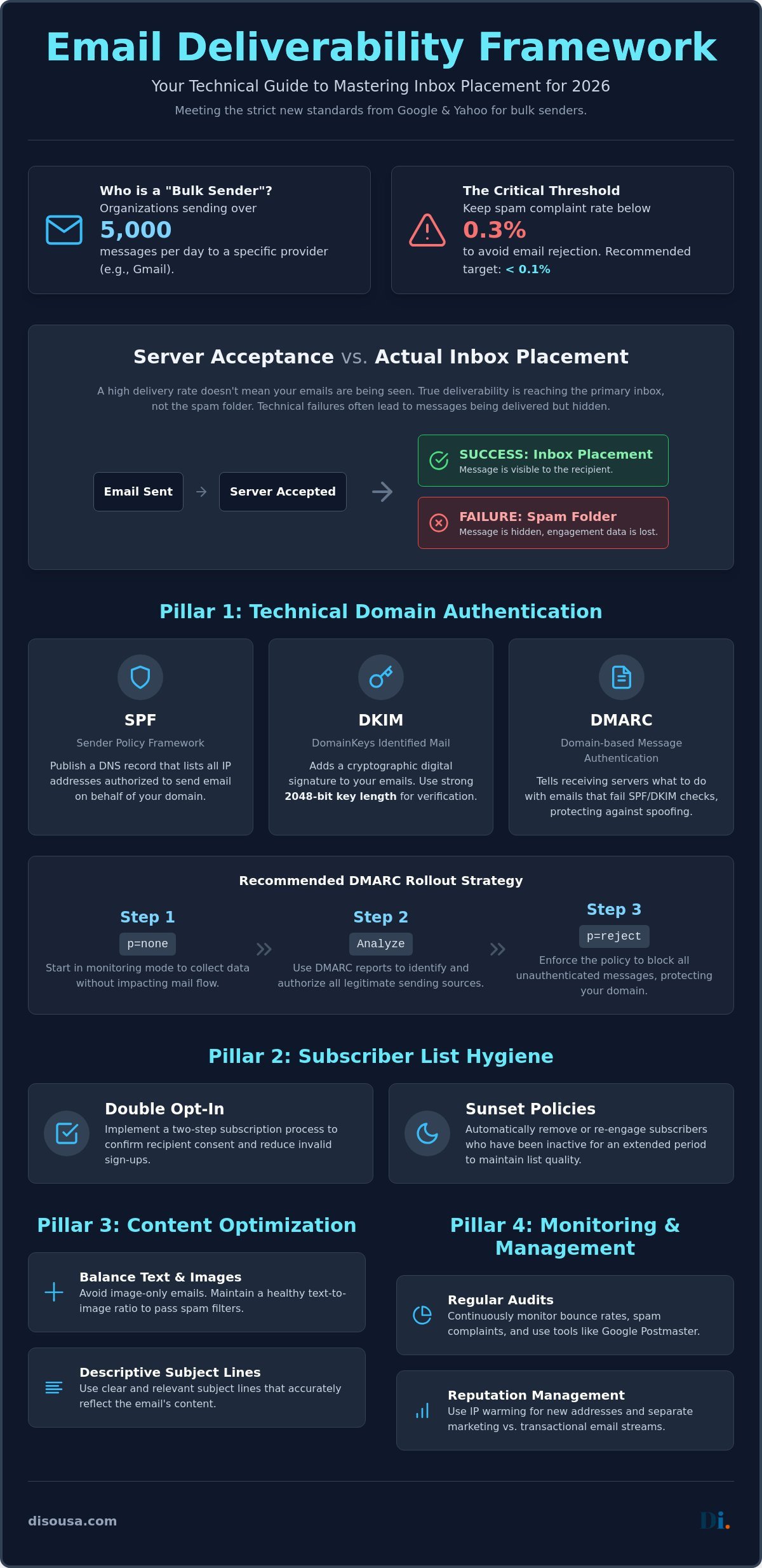
Email deliverability refers to the successful placement of messages in a recipient’s primary inbox. It’s distinct from the delivery rate, which only measures whether the receiving server accepted the file. A message can be delivered to the server but still redirected to the junk or spam folder. This distinction is critical for maintaining effective communication channels. High delivery rates are common, but they don’t ensure that the target audience sees the content. Technical infrastructure must be aligned with mailbox provider requirements to achieve consistent inbox placement.
The implementation of email deliverability best practices directly impacts the accuracy of performance marketing data. When messages land in spam folders, they aren’t opened. This results in underreported engagement metrics and skewed ROI calculations. Marketing teams often misinterpret these low numbers as a failure of creative content when the actual cause is a technical delivery failure. Reliable data collection is only possible when messages reach the intended destination.
To better understand this concept, watch this helpful video:
Performance Metrics and Data Accuracy
Spam placement prevents the collection of meaningful engagement data. Technical failures in the delivery pipeline disrupt conversion optimization strategies. If a significant portion of the audience never sees the message, the resulting analytics are incomplete. This lack of transparency complicates a functional assessment of online marketing services. Maintaining a clean reputation is necessary to ensure that performance data reflects actual subscriber interest rather than infrastructure errors.
The Role of Mailbox Providers (MBPs)
Mailbox providers like Gmail and Yahoo evaluate sender behavior to protect users from unwanted content. They use automated filters to assess the technical configuration of every incoming message. Protocols such as DMARC email authentication are used to verify the sender’s identity. In 2026, these providers prioritize user-centric engagement signals. Messages are filtered based on how often recipients interact with previous emails from the same domain. Low interaction rates or high complaint volumes lead to permanent inbox exclusion. Maintaining a spam complaint rate below 0.1% is the standard for avoiding these filtering penalties.
Technical Infrastructure and Domain Authentication Checklist
Technical infrastructure serves as the foundation for inbox placement. Mailbox providers like Google and Yahoo now enforce specific authentication standards for bulk senders. Failure to meet these technical requirements results in immediate delivery rejection. Adhering to email deliverability best practices requires a systematic approach to domain records. These protocols verify sender identity and ensure message integrity throughout the delivery process. Consistent maintenance of these records prevents unauthorized parties from spoofing your domain.
Authentication Protocol Deployment
The deployment of authentication protocols follows a precise sequence. First, audit DNS records for SPF accuracy to list authorized sending IP addresses. Second, generate and publish DKIM keys using a 2048-bit key length for cryptographic verification. Finally, implement a DMARC policy. It’s recommended to start with a “p=none” monitoring phase before transitioning to “p=reject” to block unauthenticated messages. These steps ensure that receiving servers can verify the origin of every email sent from your domain.
IP and Domain Reputation Management
Reputation management is a continuous logistical process. New IP addresses require a warming period where sending volume is gradually increased over several weeks. It’s necessary to separate transactional streams from marketing streams to protect critical system alerts. Monitoring tools like Google Postmaster provide visibility into reputation scores and delivery errors. Organizations seeking to scale their outreach can benefit from a strategic framework for performance growth to manage these technical complexities effectively.
The requirements enforced by Google and Yahoo since February 2024 have transitioned from suggestions to mandates. Senders exceeding 5,000 messages daily are permanently classified as bulk senders. These entities must provide a functional one-click unsubscribe header and maintain valid forward and reverse DNS (PTR) records. Forward DNS must point to the sending IP, while the reverse DNS must point back to the same domain. Stricter enforcement starting in November 2025 means that non-compliant messages are rejected at the gateway level rather than being filtered into junk folders.
Mailbox providers also require alignment between the “From” header and either the SPF or DKIM domain. Failure to maintain these technical standards results in a permanent loss of inbox access. Consistent monitoring of these records is a core component of modern email deliverability best practices. By maintaining a spam complaint rate below 0.1%, senders can ensure their infrastructure remains reputable and their messages reach the primary inbox.
Subscriber List Hygiene and Maintenance Procedures
Subscriber list hygiene is a technical requirement for maintaining inbox access. It involves the systematic removal of invalid or unengaged addresses from the database. Implementing email deliverability best practices requires a proactive approach to list management. Sending messages to dormant or non-existent accounts results in high bounce rates and negative reputation signals. Mailbox providers interpret these signals as a lack of sender oversight. Maintaining a clean database ensures that resources are focused on recipients who demonstrate active interest.
The first step in list maintenance is establishing a double opt-in process. This method requires a user to confirm their subscription via a secondary link sent to their address. It verifies the validity of the email and confirms the recipient’s intent. This procedure prevents the entry of spam traps and typos into the system. Additionally, hard bounces must be removed immediately. A hard bounce rate exceeding 2% often triggers filtering by mailbox providers. Honoring unsubscribe requests within 24 hours is also mandatory for compliance with CAN-SPAM and GDPR regulations.
Audit Criteria for List Quality
Regular audits are necessary to identify problematic data points within the subscriber base. Role-based addresses, such as info@ or sales@, should be identified and removed. These addresses are often managed by multiple people and rarely result in individual engagement. Verification services can be used to assess list health before large deployments. These tools detect invalid syntax and dormant domains. Identifying frequent complainers allows for their removal before they impact the domain’s reputation with a spam report.
Engagement-Based Segmentation
Engagement-Based segmentation involves categorizing users by their interaction history. High-activity segments should receive priority in sending schedules to establish positive engagement signals. Conversely, users showing declining activity require specific re-engagement protocols. If a subscriber hasn’t interacted with an email for 90 to 180 days, they should be moved to a sunset policy. A sunset policy involves a final attempt at contact before the address is permanently removed. This structural approach to email list growth and maintenance protects the sender’s long-term standing.
Maintaining a spam complaint rate below 0.1% is the industry standard for 2026. This is only achievable through strict list hygiene and the removal of unengaged users. Consistent application of email deliverability best practices prevents the degradation of the sender’s reputation over time. By focusing on a smaller, more active audience, organizations can achieve higher open rates and more reliable delivery metrics. List hygiene is not a one-time event but a recurring logistical process required for operational success.
Content Optimization and Engagement Standards
Content configuration is a primary driver of user engagement signals. Mailbox providers monitor how recipients interact with messages to determine future placement. Adhering to email deliverability best practices ensures that content doesn’t trigger automated junk filters. A functional balance between visual elements and readable text is required for server acceptance. Content that fails to load or appears distorted on mobile devices often results in immediate deletion or spam reports.
Subject Line and Header Assessment
Subject lines must prioritize clarity and relevance. Clickbait tactics often lead to high complaint rates. Spam-trigger words and excessive punctuation are identified by filtering algorithms. The preheader text provides additional context before the message is opened. A consistent “From” name establishes sender recognition and reduces the likelihood of manual spam marking. Utilizing personalized elements based on confirmed subscriber data improves the relevance of the header information.
Structural Requirements for Email Templates
Email templates require clean HTML code to pass technical inspections. Broken tags or non-functional links result in immediate delivery issues. Every marketing email must include a physical mailing address and an obvious unsubscribe link to remain compliant with international regulations. Mobile responsiveness is critical as Apple Mail accounts for over 51% of email opens as of May 2026. Testing across multiple clients is a standard procedural step before final deployment.
A text-to-image ratio of at least 60% text is a technical benchmark to avoid being flagged as a single-image spam message. Fast loading times are maintained by optimizing image file sizes and reducing unnecessary scripts. Providing an accessible preference center allows subscribers to manage their frequency and content interests. This reduces the total number of unsubscribes and protects the sender’s reputation. For organizations focusing on conversion optimization, Disousa provides a functional assessment of online marketing services to refine these technical standards.
Preference centers should be easy to navigate. They allow users to opt-down rather than opting-out entirely. This preservation of the subscriber relationship is a core component of long-term deliverability. When users feel they’ve control over the communication frequency, the probability of a spam complaint decreases. Maintaining these standards ensures that the engagement metrics used by mailbox providers remain positive.
Monitoring Protocols and Long-Term Management
Monitoring protocols ensure the long-term stability of email infrastructure. Regular deliverability audits are required to detect shifts in reputation before they impact revenue. Technical management involves the continuous observation of server responses and recipient behavior. Establishing a consistent schedule for these audits prevents the gradual degradation of sender standing. When infrastructure is monitored with precision, technical failures are identified and resolved before they result in permanent blocks.
Key performance indicators provide the data necessary for these assessments. A hard bounce rate exceeding 2% indicates a failure in list hygiene procedures. Spam complaint rates must remain below 0.1% to align with 2026 industry standards. An inbox placement rate of 95% or higher is the functional target for healthy operations. These metrics directly influence the success of affiliate marketing for brands. Performance-based ROI depends on consistent message visibility within the primary inbox.
Reporting and Feedback Loops
Feedback loops provide essential data from major internet service providers. These systems alert senders when a recipient marks a message as spam. This information allows for the immediate removal of complaining addresses to protect the domain. Seed list testing is used to verify placement across different mailbox providers. Delivery logs must be analyzed for SMTP error codes. Codes such as 421 indicate temporary rate limiting, while 550 codes signify permanent rejections. Understanding these responses is required for troubleshooting sudden drops in placement.
Scaling Email Operations Safely
Scaling operations requires a methodical approach to volume management. Sudden spikes in daily sending volume often trigger reputation alerts. Volume increases during peak periods should be managed in increments to avoid being flagged as suspicious activity. Integrating deliverability standards into broader digital growth strategies ensures operational readiness. Organizations often utilize professional email campaign strategy and automation to manage these technical milestones. This methodical oversight maintains the balance between reach and reputation.
The average ROI for email marketing in 2026 remains between $36 and $42 for every $1 spent. This return is only achievable when messages avoid the spam folder. Consistent application of email deliverability best practices is the only way to protect this investment. Long-term management involves the alignment of technical infrastructure with evolving provider requirements. By maintaining a reserved and methodical approach to monitoring, senders ensure their messages reach the intended destination reliably.
Operationalizing Email Deliverability Standards
Technical alignment with mailbox provider requirements is a mandatory component of digital infrastructure. Implementing email deliverability best practices ensures that messages reach the primary inbox rather than being rejected or filtered. It’s necessary to maintain list hygiene and domain authentication protocols to protect the sender’s long-term reputation. These procedures provide the foundation for accurate performance data and measurable engagement metrics. Consistent monitoring allows for the immediate resolution of delivery failures. Organizations that don’t prioritize these technical standards face declining open rates and restricted reach.
Operational stability is achieved through a methodical approach to conversion optimization and the deployment of strategic email automation frameworks. Global coverage for digital marketing operations is maintained through these technical standards. You can access professional email marketing and performance solutions to align your infrastructure with current industry requirements. Establishing these protocols ensures that communication channels remain functional and effective. Maintaining a reputable sender status is a continuous process that supports long-term digital growth.
Frequently Asked Questions
How can I check my current email deliverability status?
Current deliverability status is monitored through tools such as Google Postmaster Tools and Microsoft SNDS. These platforms provide data on domain reputation, spam complaint rates, and delivery errors. Seed list testing is also utilized to verify actual inbox placement across various mailbox providers. Regular audits of these metrics allow for the identification of technical failures before they impact larger campaigns.
What is a good email open rate for my industry in 2026?
A healthy open rate typically ranges between 20% and 30% for most sectors. However, this metric depends on achieving a deliverability rate of 97% or higher. Excellent inbox placement is defined as 95% or higher. If placement is low, open rates will appear artificially suppressed regardless of content quality. Monitoring these benchmarks ensures that performance data remains accurate and actionable.
Does using a dedicated IP address improve my deliverability?
A dedicated IP address provides a sender with total control over their reputation. It’s beneficial for high-volume senders who want to avoid the risks associated with shared IP pools. However, a dedicated IP requires a methodical warming process to establish trust with mailbox providers. Smaller senders often achieve better results using high-reputation shared pools where volume is already established.
What is the difference between a hard bounce and a soft bounce?
A hard bounce is a permanent delivery failure caused by an invalid or non-existent email address. These addresses must be removed from the database immediately to protect sender reputation. A soft bounce is a temporary failure, such as a full recipient inbox or a temporary server outage. Systems typically retry these deliveries several times before the address is classified as a permanent failure.
How often should I clean my email subscriber list?
List hygiene is a recurring logistical process that should be conducted at least quarterly. High-volume senders often implement automated cleaning protocols to remove hard bounces instantly. A sunset policy should be applied to subscribers who haven’t engaged with any content for 90 to 180 days. This frequency prevents the accumulation of dormant accounts and protects the domain from being flagged by spam traps.
Can my subject line cause my email to be marked as spam?
Subject lines containing excessive punctuation or known spam-trigger words can alert automated filtering algorithms. While mailbox providers prioritize technical authentication, content remains a secondary signal for filtering decisions. Adhering to email deliverability best practices involves using clear, relevant subject lines that accurately reflect the message body. Deceptive headers often result in manual spam reports from recipients.
How does a DMARC policy protect my sender reputation?
A DMARC policy allows domain owners to instruct receiving servers on how to handle unauthenticated messages. Implementing a “p=reject” policy ensures that unauthorized emails using your domain are blocked at the gateway. This prevents domain spoofing and protects the integrity of the sender’s identity. It’s a critical technical requirement for maintaining consistent inbox placement in 2026.
What should I do if my domain is blacklisted?
Identify the specific blacklist provider and the technical reason for the listing. Common causes include high spam complaint rates or incorrect DNS records. Resolve the underlying technical issue before submitting a formal delisting request to the provider. Maintaining a spam complaint rate below 0.1% is the standard procedure for preventing recurring blacklist entries and ensuring operational stability.
Disclaimer
**Disclosure:** Some articles on this website may contain affiliate links. This means we may earn a commission if you purchase a product or service through certain links, at no additional cost to you. We only recommend products, tools, and services that we believe provide value to our readers.
**Disclaimer:** The information provided on this website is for educational and informational purposes only and should not be considered financial, legal, tax, or professional advice. While we strive to keep our content accurate and up to date, we make no guarantees regarding completeness, reliability, or results obtained from using the information provided. Always conduct your own research and consult qualified professionals before making business, financial, or investment decisions.
