

Most marketing departments treat online brand visibility as a digital popularity contest. By 2026, this has shifted into a hard technical infrastructure that either fuels your performance or drains your budget. High ad spend often yields low organic recognition, which leaves you with vanity metrics that don’t reflect your actual market position. If you’re investing in online brand visibility services without a clear link to your bottom line, you’re essentially paying for digital wallpaper rather than a growth engine.
You’ve likely felt the frustration of watching budgets disappear while struggling to explain the ROI of visibility to your team. We agree that a marketing concept is useless if it isn’t measurable. I’ll show you how to transform visibility from a vague concept into a functional performance asset that drives scalable growth.
This briefing provides a clear blueprint for your digital presence. We’ll look at how to integrate organic and paid channels, including SEO and affiliate programs, to get better conversion from your existing traffic. It’s a practical manual designed to help you make better decisions about your technical infrastructure.
Key Takeaways
- Shift your focus from reach to “findability” by treating search share and inbox presence as measurable assets rather than vague marketing concepts.
- Build a technical foundation for growth using online brand visibility services that prioritize SEO and performance-based affiliate programs.
- Evaluate your audience’s attention budget to stop wasting spend on vanity metrics and start focusing on channels with clear ROI.
- Use our two-step operational blueprint to audit your branded search presence and identify specific authority gaps in your market.
- Learn how to scale your digital footprint by integrating expert performance operations that prevent your internal team from hitting a visibility ceiling.
Defining Online Brand Visibility as a Functional Asset
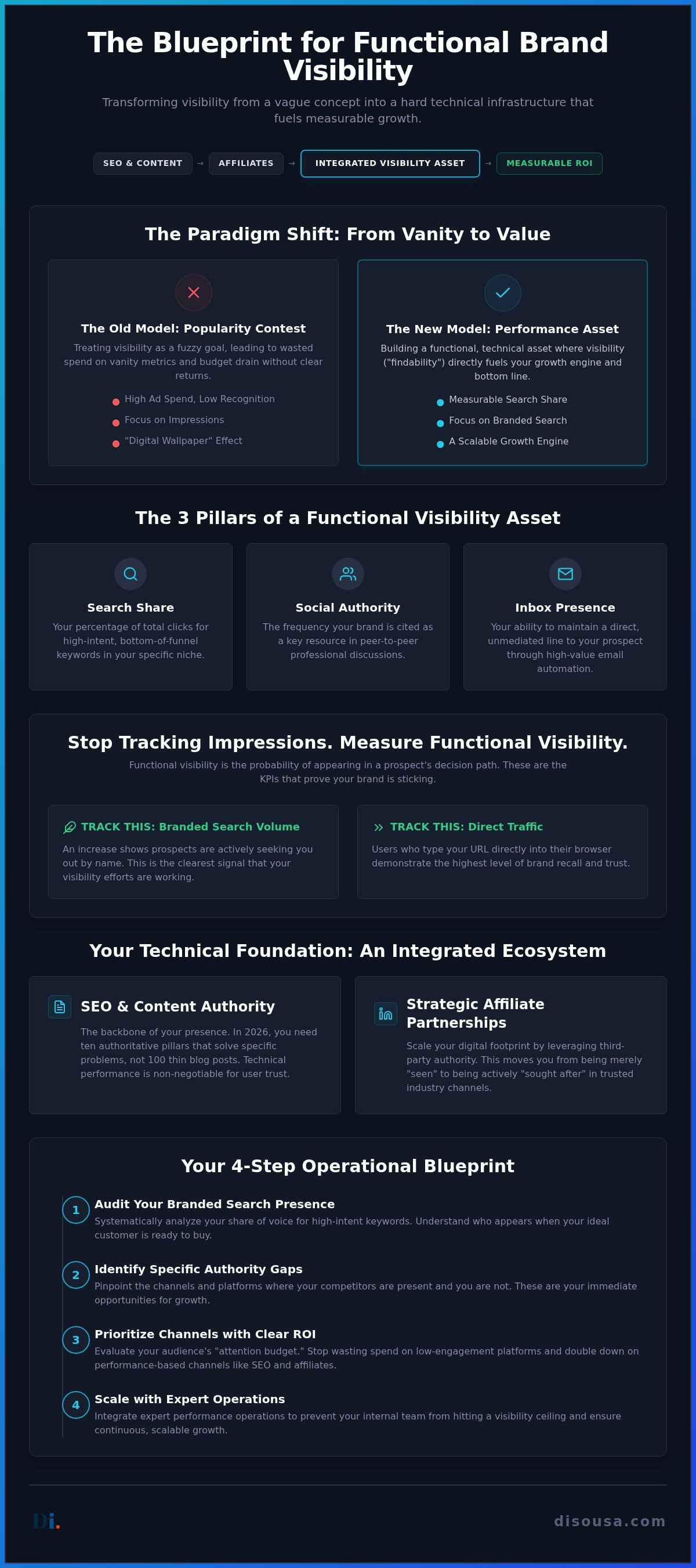
Visibility in 2026 is a technical utility. We’ve moved past the era where brand awareness was a vague sentiment measured by fuzzy surveys. Today, visibility is about findability. It’s the difference between a billboard on an empty highway and being the first result when a buyer has a credit card in hand. When you invest in online brand visibility services, you aren’t buying impressions. You’re building a functional asset that consists of search share, social authority, and inbox presence.
This asset acts as a multiplier for your conversion rate optimization (CRO) efforts. Traffic is expensive; qualified traffic that already recognizes your brand is priceless. By establishing presence early in the buyer journey, you reduce the friction of the final sale. Using established Internet branding techniques helps ensure that your technical infrastructure supports this findability. I’ve seen brands double their conversion rates simply by fixing their visibility gaps before they ever touched their landing page copy.
To treat visibility as an asset, you must define its components clearly:
- Search Share: Your percentage of total clicks for high-intent keywords in your niche.
- Social Authority: The frequency with which your brand is cited as a resource in peer-to-peer professional discussions.
- Inbox Presence: Your ability to maintain a direct, unmediated line to your prospect through high-value email automation.
The Shift from Passive to Active Presence
Waiting for customers to find you via organic search is no longer a viable standalone strategy. In competitive B2B sectors, proactive channel placement is required. You must move from being seen to being sought after. This involves a shift in how online marketing services are deployed. We ensure your brand appears exactly where your prospects look for solutions, often before they even realize they need a specific product. Proactive visibility means your brand is already a known entity when the search query is finally typed.
Measuring the ROI of Visibility Services
Stop looking at impressions. They are a vanity metric that hides the truth about your performance. Instead, track branded search volume and direct traffic. These KPIs indicate that your online brand visibility services are actually sticking in the minds of your audience. If prospects search for your company by name, your visibility is functional. Use attribution modeling to link these early touches to your bottom line. Functional Visibility is the probability of appearing in a prospect’s decision path.
The Technical Foundation: Core Components of Visibility Services
Visibility is an ecosystem, not a single tactic. To build a presence that lasts beyond the next algorithm update, you need a baseline of integrated online brand visibility services that work together. Most managers make the mistake of siloed thinking. They treat SEO, paid media, and email as separate buckets. In reality, these channels should function as a single technical stack. When you align these components, you create a footprint that is both wide and deep.
I recommend starting with a comprehensive digital marketing plan that treats visibility as a measurable asset. This isn’t about being everywhere at once. It’s about being in the right places with enough technical authority to stay there. If you’re ready to audit your own stack, we can provide a functional assessment of online marketing services for your business.
SEO and Content Authority
SEO is the backbone of your digital presence. In 2026, search engines prioritize content depth over simple volume. You don’t need 100 thin blog posts; you need ten authoritative pillars that solve specific problems. Your digital growth strategy must prioritize search intent. Technical search performance is non-negotiable because it impacts user trust. If your site is slow or hard to navigate, your brand authority drops before the prospect even reads a word.
Strategic Affiliate Partnerships
Affiliate marketing allows you to scale your footprint by leveraging third-party authority. It creates an echo chamber effect. When a prospect sees your brand mentioned across multiple trusted sites, your perceived authority grows exponentially. Implementing affiliate marketing for brands helps you recruit partners who align with your operational standards. This performance-based growth reduces your visibility risk because you only pay for results, not just impressions.
Email marketing and paid performance media round out the foundation. While SEO and affiliates build organic assets, performance marketing allows you to “rent” visibility while your long-term assets mature. Email is then used to maintain that visibility within the most personal digital channel. It ensures that once you’ve captured a prospect’s attention, you don’t lose it to a competitor’s ad. When investing in online brand visibility services, prioritize partners who understand this technical interplay. It’s the only way to move from temporary reach to permanent market share.
Channel Selection: Prioritizing Performance over Vanity Metrics
Strategic channel selection is about managing your audience’s attention budget. You don’t have infinite resources, so you can’t treat every platform as equally valuable. Effective online brand visibility services help you identify which channels actually move the needle for your specific business model. If your audience is composed of technical decision-makers, a high-volume social strategy might be a waste of capital compared to targeted search authority. You’re looking for the intersection of where they spend their time and where they are most receptive to professional solutions.
There’s a constant trade-off between cost-per-acquisition (CPA) and long-term visibility. Paid media offers immediate reach, but you’re essentially renting that space. The moment you stop paying, the visibility vanishes. Organic assets take longer to build but provide a much lower CPA over the long term. A balanced approach uses paid channels to bridge the gap while your organic footprint matures. Don’t fall into the “everything everywhere” trap. It’s better to dominate two key channels than to be a ghost on five. Focus your resources where the data shows the highest intent.
To see how a brand can dominate a specific high-intent niche effectively, you might check out Discount Hydro, a specialist retailer that maintains a strong presence in the hydroponics industry.
High-Intent vs. High-Volume Channels
Search is where intent lives. When someone types a query, they’re actively seeking an answer or a product. This makes search a high-intent channel where visibility translates directly into leads. Social media, conversely, is a high-volume channel. It’s great for building awareness, but the users aren’t always in a buying mindset. When promoting your content online, you must prioritize channels that offer the highest probability of conversion. I’ve seen brands burn through budgets on social reach that never converted because the audience wasn’t in “problem-solving mode” while scrolling. You need to balance immediate traffic needs with the slow work of building organic authority.
The Role of Email in Visibility Retention
Visibility doesn’t end at the first click. In B2B, the sales cycle can last months. If you don’t have a plan for retention, you’re just paying for one-time visits. You need lead nurturing email campaigns to maintain your presence throughout the decision-making process. This is the most personal digital channel you have. Automation allows you to stay top-of-mind with consistent, high-value touchpoints that don’t feel like spam. It’s about being a reliable resource that appears exactly when the prospect is ready to move to the next stage. Consistently appearing in an inbox is a form of online brand visibility services that most agencies overlook, but it’s often the most profitable way to maintain authority without additional ad spend.
Operational Blueprint: Auditing Your Brand’s Digital Footprint
You can’t optimize what you haven’t measured. Before scaling your online brand visibility services, you need an operational baseline of your current digital footprint. This isn’t a surface-level look at your follower count. It’s a technical assessment of how your brand appears across the decision path of a prospect. I recommend a five-step process to identify where your presence is functional and where it’s failing.
- Step 1: Conduct a branded search audit to see what prospects see first.
- Step 2: Map competitor visibility to identify authority gaps.
- Step 3: Analyze technical SEO and site performance metrics.
- Step 4: Evaluate current partnership and affiliate reach.
- Step 5: Set a baseline for branded traffic and referral conversions.
Technical SEO and site performance are the bedrock of this audit. If your site doesn’t load quickly or lacks accessibility, your visibility doesn’t matter because users will bounce before the page renders. Many brands leverage 216digital to ensure their technical infrastructure is compliant and user-friendly for everyone. Similarly, evaluate your affiliate reach. Are your partners driving qualified traffic, or are they just inflating your impression count? By setting a baseline for branded traffic and referral conversions now, you can accurately measure the ROI of your online brand visibility services as you scale.
The Branded Search Audit
Start by searching for your brand name. Page 1 of the search results is your digital business card. If you don’t own the majority of this real estate, you’re losing trust. Look for third-party reviews, industry mentions, and social profiles. If a competitor’s ad or a negative review appears above your own site, your visibility has a structural leak. Use this checklist to verify your consistency:
- Check that your meta descriptions match your current value proposition.
- Verify that third-party review sites have updated contact information.
- Ensure social media profiles use current branding and active links.
- Confirm that your Knowledge Graph or local listing displays accurate data.
Beyond these basic checks, you can explore Google Map Pack with AI Assistant to gain deeper insights into your local performance and identify new opportunities for growth in regional search results.
Identifying and Exploiting Authority Gaps
Your competitors likely own keywords that you should contest. Use technical tools to map where their visibility overlaps with your target audience. You aren’t just looking for high-volume terms; you’re looking for unclaimed digital real estate. These are niche topics where your competitors are weak or absent. Identifying these gaps allows you to scale your digital marketing by focusing on high-probability wins rather than broad competition.
Once you identify these gaps, develop a plan to occupy them. This involves creating deep, authoritative content that solves the specific problems your competitors are ignoring. This is how you move from a generic presence to a dominant one. If you’re ready to stop guessing and start measuring, you can request a functional assessment of online marketing services to see exactly where your gaps are.
Scaling Visibility: Integrating Expert Operations into Your Strategy
In-house marketing teams often hit a visibility ceiling because they focus on tactical execution rather than strategic scaling. I’ve observed that internal resources are frequently consumed by the daily grind of content creation or basic ad management. This leaves no room for the high-level technical adjustments required to maintain market share in a competitive landscape. When you reach this point, moving from tactical execution to strategic growth management requires a shift in how you deploy online brand visibility services. You need to stop being the one who does the work and start being the one who manages the results.
Integrating external operations with your internal sales team is the most efficient way to scale. Your sales team needs to know exactly which visibility assets are driving the most qualified leads. We bridge that gap by ensuring your external footprint directly supports your internal sales goals. This alignment prevents the common friction where marketing claims success while sales sees no improvement in lead quality. To scale effectively, your visibility strategy must include:
- A transition from manual task management to automated performance tracking.
- Integration of third-party authority signals to validate your brand’s expertise.
- Clear attribution modeling that connects visibility touchpoints to closed deals.
- A feedback loop between your external marketing firm and internal product leads.
Choosing a Performance-Based Partner
When you select a partner to scale your online brand visibility services, you should prioritize a functional assessment of online marketing services over a generic sales pitch. Transparency in reporting is far more valuable than “guaranteed” rankings. No one can guarantee a specific spot on a search engine; however, a competent partner can guarantee visibility within your prospect’s decision path. You want a partner who understands the logistical reality of B2B growth and treats your visibility as a performance asset rather than a branding exercise.
The Disousa Approach to Brand Visibility
We treat visibility as a growth lever. Our method focuses on “clear over clever” strategies that deliver a measurable return on investment. We leverage global performance-based affiliate programs to build a foundation of third-party authority for your brand. This makes your brand present where it matters most, which reduces the risk often associated with traditional ad spend. We also use email automation to maintain that visibility after the first touch. This ensures you stay top-of-mind during long sales cycles without increasing your cost-per-lead. If you’re ready to build a functional blueprint for your digital presence, you can start by aligning your operations with our performance-focused framework.
Transforming Visibility into a Performance Engine
We’ve established that digital presence in 2026 is a logistical reality rather than a marketing theory. You now have the blueprint to move beyond vanity impressions and treat your brand’s findability as a technical asset. By auditing your current search footprint and prioritizing high-intent channels over high-volume noise, you turn visibility into a measurable growth lever. Integrating expert online brand visibility services ensures your internal team can focus on closing deals while your digital infrastructure maintains your market position.
Success requires a shift from passive reach to active, data-driven frameworks. We specialize in performance-based affiliate growth and email automation strategies that ensure your brand is present exactly where it matters most. If you’re ready to stop guessing about your ROI, it’s time to apply these authoritative digital marketing frameworks to your specific business model.
I’m ready to help you bridge the gap between your current presence and your growth targets. You can request a functional assessment of your brand’s visibility to identify your specific authority gaps. Let’s build a digital presence that actually moves your bottom line.
Frequently Asked Questions
What are online brand visibility services exactly?
Online brand visibility services are technical frameworks designed to place your brand directly in the decision path of your target audience. They go beyond simple reach by focusing on “findability” across search engines, third-party authority sites, and direct communication channels. We use these services to build measurable assets like search share and inbox presence, ensuring your brand is a known entity before a prospect even reaches your website.
How long does it take to see results from visibility marketing?
The timeline for results depends on your specific channel mix. Paid performance media can generate visibility within days; however, building organic authority through SEO and affiliate marketing typically takes three to six months to reach a performance baseline. I focus on creating long-term assets that reduce your cost-per-acquisition over time, rather than relying solely on temporary spikes from ad spend.
Is brand visibility the same as SEO?
SEO is the backbone of visibility, but it’s not the entire ecosystem. While SEO ensures you rank for specific search queries, visibility also encompasses your presence in prospect inboxes through email marketing and your footprint on third-party sites via affiliate marketing. Comprehensive online brand visibility services integrate these channels so your brand remains present even when a prospect isn’t actively searching.
Why should a B2B company care about brand visibility?
B2B companies face longer sales cycles and multiple decision-makers, making consistent presence essential for lead nurturing. High visibility acts as a multiplier for your conversion rate optimization (CRO) efforts because prospects convert faster when they already recognize your brand. If you don’t maintain visibility, you’re forced to re-introduce your value proposition at every single touchpoint, which significantly increases sales friction.
How much should I spend on increasing my brand’s online presence?
Your budget should be determined by your growth targets and customer acquisition cost (CAC) rather than a fixed industry average. We recommend a performance-based approach where you allocate funds toward online brand visibility services that demonstrate a clear link to branded search volume or direct traffic. Focusing your spend on high-intent channels prevents the “everything everywhere” trap that leads to wasted capital on vanity metrics.
Can I manage my own brand visibility in-house?
You can manage basic visibility in-house, but internal teams often hit a ceiling when it comes to technical scaling and affiliate recruitment. Expert firms provide the specialized infrastructure needed to manage complex email automation and global affiliate networks effectively. Transitioning to an external partner allows your internal team to focus on strategic growth and sales operations while we handle the logistical reality of maintaining your digital footprint.
Disclaimer
**Disclosure:** Some articles on this website may contain affiliate links. This means we may earn a commission if you purchase a product or service through certain links, at no additional cost to you. We only recommend products, tools, and services that we believe provide value to our readers.
**Disclaimer:** The information provided on this website is for educational and informational purposes only and should not be considered financial, legal, tax, or professional advice. While we strive to keep our content accurate and up to date, we make no guarantees regarding completeness, reliability, or results obtained from using the information provided. Always conduct your own research and consult qualified professionals before making business, financial, or investment decisions.
