

Hiring a full-time affiliate manager in 2026 costs significantly more than a base salary when you factor in the specialized tech stack and recruitment lag. You might believe that keeping everything internal is the only way to maintain brand integrity. However, high overhead often stifles the growth you’re trying to achieve. When evaluating in-house vs agency affiliate programs, the decision usually comes down to whether you want to own the process or own the results.
You likely recognize the friction of manual publisher recruitment and the rising cost of training internal staff. This briefing provides a candid comparison of management models to help you decide between internal control and agency-led scalability. I will outline the true operational costs of both paths and provide a clear decision-making framework to help you grow faster. We’ll examine how to solve recruitment bottlenecks and ensure your tracking remains accurate as data privacy standards evolve. The goal is to move past the logistical hurdles and focus on measurable conversion optimization.
Key Takeaways
- Modern affiliate programs require advanced technical oversight; you’ll learn why AI-driven fraud detection and privacy-first tracking are now mandatory for survival.
- We break down the hidden costs of the in-house model, helping you see past the salary to the true price of tech stacks and recruitment lag.
- When comparing in-house vs agency affiliate programs, understand how an agency’s ‘Network Effect’ provides instant access to high-quality publishers you’d spend years recruiting alone.
- Use our decision matrix to audit your internal capacity and determine if your growth goals require steady maintenance or aggressive scaling.
- Discover how to build a technical foundation that scales without the friction of hiring, positioning your program as a high-performance growth engine.
The Reality of Affiliate Management in 2026
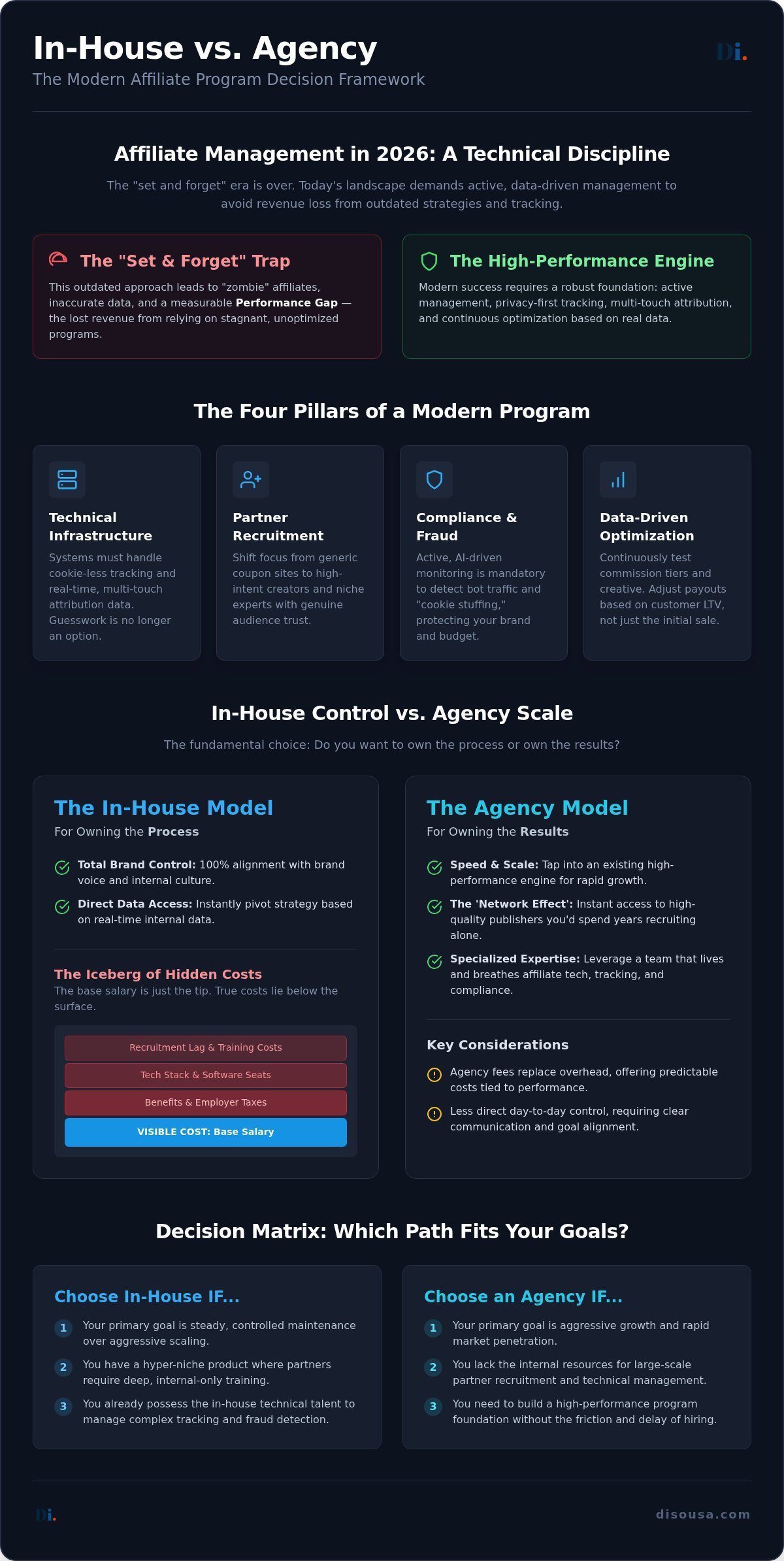
Affiliate marketing is no longer a peripheral revenue stream you can manage from the corner of a desk. By 2026, it has matured into a sophisticated technical discipline. It’s not 2015 anymore. You can’t just sign up for a network, upload some banners, and wait for the checks to arrive. Today, success requires managing multi-touch attribution, server-to-server tracking, and AI-driven fraud prevention. This technical burden is why the debate over in-house vs agency affiliate programs has become a top-tier operational priority for growth teams.
A significant majority of CMOs report that their internal teams lack the technical depth to manage performance channels at scale. The landscape has shifted toward privacy-first tracking and complex attribution models that credit multiple partners across a single customer journey. If your tracking isn’t precise, you’re either overpaying for low-value clicks or losing your best partners to competitors who can prove their worth. You’re left with a core dilemma: do you invest the capital to build this high-performance engine internally, or do you rent one that’s already optimized?
The Four Pillars of Modern Program Management
To run a competitive program in 2026, you must master four specific areas. If you’re missing even one, your ROI will suffer. These pillars form the basis of a strategic framework for performance growth.
- Technical Infrastructure: You need systems that handle cookie-less tracking and real-time attribution data. Without this, your reporting is essentially guesswork.
- Partner Recruitment: Generic coupon sites are losing their influence. Modern recruitment focuses on high-intent creators and niche experts who hold genuine trust with their audience.
- Compliance and Fraud: AI agents now scan for “cookie stuffing” and bot traffic in real time. Protecting your brand requires active, daily monitoring to ensure you aren’t paying for fake conversions.
- Optimization: This involves constant testing of commission tiers and creative assets. You must adjust payouts based on the lifetime value (LTV) of the customers being referred, not just the initial sale.
Why ‘Set and Forget’ is a Recipe for Failure
The “set and forget” mentality leads to “zombie” affiliates. These are partners who signed up years ago but haven’t sent a click in months. They clutter your dashboard and skew your data. Consumer behavior in 2026 is non-linear; a buyer might see a TikTok, read a professional review, and then use a discount code. Your tracking must map this entire path to remain effective.
Without active management, you will inevitably hit a plateau. I define the Performance Gap as the measurable loss in revenue that occurs when a program relies on stagnant partner lists and outdated tracking protocols rather than active, data-driven optimization. Understanding the structural reasons why affiliate marketing programs fail is the first step toward closing this gap before it costs you significant revenue.
The In-House Model: Control, Culture, and Hidden Costs
You want total control. I get it. The primary draw of the in-house model is 100% alignment with your brand voice and internal culture. An internal hire lives in your Slack channels, attends your product scrums, and understands the nuances of your brand better than any external partner ever could. When weighing in-house vs agency affiliate programs, this cultural intimacy is often the deciding factor for brands that view their affiliate partners as direct extensions of their sales team.
Direct access to internal data is another significant win. An in-house manager can pivot strategies instantly based on real-time inventory shifts or margin changes without waiting for a weekly sync. However, this level of control comes with a price tag that often exceeds initial budget projections. Many leaders overlook the “fully loaded” cost of a manager. Beyond the base salary and benefits, you’re paying for software seats, recruitment tools, and the ongoing education required to keep up with 2026’s technical demands. If you aren’t careful, the overhead can eat your margins before the first sale even clears.
I often see in-house programs hit a “recruitment ceiling” after about six months. An internal manager usually starts strong by onboarding low-hanging fruit and existing brand fans. Once that pool is dry, the grind of manual outreach begins. Without the massive database of an agency, an individual manager can spend 40 hours a week just trying to get a response from five high-value creators. It’s a resource drain that can stall your growth just as the program should be hitting its stride.
When In-House Makes Operational Sense
This model works best for early-stage startups with very niche partner requirements where only a handful of publishers truly matter. It’s also the correct choice for organizations handling highly sensitive or proprietary data that cannot leave the internal network for compliance reasons. If you already have a massive internal marketing operations team, adding an affiliate specialist might be a simple incremental move rather than a major structural shift.
The Resource Drain of Internal Management
The biggest risk here is the “Single Point of Failure.” If your only affiliate manager leaves, your program essentially goes dark. You lose their relationships, their specific knowledge of your tracking setup, and your momentum. Finding a “Unicorn” manager who understands both the technical side of attribution and the soft skills of relationship building is difficult and expensive in the current market. To avoid these pitfalls, many teams adopt a strategic framework for performance growth that prioritizes documented processes over individual heroics. If you’re struggling to find that balance, analyzing your internal capacity is the first step toward a more scalable solution.
The Agency Model: Speed, Scale, and Industry Leverage
While the in-house model offers cultural intimacy, it often lacks the velocity required to dominate a crowded market. When you look at in-house vs agency affiliate programs, the agency’s primary advantage is the “Instant Ecosystem.” You aren’t starting from zero. You’re plugging into a pre-built network of publishers who already have a proven track record of performance. This eliminates the “cold start” problem that kills many internal initiatives before they gain traction.
Agencies operate with a “Network Effect” that an internal manager simply cannot replicate. Because they manage programs across multiple brands, they see data in real-time that reveals exactly what’s working across the industry. If a specific creator or content site is driving high-quality traffic for an adjacent brand, the agency knows about it immediately. They don’t have to guess; they have the empirical evidence to back their recruitment strategy. This cross-brand insight allows you to skip the expensive testing phases that in-house managers must endure.
Cost efficiency is another major factor. High-end recruitment databases and premium tracking tools are expensive. Agencies spread the cost of these enterprise-level assets across their entire client base. You get the benefit of a $50,000 tech stack for a fraction of the cost. Scalability is baked into the model. If you need to ramp up partner recruitment for a massive product launch or a Q4 push, an agency can reallocate resources to your account instantly. You don’t have to deal with the friction of hiring and training a new employee for a seasonal spike.
The Advantage of Publisher Relationships
Top-tier publishers are overwhelmed. They receive hundreds of outreach emails every week, and most are ignored. However, when an agency they’ve worked with for a decade sends a proposal, they open it. Agencies hold “Preferred Partner” status, which translates into better placements, lower flat fees, and faster response times for your brand. Using agency leverage significantly reduces your time-to-market for new offers, allowing you to capture seasonal demand while your competitors are still stuck in the introductory email phase.
Advanced Analytics and Cross-Brand Insights
Data is only useful if you have the context to interpret it. Agencies use their own tech stacks to provide better attribution modeling, identifying “Super Affiliates” who are already performing well for your competitors. They can then recruit these partners using data-backed offers that are more likely to convert. This level of technical precision is detailed further in our functional assessment of online marketing services 2026, where we analyze how performance data drives long-term strategy. By utilizing an agency, you’re buying a blueprint for growth rather than just a set of hands to do the work.
Decision Matrix: Which Path Should You Take?
You’ve seen the pros and cons. Now you need to decide. The choice between in-house vs agency affiliate programs isn’t binary; it’s an operational decision based on your current burn rate and how fast you need to scale. If you’re looking for steady, incremental growth, an internal hire might be the right long-term play. However, if your board is demanding aggressive scaling, you simply won’t have the time to recruit and train a team from scratch. You have to be honest about your internal capacity before you commit to a path.
I recommend a three month test for brands that are on the fence. Many of our colleagues use an agency to launch the program, build the technical foundation, and recruit the initial partner cohort. Once the engine is humming and the workflows are documented, they bring the management in-house. It’s a low-risk way to avoid the expensive mistakes of a botched launch while keeping long-term options open. You don’t want to be six months into a program only to realize your tracking is broken and your top partners are leaving for competitors. Reviewing the most common reasons why affiliate marketing programs fail before committing to either model can save you from costly structural mistakes during this critical launch window.
A 4-Point Audit for B2B Decision Makers
Before making a move, run your current situation through this audit. It will clarify whether you’re ready to build or if you should rent expertise.
- Budget: Can you afford a six-figure salary plus benefits for a senior manager, or is a predictable agency retainer more manageable for your current cash flow?
- Tech Stack: Do you already own enterprise-level tracking software, or do you need a turn-key solution that an agency provides out of the box?
- Network: Do you have the direct contact information for the top 50 publishers in your niche? Relationships are the primary currency of this channel.
- Speed: How quickly do you need to see a return? Agencies can often go live and start recruiting within weeks, while hiring a manager can take months.
The Hybrid Model: The Best of Both Worlds?
The hybrid model is gaining traction because it balances internal strategy with external execution. In this setup, your internal marketing lead sets the high-level goals and brand guidelines, while the agency handles the heavy lifting of recruitment, technical troubleshooting, and daily partner communication. This structure prevents your internal team from getting bogged down in the minutiae of “cookie stuffing” audits and broken link reports. It allows you to grow your brand through affiliate partnerships without sacrificing your team’s focus on core product goals. If you’re ready to bypass the hiring lag and start scaling immediately, schedule a briefing with our team to see how we can integrate with your current operations.
Scaling Your Affiliate Strategy with Disousa
When you evaluate in-house vs agency affiliate programs, technical debt is often the silent killer of internal teams. We solve this by implementing a robust infrastructure that handles attribution and fraud detection from day one. This allows you to focus on high-level strategy while we manage the logistical complexities of global brand expansion. We prioritize substance and readiness over flashiness. Our goal is to ensure your program is a reliable asset rather than a constant management burden.
The Disousa Performance Framework
Our framework is built on data-driven partner recruitment. We don’t just blast generic invites. We identify creators and publishers who specifically cater to your B2B audience. We then apply continuous conversion optimization to ensure that the traffic being referred actually results in a sale. You get transparent reporting that moves beyond outdated last-click attribution. This gives you a clear view of how every partner contributes to your bottom line. We focus on measurable growth and long-term stability.
Next Steps: Launching or Migrating Your Program
If you’re currently managing a struggling in-house program, the transition doesn’t have to be disruptive. We handle the migration process by first conducting a deep audit of your existing setup. We identify the low-hanging fruit. These are the immediate technical fixes or partner optimizations that can drive quick wins. This methodical approach ensures readiness before we move into aggressive scaling phases. We value your time and prioritize the delivery of essential updates over marketing fluff.
You can start this process today. It’s time to move past the logistical hurdles of manual recruitment and inaccurate tracking. Request a Contact Disousa for a Functional Assessment of Your Affiliate Strategy to see where your current model is leaking revenue and how to fix it for 2026.
Selecting Your Performance Framework for 2026
You now have the operational context to audit your current model. The choice between in-house vs agency affiliate programs isn’t about which is better in a vacuum; it’s about which model aligns with your 2026 growth targets and technical capacity. We’ve examined the hidden costs of internal management and the “Network Effect” that allows agencies to scale with precision. If you don’t have the internal bandwidth to manage AI-driven attribution and manual partner recruitment, the agency model is the logical path forward to avoid expensive technical debt.
We focus on building high-value partnerships that drive measurable sales through our strategic partnership frameworks. Our approach prioritizes substance and readiness, ensuring your tracking is accurate and your partners are high-intent creators. If you’re ready to bypass the friction of hiring and move straight to performance, Request a Tactical Briefing on Scaling Your Affiliate Program. Our expertise in global performance marketing and data-driven conversion optimization ensures your program is built for long-term stability. The next step is selecting the framework that matches your operational capacity.
Frequently Asked Questions
Is it cheaper to manage an affiliate program in-house or with an agency?
Managing an agency is typically more cost-effective when you calculate the fully loaded cost of a full-time hire. When comparing in-house vs agency affiliate programs, remember that an agency provides an entire team and a tech stack for the price of one senior employee. You avoid the overhead of benefits, payroll taxes, and specialized software licenses. This makes the agency model a more predictable operational expense for brands focused on conversion optimization.
What are the biggest risks of an in-house affiliate program?
The most significant risk of an in-house program is the “Single Point of Failure.” If your only manager leaves, your program essentially goes dark and you lose their specific publisher relationships. You also face the risk of technical obsolescence. Internal teams often struggle to keep pace with rapid shifts in AI fraud detection and privacy-first tracking. This lag leads to inaccurate attribution and wasted commission spend.
Can a small brand afford an affiliate marketing agency?
Small brands can definitely afford agency management by choosing performance-based or hybrid fee models. It’s often more affordable than hiring a junior staffer who requires extensive training and lacks an established publisher network. Agencies allow smaller brands to punch above their weight by providing instant access to high-tier publishers who usually ignore unknown brands. This leverage is crucial for rapid growth without increasing your internal headcount.
How do I transition from an in-house program to an agency model?
Transitioning starts with a comprehensive audit of your current tracking and partner list. You should document all existing commission tiers and creative assets before handing over management. An agency will then migrate your data to a more robust platform and begin a recruitment sprint to fill gaps in your publisher mix. This process usually takes 30 to 60 days to complete without disrupting your existing revenue streams.
What software is required for in-house affiliate management?
In-house management requires a specialized tech stack including a tracking platform, a partner CRM, and fraud monitoring software. You’ll also need tools for automated payments and creative asset management. If you don’t already own these enterprise-level tools, the subscription costs can quickly exceed your budget. Agencies typically include access to these premium tools as part of their management fee, which significantly reduces your direct software spend.
How long does it take to see results with an affiliate agency vs. in-house?
Agencies generally deliver measurable results faster than in-house teams because they don’t have to start from zero. An internal hire might take three to six months just to build a pipeline of publishers and establish trust. In contrast, an agency plugs your brand into an existing ecosystem of partners. You can often see an uptick in recruitment and high-quality traffic within the first 30 days of activation.
Do agencies handle affiliate recruitment or just the tracking?
A full-service agency handles the entire lifecycle of the program, from technical setup to active publisher recruitment. They don’t just monitor the dashboard; they actively pitch your brand to high-value creators and niche content sites. This includes negotiating placements and managing the daily communications that an internal team often neglects. The goal is to move beyond mere tracking to active, data-driven performance management.
What is a typical agency fee structure for affiliate management?
Most agencies utilize a hybrid fee structure that combines a fixed monthly retainer with a performance-based commission. This ensures the agency is incentivized to drive actual sales rather than just vanity traffic. When evaluating in-house vs agency affiliate programs, this model aligns your costs directly with your revenue growth. It provides the transparency you need to maintain a healthy return on ad spend as you scale.
Disclaimer
**Disclosure:** Some articles on this website may contain affiliate links. This means we may earn a commission if you purchase a product or service through certain links, at no additional cost to you. We only recommend products, tools, and services that we believe provide value to our readers.
**Disclaimer:** The information provided on this website is for educational and informational purposes only and should not be considered financial, legal, tax, or professional advice. While we strive to keep our content accurate and up to date, we make no guarantees regarding completeness, reliability, or results obtained from using the information provided. Always conduct your own research and consult qualified professionals before making business, financial, or investment decisions.
