

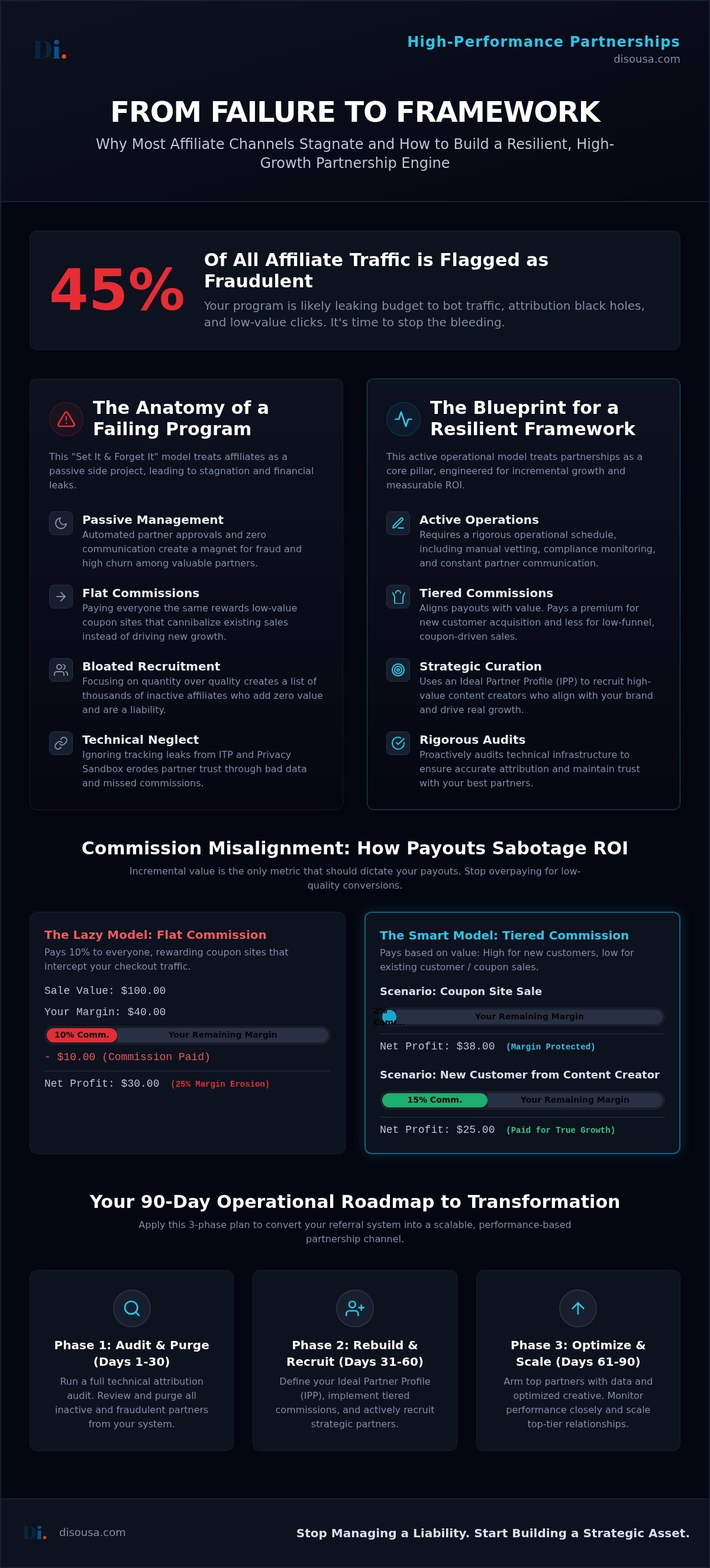
Did you know that 45% of all affiliate traffic is now flagged as fraudulent? This is a staggering figure that explains why affiliate marketing programs fail more often than they succeed in 2026. You likely feel the strain of managing a channel that demands high management overhead but delivers little more than low-quality coupon site clicks. It’s frustrating to watch your budget disappear into attribution black holes while your actual incremental growth remains flat.
I agree that the passive income mindset has crippled the potential of this channel. If you want a program that actually scales, you need to stop treating affiliates as a side project and start treating them as a strategic operations pillar. I’m going to help you identify the structural leaks in your current setup and provide a clear blueprint for building a high-performance partnership model. We will audit your tracking, fix your recruitment strategy, and move toward a system that rewards genuine value instead of bot traffic and empty clicks.
Key Takeaways
- Learn why the passive income mindset is a primary reason why affiliate marketing programs fail and how active management prevents program stagnation.
- Identify how flat commission structures accidentally incentivize low-value coupon sites instead of rewarding incremental sales growth.
- Transition from a high-volume list of inactive affiliates to a curated network of strategic partners that drive measurable results.
- Audit your technical infrastructure to stop tracking leaks caused by changing privacy regulations like ITP and Google’s Privacy Sandbox.
- Apply a 90-day operational roadmap to transform your referral system into a scalable, performance-based partnership channel.
Myth #1: The ‘Set It and Forget It’ Fallacy in Affiliate Marketing
Many brands treat their affiliate channel like a high-yield savings account that earns interest without supervision. This ‘passive income’ narrative is the primary reason why affiliate marketing programs fail within the first six months. When you treat the Affiliate marketing model as a set-it-and-forget-it system, you aren’t building a channel; you’re just opening a door for low-quality traffic and tracking errors. High-performance programs are never passive. They require a rigorous operational schedule that includes active recruitment, creative optimization, and constant compliance monitoring.
I often see mid-market brands fall into the ‘Launch-and-Languish’ cycle. They pay a setup fee to a major network, upload a single set of banners, and expect the sales to roll in. Without a dedicated manager to push the program forward, the only ‘partners’ who join are automated scrapers and coupon bots. By the time the brand realizes the sales volume is stagnant, the program has already developed a reputation for being unmanaged. An active affiliate program is a dynamic sales force that requires constant calibration to maintain alignment with your brand’s evolving goals.
The Reality of Management Overhead
Automated approval systems are a magnet for fraud. If you set your program to ‘auto-approve,’ you’re likely inviting the 45% of affiliate traffic that is currently flagged as fraudulent in 2026. Managing a program effectively involves a significant time commitment for Partner Relationship Management (PRM). You need to vet every applicant against your brand standards and check for past compliance issues. If you stop communicating with your partners, they will naturally drift away from your brand. This lack of engagement leads to high churn rates; your best creators will pivot to competitors who provide them with the data and support they need to succeed.
Strategic Alignment vs. Link Dumping
There is a massive difference between a strategic partner and a casual link-sharer. Most programs are bloated with thousands of affiliates who do nothing but dump links into dead forums or expired coupon directories. This creates a liability rather than an asset. You need a clear ‘Ideal Partner Profile’ (IPP) from day one to filter for quality. Successful affiliate marketing for brands requires a strategic framework that prioritizes high-value content creators over generic discount sites. By focusing on partners who align with your specific niche, you ensure that every click has the potential for genuine incremental growth rather than just cannibalizing your existing traffic.
Structural Misalignment: When Commissions Sabotage Your ROI
Flat commission structures are an operational lazy button. When you pay every partner the same percentage regardless of their role in the customer journey, you create a system that rewards the wrong behaviors. This structural flaw is a primary reason why affiliate marketing programs fail to deliver a positive return on investment. I’ve seen brands offer a blanket 10% commission only to find that 80% of their “sales” are coming from coupon sites. These sites don’t generate new demand; they simply intercept customers who are already in your checkout funnel looking for a discount code. You aren’t gaining a customer; you’re just losing margin.
Incremental value is the only metric that should dictate your payouts. If an affiliate introduces your brand to a new audience, they deserve a premium. If they simply provide a code to someone who was already reaching for their credit card, their commission should be minimal or zero. You can fix this by tiering your commissions. I recommend a higher payout for first-time customer acquisitions and a significantly lower rate for repeat purchases or coupon-driven conversions. This keeps your margins healthy and encourages partners to focus on genuine top-of-funnel influence. If you need to evaluate how your current setup stacks up, consider a functional assessment of online marketing services to identify these leaks.
Margin Erosion and Financial Blind Spots
Many managers fail to calculate the true cost of an affiliate sale. Once you factor in network platform fees, management time, and the cost of the discount code itself, a “profitable” sale can quickly turn into a loss. High-commission programs often attract low-LTV customers who are only loyal to the next discount. You also risk unmonitored affiliates bidding against your own brand terms in PPC. This forces you to pay a higher CPC for your own traffic while also paying the affiliate a commission. It is a double-hit to your bottom line that happens when you don’t enforce strict search policies.
Attribution Models: The Silent Program Killer
Last-click attribution is a broken relic that rewards the “closer” rather than the “introducer.” This model often hands the full commission to parasitic toolbar extensions that trigger a cookie a split second before the purchase. I’ve seen brands lose 20% of their margin to these extensions without even realizing it. Moving toward a multi-touch or value-based attribution model allows you to reward the content creators who actually did the heavy lifting. Transparency here is vital for compliance too. Partners must clearly disclose their relationship with you per the FTC Endorsement Guides to maintain trust with both the brand and the consumer. Without clean data and clear rules, your program will continue to leak revenue to low-value tactics.
The Partner Recruitment Trap: Quantity Over Strategic Value
Many marketing managers believe that a larger affiliate list naturally leads to higher revenue. This is a mistake. If you have 5,000 affiliates but only 10 are driving consistent sales, you don’t have a thriving program; you have a database management problem. This obsession with quantity over strategic alignment is a primary reason why affiliate marketing programs fail. An “Open Network” strategy, where you accept every applicant to inflate your numbers, invites low-value partners who offer no real audience connection. You end up paying for network seats and management time for thousands of partners who will never generate a single conversion.
I recommend shifting from passive recruitment to active outreach. Passive recruitment means sitting back and waiting for signups, which usually results in a flood of “professional affiliates” who sign up for every program but promote none. Active outreach involves hunting for specific partners, such as niche experts, B2B peers, or content creators, who already speak to your target demographic. This targeted approach is the cornerstone of affiliate marketing for brands that want to build a scalable sales force. When you hand-pick your partners, you ensure that every link placed has a higher probability of reaching a qualified buyer.
The 80/20 Rule in Performance Marketing
In almost every successful program, 80% of the revenue is generated by just 20% of the partners. I call these your Super Affiliates. These high-performers are the lifeblood of your channel and require one-on-one management and custom incentives. The remaining “long-tail” of inactive affiliates often costs more to maintain than they’re worth. They clutter your reporting and increase the risk of tracking errors. You should prune your list every quarter. If a partner hasn’t generated a click in six months, they’re a liability to your program’s operational health and should be removed to keep your data clean.
Vetting for Brand Safety and Compliance
Rogue affiliates can destroy your brand reputation and your SEO standing in weeks. If a partner uses unethical “black-hat” techniques or makes false claims about your product, search engines may penalize your main domain. You must vet every applicant with a critical eye. Look for red flags like generic email addresses, dead websites, or a complete lack of niche focus. I use a simple 5-minute checklist to vet high-value partners before approval:
- Niche Relevance: Does their content solve a problem for your specific customer?
- Traffic Integrity: Do they have a history of genuine engagement rather than bot-driven spikes?
- Compliance History: Do they currently follow 2026 standards for sponsored content disclosures?
- Content Quality: Is the site updated regularly with original content, or is it just AI-generated slop?
- Professionalism: Do they have a valid, domain-based email address and a clear “About” page?
By keeping your network small and high-quality, you reduce your management overhead and protect your brand’s long-term value.
Technical and Attribution Failures: Losing Trust Through Bad Data
I’ve seen excellent brands lose their best partners because of a simple tracking leak. Trust is the hardest thing to build in this channel and the easiest to break with bad data. If your affiliates can’t see their conversions in real-time, or if they suspect they aren’t being credited for sales, they will move their traffic to a competitor. Technical instability is a quiet but lethal reason why affiliate marketing programs fail. You can have the best product and the highest commissions, but if your tracking engine is broken, your program is dead on arrival.
The landscape has shifted significantly with Apple’s ITP and Google’s Privacy Sandbox. These updates have effectively killed the traditional third-party cookie. If you’re still relying on browser-side pixels, you’re likely losing 20% of your attributed sales. Server-to-Server (S2S) tracking is no longer a “nice-to-have” feature; it’s a 2026 operational requirement. Research shows that adopting server-side tracking can increase attributed conversions by 18-24% simply by bypassing browser-level blocks. If you’re unsure which platform handles these technical requirements best, I suggest reviewing this affiliate marketing software comparison to see how different tools manage the transition to server-side tracking.
The Cookie Window Crisis
In 2026, 38% of affiliate programs have shortened their attribution windows to 7 days or less. While this might protect your margins on impulse purchases, it’s a death sentence for high-ticket B2B products with a 30-day sales cycle. You must match your “Cookie Life” to your actual sales reality. If a partner drives a click on mobile but the user completes the purchase on a desktop three days later, your system must be able to bridge that gap. Without cross-device attribution, you’re effectively stealing credit from your partners, which will inevitably lead to them dropping your program.
Affiliate Fraud: Detection and Prevention
Affiliate fraud cost the industry an estimated $3.4 billion in 2025, and current data shows that 45% of all affiliate traffic is fraudulent. Common tactics like cookie stuffing and click injection can drain your budget before you even notice. You need automated fraud detection tools that flag suspicious IP clusters and impossible conversion times. When you do find fraud, handle the “clawback” professionally. I recommend providing clear evidence to the affiliate before reversing commissions. This protects your reputation with honest partners while making it clear that you have zero tolerance for bad actors. If you want to ensure your infrastructure is secure, you can start with a functional assessment of online marketing services to identify and plug these technical leaks.
Building a Resilient Affiliate Framework for 2026
To move from a stagnant referral link system to a high-performance partnership channel, you must shift your perspective. Most programs are treated as an afterthought or a low-priority task for a junior marketer. This neglect is why affiliate marketing programs fail to scale beyond a few accidental sales. A resilient framework requires a 90-day roadmap focused on operational rigor rather than passive hope. We need to treat this channel as a strategic sales force that demands the same level of attention as your direct sales team.
In the first 30 days, prioritize your technical infrastructure. You must verify that server-side tracking is active and your cookie windows match your actual B2B sales cycle. Days 31 to 60 should focus on a partner audit. Prune the 80% of affiliates who drive zero revenue and move your high-performers to tiered commission structures. Finally, days 61 to 90 are for active recruitment. Revenue from creator affiliates grew by 47% year-over-year in 2026, and they now account for 24% of total affiliate spend. You can grow your brand through affiliate partnerships by targeting these specific, high-value creators instead of generic coupon sites.
KPIs That Actually Matter
Stop reporting total sales as your primary success metric. It’s too broad and often hides significant margin erosion. Instead, track your Customer Acquisition Cost (CAC) per partner and the Lifetime Value (LTV) of the customers they refer. If an affiliate brings in 100 customers with a 90% churn rate, they aren’t helping your bottom line. Focus on recruitment velocity and partner engagement rates. This data allows you to present a clear, fluff-free briefing to the C-suite that justifies the budget for professional management and better incentives.
Next Steps: Operational Readiness
Scaling requires more than just better software. You need a dedicated budget, updated legal terms that reflect 2026 compliance standards, and a tech stack that can handle cross-device attribution. Professional Outsourced Program Management (OPM) is often the missing ingredient here. Managing these moving parts internally usually leads back to the “passive income” trap that kills growth. Disousa specializes in transforming stagnant programs into measurable growth engines by applying these strategic frameworks. If you’re ready to fix the structural flaws in your channel, you should request a functional assessment of your affiliate operations.
Operationalizing Your Partnership Channel for 2026
Shifting from a “set it and forget it” mindset to active partnership management is the first step in reversing stagnation. You’ve seen that misaligned commissions, poor partner vetting, and technical tracking leaks are the core reasons why affiliate marketing programs fail in the current landscape. Success in 2026 requires moving away from the “more is better” recruitment trap and focusing on high-value creators who drive genuine incremental growth. It’s time to stop managing a database of inactive links and start leading a dynamic sales force.
We provide the performance-based growth strategies and candid, data-driven operational auditing needed to turn these insights into revenue. With global coverage for worldwide brand expansion, we help you build a resilient infrastructure that stands up to fraud and attribution shifts. If you’re ready to fix your structural flaws and build a high-performance channel, you can scale your brand through strategic affiliate partnerships with Disousa. Let’s get your program back on track and moving toward measurable results.
Frequently Asked Questions
Why is my affiliate program getting clicks but no sales?
High click volume without conversions usually indicates a disconnect between the affiliate’s pre-sell content and your landing page experience. If the traffic is legitimate, check your offer’s conversion rate against industry benchmarks to ensure your checkout process isn’t the bottleneck. If the traffic is fraudulent, you may be seeing bot-driven clicks designed to keep an account active without providing real value. This misalignment is a frequent reason why affiliate marketing programs fail to generate revenue.
How do I identify if an affiliate is using fraudulent methods?
Look for impossible conversion windows, such as clicks that result in sales within sub-three-second timeframes. You should also monitor for high volumes of clicks coming from a single IP address or clusters of IPs in regions that don’t match your target market. These patterns are common indicators of cookie stuffing or automated click injection. Reliable tracking platforms now include automated flags for these suspicious behaviors to help you protect your budget.
What is a good commission rate for a new affiliate program in 2026?
Your rate must be competitive enough to attract quality partners while protecting your margins. I suggest starting with a tiered model rather than a flat fee for every transaction. Pay a premium for new customer acquisitions and a lower maintenance rate for repeat buyers or coupon-driven sales. This structure prevents the margin erosion that often leads to program stagnation. Always research competitor rates within your specific niche before setting your baseline.
Should I use an affiliate network or a private tracking platform?
Networks provide immediate access to a pool of affiliates but charge significant override fees on every sale. Private platforms offer more control and lower long-term costs but require you to handle all recruitment and management yourself. If you have the internal resources to manage partnerships, a private platform often provides better data transparency. Many mature brands use a hybrid approach to maximize reach while maintaining strict control over their best partners.
How do I stop coupon sites from poaching my direct traffic?
Implement “coupon-specific” attribution rules in your tracking software to ensure you aren’t paying for customers who were already at the finish line. You can set your system to only pay commissions if a specific, unique code was used during the checkout process. Additionally, you should prohibit affiliates from bidding on your brand name plus “coupon” or “discount” terms in search engines. This prevents partners from intercepting your existing organic or paid traffic.
What is the average management fee for an outsourced affiliate agency?
Management fees vary based on the scope of the program and the level of active recruitment required. Most agencies charge a combination of a monthly retainer and a performance-based override on the sales they generate. You should check with specific providers to get a quote that reflects your brand’s volume and growth goals. I recommend looking for agencies that prioritize transparency and provide clear reporting on incremental value rather than just total sales.
Can affiliate marketing work for B2B service-based businesses?
Yes, it works exceptionally well when you pay for qualified leads or booked consultations rather than just final sales. In B2B, the sales cycle is longer, so your tracking must account for multi-touch attribution. Partnering with industry consultants and niche B2B content creators can drive higher-quality leads than traditional consumer-focused methods. This approach turns your affiliates into a professional referral network that understands the complexities of your specific service offering.
How long does it take for a new affiliate program to become profitable?
You should expect a ramp-up period of four to six months before seeing a consistent return on your investment. The first 90 days are usually dedicated to technical setup, partner recruitment, and offer testing. Once you identify your top-performing partners and optimize your commission tiers, the program should begin to scale predictably. Patience during the initial recruitment phase is vital for building a resilient foundation that supports long-term profitability.
Disclaimer
**Disclosure:** Some articles on this website may contain affiliate links. This means we may earn a commission if you purchase a product or service through certain links, at no additional cost to you. We only recommend products, tools, and services that we believe provide value to our readers.
**Disclaimer:** The information provided on this website is for educational and informational purposes only and should not be considered financial, legal, tax, or professional advice. While we strive to keep our content accurate and up to date, we make no guarantees regarding completeness, reliability, or results obtained from using the information provided. Always conduct your own research and consult qualified professionals before making business, financial, or investment decisions.
