

Why would a high-performing affiliate risk their conversion rates on a brand with zero market presence? Most new founders struggle with this because they treat recruitment as a numbers game rather than a structured value-exchange. You’ve likely experienced the frustration of sending outreach emails only to be ignored or targeted by low-quality coupon sites. Learning how to find affiliates for a new brand isn’t about begging for attention. It’s about engineering a deal that makes sense for partners who prioritize data-driven results.
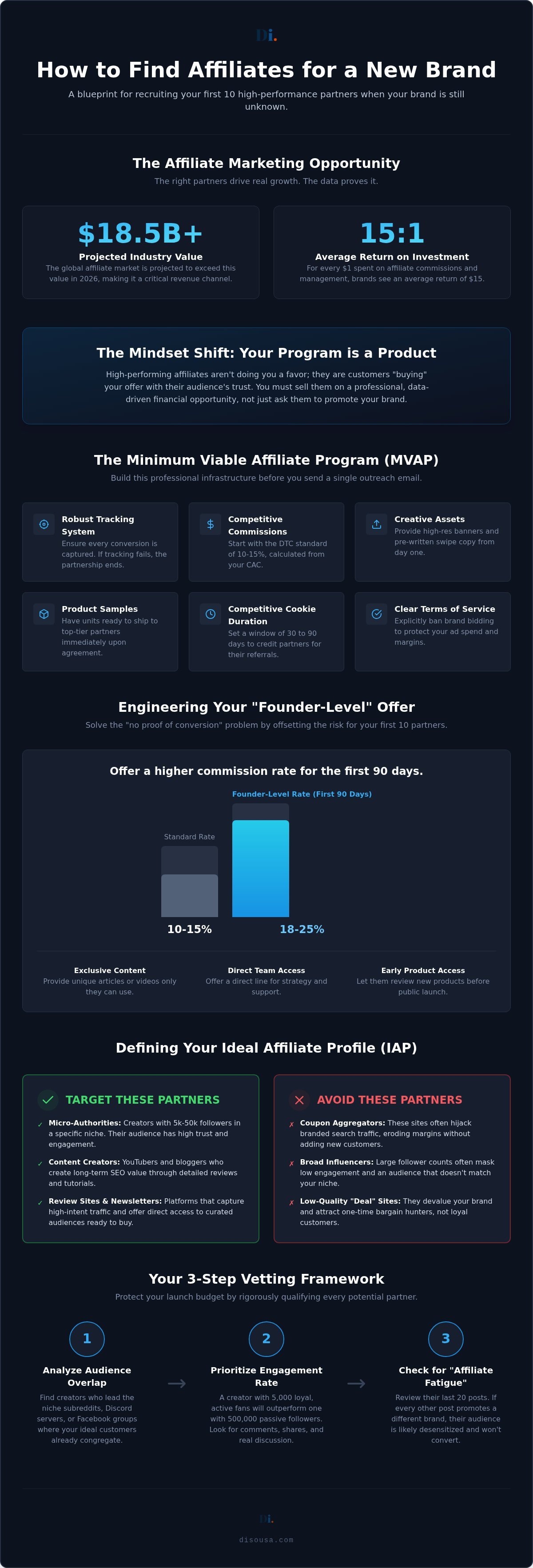
The global affiliate industry is valued at over $18.5 billion in 2026, with an average return of $15 for every $1 spent. This briefing provides a step-by-step blueprint for identifying and pitching high-performance partners even if your brand is currently unknown. I’ll show you how to build a list of 10 to 20 quality candidates and implement a repeatable outreach system. We’ll also define clear ROI expectations and commission benchmarks, such as the 10% to 15% DTC standard, to ensure your program is competitive from the start.
Key Takeaways
- Treat your affiliate program like a product you’re selling. You’ll learn how to engineer specific “first-mover” incentives to secure your initial ten partners.
- Shift focus from broad influencers to micro-authorities. These niche experts provide the high-trust environment necessary for a new brand to convert traffic.
- Master how to find affiliates for a new brand by reverse-engineering your competitors’ existing partnerships and identifying high-value targets in private niche communities.
- Adopt a “briefing-style” outreach approach. This tactical method treats potential affiliates as professional colleagues rather than fans to increase response rates.
- Build a long-term retention system using performance briefings. Integrating email marketing into your management strategy ensures your brand remains a priority for your partners.
Preparing Your New Brand for Affiliate Recruitment
You are not just looking for partners; you are selling a financial opportunity. Most founders fail at recruitment because they view affiliates as a free marketing channel. In reality, a high-quality partner is a customer who pays with their audience’s trust. If your program doesn’t look like a professional product, they won’t buy in. This is the core of how to find affiliates for a new brand: you must prove your infrastructure is ready to handle their traffic before they send a single click. The “First-Mover” advantage allows you to recruit partners who are usually locked into exclusive deals with competitors by offering them a seat at the table during your growth phase.
Trust starts with technical accuracy. If your tracking fails, the partnership ends immediately. You need a robust system that captures every conversion across devices and platforms. A foundational understanding of affiliate marketing shows that performance-based tracking is the bedrock of the industry. Without it, you cannot build a strategic framework for performance growth that scales. Competitive commission structures must be calculated backward from your Customer Acquisition Cost (CAC). If a typical sale allows for a 15% margin, consider starting your early adopters at a slightly higher rate to account for the friction of promoting an unproven brand.
The Minimum Viable Affiliate Program (MVAP)
Don’t launch with a blank portal. You need a suite of creative assets including high-resolution banners and pre-written swipe copy that matches your brand voice. Product samples should be ready for shipment to your top targets as soon as they sign the agreement. Your cookie duration should be set between 30 and 90 days to remain competitive in 2026. Finally, define your terms of service strictly. Explicitly ban “brand bidding” on search engines. This prevents affiliates from driving up your own ad costs by competing for your brand’s name in search results.
Incentivizing Early Adopters
You face a “chicken and egg” problem. Affiliates want proof of conversion, but you need them to generate the data. Solve this by engineering a “Founder-Level” commission structure. Offer a significantly higher rate for the first 90 days to offset their risk of testing an unproven brand. Provide these initial 10 partners with exclusive content, direct access to your team, or early access to upcoming product lines. Performance-based incentives are the core of partner trust because they align your brand’s revenue goals directly with the affiliate’s earnings. This structure ensures you protect your long-term margins while providing a practical answer to how to find affiliates for a new brand that actually want to grow with you.
Defining Your Ideal Affiliate Profile (IAP) for 2026
Chasing big influencers is a common mistake for unproven brands. High follower counts often mask low engagement and broad audiences that don’t convert. When considering how to find affiliates for a new brand, you should prioritize “Micro-Authorities” instead. These are creators with 5,000 to 50,000 followers who dominate a specific, narrow niche. Their audience trusts their technical recommendations because they provide deep value, not just lifestyle aesthetics. You want partners who act as a bridge between a customer’s problem and your solution.
Categorizing your potential partners helps you allocate resources effectively. Content creators on YouTube or blogs provide long-term SEO value. Review sites capture high-intent traffic from users comparing options. Newsletter operators offer direct, high-conversion access to a curated list. This classification is a vital step in how to find affiliates for a new brand that align with your specific growth stage. Conversely, you must define a “Negative IAP.” Avoid coupon aggregators and low-quality “deal” sites. These entities often use aggressive SEO to hijack your branded search traffic, which erodes your margins without adding incremental value.
The Vetting Framework
Your vetting process must be rigorous to protect your limited launch budget. Start by analyzing audience overlap. If your customers spend time in specific subreddits or Discord servers, find the creators who moderate or lead those spaces. Engagement rate is your primary metric. A creator with 5,000 loyal fans who comment and share will outperform a celebrity with 500,000 passive followers every time. Look for “Affiliate Fatigue” by reviewing their last 20 posts. If every second post is a different sponsored ad, their audience has likely stopped paying attention.
Strategic Alignment Metrics
Evaluation goes beyond just looking at numbers. You need to assess the “Problem-Solution” fit. Does your brand actually solve a pain point their audience frequently discusses? Technical competence is another non-negotiable factor. A partner must understand how to implement tracking links and comply with FTC guidelines on digital advertising disclosures. Non-compliance can lead to fines exceeding $51,000 per violation, which a new brand cannot afford. For more advanced strategies on vetting, see our Affiliate Marketing for Brands guide. If you’re struggling to filter these candidates, a functional assessment of your marketing services can help refine your target list.
Strategic Discovery: Where High-Value Partners Congregate
Finding quality partners isn’t a scavenger hunt; it’s a forensic investigation. If you’re wondering how to find affiliates for a new brand, stop searching for general influencers and start looking for where your competitors’ traffic originates. High-value partners are already promoting your rivals because those brands have already proven the market demand. Your goal is to identify these established publishers and present a superior value-exchange. Beyond the open web, significant activity happens in gated communities. Niche-specific Slack channels, Discord servers, and Telegram groups are the new hubs for high-performance marketers. These spaces allow you to connect with the Micro-Authorities we identified earlier who have direct access to your target demographic.
You also need a passive discovery setup. This is a basic operational requirement. Place a clear “Affiliates” or “Partners” link in your website footer. It ensures that when a potential partner organically discovers your brand and likes the product, they can immediately see your program’s structure. SEO tools are equally vital for identifying top-ranking informational content. By finding the articles that currently rank for “how to” or “best of” keywords in your niche, you can target the exact creators who already own the search results you want to occupy. This proactive approach ensures you aren’t just waiting for traffic; you’re going to where it already exists.
Competitor Backlink Analysis
I recommend using SEO tools like Ahrefs or Semrush to audit your direct competitors. Focus on their “referring domains” to see which websites are sending them the most traffic. Filter these results for “best of,” “review,” or “comparison” style articles. These pages represent high-intent traffic sources. If a site lists five of your competitors in a “Top 10” list, they are an ideal candidate for your outreach. You’ll also find aggregator sites that specialize in listing every brand in a category. While these are less personal, they provide essential base-level visibility for a new brand while you build your higher-tier partnerships.
Network vs. Direct Discovery
You have a choice between joining an established network or going direct. Networks like ShareASale or CJ Affiliate provide immediate access to a pool of publishers. However, they charge network fees on top of your commissions, which can squeeze a new brand’s margins. The direct-to-partner approach is often more effective for securing high-value deals. It allows for deeper personalization and better relationship management. You can also use strategies for promoting your content online to attract partners to you organically. This manual discovery process is slower but results in partners who are more aligned with your specific ROI goals. Understanding how to find affiliates for a new brand through direct channels often yields a much higher conversion rate than casting a wide net in a crowded network.
The Outreach Blueprint: Securing Your First 10 Partners
Mass-blasting generic emails is the fastest way to get your domain blacklisted. When you are determining how to find affiliates for a new brand, you must shift from a “marketing” mindset to a “business development” mindset. High-tier publishers receive dozens of pitches daily. They ignore anything that looks like a template. I recommend a “briefing-style” pitch that treats the recipient as a smart colleague rather than a fan. This approach respects their time and focuses on the logistical reality of a partnership: conversion rates, average order value, and commission floors.
The most common hurdle for a new brand is the “No Traffic” objection. Affiliates are hesitant to swap a proven earner for an unproven one. You must handle this with absolute transparency. If you don’t have affiliate data yet, use your internal metrics from SEO or email marketing as a proxy. Show them your cart conversion rate or your repeat purchase frequency. This data-driven honesty builds the trust necessary to secure those first ten “Anchor” partners who will define your program’s initial trajectory. Your follow-up sequence should be persistent but methodical; three touches over 14 days is usually the limit before you become a nuisance.
Crafting the Value-First Pitch
Your subject line must be functional. Use something like “Partnership Brief: [Your Brand] x [Their Site Name]” to signal a professional inquiry. Once they open the email, apply the “3-point” rule for personalization. Start with a specific compliment on a recent piece of their content to prove you aren’t a bot. Second, explain the logical alignment between their audience’s pain points and your product. Third, make a low-friction “Ask.” Don’t ask for a permanent site-wide link immediately. Propose a 30-day trial period or a featured spot in their next newsletter to test the conversion viability.
Closing the Deal
Negotiation is expected when you are recruiting high-potential partners. Be prepared to offer custom rates or “bounties” for new customer acquisitions to your first few affiliates. To understand these partnership dynamics better, read our Easy Guide to Affiliate Marketing. Once they agree to the terms, minimize their workload by providing a “Ready-to-Post” kit. This should include high-resolution assets, pre-approved disclosures that meet the latest FTC standards, and tracking links that are already tested. If you need a custom outreach strategy that bypasses the spam filters, explore our performance-based affiliate marketing services. Making the implementation process effortless is just as important as the commission rate when you are solving how to find affiliates for a new brand.
Management Systems: Scaling Beyond the Initial Phase
Once you have secured your initial partners, your focus must shift from recruitment to retention. Scaling a program is not just about increasing the number of sign-ups. It is about maximizing the output of every active link. Many founders fail because they believe the work ends after they learn how to find affiliates for a new brand. In reality, an unmanaged affiliate is a wasted resource. You need a structured management system to keep your brand top-of-mind. This involves a transition from manual, one-on-one outreach to a systematic, data-driven engine that rewards performance and prunes inactivity.
A “Monthly Performance Briefing” is a tactical necessity for this phase. This isn’t a marketing pitch; it’s a data update. Send your partners a concise summary of what worked over the last 30 days. Include the highest-converting creative assets, successful angles used by other partners, and any upcoming inventory changes. By providing this logistical reality, you position yourself as a reliable expert who values their time. This level of transparency makes it easier for partners to justify keeping your links active instead of switching to a competitor with a larger market presence.
Leveraging Email for Partner Nurture
Email marketing is your most effective tool for partner retention. An automated onboarding sequence should trigger the moment an affiliate is approved. This sequence provides them with their links, brand guidelines, and three immediate action steps to get their first conversion. You should apply our Lead Nurturing Framework to your affiliate segments just as you would for high-value B2B prospects. Regular communication keeps the partnership alive. Use monthly newsletters to share top-performing creatives and feature an “Affiliate of the Month” to encourage healthy competition among your cohort.
ROI and Performance Protocols
Data transparency is vital for long-term scaling. I recommend setting realistic 6-month KPIs for your program, focusing on active partner rates and average order values. Use your tracking software to identify “incrementality.” You need to determine if affiliates are bringing in new customers or simply poaching existing traffic through coupon hijacking. If a partner consistently brings in low-quality traffic with high return rates, prune them from the program immediately. Conversely, double down on your winners by offering higher tiers or exclusive bonuses. For a technical deep dive into these metrics, check our ROI Evaluation Guide.
The ultimate goal of this management phase is to create a self-sustaining referral engine. As your brand gains market presence, quality affiliates will begin to find you through your footer links or niche rankings. This organic growth only happens if your existing program has a reputation for accuracy, professionalism, and prompt payments. By moving beyond the initial phase of how to find affiliates for a new brand and into a disciplined management routine, you turn a volatile marketing channel into a predictable, scalable revenue stream.
Building a Scalable Performance Engine
Success in this channel depends on your ability to move from manual recruitment to a structured management system. We’ve established that the foundation of your program is the technical infrastructure and the “Founder-Level” incentives that attract your first ten partners. By prioritizing micro-authorities over broad influencers, you ensure that your traffic is high-intent. This approach works. It relies on niche trust rather than mass recognition to drive early results.
Mastering how to find affiliates for a new brand is only half the battle; the other half is maintaining the relationship through performance briefings and data transparency. You must verify your ROI and ensure that your partners are driving incremental growth. A methodical system turns a volatile outreach project into a predictable revenue stream. It’s about engineering a deal that makes sense for both parties long-term.
If you’re ready to move beyond the “failed recruitment” phase, we’re here to help. You can scale your performance marketing with Disousa’s strategic frameworks. We’re specialists in performance growth with a global management footprint and a strict focus on data-driven ROI. Your brand has the potential to scale worldwide with the right partner infrastructure in place.
Frequently Asked Questions
How much commission should a new brand offer to affiliates?
Most DTC brands offer a commission of 10% to 15% of the sale or a flat rate of $10 to $15 for new-customer orders. For specific niches like beauty, you might need to go as high as 18% to remain competitive. I recommend offering a “Founder-Level” bonus for the first 90 days. This higher rate offsets the risk that partners take when promoting an unproven product and helps you secure the initial ten partners discussed in the outreach blueprint.
Do I need a large affiliate network or can I run it myself?
You can choose based on your budget and internal technical expertise. Networks like ShareASale or CJ Affiliate provide access to large publisher pools but involve high entry costs and transaction fees. When deciding how to find affiliates for a new brand, you must weigh that reach against the cost of your own software. Self-serve platforms like ReferralCandy start at $39 per month, while Tapfiliate begins at $89 per month, allowing you to maintain higher margins by avoiding network overhead.
How long does it take to see results from a new affiliate program?
It typically takes 3 to 6 months for a new affiliate program to gain traction and generate consistent revenue. This period is necessary for partners to test your product, integrate links into their content, and for search engines to index new reviews. You won’t see an immediate surge in sales. Success requires a methodical approach to recruitment and a focus on long-term partner retention rather than short-term spikes.
Should I work with coupon and deal sites as a new brand?
I advise against working with coupon and deal sites during your initial launch phase. These sites often use aggressive SEO to rank for your brand name plus “coupon,” which allows them to claim commissions on customers who were already going to buy. Focus on the “Micro-Authorities” mentioned earlier who introduce your brand to new audiences. This ensures your affiliate spend is driving incremental growth rather than just poaching existing traffic.
What is the best way to track affiliate sales accurately?
The most accurate way to track sales in 2026 is through server-to-server (S2S) tracking or first-party data solutions. With the decline of third-party cookies, traditional tracking methods are less reliable. A 30-day attribution window is the common industry default. Using a platform that offers a branded portal for affiliates ensures they can monitor their own performance in real-time, which builds the trust necessary for a long-term partnership.
How do I find affiliates if I don’t have a big marketing budget?
You can solve how to find affiliates for a new brand on a limited budget by performing manual outreach to micro-authorities. Focus on creators with 5,000 to 20,000 followers in narrow niches. These partners often value early access to products and direct founder relationships more than high upfront fees. Use the competitor backlink analysis strategy to find who is already ranking for informational keywords in your niche and pitch them a performance-based partnership.
Can I use AI to find and pitch affiliates effectively?
You should use AI for partner discovery and data analysis, but avoid using it for bulk outreach. Professional publishers can easily identify AI-generated pitches, and these often get flagged as spam. Instead, use AI to summarize a partner’s recent content so you can write a more personalized email using the “3-point” rule. This allows you to maintain a human connection while scaling your research process effectively.
What are the biggest mistakes new brands make in affiliate marketing?
The biggest mistake is failing to vet partners properly, which leads to a program filled with low-quality traffic. Many brands also ignore FTC disclosure requirements. Fines for non-disclosure can reach over $51,000 per violation. Another common error is “setting and forgetting” the program. Without regular performance briefings and updated creative assets, your partners will eventually lose interest and switch to more active competitors who offer better support.
Disclaimer
**Disclosure:** Some articles on this website may contain affiliate links. This means we may earn a commission if you purchase a product or service through certain links, at no additional cost to you. We only recommend products, tools, and services that we believe provide value to our readers.
**Disclaimer:** The information provided on this website is for educational and informational purposes only and should not be considered financial, legal, tax, or professional advice. While we strive to keep our content accurate and up to date, we make no guarantees regarding completeness, reliability, or results obtained from using the information provided. Always conduct your own research and consult qualified professionals before making business, financial, or investment decisions.
