
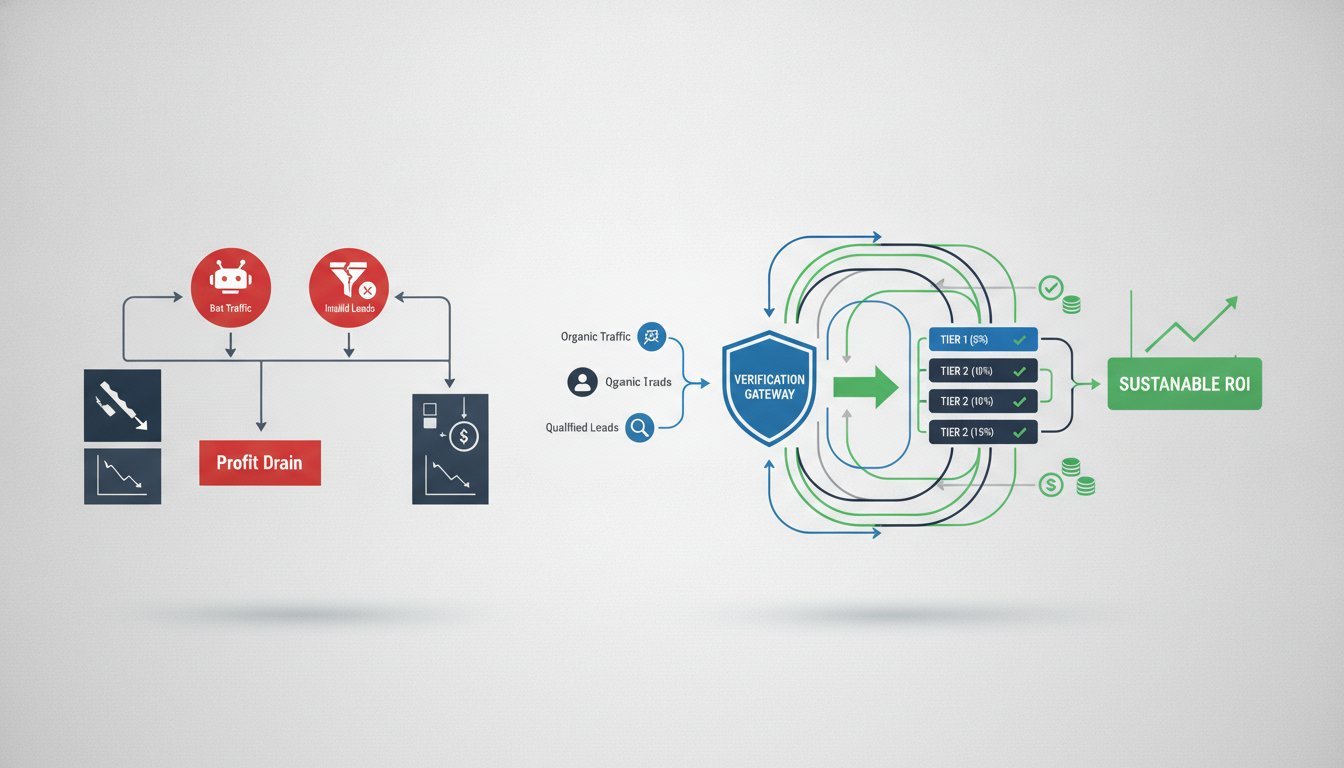
Approximately 45% of all affiliate traffic in 2026 is now classified as invalid or fraudulent. This trend contributes to a projected $100 billion in global losses for advertisers this year. You’re likely familiar with the frustration of investigating suspicious leads or watching bot traffic drain your budget while you are under pressure to scale. Preventing affiliate marketing fraud requires moving beyond reactive tools. You need a commission structure that makes fraudulent activity unprofitable by design.
I’ve put together this briefing to help you build a framework that prioritizes quality over raw volume. We will examine the specific fraud risks linked to various payout models and establish a roadmap for performance-based tiers. You’ll learn how to align your incentives with verified customer lifetime value to protect your brand’s profit margins. This guide provides the tactical blueprint needed to grow your program without increasing your exposure to sophisticated invalid traffic or residential-proxy botnets. By focusing on data-driven ROI, you can maintain program health while rewarding your most valuable partners.
Key Takeaways
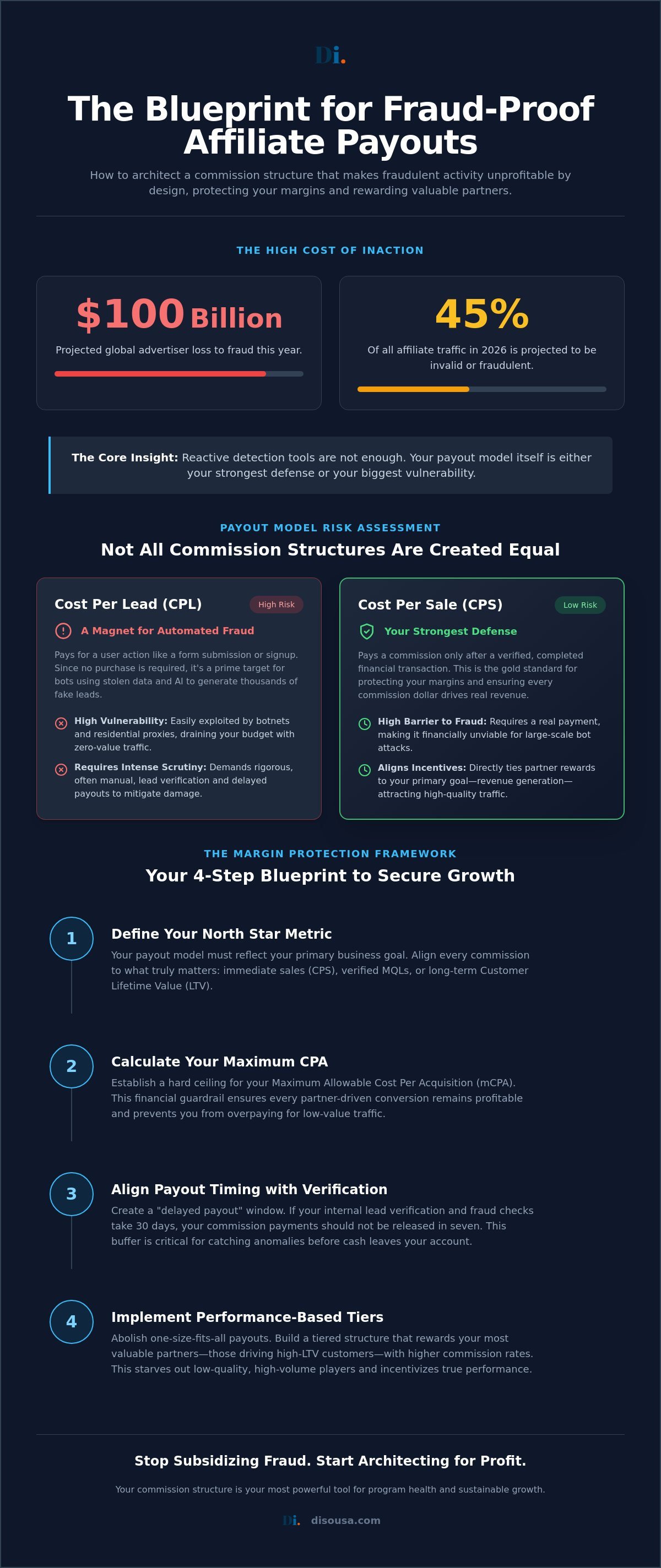
- Learn why shifting from Cost Per Lead (CPL) to Cost Per Sale (CPS) models is the most effective method for securing immediate margins against automated bot traffic.
- Discover how to calculate your Maximum Allowable Cost Per Acquisition (mCPA) to set commission ceilings that prioritize sustainable profit over raw volume.
- Master the tactical shift toward preventing affiliate marketing fraud by designing payout frameworks that make automated exploitation financially unviable for bad actors.
- Get a step-by-step roadmap for transitioning to tiered commission structures that reward high-quality performance without causing partner churn.
- Identify the specific operational triggers that indicate when to move from automated systems to active, managed program oversight for your high-value partnerships.
The Financial Impact of Affiliate Fraud: Why Prevention Starts with Payouts
In 2026, the financial damage from ad fraud is projected to exceed $100 billion. This isn’t just about simple bots anymore. Fraudsters now use sophisticated AI to mimic human behavior, making it harder to detect invalid traffic. If you want to succeed in preventing affiliate marketing fraud, you have to look at your commission structure first. Many brands treat payouts as a simple administrative task. They don’t realize that a poorly designed structure is actually an invitation for exploitation.
For a broader affiliate marketing overview, it’s clear that the industry has always struggled with issues like cookie stuffing. However, the modern “bottom-feeder” trap is more dangerous. When you offer a flat-rate commission for any lead or click, you attract affiliates who prioritize volume over value. These partners often use bot networks to hit targets because the payout doesn’t require actual customer intent. This creates a psychological rift with your high-tier partners. If they see you’re paying bot farms the same rate you pay them for expert content, they’ll move their traffic to your competitors.
To better understand the methods fraudsters use to exploit these systems, watch this helpful video:
The Failure of One-Size-Fits-All Models
Paying the same rate to a generic coupon site and a dedicated niche expert is a strategic error. Rigid structures lead to program stagnation. If your payout model doesn’t distinguish between high-intent traffic and low-value clicks, you’re likely over-rewarding partners who provide zero incremental value. This environment is where click injection thrives. You’re essentially subsidizing fraud while starving your legitimate growth drivers. Preventing affiliate marketing fraud requires a structure that recognizes the difference in lead quality at the point of payment.
Aligning Payouts with Brand Goals
You need to define a North Star metric for your program. Is it immediate sales, verified leads, or long-term customer lifetime value (LTV)? Your payout model should reflect this priority. We focus on affiliate marketing for brands by ensuring every dollar spent on commissions supports actual growth. You should also match your payout frequency to your internal verification requirements. If it takes 30 days to verify the legitimacy of a lead, don’t pay out in seven. This delay creates a necessary window to spot anomalies before the cash is transferred.
Evaluating Payout Models: Aligning Incentives to Eliminate Fraudulent Traffic
Software detection is a reactive measure. If your financial structure rewards bot-friendly behavior, you’ll always be behind. Preventing affiliate marketing fraud starts by choosing the right payout model for your business objectives. While many brands default to simple structures, sophisticated operations use their commission frameworks as a primary filter for traffic quality.
The Cost Per Sale (CPS) model is the most secure option for protecting immediate margins. Because a financial transaction must be verified before a commission is triggered, the barrier to entry for fraudsters is high. Conversely, the Cost Per Lead (CPL) model is often a magnet for invalid traffic. In 2026, where AI can generate realistic lead data at scale, CPL requires rigorous validation. You should consider deterring affiliate marketing fraud by implementing a “delayed payout” window for CPL, allowing your team to verify lead authenticity against CRM data before any funds are released.
Hybrid models offer a middle ground. You might provide a small flat fee to attract high-value partners, but keep the bulk of the incentive tied to performance bonuses. This attracts “Super Affiliates” who have the reach to drive volume but are willing to be held accountable for the quality of that traffic. If you’re struggling to balance these competing interests, partnering with an expert in affiliate marketing for brands can help you design a structure that scales without increasing your risk profile.
Performance-Based Tiers as a Filter
Legitimate partners typically show a steady, logical growth curve. Fraudsters often attempt to hit high-volume targets immediately using bot nets. By setting realistic performance tiers, you can isolate suspicious spikes. Only partners who pass initial quality audits should be moved into higher commission brackets. This approach motivates “middle-of-the-road” affiliates to improve their traffic quality while providing you with the data needed to spot anomalies in real time.
Dynamic Rates for Product Lifecycles
You can use higher rates for inventory clearance or new product launches without inviting long-term fraud. The key is to limit these “boosts” to trusted partners with a proven history of clean traffic. Protecting your margins on low-margin items is equally vital. You should exclude these products from high-tier payouts to ensure that a sudden surge in low-value sales doesn’t drain your budget. This methodical approach ensures your commission spend is always aligned with actual business value. For brands looking to optimize these complex frameworks, Disousa provides the operational oversight necessary to manage high-value partnerships securely.
Margin Protection Framework: Financial Modeling for Secure Affiliate Growth
Copying a competitor’s commission rate is one of the fastest ways to erode your margins. Their unit economics, overhead, and customer lifetime value (LTV) are not yours. If you set a rate based on what others are doing, you risk overpaying for low-value traffic or making your program a prime target for bot networks. Preventing affiliate marketing fraud requires a grounded understanding of your specific profitability thresholds. A rigorous financial model acts as a filter; if a commission is too high to be sustainable, it attracts partners who prioritize volume over quality. By anchoring your payouts to mCPA, you’re effectively preventing affiliate marketing fraud by making the cost of sophisticated bot traffic higher than the potential payout.
The Margin Protection Formula
To find your break-even point, you must look beyond the simple sale price. Start with your Gross Revenue per order and subtract the Cost of Goods Sold (COGS). Then, subtract platform fees, such as SaaS costs and network overrides, and your management overhead. You must also factor in a buffer for returns and chargebacks. Research from early 2026 indicates that even after standard network filtering, an estimated 5-10% of affiliate-attributed conversions are invalid. If you don’t account for these losses in your payout schedule, your true ROI will be significantly lower than reported. mCPA is the absolute ceiling for all performance marketing spend.
- Step 1: Identify Gross Margin after COGS.
- Step 2: Deduct fixed operational costs and platform overrides.
- Step 3: Apply a historical “Invalid Traffic” or “Return” percentage (typically 10-15%).
- Step 4: The remaining balance is your maximum commission pool.
Incentivizing High-LTV Customers
Not all customers are equal. A user who buys once and never returns is less valuable than a repeat buyer, yet many brands pay the same commission for both. You can disincentivize cookie stuffing on your existing audience by offering higher bonuses specifically for “New Customer” acquisitions. This forces affiliates to find fresh audiences rather than poaching your organic traffic. Use data-driven insights to reward quality over sheer volume. This approach ensures your budget is spent on high-value partnerships that contribute to sustainable growth. For a deeper look at how to measure these results, see our briefing on affiliate marketing ROI. Focusing on LTV allows you to set higher commission ceilings for the partners who actually move the needle for your business.
Operational Blueprint: Transitioning to Tiered Commissions Without Partner Churn
Moving from a flat-rate commission model to a tiered system is a high-stakes operational shift. If you do it wrong, you lose your best partners. If you don’t do it at all, you remain vulnerable to volume-based attacks. Preventing affiliate marketing fraud at this stage requires a methodical audit of your existing database. You need to identify which partners are driving incremental value and which are merely “bottom-feeding” on existing brand traffic. By establishing baseline tiers based on historical lead-to-sale ratios, you create a meritocratic environment that naturally pushes out low-quality actors.
Before a full-scale rollout, test the new structure with a small cohort of your most trusted “Super Affiliates.” These partners have the traffic volume to stress-test your tracking and the professional relationship to provide honest feedback. This pilot phase ensures your technical infrastructure is ready for the complexities of multi-tier attribution. It also allows you to refine your verification window. A standard 30-day window is often necessary to cross-reference affiliate data with CRM records, ensuring you never pay for a lead that doesn’t exist. If you need assistance managing these technical and operational complexities, Disousa provides the managed performance expertise required to secure your program.
The Communication Strategy
Transparency is your best tool for preventing partner churn. We recommend framing the shift as an opportunity for your best partners to earn more by hitting higher quality benchmarks. You should provide 30 to 60 days of notice before any downward adjustments go live. This window maintains trust and gives partners time to adjust their traffic sources. While you optimize your current roster, you can also use online brand visibility services to recruit new, high-value partners who are already accustomed to performance-based tiers. This proactive recruitment helps offset any temporary volume loss during the transition.
Technical Tracking and Attribution
Your CRM and affiliate platform must share real-time conversion data for a tiered system to work. Without this sync, you can’t accurately distinguish between a raw lead and a verified conversion. You’ll also need to decide on your attribution logic. Whether you use first-touch or last-touch, the rules must be clear and applied consistently across all tiers. We’ve found that providing partners with transparent, real-time reporting dashboards is the best way to prevent disputes. When an affiliate can see exactly why a lead was rejected or how close they are to the next tier, they’re more likely to focus on quality over volume. This level of clarity is essential for preventing affiliate marketing fraud while scaling your program’s legitimate reach.
Managed Performance: Scaling Strategic Partnerships Through Active Oversight
Automation has limits. While your software flags obvious bot spikes, it often misses the subtle patterns of sophisticated invalid traffic (SIVT) that only human oversight can identify. Moving to an active management model is essential when your program reaches a volume where manual auditing becomes a full-time job. I recommend leveraging outsourced affiliate program management to handle the technical and operational complexity of global scaling. An agency doesn’t just monitor traffic; it acts as a strategic negotiator. They have the market data to know when a partner is providing genuine incremental value or merely poaching your existing organic traffic.
Quarterly reviews are the backbone of a secure program. You must continuously optimize your commission spend against verified ROI. If a particular partner’s lead-to-sale ratio begins to dip, your management team must be ready to adjust their rates or placements immediately. This level of active oversight is what separates high-growth programs from those that eventually collapse under the weight of invalid traffic. By maintaining a tight feedback loop between your CRM data and your affiliate payouts, you’re effectively preventing affiliate marketing fraud before it can drain your quarterly budget.
Managing Super Affiliate Relationships
Your top 5% of partners will likely drive the majority of your revenue. These partners require custom commission structures that go beyond your standard tiers. You’ll often need to negotiate tenancy fees, which are flat payments for high-visibility placements, alongside your performance bonuses. The goal is to maintain brand alignment and exclusivity. If a partner has a massive, loyal audience, they deserve a bespoke rate that reflects their influence. However, this also requires stricter oversight to ensure their promotional methods don’t conflict with your internal online marketing services strategy. Bespoke deals should always be contingent on a clean audit history.
The 2026 Roadmap for Affiliate Success
The 2026 landscape is defined by the full implementation of the EU Digital Services Act and the move toward a cookieless future. Traditional tracking methods are becoming less reliable. Preventing affiliate marketing fraud in this environment requires a shift toward server-to-server (S2S) tracking and first-party data integration. You should treat your program as a partnership ecosystem rather than a simple sales channel. My final recommendation is to remain agile. As regulators in the US and UK tighten disclosure rules for influencers and live streamers, your commission framework must be flexible enough to reward compliance. A program built on transparency and data-driven ROI is the only way to ensure long-term, fraud-resistant growth.
Secure Your Growth with Data-Driven Payouts
Transitioning your program from a passive sales channel to a strategic partnership ecosystem is the only way to maintain margins in 2026. We’ve discussed how flat-rate payouts invite low-quality traffic and how anchoring your incentives to mCPA creates a natural barrier against bad actors. Preventing affiliate marketing fraud isn’t about finding a perfect software solution; it’s about building a financial framework that makes fraud unprofitable. By implementing performance-based tiers and rigorous verification windows, you protect your budget while rewarding the partners who drive actual value.
Scaling globally requires more than just a tracking platform. You need active oversight and data-backed ROI optimization to navigate complex attribution and evolving regulations. If you’re ready to move beyond automated systems and build a more resilient program, Explore Strategic Affiliate Management with Disousa. Our expertise in performance-driven growth strategies and global affiliate scaling ensures your program remains healthy as you expand. You have the tactical blueprint; now it’s time to execute.
Frequently Asked Questions
How can I prevent affiliate fraud in my commission structure?
You can effectively start preventing affiliate marketing fraud by shifting to a Cost Per Sale (CPS) model with a mandatory verification window. This delay allows you to cross-reference transactions against your CRM to identify bot-driven leads or chargebacks before funds are released. Aligning payouts with verified revenue rather than raw clicks makes the cost of running sophisticated bot nets higher than the potential reward for fraudsters.
What is a typical affiliate commission rate for e-commerce brands in 2026?
Commission rates vary significantly by sector but generally range from 5% to 20% of the net sale value. In 2026, many brands utilize a bifurcated approach where low-intent traffic sources receive a lower base rate while niche content experts earn higher percentages. You shouldn’t blindly copy competitor rates; instead, anchor your payouts to your specific unit economics and profit thresholds.
How do tiered commission structures work for high-growth brands?
Tiered structures utilize performance brackets to reward partners as they hit verified conversion milestones. A partner might earn a base percentage on their first 50 sales and move to a higher bracket once they exceed that volume. This approach allows you to audit traffic quality in the lower tiers before committing to the higher payouts required for scaling with super affiliates.
Should I pay affiliates for repeat purchases or only for new customers?
Prioritizing new customer acquisitions is a tactical move for preventing affiliate marketing fraud like cookie stuffing on your existing audience. While paying for repeat purchases can support long-term LTV goals, it often rewards affiliates for sales that would have occurred organically. Many brands find success by offering a premium bonus for the first transaction and a reduced rate for subsequent orders.
What is the difference between a flat fee and a percentage-based commission?
A flat fee is a fixed dollar amount paid per action, while a percentage-based commission scales with the total order value. Flat fees are standard in lead generation but carry a higher risk of exploitation through automated form fillers. Percentage-based models are more secure for e-commerce because they ensure the affiliate’s incentive is always directly proportional to the actual revenue they generate.
Can I change my affiliate commission rates once the program has launched?
Yes, you can adjust rates as your margins or goals evolve. The key is providing a 30 to 60-day notice period to maintain trust and allow partners to update their promotional content. Transparent communication regarding why the change is happening prevents churn and ensures your most valuable partners stay aligned with your new performance benchmarks.
What is a hybrid affiliate commission model?
A hybrid model combines a fixed tenancy fee for placement with a performance-based commission. This structure is typically used to secure high-visibility spots on major authority sites or with super affiliates. The flat fee covers the partner’s overhead and “real estate” value, while the percentage-based commission ensures they remain focused on driving high-quality, converting traffic to your brand.
How do I determine if my affiliate program is actually profitable?
Profitability is determined by comparing your total affiliate acquisition cost against the net revenue generated after all expenses. You must factor in Cost of Goods Sold (COGS), platform overrides, returns, and management fees. If your total spend per customer stays below your calculated Maximum Allowable Cost Per Acquisition (mCPA), your program is contributing to sustainable net profit.
Disclaimer
**Disclosure:** Some articles on this website may contain affiliate links. This means we may earn a commission if you purchase a product or service through certain links, at no additional cost to you. We only recommend products, tools, and services that we believe provide value to our readers.
**Disclaimer:** The information provided on this website is for educational and informational purposes only and should not be considered financial, legal, tax, or professional advice. While we strive to keep our content accurate and up to date, we make no guarantees regarding completeness, reliability, or results obtained from using the information provided. Always conduct your own research and consult qualified professionals before making business, financial, or investment decisions.
