
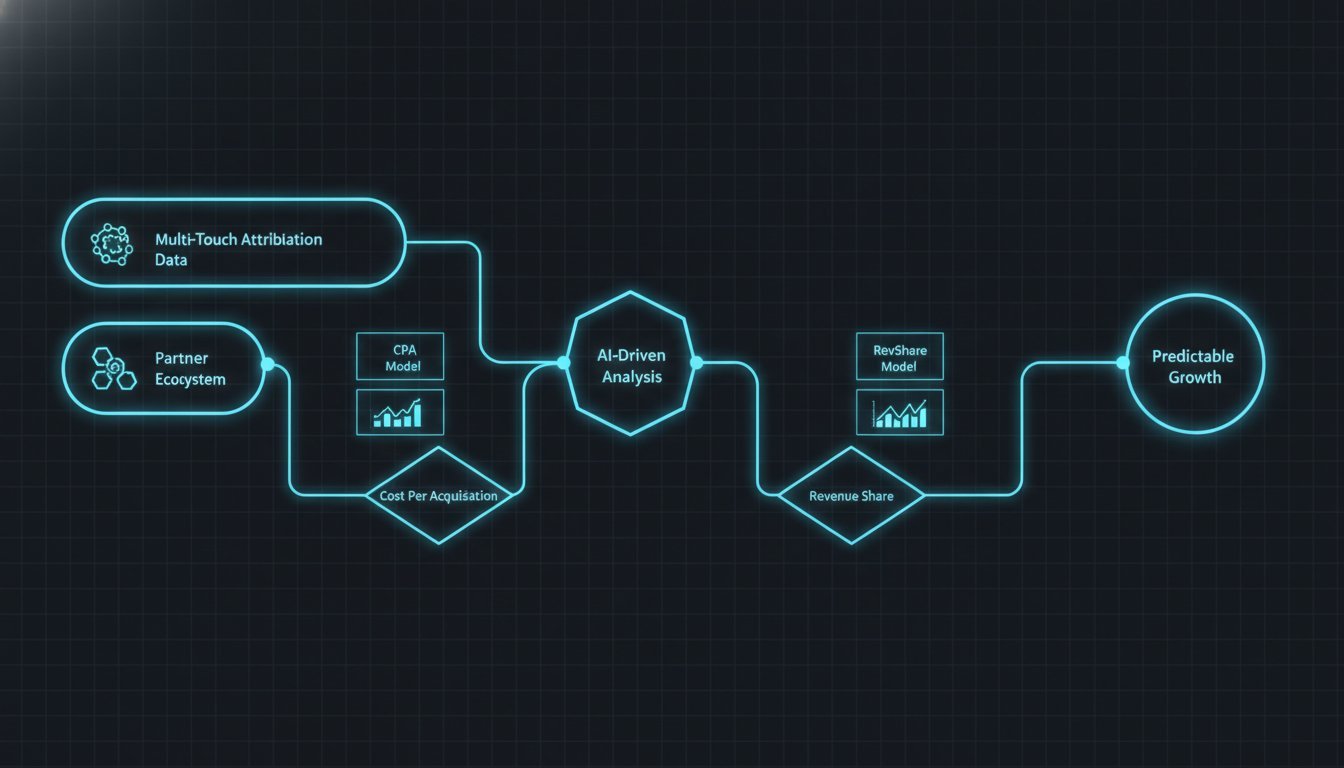
By November 2025, 71% of organizations had already moved to tying compensation directly to measurable performance goals. You’re likely feeling the pressure to follow suit while protecting your margins. If you haven’t refined your performance-based commission models yet, you’re probably dealing with misaligned incentives and low-quality leads. I know the complexity of tracking multi-touch attribution often leads to a fear of overpaying for growth that isn’t actually incremental.
I’ve designed this briefing to provide you with a tactical framework for selecting and implementing commission structures that align with your business outcomes. We’ll examine how to maintain ASC 606 compliance and use AI-driven tools to lower acquisition costs by up to 29%. This guide moves past the theory to give you a blueprint for predictable scaling and higher partner conversion rates. You’ll get the exact data points you need to make informed decisions for your 2026 growth strategy.
Key Takeaways
- Understand the transition to a “pay-for-results” economy and why fixed-fee structures are no longer viable for 2026 digital partnerships.
- Compare the mechanics of different performance-based commission models like RevShare and CPA to identify which structure best protects your profit margins.
- Learn how to align your chosen commission model with your specific sales cycle to ensure you aren’t overpaying for non-incremental growth.
- Establish a technical blueprint for multi-touch attribution and tracking to maintain high data integrity across your partner ecosystem.
- Discover how to scale your results by integrating email marketing and affiliate management into a unified performance strategy.
The Shift to Performance: Why Fixed Fees Are Fading in 2026
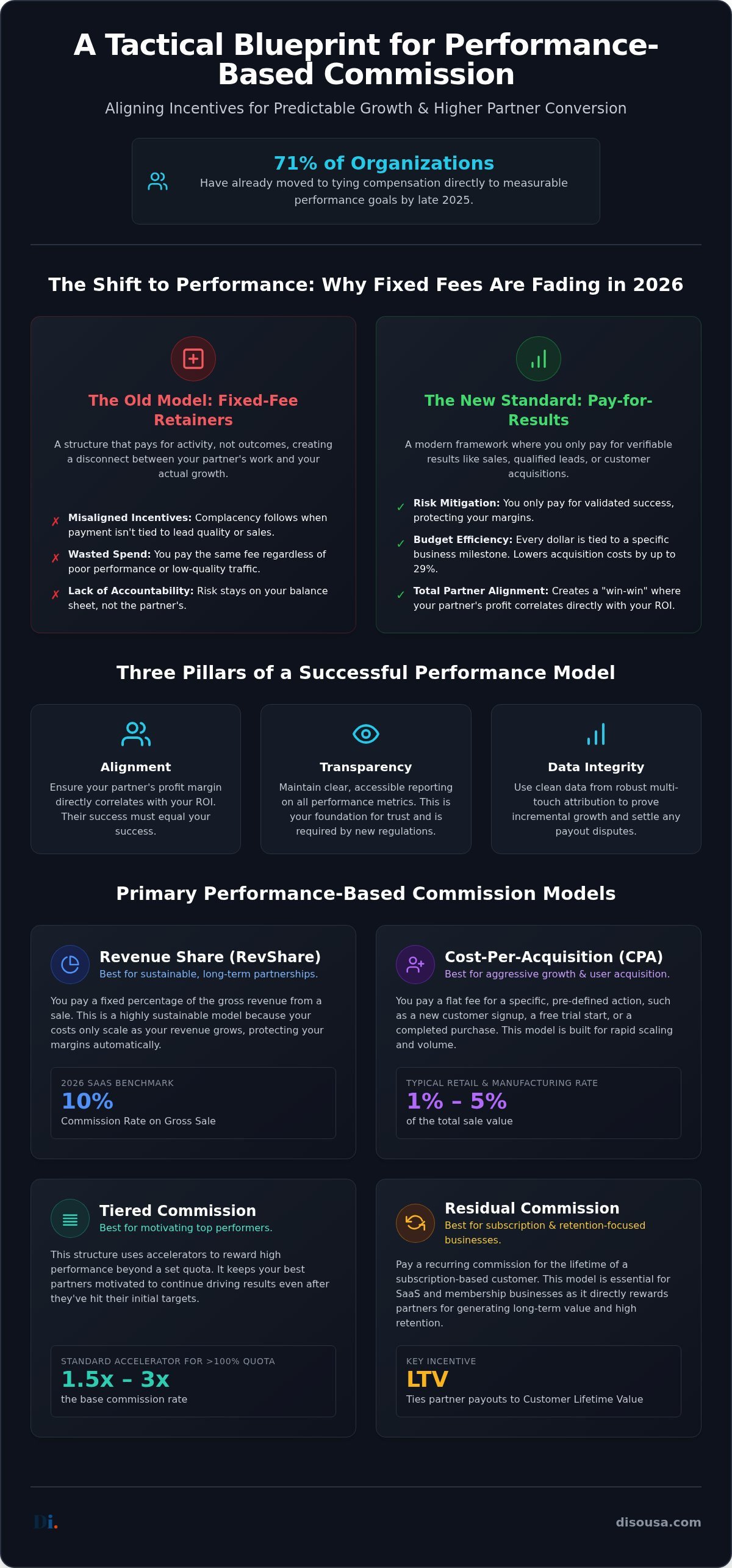
Fixed fees are losing ground because they don’t solve the core problem of accountability. In 2026, performance-based commission models have become the standard for businesses that need to scale without gambling their marketing budget. These models move away from paying for effort and focus strictly on paying for verifiable results like sales, qualified leads, or customer acquisitions. This isn’t just about sales reps anymore; it’s the new infrastructure for all digital partnerships. The benefits are clear for any scaling enterprise:
- Risk mitigation by only paying for validated success.
- Budget efficiency by eliminating wasted spend on low-quality traffic.
- Total partner alignment where goals are shared across the board.
This transition is fueled by a broader shift toward performance-based advertising across all digital channels. When you tie payment to outcomes, you effectively transfer the risk of poor execution from your balance sheet to the partner. This ensures that every dollar spent is tied to a specific business milestone. With 87% of marketers now using GenAI in their workflows as of mid-2026, the volume of content and leads is higher than ever, making quality verification through performance models a survival necessity.
To better understand how these compensation structures look in practice, watch this breakdown:
The Problem with Traditional Retainers
Traditional retainers often create a disconnect between agency activity and business growth. When a partner receives the same check regardless of lead quality, complacency usually follows. This “drift” happens when the agency focuses on maintaining the status quo rather than aggressive optimization. In 2026, your budget requires higher accountability. You shouldn’t be paying for “brand awareness” that doesn’t eventually convert into a measurable transaction. If the partner isn’t incentivized to improve, they won’t.
Core Principles of Performance Alignment
A successful model relies on three pillars: alignment, transparency, and data. You want a “win-win” scenario where your partner’s profit margin directly correlates with your ROI. This is why many brands are looking at online marketing services that prioritize performance over fluff. Transparency is your foundation. Since regulations like the EU Pay Transparency Directive now mandate detailed reporting on variable pay, being clear about your performance-based commission models is no longer optional. You need clean data to settle disputes and prove that the growth you’re paying for is truly incremental. Data-driven plan design, often supported by AI-powered ICM tools, allows you to simulate these payouts before they hit your books. This level of preparation prevents expensive mistakes and ensures your scaling remains predictable.
Primary Performance-Based Commission Models for Digital Growth
I’ve found that the most effective performance-based commission models are those that align directly with your specific financial goals. You can’t apply a SaaS model to a retail product and expect the same efficiency; for example, a boutique agency like Sunlover Travel requires a structure tailored to the high-touch nature of tropical vacation planning, while a review-driven platform like Uni Market Shop might prioritize CPA models for consumer products. In 2026, the market is too competitive for “one size fits all” incentives. We’re seeing a clear divide between models that prioritize immediate volume and those that focus on long-term sustainability. Here are the four primary structures you should consider:
- Revenue Share (RevShare): You pay a fixed percentage of the gross sale. In SaaS, a 10% commission rate is the 2026 benchmark. This model is sustainable because your costs only scale as your revenue grows.
- Cost-Per-Acquisition (CPA): You pay a flat fee for a specific action, like a new customer signup. This is built for aggressive growth. In retail and manufacturing, rates typically range from 1% to 5% of the sale value.
- Tiered Commission: This uses accelerators to reward high performers. For performance above 100% of a quota, accelerators of 1.5x to 3x are standard. It keeps your best partners motivated after they hit their initial targets.
- Residual Commission: This is essential for subscription models. You pay a smaller, ongoing commission for as long as the customer remains active. It forces partners to focus on lifetime value (LTV) rather than just the initial click.
Revenue Share vs. CPA: A Tactical Comparison
Use RevShare when you want long-term partner loyalty. It ensures the partner cares about the quality of the deal because their payout depends on the total transaction value. If you’re focused on high-volume lead generation, CPA is usually the better choice. It lets you know exactly what each new user costs before they even enter your ecosystem. Many brands now use a hybrid approach. This combines a base retainer with performance kickers to provide stability while rewarding growth. Balancing brand building and performance marketing is much easier when your commission structure supports both short-term wins and long-term equity.
Advanced Incentive Structures
Advanced performance-based commission models often include multipliers for high-margin products. If a partner sells a premium tier, their commission might double. You also need clawback provisions. These protect you against low-quality or fraudulent leads by allowing you to reclaim commissions if a customer cancels within a specific window. This is a baseline requirement for audit readiness under ASC 606 regulations. For a deeper look at how this works in practice, check out our Affiliate Marketing for Brands: A Strategic Framework. If you need help auditing your current structure, you can reach out to us at Disousa for a tactical consultation.
Selecting the Right Model for Your Business Objectives
You can’t select a model based on what your competitors are doing. Selection is an operations decision that must be rooted in your specific unit economics. When evaluating performance-based commission models, you’re looking for the intersection of partner motivation and margin protection. If you set a rate too low, you won’t attract high-tier partners. If you set it too high, you’ll scale yourself straight into a deficit. I’ve seen brands ignore their fulfillment costs and overhead, only to realize their “growth” was actually costing them money on every transaction.
The Margin-First Approach
Your first step is calculating your “Break-Even” commission rate. This isn’t just your gross margin; it’s what’s left after you account for customer support, shipping, and administrative overhead. In 2026, you also need to factor in regulatory requirements. Under ASC 606, commissions that are incremental costs of obtaining a contract must be capitalized and amortized if the benefit period exceeds one year. This accounting reality should influence whether you offer a heavy upfront CPA or a spread-out residual model. Over-incentivizing might seem like a good way to grab market share, but it often leads to “junk” volume that doesn’t actually convert into long-term value.
Matching Models to Funnel Stages
Different stages of the buyer journey require different incentives. If you’re focusing on Top-of-Funnel (TOFU) activity, you might reward traffic or engagement to build a retargeting pool. However, for most B2B operations, the focus remains on the Bottom-of-Funnel (BOFU). This is where you pay for the final conversion. Researching various performance-based commission structures shows that high-intent leads deserve a higher payout than general awareness traffic. To ensure you’re getting the best return, you should implement a strategic framework for performance growth that tracks every touchpoint.
Market maturity also plays a role in your choice. If you’re breaking into a new territory, you might need to offer more aggressive “pioneer” rates to entice partners to take a risk on an unproven brand. As your brand matures and the sales cycle becomes more predictable, you can shift toward tiered models that reward volume and consistency. I recommend matching the model to the partner’s specific capabilities. Don’t force a content creator into a CPA model designed for a high-volume coupon site; they won’t have the infrastructure to make it work, and you’ll both end up frustrated.
Implementation Blueprint: Tracking, Attribution, and Reporting
You can’t manage modern performance-based commission models using manual spreadsheets or legacy tools. In 2026, your technical stack is the single point of failure or success for your program. It’s a common bottleneck; 39% of organizations still take up to two months to implement simple plan changes. You need a tracking platform that integrates directly with your CRM and financial systems to establish a “Source of Truth.” When your payout data matches your internal revenue reports, you eliminate the friction of payment disputes and build long-term partner credibility. Real-time reporting allows you to see which partners are driving high-margin growth and which are simply recycling existing traffic.
Attribution Protocols in 2026
We’re officially operating in a cookie-less world. If you’re still relying on client-side cookies, you’re likely losing 30% or more of your tracking accuracy. I recommend moving to server-side tracking immediately to capture the full scope of your partner’s influence. This is especially critical for complex B2B sales cycles where a prospect might interact with three different affiliates before converting. While last-click attribution is easy to track, it’s often unfair. Data-driven models use machine learning to distribute credit across the entire journey. This shift is already well underway; by April 2026, 81% of incentive compensation teams were using AI to handle these complexities.
An attribution window is the defined period during which a partner receives credit for a conversion after a user’s initial interaction, and setting this correctly is vital for maintaining partner trust by ensuring they are paid for the full influence of their marketing efforts. If your window is too short, you’ll alienate high-value partners who drive long-term nurturing. If it’s too long, you risk paying for non-incremental growth that would have happened anyway. Finding that balance requires historical data and a clear understanding of your average time-to-convert.
Audit and Fraud Prevention
Scaling your program also means scaling your risk. You must implement standard procedures for verifying lead quality before any commission is approved. I’ve seen brands lose thousands to “brand bidding,” where partners bid on the company’s own trademarked keywords to steal credit for organic traffic. Fraud detection tools are now a baseline requirement. These tools identify suspicious patterns like IP clusters or unnaturally high conversion rates from low-quality traffic sources. Protecting your budget requires a proactive stance on lead auditing. If you want to ensure your tracking is airtight and your spend is optimized, work with Disousa to audit your performance marketing infrastructure.
Scaling Your Performance Strategy with Disousa
You’ve built the framework and selected your tracking tech. Now you have to run the program. Implementing performance-based commission models is a significant operational lift that often catches internal teams off guard. Most managers get bogged down in the administrative details of auditing payouts and resolving attribution conflicts. We take that burden off your plate. Disousa acts as your tactical partner to ensure your incentives stay aligned with your actual growth. We don’t just set a rate; we manage the high-value partnerships that move the needle.
Managed Performance Marketing
Outsourcing your program management reduces the friction that usually kills high-growth initiatives. You get immediate access to our global network of vetted partners who are already comfortable with results-driven structures. This isn’t just about finding affiliates. It’s about managing a complex ecosystem where every partner has different capabilities. For a deeper look at how this fits into your broader 2026 strategy, read our A Functional Assessment of Online Marketing Services. We handle the vetting, fraud prevention, and attribution audits so your team can focus on product development.
I’ve found that many brands overlook the role of email marketing in a performance ecosystem. You shouldn’t just pay for the first sale and stop there. We integrate email marketing to drive lead nurturing and customer retention. This increases the lifetime value of every lead your partners generate. When your partners see that you have a high-converting backend, they’re more likely to send you their best traffic because their effective earnings per click will be higher. It’s a feedback loop that rewards everyone involved.
Continuous Optimization
Optimization is an iterative process, not a one-time setup. We constantly test and refine your performance-based commission models to find the “sweet spot” where you maximize volume without sacrificing your bottom line. If a specific tier is underperforming, we adjust the accelerators. If a partner drives high-quality leads but low conversions, we apply conversion optimization techniques to fix the leak. This methodical approach ensures your marketing spend remains predictable even as you scale into new territories.
Moving from a fixed-fee mindset to a results-driven model is the most effective way to protect your margins in 2026. You need a partner who understands the logistical reality of these complex systems. Ready to scale? Contact Disousa for a tactical briefing on designing your custom commission roadmap. We’ll help you build a strategy grounded in data and designed for measurable growth.
Executing Your 2026 Growth Blueprint
Moving your organization toward performance-based commission models isn’t just a tactical shift; it’s a commitment to operational transparency and measurable ROI. We’ve covered why the “pay-for-results” economy requires a margin-first approach and a robust technical stack to handle the cookie-less tracking challenges of 2026. Success now depends on your ability to align partner incentives with verifiable business outcomes while protecting yourself from low-quality leads. You have the framework; now you need the execution.
You don’t have to manage this transition alone. Leveraging global affiliate management expertise and transparent reporting systems allows you to focus on high-level strategy while we handle the logistical reality. By applying data-driven conversion optimization to your existing funnels, you can ensure that every lead has the highest chance of turning into revenue. It’s time to move past the uncertainty of fixed retainers and start paying for actual growth that hits your bottom line.
Explore Strategic Affiliate Frameworks at Disousa and start building a predictable, scalable marketing engine today. You’re now equipped with the blueprint to outperform your competition and secure your margins.
Frequently Asked Questions
What is the most common performance-based commission model for SaaS?
The most common model for SaaS is a 10% commission rate on the total contract value. Account Executives typically operate on a 50/50 split between their base salary and variable commission. This structure ensures that sales teams are incentivized to close high-value contracts while maintaining a stable income floor. It’s a reliable benchmark for 2026 growth strategies in the software sector.
How do I determine a fair commission rate for my affiliate partners?
You determine a fair rate by benchmarking against your specific industry and calculating your break-even point after accounting for all fulfillment costs. For example, retail and manufacturing sectors typically offer 1% to 5%, while financial services can range from 10% to 20%. I recommend starting with these industry averages and adjusting based on the lead quality your partners provide to your ecosystem.
Can I use performance-based models for B2B lead generation?
Yes, you can use these models for B2B lead generation by tying payouts to specific milestones like Marketing Qualified Leads (MQLs) or Sales Accepted Leads (SALs). This prevents you from paying for low-quality traffic and ensures partners focus on high-intent prospects. It’s a standard way to align external marketing efforts with your internal sales pipeline and predictable spend goals.
What is the difference between revenue share and profit share models?
Revenue share pays a percentage of the total sale price, while profit share pays a percentage of the net income after all expenses. Revenue share is easier to track and provides more transparency for your partners. Profit share protects your margins more effectively but requires you to open your books, which can lead to complex audits or trust issues with external partners.
How do I handle commission payments for subscription-based products?
For subscription products, I suggest using residual commission models that pay a percentage for as long as the customer remains active. This aligns partner incentives with customer retention and lifetime value rather than just the initial signup. Under ASC 606 regulations, you’ll need to decide whether to expense these immediately or amortize them over the period the customer benefits from the service.
What happens if a customer returns a product after a commission is paid?
You handle returns by implementing clawback provisions in your partner agreements. This allows you to reclaim or offset commissions if a customer cancels within a specific window, such as 30 or 60 days. It’s a critical safeguard that protects your budget from paying for non-incremental or fraudulent growth. Most modern tracking platforms automate this process by syncing with your return data.
Is it possible to combine a base salary with a performance-based model?
Combining a base salary with performance-based commission models is the standard approach for internal sales teams. For Sales Development Reps in 2026, a 60% to 70% base with 30% to 40% variable compensation is common. This provides the financial security your team needs while still driving the aggressive growth behaviors required to scale your business operations effectively.
How do I track performance-based commissions across multiple channels?
You track these commissions by using server-side tracking and multi-touch attribution platforms that integrate directly with your CRM. Avoid relying on simple last-click models, as they often ignore the full customer journey and lead to partner disputes. Since 81% of incentive teams now use AI in some capacity, I recommend leveraging automated tools to handle the complex cross-channel data reconciliation.
Disclaimer
**Disclosure:** Some articles on this website may contain affiliate links. This means we may earn a commission if you purchase a product or service through certain links, at no additional cost to you. We only recommend products, tools, and services that we believe provide value to our readers.
**Disclaimer:** The information provided on this website is for educational and informational purposes only and should not be considered financial, legal, tax, or professional advice. While we strive to keep our content accurate and up to date, we make no guarantees regarding completeness, reliability, or results obtained from using the information provided. Always conduct your own research and consult qualified professionals before making business, financial, or investment decisions.
