

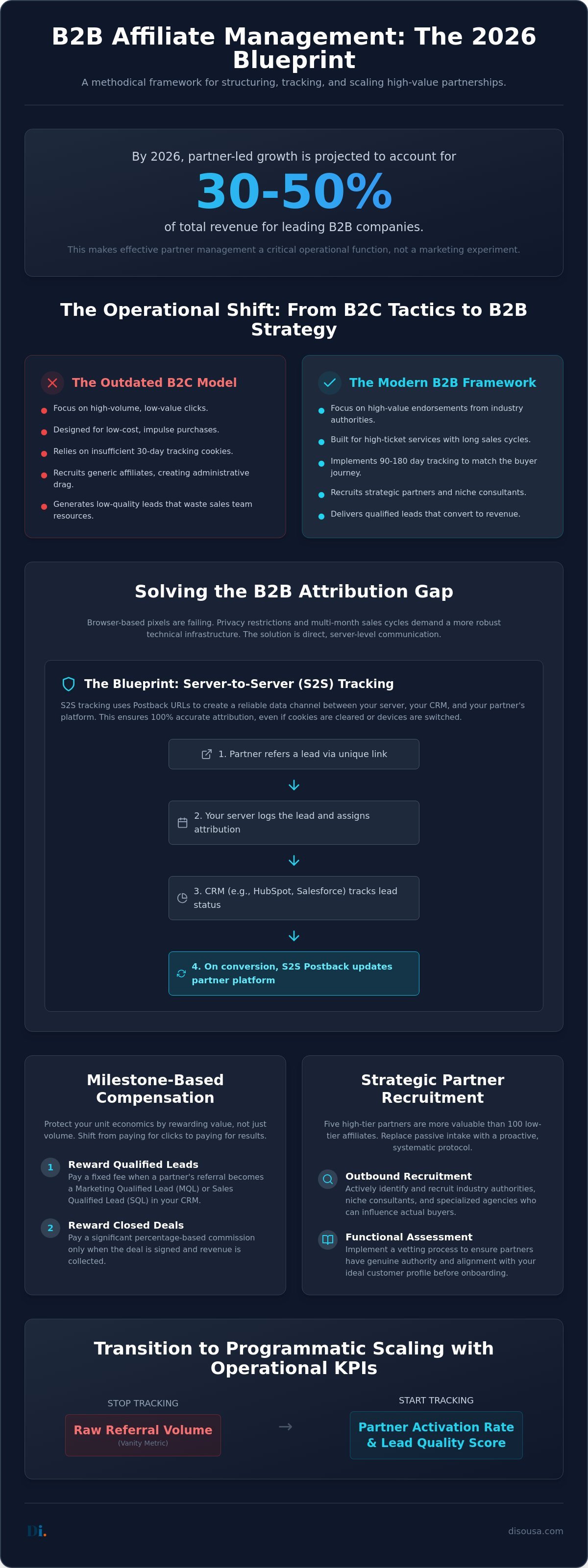
Partner-led growth is projected to account for 30% to 50% of total revenue for leading B2B companies in 2026. Effectively managing a B2B affiliate program is now a critical operational function rather than a simple marketing experiment. You’ve likely noticed how traditional B2C tactics fail when applied to complex enterprise sales. High friction in lead tracking and low-quality referrals from generic affiliates often create more administrative work than actual profit.
I understand the difficulty of attributing revenue in a multi-touch journey that spans several months. This briefing provides a methodical framework for structuring, tracking, and scaling high-value B2B partnerships. You’ll learn how to align your affiliate platform with your internal CRM to ensure seamless lead flow and predictable ROI. We’ll also examine the technical infrastructure required to manage industry authorities and consultants who demand professional-grade enablement tools. This guide moves past the fluff to give you a functional blueprint for 2026.
Key Takeaways
- Shift from volume to value by treating B2B affiliate management as a long-term strategy for high-ticket services rather than a mass-market B2C experiment.
- Solve attribution gaps in multi-month sales cycles by integrating your affiliate platform with your CRM using Server-to-Server (S2S) tracking.
- Establish a milestone-based compensation framework that rewards partners for qualified leads and closed deals to protect your unit economics.
- Replace passive sign-up pages with a systematic outbound recruitment protocol to secure partnerships with industry authorities and niche consultants.
- Transition to programmatic scaling by prioritizing operational KPIs like Partner Activation Rate and Lead Quality Score over raw referral volume when managing a B2B affiliate program.
Distinguishing B2B Affiliate Management from B2C Models
Managing a B2B affiliate program requires a fundamental shift in operational logic compared to consumer retail models. B2C programs prioritize high-volume traffic. They focus on low-cost impulse purchases. In contrast, B2B models focus on high-ticket services where trust is the primary currency. You aren’t just looking for clicks. You are looking for professional endorsements that carry weight in a boardroom. To understand the foundations of these systems, it helps to review What is affiliate marketing in its traditional sense before applying the necessary enterprise filters. In 2026, the industry has moved away from the term “affiliate” in favor of “strategic partners” or “consultants.”
The complexity of the B2B buyer journey is the main differentiator. A single transaction often involves six to ten decision-makers. This group dynamic makes attribution difficult. The person who clicks the affiliate link may be a researcher, while the actual buyer is a CFO who never interacts with the original referral source. This reality demands a value-based model that rewards influence rather than just the final click. Successful programs now integrate directly with sales pipelines to track these multi-touch interactions accurately.
To better understand this concept, watch this helpful video:
The Impact of Long Sales Cycles on Tracking
Standard 30-day cookies are insufficient for B2B environments. Most enterprise deals take three to six months to close. If your tracking window is too short, you will fail to attribute revenue to the partners who initiated the lead. You must implement 90-day to 180-day cookie windows to capture the full sales cycle. There is often a significant “lead-to-opportunity” gap where a lead remains dormant before becoming a viable deal. Your technical setup must account for this delay to maintain partner trust. For more on this, review our Strategic Framework for Performance Growth.
Quality Over Quantity in Partner Recruitment
Managing 100 low-tier affiliates creates excessive administrative overhead with minimal return. Five high-tier partners, such as niche consultants or specialized agencies, can provide more value than a thousand generic coupon sites. High-value partners require more than a link; they need enablement. You should implement a “Functional Assessment” for every new applicant. This process ensures the partner has the industry authority required to influence B2B buyers. It also filters out low-quality leads that clog your CRM and waste your sales team’s time.
Establishing the Technical Infrastructure for B2B Tracking
Infrastructure is the backbone of any performance-based growth strategy. When managing a B2B affiliate program, your technical setup must go beyond simple tracking links. It requires a three-way synchronization between your affiliate platform, your CRM, and your analytics suite. Browser-based pixels are no longer sufficient for high-ticket enterprise deals due to privacy restrictions and long decision cycles. You should implement Server-to-Server (S2S) tracking using Postback URLs. This method communicates directly between your server and the partner’s platform, ensuring data integrity even when users clear their cookies or switch devices.
Clean data is the primary requirement for maintaining partner trust. If your tracking is unreliable, high-value consultants and industry authorities will stop promoting your services. You must provide partners with transparency into the full lifecycle of their referrals. This means your system must log every touchpoint, from the initial click to the final contract signature. For those auditing their current capabilities, a functional assessment of online marketing services can help identify technical gaps before they impact your ROI.
CRM Integration Protocols (HubSpot, Salesforce)
Attribution Models in Multi-Touch Journeys
B2B buyer journeys are rarely linear. While many programs default to last-click attribution, this often ignores the partners who did the heavy lifting during the discovery phase. First-click attribution rewards the partner who introduced the prospect to your brand. However, a U-shaped model is often more effective for complex sales. This model assigns 40% of the credit to the first and last touchpoints, with the remaining 20% distributed among the middle interactions. This approach ensures that consultants who influence the middle of the funnel are fairly compensated, preventing them from losing interest in your program.
Developing a Compensation Framework for Long Sales Cycles
Commission structures in the B2B world must account for the reality of the “waiting period.” When you are managing a B2B affiliate program, you can’t rely on the instant gratification typical of retail checkouts. If a partner sends you a high-value lead in January that doesn’t close until June, they won’t stay motivated if they only see a payout half a year later. You need a framework that balances partner cash flow with your own unit economics.
I recommend moving away from a single “Closed-Won” trigger for all payouts. Instead, use a milestone-based system. This rewards the partner for the quality of the lead while reserving the bulk of the incentive for the actual revenue. You should also be transparent about clawbacks. If a client cancels within a specific window, usually the first 90 days, the commission is reversed. High-tier partners respect this transparency because it protects the integrity of the program and prevents fraud.
Dual-Stage Commission Models
A dual-stage model is the most effective way to keep partners engaged during a 180-day sales cycle. Stage 1 triggers a small payout once a lead is validated as a Marketing Qualified Lead (MQL). This confirms the partner is targeting the right audience and provides them with immediate feedback. Stage 2 triggers the primary commission when the contract is officially signed. This structure ensures partners are consistently feeding the top of your funnel without feeling ignored by your internal sales team during the long middle-of-funnel negotiation phase.
Managing Recurring vs. One-Time Fees
For SaaS brands with high retention, recurring commissions are a powerful recruitment tool. In 2026, typical revenue shares for B2B SaaS affiliate programs range between 20% and 30% of the monthly recurring revenue. I suggest capping these at the first 12 months to protect your long-term margins while still offering a predictable ROI for the partner. For enterprise deals or high-ticket one-time services, a flat-fee bounty is often more functional. These payments are typically 100% to 200% of the first month’s revenue. This provides the partner with a significant immediate return, which is often preferred by agencies and consultants who value immediate cash flow over a small monthly trickle.
Strategic Partner Recruitment and Enablement Protocols
Recruitment in the B2B sector is a targeted operation rather than a mass marketing campaign. You cannot rely on passive “join our program” links in your website footer. Managing a B2B affiliate program requires an outbound mindset where you identify and vet partners who already hold the trust of your ideal customers. This process is less about finding affiliates and more about building a network of industry authorities. For a deeper look at the underlying logic, I recommend reviewing our Affiliate Marketing for Brands: A Strategic Framework.
Enablement is the most overlooked task in partner management. Most programs fail because they provide a tracking link and nothing else. In B2B, your partners are often consultants or agencies who need to justify your service to their own clients. If you don’t give them the tools to sell, they won’t. You should treat your partners like an extension of your internal sales team. This means providing them with the same level of training and collateral you would give a new hire. Effective enablement ensures that when you are managing a B2B affiliate program, your partners represent your brand with the necessary technical accuracy.
Identifying Authority Partners and Niche Influencers
We look for partners based on technical authority and audience alignment. LinkedIn groups and professional forums are the primary hunting grounds for these individuals. You are looking for the people who are already answering complex questions in your niche. Complementary agencies are also high-performing affiliates. For example, if you sell email marketing services, an SEO agency is a perfect partner because their clients already need your solution. We use a functional assessment to verify that their audience is actually composed of decision-makers rather than just entry-level practitioners. This prevents the influx of low-quality leads that can happen with broader B2C-style recruitment.
Designing the B2B Enablement Kit
Your enablement kit should remove every possible barrier to the sale. A simple dashboard is not enough. You must provide high-value assets that the partner can use in their own consulting sessions. Your kit should include:
- Co-branded landing pages: These maintain the “hand-off” trust from the partner to your brand.
- Whitepapers and case studies: Partners need data-backed evidence to share with their leads.
- Customized sales decks: These should be tailored to the partner’s specific vertical or audience type.
- Regular partner briefings: Schedule monthly updates to keep partners informed about product changes or new features.
If you want to build a scalable channel, you must invest in these protocols early. You can start by assessing your current marketing services to see which assets are already available for repurposing for your partners.
Scaling and Optimizing Performance-Based Partnerships
Transitioning from manual oversight to programmatic scaling is the final stage of maturation for your channel. When you are managing a B2B affiliate program, you will eventually reach a point where individual partner management becomes a bottleneck. You must implement automated workflows to handle repetitive tasks like commission approvals and asset distribution. This shift allows you to focus on high-level strategy rather than administrative maintenance. For brands seeking to accelerate this transition, Disousa’s Online Marketing Services provide the technical framework needed for managed growth.
Success at scale depends on identifying KPIs that reflect the health of your funnel. I look beyond raw sales numbers to focus on the Partner Activation Rate. This metric tracks the percentage of your partners who successfully refer a lead within their first 90 days. You should also monitor your Lead Quality Score to ensure your partners aren’t just filling your CRM with low-intent prospects. Periodic program audits are essential to maintain a high-performing network. Removing inactive partners reduces your security risk and ensures your resources are spent on creators who actually drive revenue.
Data-Driven Performance Evaluation
We use ROI data to segment partners into three distinct tiers. Top-tier partners who consistently deliver high-value contracts should receive custom commission boosts or exclusive access to your product roadmap. For underperforming partners, we use a standard reactivation protocol. This involves a direct outreach to identify if the barrier is technical or a lack of relevant enablement assets. If there is no improvement after two quarters, the partnership should be terminated. Incremental growth in a B2B affiliate context is the revenue generated through partner channels that would not have occurred through your direct sales or organic search efforts.
Outsourcing Affiliate Management for Global Reach
Managing international B2B partnerships requires an understanding of local regulations, such as the new Law on E-commerce in Vietnam effective July 1, 2026. You must also ensure all partners comply with FTC disclosure requirements regarding financial relationships. The cost-benefit of in-house management versus a specialized agency often favors the latter as you scale. Outsourced program management fees typically range from $2,000 to $10,000 per month, which is often more cost-effective than hiring a dedicated internal team with global expertise. To see how these strategies apply to your specific business, you can contact Disousa for a professional assessment of your affiliate operations.
Building Your 2026 Partner-Led Growth Engine
Successfully managing a B2B affiliate program requires you to treat your partners as a high-performance sales extension rather than a simple traffic source. We’ve established that 30-day cookies and basic link tracking won’t survive the 2026 landscape. You need a technical foundation built on S2S tracking and deep CRM integration to capture revenue from long, multi-touch sales cycles. By implementing milestone-based payouts, you ensure your consultants and industry authority partners stay engaged from the initial lead through to the final contract signature.
The most successful brands this year are those that prioritize enablement over raw recruitment. If you provide your partners with the same quality of decks and whitepapers as your internal team, you transform a passive link into a predictable revenue stream. We specialize in performance-based B2B partnership growth and CRM-integrated attribution to help you navigate these complexities without the expensive trial and error. You don’t have to guess which levers to pull to achieve a measurable ROI.
Take the first step toward a scalable, high-value network. I invite you to Request a Functional Assessment of Your Affiliate Strategy to identify your current technical and operational gaps. The shift toward partner-led growth is the biggest opportunity in B2B marketing right now; it’s time to build yours.
Frequently Asked Questions
How do I track B2B affiliate leads that close offline?
You must integrate your affiliate platform with your internal CRM, such as Salesforce or HubSpot. By mapping a unique click-ID to the lead record, you can track the prospect from the initial online referral through the entire sales pipeline. When the deal status changes to “Closed-Won” in your CRM, a webhook triggers a postback to the affiliate platform to credit the partner for the offline conversion.
What is a typical commission rate for a B2B SaaS affiliate program?
In 2026, typical recurring revenue shares for B2B SaaS programs are between 20% and 30% of the monthly recurring revenue. These are often capped at the first 12 months of the contract. One-time bounty payments usually range from 100% to 200% of the first month’s revenue or a flat fee between $100 and $500 per sale. Enterprise-level leads can command $50 to $250 per qualified demo.
Why do B2B affiliate programs fail more often than B2C?
Failure usually results from applying B2C volume tactics to complex B2B sales cycles. B2C programs focus on immediate impulse buys, while B2B requires a relationship-based strategy. Programs often fail because they provide insufficient tracking for long sales journeys or they flood the sales team with low-quality leads. Success requires high-touch partner enablement and technical infrastructure that can handle multiple decision-makers.
Can I manage a B2B affiliate program in-house without a dedicated platform?
Managing a B2B affiliate program manually is possible for a small number of partners, but it is not functionally scalable. Spreadsheets lead to attribution errors and create friction in the payment process. Without a dedicated Partner Management (PMAP) system, you will struggle to provide the transparency and real-time data that high-value partners expect. Most businesses require a platform once they manage more than five active partners.
How long should the cookie duration be for a B2B affiliate program?
Cookie windows for B2B should be set between 90 and 180 days. Standard 30-day cookies are insufficient because the average enterprise sales cycle often exceeds three months. A longer window ensures that partners who initiate the discovery phase are fairly compensated when the deal finally closes. This is a critical factor in maintaining trust when managing a B2B affiliate program with industry consultants.
What is the difference between an affiliate program and a referral program in B2B?
Affiliate programs are performance-based channels open to external third parties like content creators, agencies, and consultants. Referral programs are typically designed for existing customers to invite their professional peers. While both reward successful leads, affiliate programs are structured as a scalable marketing engine with formal contracts. Referral programs are often more informal and leverage individual customer loyalty rather than professional authority.
How do I prevent affiliate fraud in a B2B environment?
You prevent fraud by implementing milestone-based payouts instead of paying for raw lead volume. Do not pay for simple form submissions. Instead, trigger commissions only when a lead reaches a “Qualified” status or a final sale. Using Server-to-Server (S2S) tracking also eliminates browser-based pixel manipulation. This ensures that every conversion is verified by your internal server data before any payment is authorized.
What kind of assets do B2B affiliates need most to be successful?
B2B partners require high-value enablement assets like co-branded landing pages, whitepapers, and customized sales decks. They need tools that help them justify your service to their own clients or internal decision-makers. Providing case studies and regular product briefings is also essential. These assets allow the partner to maintain their authority while accurately representing your brand’s technical capabilities.
Disclaimer
**Disclosure:** Some articles on this website may contain affiliate links. This means we may earn a commission if you purchase a product or service through certain links, at no additional cost to you. We only recommend products, tools, and services that we believe provide value to our readers.
**Disclaimer:** The information provided on this website is for educational and informational purposes only and should not be considered financial, legal, tax, or professional advice. While we strive to keep our content accurate and up to date, we make no guarantees regarding completeness, reliability, or results obtained from using the information provided. Always conduct your own research and consult qualified professionals before making business, financial, or investment decisions.
