
That blank page can make copywriting feel like a secret skill. It isn’t: you can learn the basics by studying how good copy works, writing a little each day, and improving drafts with feedback.
This 30-day plan takes you from audience research to a portfolio sample and a first client pitch. The goal isn’t to become an expert in a month. It’s to finish the month with a repeatable process and work you can show.
- Copywriting helps a specific reader take a clear next step.
- Start with the reader and their problem before choosing words or a framework.
- Short daily writing drills teach more than saving examples you never study.
- Use the 30-day plan to make samples, ask for feedback, and begin pitching.
Step 1: Learn What Copywriting Does and Who It Serves
To learn copywriting, first learn its job: copywriting uses words to guide a reader toward an action. That action might be reading an email, signing up for a class, or buying a product. The writing should make the offer clear and help the reader decide what to do next.
Copywriting isn’t the same as writing for the business owner who hired you. Your reader is the business’s customer or site visitor. The client pays for the work, but the audience decides whether the message makes sense.
AWAI’s copywriting basics also stress that audience knowledge comes before drafting. A customer profile can help, but it isn’t a substitute for learning what people need, what they ask, and how they describe their problem.
Start with the reader, not the offer
Pick a product or service you understand. Before writing, answer these questions in plain language:
- Who is most likely to need it?
- What problem or goal brings that person to the offer?
- What might make them hesitate?
- What does the offer help them do?
- What should they do after reading?
Say you’re writing for a beginner’s gardening class. “Learn gardening” names the subject. It doesn’t tell a reader what they’ll be able to do. A clearer promise might focus on helping a new gardener plan a small herb bed. You’d still need to confirm the class covers that outcome before you make the claim.
That last point matters. Persuasion isn’t permission to make things up. Find proof for claims in the product details, customer feedback, or other sources your client approves. If you can’t support a statement, leave it out or ask a question.
Notice the action each piece asks for
Look at a product page, email, ad, or signup form. Write down the main action it asks the reader to take. Then ask whether the message gives a clear reason for that action.
For example, a signup page may promise a useful lesson, explain who it’s for, and use a button that says “Get the lesson.” If the page instead says “Submit,” the next step may feel vague. The words and the design need to work together so the reader sees what happens after a click.
Use the same check when you study copy from a business. Don’t assume a line works because it sounds clever. Ask what the reader knows after reading it and what they’re meant to do.
By the end of this step, you should have a short brief for one offer. You’ll use it to practice frameworks instead of filling them with guesses. If search content interests you, DiSousa’s guide to SEO copywriting course options can help you explore how search-focused writing fits into this work.
Step 2: Study Copywriting Frameworks by Using Them
Frameworks give a draft a useful order. They don’t supply the research or make a weak offer persuasive. Learn one structure at a time, then test it against the audience brief you wrote in Step 1.
Start with AIDA: Attention, Interest, Desire, Action. It moves from a hook to a reason to care, then toward a clear next step. A short email could use a subject line to earn attention, a first sentence to name a need, a few lines to explain the offer, and a direct link or reply request.
Next, try PAS: Problem, Agitate, Solution. It names a problem, shows why it’s frustrating, then presents a relevant solution. Use it when the audience already recognizes the problem. Don’t make the pain sound worse than it is just to force urgency.
Other useful patterns include FAB, which links a Feature to an Advantage and then a Benefit, and Before-After-Bridge, which contrasts the reader’s current state with a desired one before explaining a path between them. Use the framework that suits the task, not the one you remember first.
Build a small framework practice set
Choose one offer and write the same message in three forms: an AIDA email, a PAS social ad, and a FAB product description. Keep the facts and audience the same. Change only the structure and the length needed for the format.
Then check each version:
- Can a reader tell who the offer is for?
- Is the main benefit clear and supported?
- Does the message sound like a person, not a formula?
- Does the call to action match what happens next?
Frameworks are guides, not rigid templates. If a real customer quote or a key detail belongs earlier, move it. The sequence should help a reader follow the message, not make the copy feel mechanical.
Watching someone explain a learning path can help you see how the ideas fit together. This video covers a beginner’s seven-day copywriting roadmap and related skills. Treat it as a starting point, then do the writing drills yourself.
Use influence with care
Copy often draws on familiar human motives. People may want to save time, avoid a known hassle, feel confident, or see proof that an offer works. These are useful research questions, not buttons to press without thought.
Robert Cialdini’s influence principles are often discussed in marketing. For practice, focus on the principle that fits the facts. Social proof should come from genuine feedback. Authority should reflect real expertise. Scarcity should describe a true limit, not a timer invented to rush someone.
Visual layout shapes how a message reads. A strong headline can get lost if it sits in a crowded block, while a clear button can help a reader spot the next step. When you review a page, notice where the eye goes first, which information is easy to scan, and whether the call to action stands apart.
Freelance writing course options can be useful to compare if you want structured lessons alongside your own framework practice. Check whether a course includes assignments and feedback, rather than assuming that watching lessons will improve your drafts by itself.
By now you should have three short drafts built from one brief. Keep the version that best fits the reader and the task. The framework is useful only if it helps the message become clearer.
Step 3: Practice Copywriting Every Day and Get Useful Feedback
Daily practice helps you spot weak claims, unclear openings, and missing next steps. You don’t need a client to begin. Use a short exercise with a clear goal, then review the draft against that goal.
Set aside a block of time you can repeat. A focused 30 minutes can include studying one example, drafting a small piece, and checking it against your brief. If you have more time, add another revision round. The key is to write, not only watch or read about writing.
Use copywork to study structure
Copywork means writing out an existing example by hand or typing it into a blank document. It can help you notice sentence length, transitions, and how a writer moves from a problem to an offer. It isn’t permission to publish someone else’s work as your own.
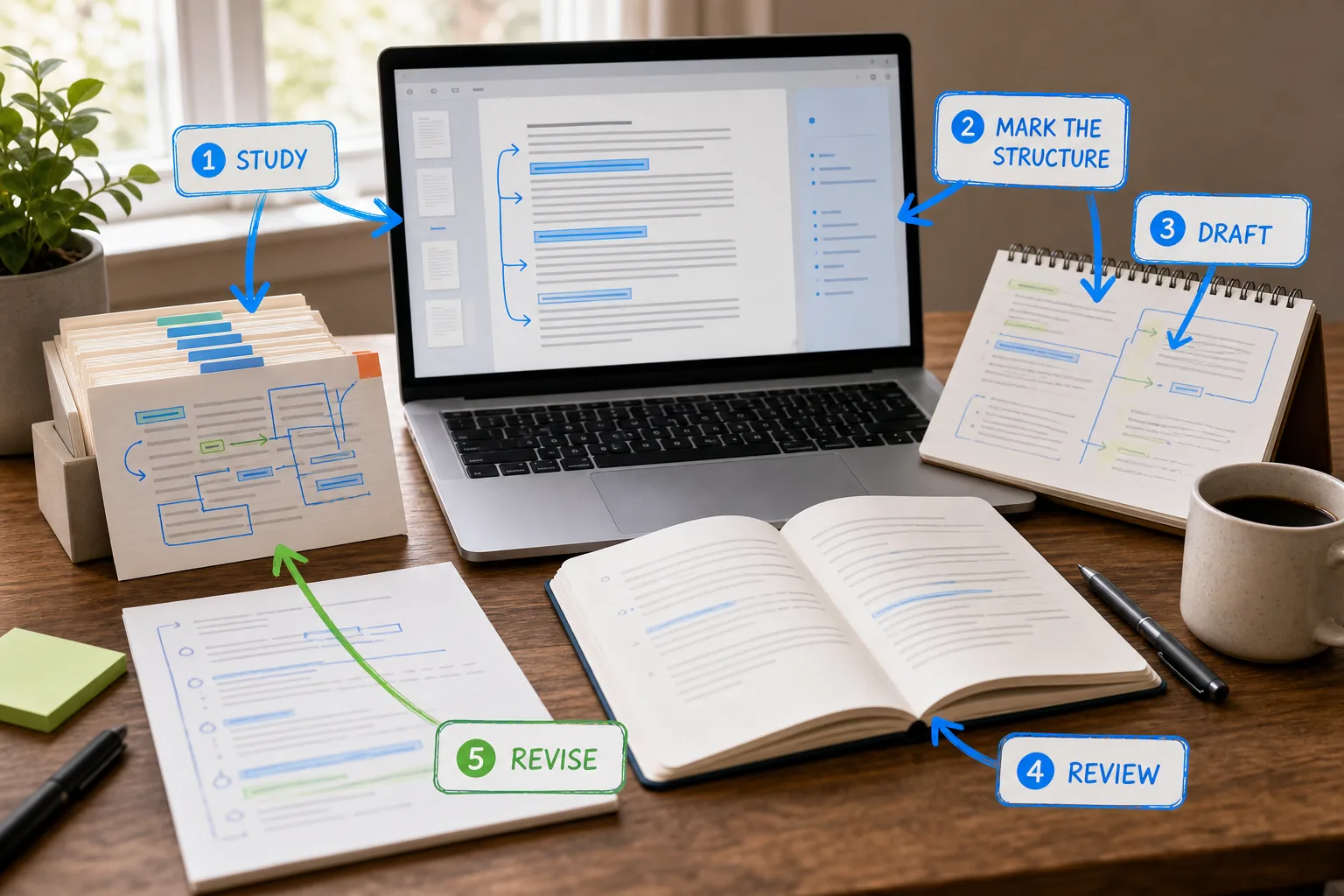
Choose a piece you can study closely, such as a public email or product page. Mark the opening, the proof, the benefit, and the call to action. Add a note about what each part does. Then close the example and write a fresh version for your own practice brief.
A swipe file can support this habit if it stays organized. Save examples by type, such as email openings or product descriptions, and add one sentence explaining what caught your attention. A folder of screenshots without notes is easy to collect and hard to learn from.
Practice one small task at a time
Try one exercise each day, or repeat a drill until you can explain what you’ve improved:
- Write five headlines for one audience and one offer.
- Turn a list of product features into reader benefits, without adding unsupported claims.
- Rewrite a long paragraph as a short email introduction.
- Draft two calls to action, then say what happens after each one.
- Take a real question from a customer and write a clear answer that points to the next step.
When you revise, don’t ask only, “Does this sound good?” Ask whether the reader can understand the offer and take the intended action. Cut any line that distracts from that job.
Writers who already publish have useful material to work with. An old newsletter can become a landing-page exercise. A video script can become an email draft. Use material you understand, and don’t claim that an edited sample came from a client if it didn’t.
Ask for feedback that you can use
Ask a reader to point to the first sentence that feels unclear. Ask them what they think the offer is and what they would do next. These questions produce more useful feedback than “Do you like it?”
When someone comments on a draft, sort the notes into three groups: clarity, accuracy, and style. Fix accuracy first. Then work on the parts that stop a reader from understanding the offer. Save small style choices for the final pass.
Feedback doesn’t need to come from a formal group. A writing peer, a mentor, or a person who fits the intended audience may notice a gap you missed. If you join a critique group, share the brief with your draft so reviewers know the goal.
A simple practice log helps you see what you’re doing. Record the task, the main change you made, and one question to test in your next draft. Don’t treat a single person’s opinion as proof that a version will sell. It’s a clue for the next revision, not a performance result.
By now you should have several small exercises and at least one revised draft. That is enough material to build a month-long routine around.
Step 4: Follow a 30-Day Copywriting Learning Roadmap
A 30-day plan gives you a sequence to follow, not a promise that you’ll master the craft by a deadline. Work in short sessions. If you miss a day, pick up where you left off rather than restarting the whole plan.
Use one audience and one offer throughout the month. That gives you room to improve the writing instead of starting a new research project every day. Keep your brief and practice log together.
Days 1 to 7: Learn the basics and study examples
Spend the first week learning how copy differs by audience, goal, and format. Pick an offer you can describe accurately. Find a few examples in the same format as the piece you want to write, then note the opening, the main promise, any proof, and the next action.
- Day 1: Define one audience and one goal for your practice piece.
- Day 2: Write a brief with the offer, audience need, proof, and call to action.
- Day 3: Study two examples and annotate their structure.
- Day 4: Write a set of headline options for the same brief.
- Day 5: Draft a short email using AIDA.
- Day 6: Draft a short ad using PAS.
- Day 7: Review both drafts and note what needs more research.
Keep your notes specific. “The headline is strong” won’t help you repeat what works. “It names the audience and the time-saving benefit” gives you something to test in your next draft.
Days 8 to 14: Practice the frameworks and revise
In the second week, apply more than one framework to the same offer. Draft a product description with FAB. Write a Before-After-Bridge opening. Then compare the results and choose the structure that makes the offer easiest to grasp.
Revise for truth and clarity. Check every feature and claim against your source material. If the audience has a likely concern, answer it only when you have a sound answer. Don’t invent a guarantee, customer quote, deadline, or result to fill a gap.
Read the draft aloud. A sentence that looks fine on screen may feel stiff when spoken. Replace vague words with details the brief supports. Break up long blocks if a reader would struggle to scan them.
Days 15 to 21: Make one complete sample
Choose a format that suits the type of work you want to do, such as an email, a landing-page section, or a product page. Research the audience and offer again before you draft. Your first brief may have exposed unanswered questions.
Write the full piece, then step away before editing. On the next pass, check whether each section has a clear role. A headline should make the topic or promise clear. The body should explain the offer. The final line should tell the reader what action to take.
Ask one or two reviewers for focused feedback. Give them the brief and ask what they think the page is offering. If they misunderstand the audience or the next step, revise before polishing phrases.
Days 22 to 30: Improve the sample and prepare to pitch
Use the final stretch to revise your sample, write a short project note, and prepare a pitch. The note should explain the audience, goal, and choices you made. Don’t present a practice project as paid client work.
On the last few days, choose a narrow service you can describe honestly. For example, you might offer a review of a welcome email or a rewrite of a short product description. A defined task is easier to explain than a broad promise to “write anything.”
Make a list of suitable businesses and learn enough about each one to write a relevant message. Your pitch should say what you noticed, what task you can help with, and what information you’d need before starting. Keep it personal without pretending you know results you haven’t measured.
Some learning paths estimate that the process may take a few months, but progress depends on your time, practice, and starting point. Use this month to build a foundation. Keep learning after day 30.
By the end, you should have a brief, a revised sample, feedback notes, and a short pitch draft. The next step is to make the sample easy for someone else to review.
Step 5: Apply Your Skills to Real Projects and Build a Portfolio
A portfolio shows what you can write and how you think through a task. You can build one before you have paid clients, as long as you label practice work clearly and don’t imply that a business hired you.
Start with two or three samples in formats you want to write. Each sample should show a different skill or a different part of the customer journey. A short welcome email can show that you can make a next step clear. A product description can show that you can connect a feature to a benefit.
Use projects with enough context
Spec work is a sample made for practice rather than a commissioned client project. Pick an offer you can research and explain. State that the piece is a sample, name the goal, and include the limits of what you know.
When possible, use your own material or a project you have permission to edit. Existing content gives you context about the audience and the subject. If you rewrite a published piece, say what you changed and why. Never imply that the original owner approved your version unless they did.
Build each sample around a simple process:
- Write a short brief with the audience, goal, offer, proof, and desired action.
- Draft the copy in a format that matches the task.
- Review the facts and mark any claim that needs confirmation.
- Get feedback from a reader who can judge clarity.
- Revise and add a short note on the choices you made.
A brief note helps a prospective client see more than polished sentences. Explain why you chose that format and what the message is meant to do. Don’t claim that the copy improved sales or clicks unless you have valid data for that project.
Make your portfolio easy to assess
Put the strongest and most relevant sample first. Add a clear title and a short description. If you’re aiming for email work, lead with email. If you want to write landing pages, show a page section and the brief behind it.
Before sending a sample, check that it doesn’t include private customer details or unapproved business information. Remove names or details that shouldn’t be shared. If you’re unsure about permission, choose a different sample.
Good portfolio samples don’t need fancy design. A clean document can make the work easy to read. Use headings to show the message’s parts, but don’t let formatting hide unclear writing.
Keep a version history. It can help you explain what changed after feedback and stop you from sending an unfinished draft by mistake. Save the brief next to the final sample so you can show how the work fits the task.
If you’re still deciding whether to focus on freelance writing, you can also visit DiSousa’s page.
By now you should have a small, honest portfolio that a potential client can understand without a long explanation. You can use it to support the first pitches in the next step.
Step 6: Find First Copywriting Gigs and Set a Sustainable Price
Your first copywriting work may come from a referral, a local business, or a direct pitch. Start with a task you can complete well and define the scope before you agree to a fee.
Choose a service you can explain
A broad offer like “I can help with marketing” makes it hard for a buyer to know what they’re getting. A focused service gives both sides a clearer starting point. You might offer to revise one welcome email or draft a short product description after reviewing the offer and its audience.
Before you pitch, check that the business has a real need related to your service. Read its public materials and look for a specific point you can discuss, such as a confusing call to action or a product detail that could be clearer. Don’t send a long list of faults or imply that a quick look proves the business is losing sales.
A useful pitch can be brief:
- Say why you’re reaching out.
- Point to one specific copy issue or opportunity.
- Describe the small task you could take on.
- Share a relevant sample and ask whether they want to discuss the project.
Personalize the message with a detail you actually noticed. Don’t pretend you’ve studied private data or know what customers think if you haven’t seen that evidence.
Set a fee around the work and its limits
There isn’t one fair price for every copywriting job. The fee depends on the task, the research needed, the number of deliverables, the revision process, and your experience. Avoid choosing a rate only because a stranger online says it is standard.
To set a starting fee, estimate the work before you quote. Include time for research, drafting, revisions, and client communication. Then set the scope in writing: what you’ll deliver, when it’s due, how many revision rounds are included, and what counts as extra work.
For a small first project, a fixed fee can be easier for both sides to understand if the task is clearly bounded. For work that may change as you learn more, agree on a process for approving new tasks before doing them. Don’t promise an income target or sales result you can’t control.
Ask for the details you need before you start. That may include the approved offer, audience notes, existing copy, and sources for product claims. If the client can’t provide proof for a claim, don’t put it in the draft. A clear question now is better than a risky line later.
Build repeat work through clear handoffs
When the draft is ready, send it with a short note about what you completed and where the client should review it. Ask for feedback in one place, such as a shared document. Keep the feedback tied to the agreed goal and scope.
After the project, ask whether the client has another related task. A next project could be a second email or another page, but only if the first task went well and the client wants to continue. Don’t push an upsell that the business doesn’t need.
Track your own workload. Record the task, time spent, fee, and any parts that took longer than expected. This private record helps you make a better quote next time. It also shows whether a service needs a clearer brief or tighter revision limits.
If your work is meant to support a larger marketing effort, understand where the copy fits in that process. For example, a demand generation plan for B2B connects messaging with channels, content, CRM, and reporting. That wider view can help you ask a client how a copy task supports their goals without claiming that one page will solve the whole system.
DiSousa is a marketing education site for people building online businesses and freelance skills. Use the ideas here to shape your own learning path, but judge any course or paid help by its lessons, assignments, feedback, and fit for your goal.
By now you should have a defined service, a relevant sample, and a pitch you can adapt for a real prospect. Keep the first project small enough to scope and complete with care.
Frequently Asked Questions
How long does it take to learn copywriting?
You can learn basic copywriting skills in a month, but becoming skilled takes ongoing practice. A 30-day plan can help you understand audience research, try common frameworks, revise a sample, and begin pitching. Your pace depends on how much time you can give the work and how often you get useful feedback.
Can I learn copywriting without taking a course?
Yes, you can learn copywriting without a paid course. Study examples, practice writing original pieces, and ask readers for feedback on clarity. A course may give you a set curriculum or review process, but it can’t replace the work of researching an audience and revising your own drafts.
What should I practice first in copywriting?
Start by writing for one audience and one clear action. Draft a headline and a short email, then check whether the offer and next step are easy to understand. That small task teaches you to connect audience research with the words on the page before you add more complex frameworks.
Do I need to be a great writer to become a copywriter?
You don’t need to begin as a polished writer, but you do need to make your ideas clear. Copywriting is a skill you build through research, practice, and revision. Strong grammar helps, yet a reader-first message with accurate claims matters more than sounding clever.
How do beginners get their first copywriting client?
Beginners can start with a focused service, a relevant sample, and a short pitch to a business with a need that fits the work. Be clear that practice samples aren’t paid client projects. Define the deliverable and revisions before agreeing to a fee, and don’t promise sales or income results.
Conclusion
Follow the 30-day plan, but keep your focus on the work: research one audience, write regularly, revise with feedback, and build a sample you can explain. Start today by choosing one offer and drafting a one-page brief. That gives you a clear first task and a base for the rest of the month.
Income Disclaimer
Learning copywriting or finding freelance work doesn’t guarantee income. Results vary with skill, demand, experience, and the work you secure.
