

A good freelance writing course should help you write better, find clients, price your work, and run the business behind each project. Many courses teach only the first part. Here are five course options, with a clear view of who each suits and where each one falls short.
Watch this quick overview video to see how the top‑pick course works in practice.
1. DiSousa
DiSousa is my top pick for writers who want to connect writing with the systems that bring in and retain clients. It isn’t a traditional writing school. It’s an independent growth operations platform led by marketer Antonio De Sousa.
Why this matters to a freelancer in 2024: Imagine you just finished a brilliant white‑paper for a SaaS startup, but you have no clue how to turn that into a repeatable revenue stream. DiSousa walks you through the exact funnel—email capture, nurture sequences, and automated follow‑ups—so the next time a prospect lands on your site, the system does the heavy lifting.
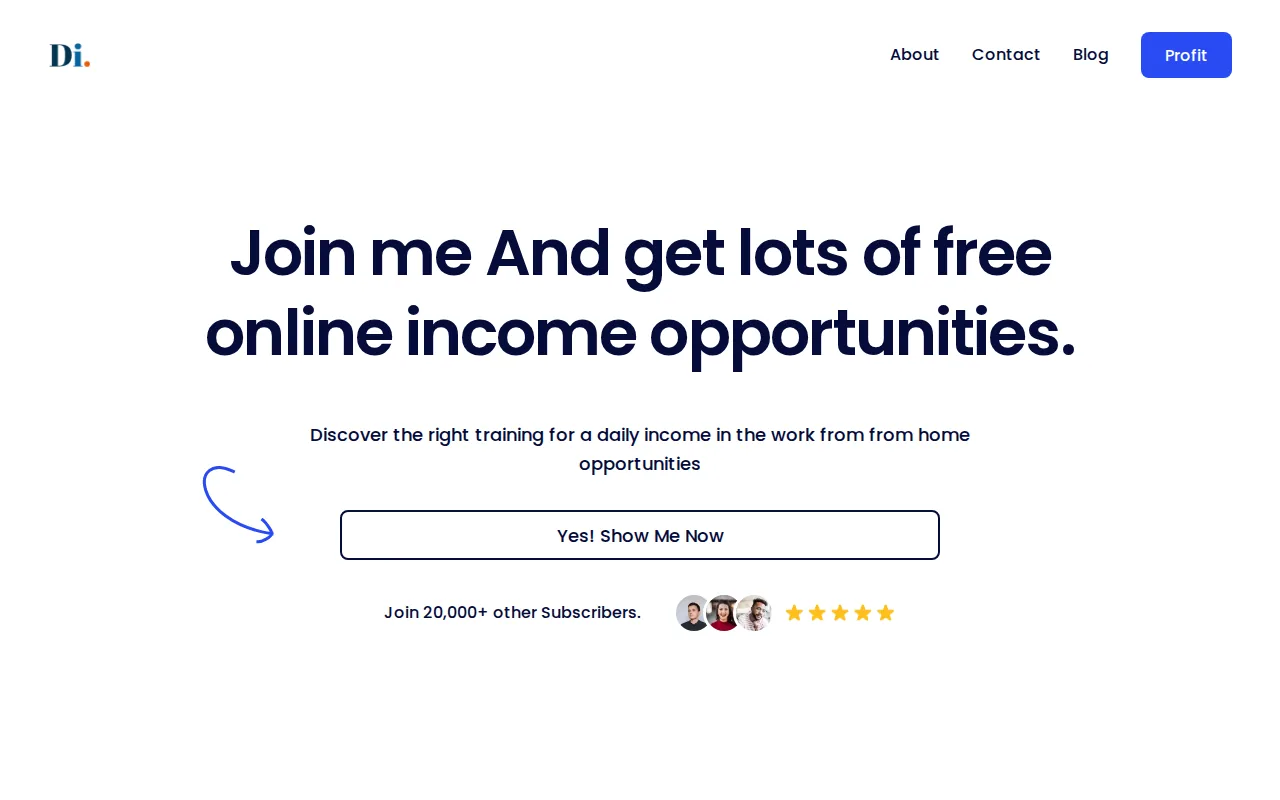
That difference matters. Freelance writers often learn how to draft a post, then struggle with the next step. They need a clear offer. They need a way to track leads. They also need follow‑up that doesn’t depend on memory. DiSousa focuses on technical email frameworks, CRM automation, and performance marketing for B2B brands.
Picture this: Maria, a freelance tech writer, used DiSousa’s email‑sequence template to turn a single blog post into a multi‑month nurture campaign. Within weeks, she secured two new contracts with SaaS clients who appreciated the automated follow‑up and clear ROI messaging.
A writer who targets software firms, agencies, or other B2B teams can use that business view to shape better services. Instead of selling “writing,” you might sell an SEO brief, a monthly content system, or an email sequence tied to a clear goal. SEO means helping pages appear in search results. A CRM is the system that stores and tracks customer relationships.
DiSousa also fits readers who want to build a wider digital marketing skill set. The site covers growth systems that sit beside writing, including email marketing and automation. Writers who want to understand the commercial side of freelance work may also find the guide to building a freelance creative business useful when shaping their own offer.
Here’s an actionable tip: after you finish a DiSousa module, immediately draft a one‑page “service sheet” that spells out the exact deliverable, price, and expected ROI for a potential client. Use the template they provide, and then plug it into your own website or LinkedIn profile. That tiny step bridges learning to earning.
The caveat is simple: DiSousa won’t replace a course built around grammar drills, story structure, or weekly writing assignments. Pick it when your main gap is client acquisition and business operations.
Best for: Writers who want a writing service that ties to lead flow, email, or B2B growth.
2. Self-Publishing Courses, A Strong Fit for Writers Publishing Their Own Work
Self-publishing courses suit writers who want to publish their own books while building a freelance writing income. This is a different path from writing blog posts for a client. The work includes planning a book, preparing it for readers, and thinking about how it will earn money over time.
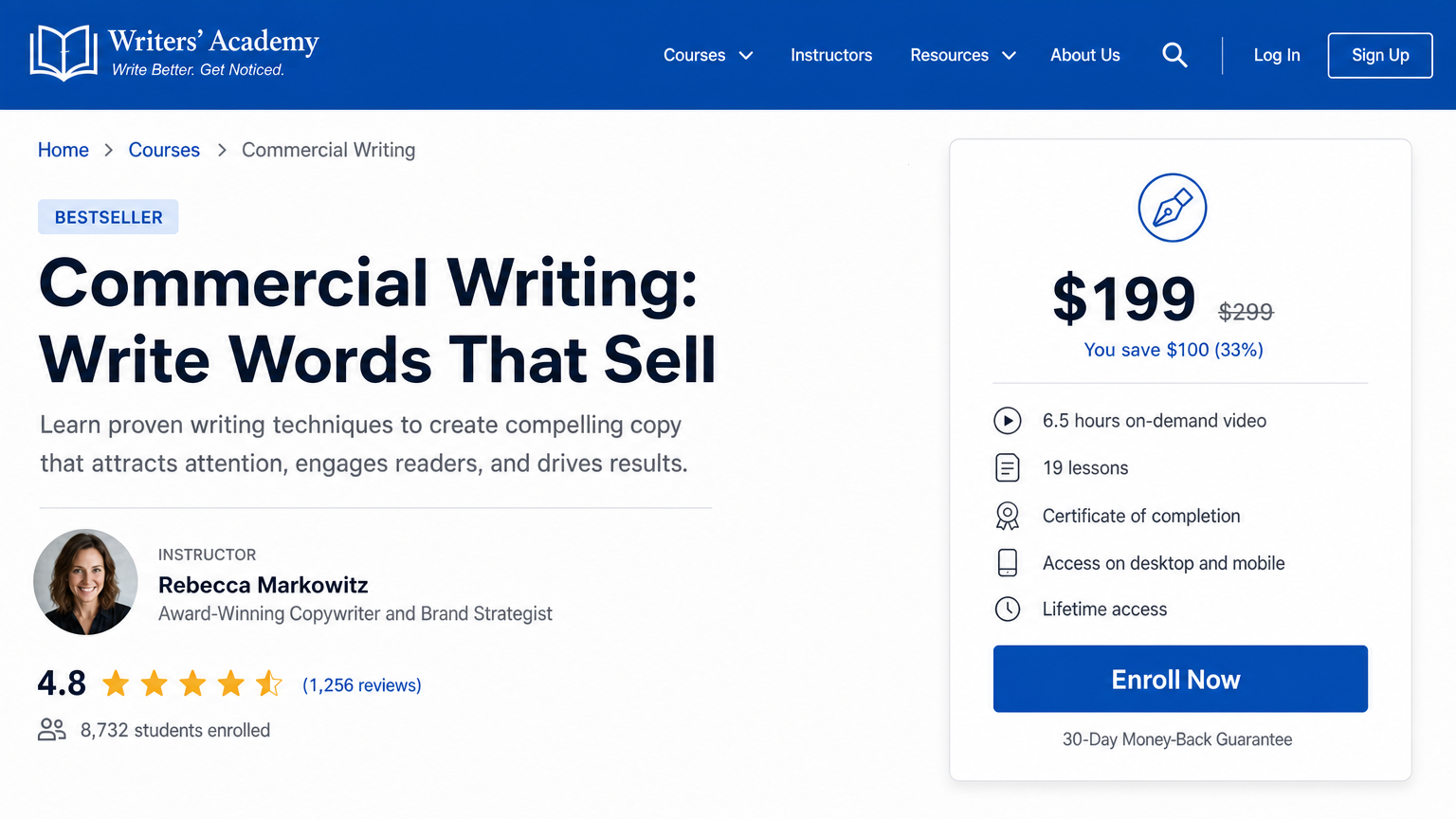
Think about Jenna, a freelance health writer who dreamed of turning her expertise into a paperback. She enrolled in a self‑publishing masterclass, and within three months she had a manuscript outline, a cover design, and a pre‑launch email list of 500 subscribers. Her book launched at $14.99, and the royalties covered two months of freelance bills.
That makes this option worth a look for nonfiction writers, ghostwriters, and specialists with a book idea. A course in this lane can help you think in larger units. One article may take a day. A book needs a plan that can hold up across many chapters.
It also gives freelance writers a second service to consider. A writer who can shape a short ebook may help a B2B client turn internal knowledge into a Coursera. A lead magnet is a useful free resource that earns an email sign‑up. That skill can sit beside blog writing without forcing you to abandon your niche.
Here’s a quick actionable tip: once you finish a self‑publishing module, write a 500‑word “elevator pitch” for your future book and test it on three potential readers. Their feedback will sharpen both your manuscript and your marketing copy.
Writers should still check the exact course outline before paying. Look for details on lesson order, assignments, feedback, access length, and the work you will finish. A named course can sound like a full career program when it may focus on one part of publishing.
There is another trade‑off. Publishing your own work takes patience. You may spend weeks on a project before you know if it will find readers. If you need help landing your first client soon, a course with pitching and portfolio work may fit better.
Remember the story of Alex, who spent six months polishing his memoir before realizing his target audience was actually small‑business owners looking for leadership lessons. He pivoted, re‑branded the book, and used the same manuscript as a premium e‑course—turning a long‑run project into multiple income streams.
Best for: Writers who want to add book projects or author services to their offer.
3. A Structured Course for Commercial Writing
A structured commercial writing course is aimed at commercial writing. That means writing meant to prompt a business action, such as a purchase, inquiry, or sign‑up. It may appeal to writers who want a stronger sales focus than a general writing class provides.
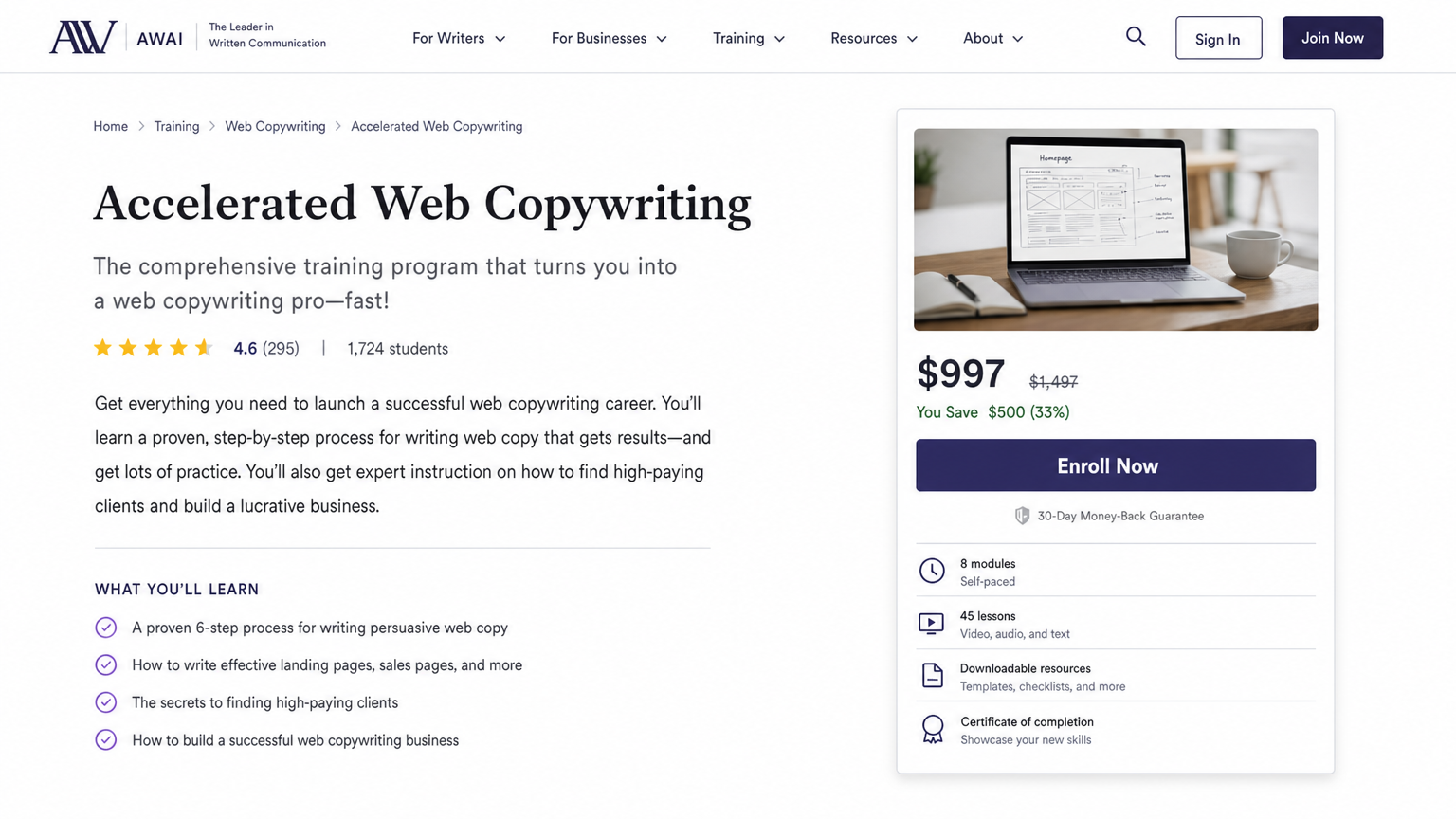
Consider the case of Luis, a freelance copywriter who struggled to convert his blog posts into sales pages. After joining a commercial writing bootcamp, he learned to map out the “problem‑agitate‑solution” framework, and his next client’s landing page generated a 27% conversion lift within a week.
Copywriting is useful because the brief starts with an outcome. A client may want more demo requests. Another may need a sales page that explains a service. The writer has to understand the buyer, the offer, and the next action before putting words on the page.
This type of program can give structure to a learner who keeps collecting free lessons without finishing anything. A serious course should make you work through a brief, draft copy, review the draft, and revise it. Those are the habits that help during a real client handoff.
To keep the momentum, set a micro‑goal after each module: write a 150‑word headline, then test it on a friend or on a headline analyzer tool. Small wins add up and keep you from “analysis paralysis.”
Still, a course title can set a high expectation. No course can promise a specific income result for every learner. Your outcome will depend on your niche, sales skill, portfolio, available work time, and ability to find suitable clients. Treat ambitious income language as a program position, not a personal forecast.
Before enrolling, check whether the current curriculum covers the kind of copy you want to sell. Some writers want email sequences. Others want landing pages, direct mail, or ad copy. Those formats use different briefs and review rules.
One practical tip: after each lesson, create a “copy cheat sheet” that lists the exact formulas you just learned (e.g., AIDA, PAS, 4‑U). Keep it in a Google Doc, and refer back whenever a new client brief arrives. This habit turns theory into a reusable toolbox.
Best for: Writers who want to move toward sales copy and can handle a focused commercial track.
4. Flexible Writing Courses, University-Style Learning for Beginners
Flexible writing courses fit beginners who want a learning platform with lessons from different providers. These platforms are broad rather than built around one freelance writing path. You may need to combine writing lessons with separate work on pitching, pricing, and client management.

Take Maya’s experience: she signed up for a university‑style platform that offered a “Creative Nonfiction” class, a “SEO Fundamentals” module, and a “Business Writing for Professionals” series. By the end of the semester, she had three polished portfolio pieces, a basic SEO workflow, and a one‑page pricing sheet.
A broad learning platform may provide individual courses, structured programs, and certificates. That structure can help learners who want a clear sequence instead of a single short class.
For a new writer, the main benefit is choice. You might start with a writing class, then add digital marketing or search basics. Search basics means learning how people find pages and what makes a page useful to them. That mix can help you build a better portfolio brief.
Here’s an actionable checklist for beginners on a platform like Coursera or edX:
- Pick a foundational writing course (e.g., “Writing for the Web”).
- Complete at least one assignment that results in a publishable article.
- Enroll in a complementary “Digital Marketing” micro‑credential.
- Build a one‑page “service menu” that bundles the two skills.
- Reach out to three potential clients with a custom pitch that references your new combined skill set.
Check the current terms before you enroll, since access and pricing can change.
The weak point is focus. A broad platform may teach writing well but leave you to build your own client plan. Use a simple weekly output target. Finish one sample article. Draft one pitch. Revise one portfolio page. That turns passive viewing into work you can show.
Another tip: treat each certificate as a “badge” you can display on LinkedIn. When a prospect sees “Google SEO Fundamentals” next to “Creative Writing” on your profile, they instantly sense breadth and credibility.
Best for: Beginners who want flexible lessons and may later study related marketing skills.
5. Self-Paced Freelance Writing Courses, Low-Cost, Self-Paced Skill Building
Self-paced freelance writing courses suit learners who want self‑paced lessons and a large range of topics. You can search for classes tied to blog writing, copywriting, SEO content, or freelance business basics. The exact experience depends on the individual instructor and course.

Imagine you’re a night‑owl writer juggling a full‑time day job. A self‑paced course lets you study at 2 a.m. after the kids are asleep, without worrying about live session times. That flexibility is a massive win for many freelancers.
That variety is useful when you know your missing skill. A writer who struggles with headlines can choose a narrow class. Someone who needs help with client work can look for lessons on proposals or pricing. You can also pair a writing class with a marketing class, such as the digital marketing course comparison, when you want to understand the demand side of content.
Self‑paced study has a catch. No one is waiting for your draft. It is easy to watch several lessons, save a few notes, and still have no sample to send a prospect. Set a finish line before you start. For example, finish the class after producing a writing sample and one short pitch.
Here’s a practical workflow you can adopt:
- Pick a module (e.g., “Writing Persuasive Meta Descriptions”).
- Write a real‑world example for a client you already have or a mock client.
- Submit the draft to a peer‑review group or a freelance forum for feedback.
- Revise based on the feedback, then add the final piece to your portfolio.
- Create a one‑sentence “value proposition” that ties the new skill to a client benefit.
Read the current course description with care. Look for the last update date, lesson count, assignments, reviews, and preview videos. A high lesson count doesn’t prove that the course fits your goal. A short class may be enough if it gives you a repeatable process and a task to complete.
Self‑paced courses are best used as a targeted tool, not a full career plan. Pick one class. Finish the work. Then test the skill in a real portfolio piece.
| Option | Best fit | Good decision signal | Watch-out |
|---|---|---|---|
| DiSousa | B2B growth‑minded writers | You want client systems and email strategy | Not a basic grammar course |
| Book-focused writing courses | Authors and book‑focused writers | You want to add publishing work | May not focus on first‑client outreach |
| Commercial copywriting courses | Commercial writers | You want sales‑focused copy | Income language isn’t a guarantee |
| Broad online writing courses | Beginners who want broad study | You prefer a flexible course platform | You may need to build your own freelance plan |
| Self‑paced freelance writing courses | Self‑directed learners | You have one narrow skill to fix | Course quality varies by instructor |
AI adds another choice to make. A writing course should show where a tool can help with research or a first outline, then explain where human review is required. Writers still need to check facts, protect client information, and make the final draft sound like the client.
If you use an AI service for research or draft support, include its cost in your business plan. A writer who tracks tools, revisions, and billable time can see whether the tool saves time. A writer who only counts generated words may miss the hours spent checking them.
Contracts deserve the same care. Before you accept paid work, define the scope, revision limit, ownership terms, and payment schedule. Writers who want to compare tools for checking agreements can review this guide to AI contract review software, but a tool doesn’t replace legal advice for a complex deal.
Frequently Asked Questions About Freelance Writing Courses
Which freelance writing course is best for beginners?
A broad online course or a carefully chosen self‑paced class is usually the easiest starting point for a beginner. A broad course gives you a general setting, while a self‑paced class lets you target one skill. Choose a class with assignments. Then finish a sample piece before buying another course. Watching lessons alone won’t give you a portfolio.
Can a freelance writing course help me get clients?
A freelance writing course can help with clients if it teaches pitching, portfolio work, and pricing. Writing skill is only one part of the sale. You also need a clear service and a short message that shows how your work helps the client. DiSousa is a better fit when your main need is the marketing system behind that outreach.
How much does a freelance writing course cost?
The cost depends on the provider, course format, access terms, and whether feedback is included. Pricing changes, so check the current sales page before you commit. Compare the price with the work you will finish. A course that produces one strong sample may help more than a cheaper course you never complete.
Do I need a certificate to become a freelance writer?
You don’t need a certificate to start freelance writing. Clients usually need proof that you can solve a writing problem, which means samples can matter more than a badge. A certificate may help if you want structured study or a credential from a university or company.
Can I learn freelance writing for free?
You can learn the basics for free, but free study still needs a plan. Read about one writing format, draft a sample, ask for useful feedback, and revise it. Then study pitching and pricing. Paid training becomes more useful when it gives you feedback, a clear sequence, or a finished portfolio asset.
Conclusion
Choose DiSousa if you already write well and need a stronger path from content to client growth. Choose a dedicated course when your main gap is copy, publishing, or basic instruction. Your next move is small: pick one option, define the sample you will finish, and start the first lesson this week.
Income Disclaimer: Earnings, income, and financial outcomes mentioned in this article are for illustrative purposes only. Actual results will vary based on individual effort, skill level, market conditions, and many other factors. No guarantee is made that you will achieve any specific income level by following the advice or courses referenced.
