

Global affiliate marketing spend is projected to reach $20.07 billion in 2026, yet many programs are currently leaking revenue through inefficient management. You’ve likely noticed that simply adding more partners hasn’t translated to a linear increase in revenue. It’s frustrating to manage a growing list of associates while your growth remains stagnant. If you’re finding it difficult to distinguish between high-value traffic and the noise that clogs your reporting, it’s time to focus on improving affiliate partner performance through technical discipline rather than just recruitment.
We agree that the traditional approach of “more is better” is failing in a market where attribution windows are shrinking and FTC disclosure fines have risen to over $51,000 per violation. This briefing provides a methodical blueprint for identifying underperformance and implementing the technical strategies needed to optimize your partner output. I’ll walk you through a clear framework for partner evaluation, specific technical optimization tactics, and the procedures required to scale your program without increasing your administrative burden.
Key Takeaways
- Learn how to identify the specific signals of a performance plateau and implement Earnings Per Click as a primary diagnostic tool.
- I’ll explain how to audit and rebalance your partner mix to prioritize high-conversion traffic, which is a critical step for improving affiliate partner performance.
- Discover a standardized framework for tiered commission structures that incentivizes growth without inflating your operational overhead.
- Evaluate the logistical trade-offs between in-house management and outsourced agencies to determine the most scalable path for your program.
- Implement technical tracking procedures that allow you to distinguish between incremental growth and low-value traffic overlap.
Identifying Underperformance in Affiliate Programs
Most managers assume that a growing list of partners automatically leads to more revenue. This isn’t true. In the context of affiliate marketing, volume often masks underlying inefficiency. You might see thousands of clicks but stagnant sales. Improving affiliate partner performance begins with looking past surface metrics to identify where the engine is actually stalling.
If your Return on Ad Spend (ROAS) is declining while your partner count rises, you have a structural issue. High-reach partners might be cannibalizing your organic traffic or simply driving low-intent visitors. You must evaluate traffic quality against actual conversion volume. Often, the problem lies in administrative bottlenecks. If your onboarding process is slow or your communication is fragmented, your best partners will lose interest and move on to competitors.
To better understand this concept, watch this helpful video:
The Performance Plateau Signal
A performance plateau is a specific signal that your current administrative structure has reached its limit. You’ve hit a point where adding new affiliates doesn’t move the needle. This often happens because your commission models have become static. They no longer incentivize the specific behaviors you need for growth in 2026. Without active engagement, partners become passive, and your program enters a slow decline. Improving affiliate partner performance requires recognizing this plateau as a call for a strategic pivot rather than just more recruitment.
Initial Functional Assessment
You can’t fix what you haven’t audited. Start by categorizing your list into active and dormant accounts. An active partner isn’t just someone with a link; it’s someone consistently driving qualified leads. For a deeper look at how your partnerships fit into your overall strategy, I recommend using Disousa’s functional assessment. This audit helps you align your affiliate goals with your broader marketing infrastructure, ensuring your partners don’t operate in a vacuum. By identifying who is actually contributing, you can stop wasting resources on accounts that provide zero incremental value.
Establishing Performance Metrics and Technical Tracking
Data is the only objective way to measure success. You can’t rely on gut feelings or partner tenure. Improving affiliate partner performance starts with a technical audit of your tracking infrastructure. If your data is siloed, you’re making decisions based on incomplete facts. We need to move toward a model where every click is tied to a specific value and a specific stage of the buyer journey.
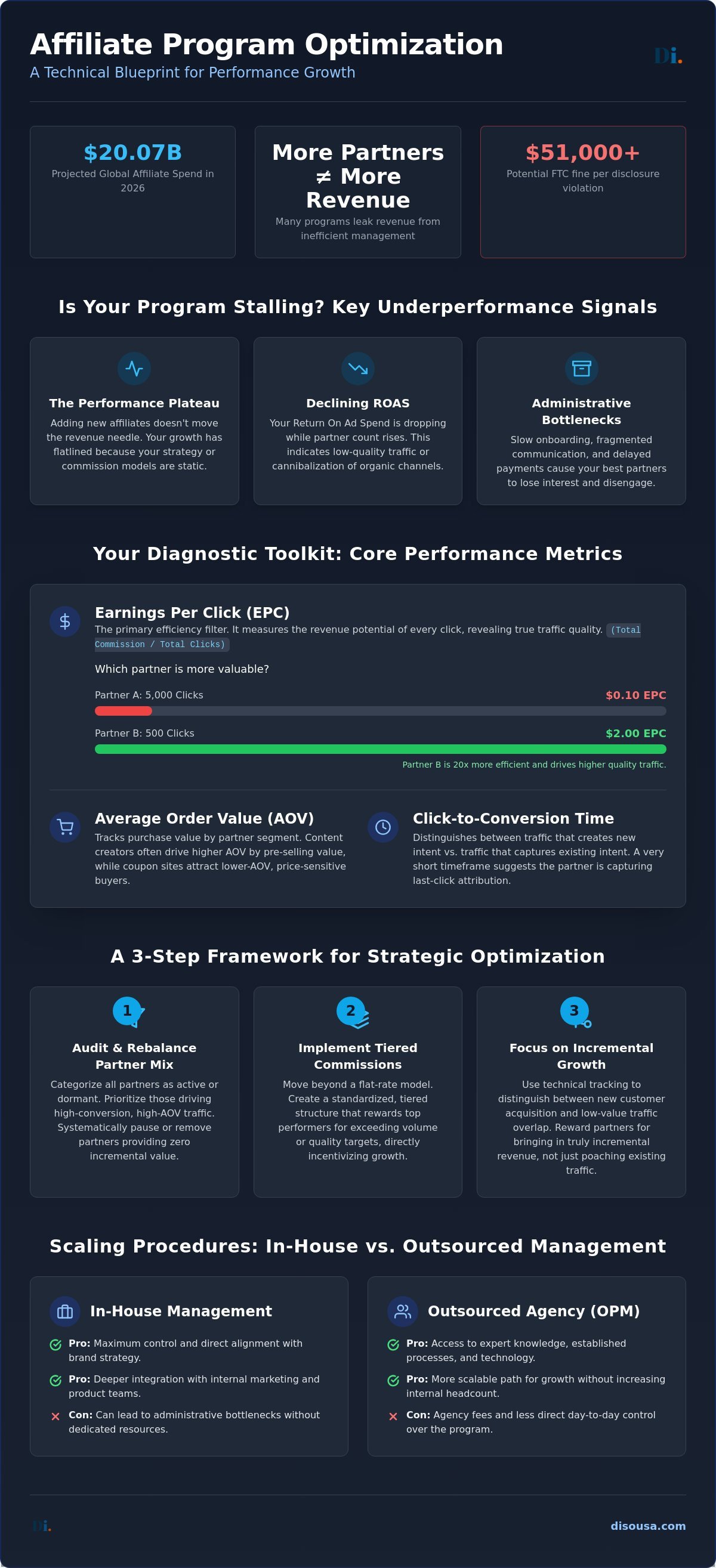
Earnings Per Click (EPC) acts as your primary efficiency filter. It measures the revenue potential of every click sent to your site. A partner with 5,000 clicks and a $0.10 EPC is less valuable than one with 500 clicks and a $2.00 EPC. The latter demonstrates higher traffic quality. You also need to monitor Average Order Value (AOV) by partner segment. Content creators typically drive higher AOV because they pre-sell the product’s value. Coupon sites often drive lower AOV as they attract price-sensitive shoppers who may only buy the minimum required for a discount.
Establishing these benchmarks is part of a larger strategic framework for performance growth that prioritizes measurable outcomes over vanity metrics.
Primary Affiliate Metrics
Calculating the true cost of acquisition requires more than looking at commission rates. You must factor in platform fees. For example, some networks apply a 2.5% tax on every commission generated. Click-to-conversion timeframes are another vital metric. If a conversion happens within seconds of a click, the partner is likely capturing existing intent rather than creating it. Effective management requires tracking these three core areas:
- EPC: Calculated as (Total Commission / Total Clicks) x 100 to normalize performance across different traffic volumes.
- AOV: Tracked by partner category to identify which segments bring in your highest-spending customers.
- Conversion Lag: Measured to distinguish between partners who influence the research phase and those who intercept the checkout.
Advanced Attribution Standards
Last-click attribution models are fundamentally flawed for complex B2B sales. They reward the final touchpoint while ignoring the partners who did the heavy lifting during the discovery phase. You should implement multi-touch attribution to see the full customer journey. This requires robust first-party data tracking. Since third-party cookies are no longer reliable, server-side tracking is the standard for 2026. It provides a more accurate picture of how different channels interact without relying on browser-based storage.
Consistency across channels is mandatory. Your affiliate tracking must align with your internal CRM and SEO data. This prevents paying commissions on sales that were actually driven by your own email marketing or organic search efforts. A unified tracking protocol ensures that your performance data is clean, actionable, and ready for scaling.
Optimizing the Affiliate Partner Mix for Incremental Growth
Incremental growth stops when your partner mix becomes top-heavy. If 90% of your revenue comes from your top three partners, you don’t have a program; you have a dependency. Improving affiliate partner performance requires a diversified portfolio that covers every stage of the customer journey. You need to look beyond the “super-affiliates” and identify exactly where your brand is missing from the conversation.
I recommend mapping your current partners against a standard marketing funnel. This reveals gaps in your coverage. For instance, if your mix is dominated by coupon sites, you’re likely capturing existing demand rather than creating new interest. Conversely, a program heavy on top-of-funnel content may see high engagement but struggle with final conversions. A functional mix balances high-reach publishers with high-conversion loyalty partners to ensure a steady flow through the pipeline.
Funnel-Based Partner Segmentation
We categorize partners based on their functional role in the purchase process. This clarity allows you to allocate resources more effectively. I’ve broken down the mix into three distinct layers:
- Top-of-funnel: These are your editorial publishers and niche blogs. Their primary value is awareness and education. They introduce your brand to new audiences who aren’t yet searching for a specific solution.
- Middle-of-funnel: Comparison sites and review platforms sit here. They help consumers evaluate your product against competitors. These partners are essential for establishing authority during the research phase.
- Bottom-of-funnel: Loyalty, cashback, and incentive-based partners drive the final click. They’re highly efficient at closing sales, but you must monitor them closely to ensure they aren’t simply intercepting your own direct traffic.
Partner Recruitment and Diversification
You need a standard procedure for identifying and onboarding niche partners who operate in specific regional or vertical markets. Relying on the top 5% of your partners creates systemic risk. If one of those partners changes their strategy or leaves the network, your revenue will crater. I’ve seen programs lose 40% of their volume overnight because they failed to diversify their traffic sources. Improving affiliate partner performance means building a safety net of smaller, high-potential partners.
Effective recruitment is a continuous operational task. You should actively seek out publishers who align with your brand’s core values but reach underserved segments. This approach is central to the strategic framework for performance growth. By spreading your traffic sources across multiple categories and regions, you build a resilient infrastructure that can scale without being held hostage by a single large entity.
Implementing Strategic Communication and Incentive Frameworks
Communication is a functional lever, not a soft skill. If you treat your partners like a set-and-forget marketing channel, they’ll treat your brand with the same indifference. Improving affiliate partner performance requires a proactive communication rhythm that keeps your brand top-of-mind for your highest-value publishers. I recommend standardizing your outreach into predictable intervals. Monthly briefings for your top 10% of partners should focus on upcoming product launches and data-driven insights. For mid-tier partners, quarterly reviews are sufficient to identify who is ready to scale into a higher tier.
You must move away from the idea that a single commission rate fits every partner. A flat structure often leads to a performance plateau because there’s no financial incentive for a partner to push harder once they hit a certain volume. By implementing a framework that rewards growth and quality, you transform your affiliate list into a motivated sales force. This approach ensures your program remains competitive in a market where partners have endless options for where to send their traffic.
Tiered Commission Models
Tiered structures are the most effective way to incentivize volume and traffic quality simultaneously. I suggest using “performance kickers” that trigger once specific milestones are reached. For example, you might offer a baseline commission for the first 50 sales, with a 2% increase for every sale thereafter within the same month. This creates a psychological “race to the top” for your partners. It’s vital to maintain a neutral and transparent payout schedule. If your partners don’t understand how or when they’ll be paid, they’ll move their traffic to a brand with more reliable administrative procedures. Transparency reduces friction and builds the long-term trust necessary for scaling.
Resource Provision for Partners
Your partners can’t sell what they don’t understand. You need to provide them with clear brand guidelines and high-quality creative assets that reflect your current marketing strategy. If a partner is using banners from 2024, their click-through rate (CTR) will suffer, and your brand will look neglected. High-quality assets directly impact partner efficiency. I also recommend sharing proven content promotion strategies with your partners. When you help them optimize their own reach, you’re effectively training them to be better advocates for your brand. This collaborative approach turns a transactional relationship into a functional partnership.
If you’re finding it difficult to manage these moving parts in-house, consider moving toward managed affiliate programs for global growth to ensure your incentive structures are always optimized for the current market.
Professional Affiliate Management and Scaling Procedures
Scaling an affiliate program requires a transition from manual oversight to systemic management. You’ve reached the point where improving affiliate partner performance is no longer about individual tweaks but about operational architecture. As your partner list grows, the administrative burden of tracking, payments, and compliance will eventually outpace your internal resources. Automation plays a critical role here, specifically in fraud detection and performance reporting. Without these systems, you’re vulnerable to low-value traffic and attribution errors that drain your budget.
Compliance is another area where manual management fails. With FTC disclosure violation fines reaching up to $53,088 per violation in 2026, you cannot afford to ignore partner transparency. Regular auditing procedures must be baked into your workflow. This includes checking for proper disclosures on social media and ensuring that your brand is represented accurately across all publisher sites. If you don’t have a standardized process for this, you’re carrying a significant legal and financial risk.
In-house vs. Managed Programs
Deciding between in-house management and an outsourced agency is a calculation of resource allocation. In-house management offers total control, but it requires hiring specialized talent which is expensive and time-consuming. Agencies bring immediate access to established publisher networks. They’ve already done the vetting and recruitment work that would take an in-house team months to complete. I recommend a data-driven evaluation of affiliate marketing ROI to determine which model fits your current growth stage. Most brands find that as they scale, the efficiency of an agency outweighs the overhead of a dedicated internal department.
Scaling for Global Operations
Moving into international markets adds a new layer of administrative complexity. You’ll need to support multi-currency payouts and navigate diverse tax regulations. Global affiliate marketing spend is projected to exceed $20 billion this year, but you can only capture that value if your infrastructure is ready. Multi-language support for your creative assets and partner communication is mandatory. Professional management is the final step in the growth arc. It ensures that your global strategy is cohesive rather than a fragmented collection of regional efforts. Scaling is about building a machine that runs without your constant intervention, allowing you to focus on high-level strategy and long-term partnerships.
Executing Your Affiliate Performance Pivot
Improving affiliate partner performance in 2026 requires a shift from passive link sharing to rigorous technical management. We’ve established that identifying the performance plateau and implementing granular tracking metrics like EPC are the only ways to ensure your program remains efficient. By diversifying your partner mix and applying tiered incentives, you create a resilient infrastructure that isn’t dependent on a handful of top-tier publishers.
Scaling these operations globally introduces administrative hurdles that often outpace internal teams. If your current focus is on measurable results rather than just partner volume, you should explore professional affiliate marketing management services to optimize your output. We provide performance-based growth strategies and data-driven partnership optimization, leveraging our global digital marketing expertise to handle the complexities of compliance and scaling.
You now have the framework to transition from a stagnant program to a high-performance marketing engine. The logic is sound and the data is clear. It’s time to implement these strategies and secure the incremental growth your brand deserves.
Frequently Asked Questions
What is the most effective way to identify underperforming affiliate partners?
You should audit Earnings Per Click (EPC) and conversion lag over a 90 day period. A partner sending high traffic volume with zero conversions or an EPC significantly below your program average is a clear underperformer. Compare these metrics against category benchmarks to determine if the issue lies with their traffic quality or a lack of alignment with your current offer.
How often should an affiliate commission structure be reviewed?
Review your commission structure at least twice a year to stay competitive. Market conditions and competitor rates shift quickly in 2026. A bi annual audit ensures your incentives align with your current profit margins and growth goals. If you notice a sudden dip in recruitment or a plateau in sales, you should conduct an immediate review of your payout tiers.
What is a good conversion rate for an affiliate program in 2026?
A healthy conversion rate typically ranges between 1% and 5% depending on your specific industry. E-commerce programs often see rates around 1% to 3%, while high intent B2B services can reach 5% or higher. Don’t focus on a static number; instead, track your month over month growth. If your rate falls below 1%, you likely have a traffic quality problem or friction in your checkout process.
How does EPC differ from standard conversion rate metrics?
EPC measures the financial value of every 100 clicks, while conversion rate only tracks the percentage of visitors who complete a purchase. EPC is a superior metric for improving affiliate partner performance because it accounts for both conversion and average order value. It tells you exactly how much revenue a partner generates per unit of traffic, which is vital for calculating your true ROI.
Should I remove inactive partners from my affiliate program?
Yes, you should prune dormant accounts that haven’t generated a click or sale in six months. Large numbers of inactive partners create administrative noise and skew your program’s health data. Reach out one final time to offer updated assets or support. If they remain unresponsive, remove them to keep your reporting clean and focus your management resources on partners who actually contribute to your revenue.
What are the benefits of a tiered commission model?
Tiered models provide a clear path for partners to increase their earnings by hitting specific volume milestones. This structure encourages partners to prioritize your brand over competitors as they approach the next reward level. It ensures you aren’t overpaying for low volume traffic while specifically rewarding the high value publishers who drive the majority of your program’s incremental growth.
Can email marketing be integrated with affiliate partner strategies?
Email marketing is a powerful tool when integrated with your affiliate strategy. You can provide top tier partners with exclusive email templates or dedicated landing pages for their newsletters. This ensures brand consistency and allows you to track email driven conversions separately from standard web traffic. It leverages the partner’s established trust with their audience to drive high intent visitors directly to your funnel.
Is it better to manage an affiliate program in-house or through an agency?
The choice depends on your internal bandwidth and the complexity of your goals. In house management offers direct control but requires hiring a full time specialist. Agencies bring existing publisher relationships and specialized tools that can accelerate growth. For improving affiliate partner performance on a global scale, an agency’s ability to handle multi regional compliance and recruitment often provides a faster and more efficient return on investment.
Disclaimer
**Disclosure:** Some articles on this website may contain affiliate links. This means we may earn a commission if you purchase a product or service through certain links, at no additional cost to you. We only recommend products, tools, and services that we believe provide value to our readers.
**Disclaimer:** The information provided on this website is for educational and informational purposes only and should not be considered financial, legal, tax, or professional advice. While we strive to keep our content accurate and up to date, we make no guarantees regarding completeness, reliability, or results obtained from using the information provided. Always conduct your own research and consult qualified professionals before making business, financial, or investment decisions.
