
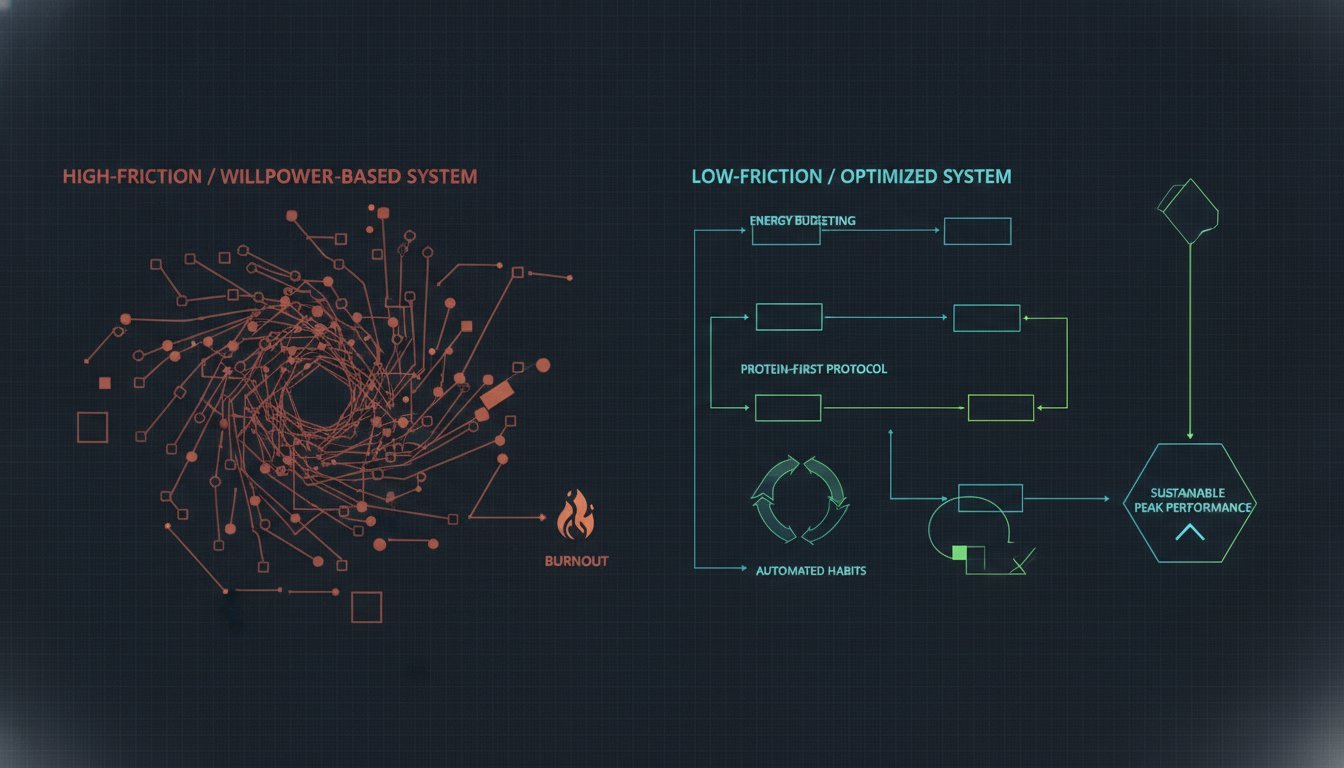
Weight loss is a logistics problem, not a test of character. Most professionals fail because they rely on willpower rather than system design. If you’re looking for how to easily lose weight, you must shift your focus from restriction to optimization. A July 2026 Gallup poll shows the U.S. adult obesity rate has dropped to 36.4%. This shift suggests that more people are moving toward sustainable, systemic changes rather than short term fixes.
You likely feel the exhaustion of decision fatigue from complex meal plans and the frustration of energy crashes that stall your workday. You don’t have time for two hour gym sessions that leave you drained for afternoon meetings. This article provides a tactical blueprint for sustainable fat loss and higher cognitive clarity by replacing willpower with low friction biological systems. We’ll outline five science-backed steps to achieve a repeatable weight management process. This includes protein optimization based on the 2026 Dietary Guidelines and methods to reduce the friction of daily health decisions.
Key Takeaways
- Replace willpower with low-friction systems to eliminate decision fatigue and ensure long-term adherence to your health goals.
- Manage your Basal Metabolic Rate and energy balance as a performance budget rather than a moral obligation.
- Transition from restrictive fixed diets to flexible frameworks to discover how to easily lose weight without increasing implementation costs.
- Integrate tactical habits like the “Protein-First” protocol and “Walking Meetings” to optimize fat loss during professional hours.
- Utilize physical health optimization as a tool to enhance cognitive clarity and executive decision-making.
Redefining Easy Weight Loss: Systems Over Willpower
“Easy” is a term often misused in fitness marketing. In an operational context, we define “easy” as the reduction of friction. If you want to understand how to easily lose weight, you must stop viewing your body as a moral battleground and start viewing it as a logistics problem. Willpower is a finite cognitive resource. Relying on it to resist high-calorie options after a day of high-stakes decision-making is a failing strategy. We prioritize systems that automate choices, ensuring your health goals don’t compete with your professional output.
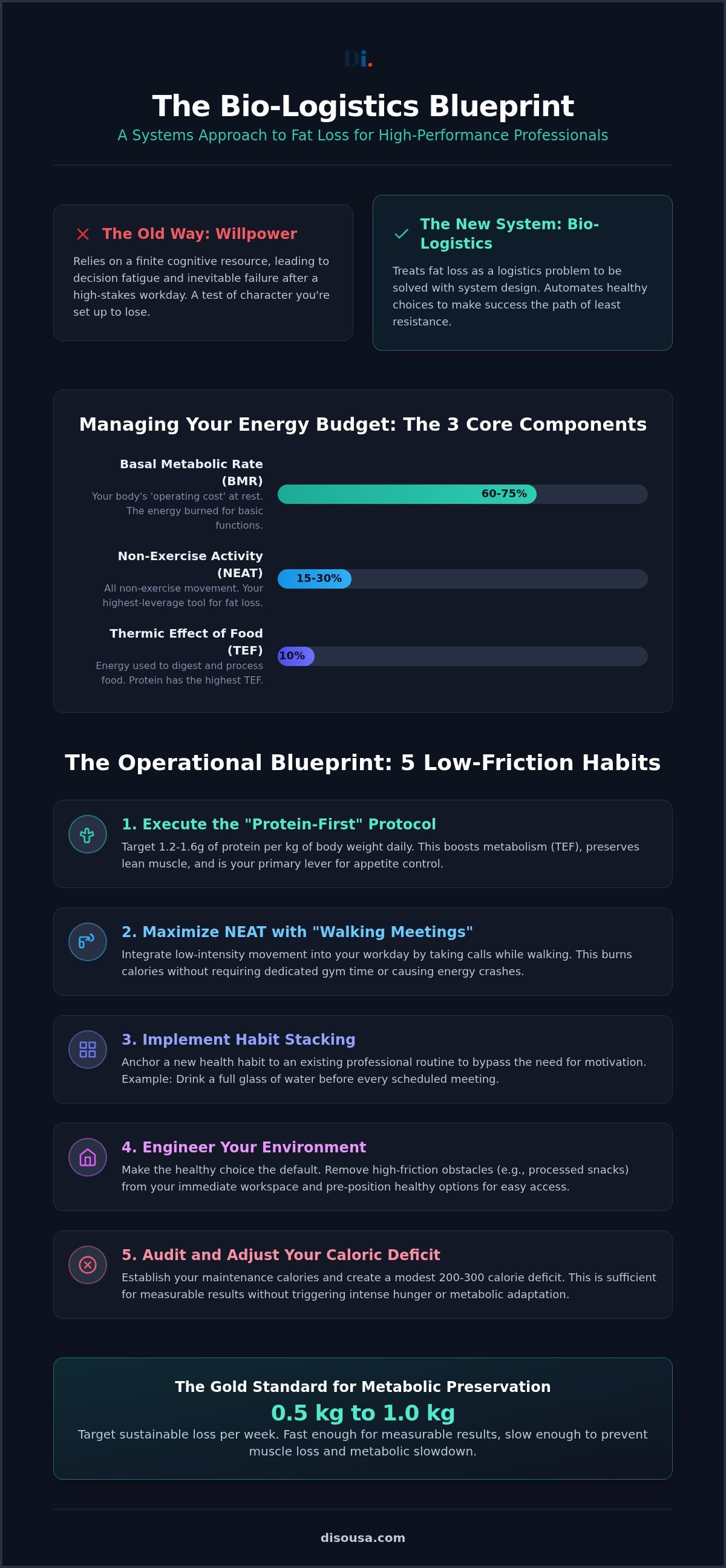
Think of your body as a business with a strict energy budget. This concept, which I call “Bio-Logistics,” involves managing your caloric inputs and metabolic outputs like a P&L statement. For a comprehensive overview of weight loss, it is essential to distinguish between intentional fat loss and the unintentional muscle wasting that often accompanies crash diets. We recommend a target loss of 0.5kg to 1kg per week. This rate is the gold standard for metabolic preservation; it’s fast enough to see measurable results but slow enough to prevent your body from aggressively lowering its operating costs through metabolic adaptation.
The Failure of Traditional Dieting
Most traditional diets fail because they ignore the “Restriction Cycle.” When you drastically cut calories without a plan, your Basal Metabolic Rate (BMR) eventually drops to match the lower intake. This leads to a plateau. The psychological cost is also high. High-friction food rules require constant mental monitoring, which creates decision fatigue. Fad diets usually fail the professional lifestyle audit because they aren’t compatible with travel, client dinners, or tight schedules. You can learn more about how to choose the best diet to lose weight in 2024 to avoid these common pitfalls.
The Systems-Based Alternative
Habit stacking is the most effective method for automated weight loss. By anchoring a new health habit to an existing professional routine, you bypass the need for motivation. We also utilize “Environment Design” to make the healthy choice the default. This means removing high-friction obstacles, such as keeping processed snacks out of your immediate workspace. We focus on how to easily lose weight by engineering your surroundings so the healthy choice becomes the path of least resistance. When the system is designed correctly, you no longer have to “try” to lose weight; the environment does the heavy lifting for you.
The Bio-Logistics of Fat Loss: Managing Your Energy Budget
Weight loss is governed by the Energy Balance Equation: Calories In versus Calories Out (CICO). While critics often call this oversimplified, it remains the fundamental law of thermodynamics. If you consume more energy than you expend, your body stores the surplus. If you consume less, it burns stored fat. To understand science-backed steps for losing weight, you must first audit your current energy expenditure. We treat this audit like a financial budget; you cannot manage what you do not measure.
Your metabolism is a composite of three main factors. First is Basal Metabolic Rate (BMR), which represents your body’s “operating cost” at rest. It is the energy required for basic functions like breathing and cell production. Second is the Thermic Effect of Food (TEF), the energy used to digest and process nutrients. Finally, there is Non-Exercise Activity Thermogenesis (NEAT). NEAT includes all movement that isn’t formal exercise, such as pacing during a meeting or standing at your desk. For a high-performance professional, NEAT is the highest-leverage tool for fat loss because it doesn’t require a dedicated gym session or a change of clothes.
Calculating Your Metabolic Baseline
To establish your baseline, use a simplified estimate. For a sedentary professional, multiply your current body weight in pounds by 12 to 14. This provides a rough maintenance level. BMR typically accounts for 60% to 75% of your daily energy burn. This means most of your fat burning happens while you’re focused on your work. Adjust your maintenance number down by 200 to 300 calories to create a deficit that allows you to see how to easily lose weight without triggering intense hunger signals.
The Role of Macronutrients in Satiety
Protein is your primary lever for appetite control. The 2025-2030 Dietary Guidelines released in January 2026 recommend 1.2 to 1.6 grams of protein per kilogram of body weight. High protein intake increases TEF and preserves lean muscle mass during a deficit. You should balance fats and carbohydrates to support cognitive performance. Glucose is necessary for high-intensity thinking, while fats are essential for hormonal health. Integrating The Science of Mindful Eating helps manage psychological satiety, ensuring your brain registers fullness during a busy workday.
Managing these biological inputs is similar to managing a performance campaign. You identify high-leverage habits to drive the best results. If you’re looking to scale your personal health with the same precision you apply to your business, you can explore our weight loss frameworks. Knowing how to easily lose weight is simply a matter of aligning your energy budget with your physical output.
Strategic Comparison: Sustainable Frameworks vs. High-Friction Diets
Fixed diets like Keto or Paleo are high-friction systems. They demand total compliance, which is a poor fit for a dynamic professional schedule. If you are solving for how to easily lose weight, you need a framework that accommodates variables, not one that breaks under pressure. Flexible frameworks like IIFYM (If It Fits Your Macros) or Mindful Eating operate on an energy budget rather than a restricted list. This lowers the “Cost of Implementation,” which includes the mental energy required to scan menus or decline social invitations. We value these frameworks because they respect your cognitive bandwidth.
Rigid eating patterns often disrupt workplace focus. Low-carb diets can lead to brain fog during critical tasks, while extreme calorie restriction causes irritability and poor executive function. We prioritize frameworks with a high Sustainability Score. This score measures how well a system survives travel, client dinners, and high-stress weeks. Addressing the health consequences of being overweight requires a system you can actually maintain when your schedule gets chaotic. A system that only works in a controlled environment is not a system; it is a liability.
Why Flexible Frameworks Win in 2026
Adherence is the only statistically significant predictor of long-term weight loss. Rigid diets fail because they don’t account for the reality of business dinners or airport food. Flexible frameworks allow you to adjust your inputs based on the environment. If a client dinner involves a high-calorie meal, you simply adjust your earlier intake to balance the day’s budget. This prevents the “all-or-nothing” mentality that leads to total program abandonment. For a deeper selection guide on these systems, read How to Choose the Best Diet to Lose Weight in 2026.
The “Affiliate Mindset” of Health
I recommend treating your health habits like affiliate partners. Every habit must deliver a positive ROI in the form of energy, satiety, or fat loss. If a specific health routine, like a 5 AM workout, leaves you exhausted and unproductive by noon, it is a low-performing partner. You should fire these habits and replace them with high-conversion actions. Focus on the 20% of behaviors that drive 80% of your results. This is how to easily lose weight without sacrificing your professional output. High-leverage habits, such as hitting a daily protein target, require minimal maintenance but provide a massive return on your energy investment.
The Operational Blueprint: 5 Low-Friction Habits for Rapid Results
Theory requires execution. To see how to easily lose weight, you must deploy these five low-friction habits. These are designed to integrate into a high-performance schedule without requiring a total lifestyle overhaul. We focus on habits that provide the highest return on investment with the lowest cognitive load.
- Step 1: The “Protein-First” Protocol. Every meal must begin with 30g of protein. This ensures satiety and prevents the blood sugar spikes that lead to afternoon productivity crashes.
- Step 2: The “Walking Meeting” Strategy. Convert at least two internal calls per day into walking meetings. This leverages NEAT without stealing time from your deep work blocks.
- Step 3: The “Hydration Anchor.” Consume 500ml of water 15 minutes before every meal. This pre-emptively manages hunger signals and improves metabolic efficiency.
- Step 4: The “Digital Tracking” Audit. Use a tracking tool to visualize your energy budget. This is the only way to identify “hidden” caloric leaks in your daily routine.
- Step 5: The “Sleep Hygiene” Mandate. Prioritize 7 to 8 hours of recovery. Sleep deprivation spikes ghrelin, the hormone responsible for intense hunger, making your systems-based approach much harder to maintain.
Automating Your Nutrition
Decision fatigue is the enemy of consistency. I recommend using meal templates to automate your intake. A template consists of a fixed protein source, two servings of fibrous vegetables, and a healthy fat. This removes the need to “think” about what to eat. You should also use pre-portioned logic for snacks; never eat directly from a large container. Conduct a weekly food audit every Sunday. Review your tracked data to see where your energy budget exceeded projections and adjust your “inventory” for the coming week.
Integrating Movement into the Workday
For most professionals, 10,000 daily steps outperform 30 minutes of high-intensity cardio. Cardio often triggers compensatory hunger, whereas walking provides a steady burn without the metabolic rebound. Use a standing desk or incorporate micro-movements, such as a one-minute stretch between deep work blocks. If you struggle with consistency, use the 10-minute rule: commit to just 10 minutes of movement. This low barrier to entry usually results in a full session. If you want to see how to easily lose weight while maintaining peak output, you can explore our optimized weight loss strategies.
Sustaining Peak Performance: Integrating Health into Professional Life
Weight loss shouldn’t be a side project. It’s a core component of “Online Marketing for the Self.” Just as you optimize a landing page for conversions, you should optimize your biology for output. Physical health directly correlates with executive function and decision-making. When your energy is managed correctly, your cognitive bandwidth increases. This is the real secret to how to easily lose weight. You stop fighting your biology and start leveraging it for professional success. This approach clarifies how to easily lose weight by focusing on data over drama.
During high-stress periods, we utilize “Minimum Viable Consistency.” You don’t need perfect performance every day. You need a floor that prevents regression. This means hitting your protein target even if you miss a walking meeting. Once you reach your goal, you transition from “Weight Loss” to “Weight Management” operations. This is a shift from a deficit mindset to a maintenance mindset. You monitor your energy budget like a stable business account to ensure long term stability.
The ROI of Health
Stable blood sugar is a productivity multiplier. It eliminates the mid-afternoon energy troughs that destroy deep work blocks. Improved health also reduces the long-term liability of chronic illness. Chronic health issues are an expensive drain on your time and capital. We apply this same logic to business growth in our A Functional Assessment of Online Marketing Services. The goal is always measurable improvement with minimal wasted resources.
Next Steps for Implementation
Identify your single lowest-friction habit. For most, it’s the “Protein-First” protocol. Start there today. Commit to a 30-day “system trial” before making permanent adjustments to your lifestyle. This period allows you to gather data on how your body responds to these low-friction inputs. Once the data confirms the ROI, you can scale the system. If you’re ready to optimize your performance with Disousa’s strategic frameworks, now is the time to audit your operations.
Scale Your Personal Performance Infrastructure
Sustainable weight management is an operational challenge that requires a data-driven response. You have seen that understanding how to easily lose weight depends on shifting from volatile willpower to stable biological systems. By auditing your energy budget and prioritizing high-ROI habits like the Protein-First protocol, you treat your health as a critical business asset rather than a secondary concern. This systems-based approach ensures your physical health supports your cognitive output instead of draining it.
We apply this same performance-driven methodology and global strategic expertise across our optimization projects. If you’re ready to apply a measurable results focus to your professional and personal growth, Explore Disousa’s Strategic Frameworks for Growth. Your health is the foundation of your executive function; it’s time to manage it with the same precision you bring to your business. You have the tactical blueprint required for success. It’s time to begin the implementation phase.
Frequently Asked Questions
Is it possible to lose weight without going to the gym?
Yes, weight loss is primarily driven by a caloric deficit rather than formal exercise. While resistance training is excellent for metabolic health and muscle preservation, you can achieve significant fat loss through nutritional control and increased daily movement. Focus on managing your energy budget and prioritizing high-satiety foods. This approach allows you to see results without the time commitment of traditional gym sessions.
How much water should I drink to help with weight loss?
Aim for 2 to 3 liters of water daily to maintain metabolic efficiency. Consuming 500ml of water approximately 15 minutes before meals can help you manage hunger signals and reduce total caloric intake. Water serves as a zero-calorie tool that prevents you from mistaking thirst for hunger. Proper hydration also supports cognitive function, ensuring your professional performance remains high during a caloric deficit.
Can I lose weight easily while working a sedentary desk job?
You can learn how to easily lose weight even with a desk-bound schedule by optimizing your Non-Exercise Activity Thermogenesis (NEAT). Incorporate standing desks, frequent stretching, and short walking breaks to increase your daily energy expenditure. Focus on high-protein meal templates to maintain stable blood sugar levels. These small tactical adjustments prevent the metabolic slowdown often associated with prolonged sitting and professional decision fatigue.
What happens if I hit a weight loss plateau?
A plateau typically indicates that your body has adapted to its current energy budget. Conduct a precise audit of your caloric intake and movement patterns to identify hidden energy leaks. You may need to adjust your daily budget by 100 to 200 calories or increase your step count to restart progress. Plateaus are data points, not failures; they signal that your system requires a minor operational recalibration.
Is intermittent fasting an effective system for professionals?
Intermittent fasting can be a useful tool for reducing decision fatigue by limiting your eating window. This system simplifies your daily logistics and can naturally lead to a caloric deficit. However, you must ensure your fasting schedule doesn’t cause energy crashes during high-stakes meetings or deep work blocks. Test different windows to find a framework that supports both your fat loss goals and your executive output.
How do I handle business travel while trying to lose weight?
Maintain your progress during travel by sticking to the “Protein-First” protocol at airport lounges and restaurants. Choose hotel rooms with easy access to healthy food options or basic fitness facilities. Use walking as your primary mode of transport through terminals to keep your movement baseline stable. A flexible framework allows you to accommodate social dinners without abandoning your long-term weight management systems.
What are the best low-friction snacks for the office?
Prioritize high-protein, pre-portioned snacks like Greek yogurt, beef jerky, or hard-boiled eggs. These options provide sustained satiety and prevent the insulin spikes caused by processed office snacks. Keep these items readily available in your workspace to avoid impulsive decisions when stress levels rise. Choosing low-friction, nutrient-dense snacks is a practical way to manage your energy budget without requiring significant preparation time.
How does sleep affect weight loss efficiency?
Sleep is a critical operational requirement for hormonal balance. Deprivation increases ghrelin, which triggers hunger, and decreases leptin, which signals fullness. This hormonal shift makes it difficult to maintain even the best weight loss systems. Prioritizing seven to eight hours of recovery ensures your brain has the willpower and clarity needed to make optimal food choices throughout the following workday.
Disclaimer
**Disclosure:** Some articles on this website may contain affiliate links. This means we may earn a commission if you purchase a product or service through certain links, at no additional cost to you. We only recommend products, tools, and services that we believe provide value to our readers.
**Disclaimer:** The information provided on this website is for educational and informational purposes only and should not be considered financial, legal, tax, or professional advice. While we strive to keep our content accurate and up to date, we make no guarantees regarding completeness, reliability, or results obtained from using the information provided. Always conduct your own research and consult qualified professionals before making business, financial, or investment decisions.
