
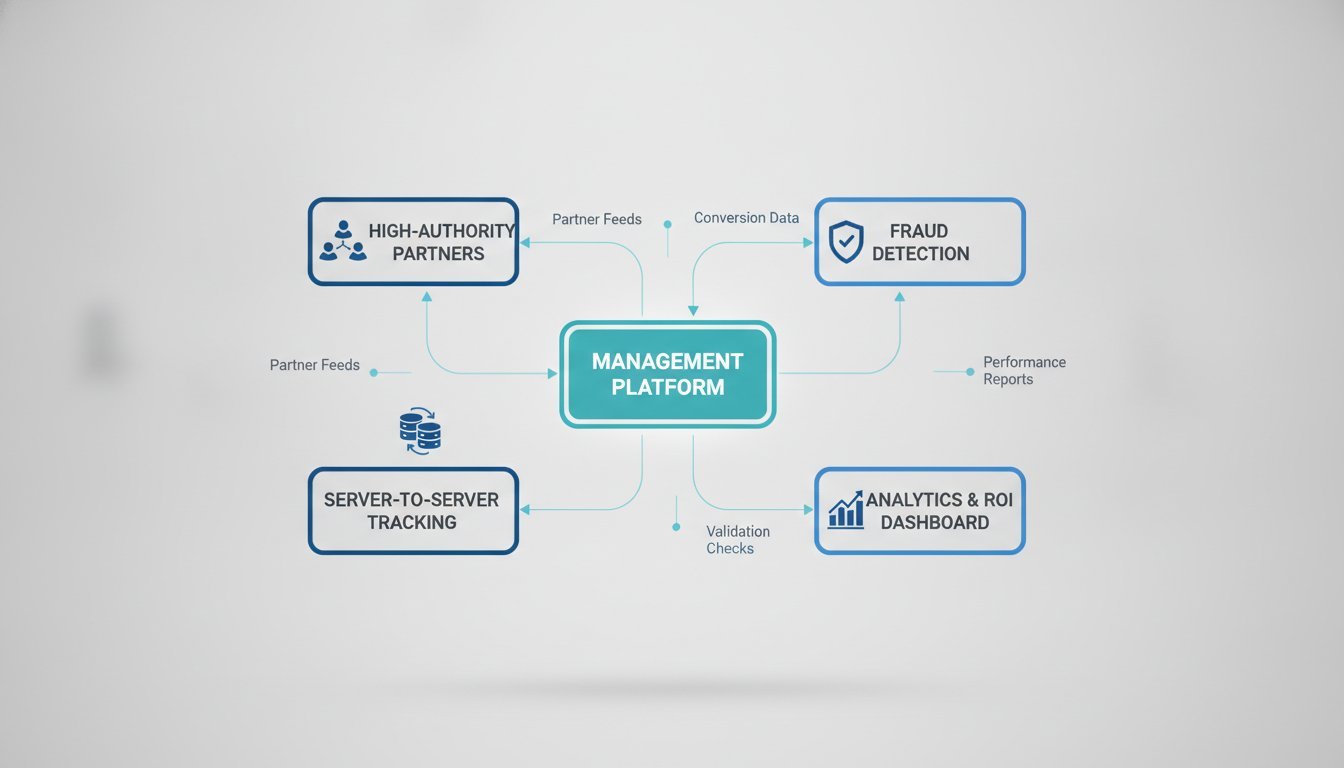
The passive income narrative has distorted the reality of affiliate marketing for too long. Most businesses approach these channels as automated revenue streams, only to face issues with fraudulent traffic and inaccurate attribution. If you’re tired of vague advice from self-proclaimed experts, you’re looking for a more grounded approach. You need a system that prioritizes data integrity and professional partnerships over the ‘set it and forget it’ mentality. Moving from a manual, disorganized approach to a professionalized operation is often the biggest hurdle for growing brands. It requires a fundamental shift in how you view both your partners and your internal data structures.
I’ll demonstrate how to do the affiliate marketing the right way by establishing a tactical, high-performance ecosystem. This article provides a clear roadmap for partner recruitment and sustainable ROI through performance-based channels. We’ll examine how to professionalize your marketing operation and solve the technical confusion surrounding tracking and attribution models. By the end, you’ll have a functional blueprint for building a reliable affiliate program that produces measurable results and avoids expensive mistakes.
Key Takeaways
- Shift your perspective from passive income myths to a performance-based partnership model that focuses on verified business outcomes.
- Implement server-to-server (S2S) tracking to ensure data integrity and accurate attribution in a privacy-first digital landscape.
- Master how to do the affiliate marketing the right way by recruiting high-authority partners instead of relying on low-quality coupon or discount sites.
- Protect your marketing budget by deploying automated fraud detection tools to block cookie stuffing, bot traffic, and ad hijacking.
- Identify the specific operational milestones that signal it’s time to scale from manual management to a professionalized, outsourced ecosystem.
Redefining Affiliate Marketing as a Performance Partnership
Stop thinking about affiliate marketing as a digital lottery or a hands-off revenue stream. It’s not a “passive income” hack; it’s a performance-based arrangement where you pay partners for specific, verified outcomes. To understand what is affiliate marketing in a modern context, you must view it as a professionalized sales channel. This shift in mindset is the foundation of how to do the affiliate marketing the right way in a high-stakes B2B or D2C environment.
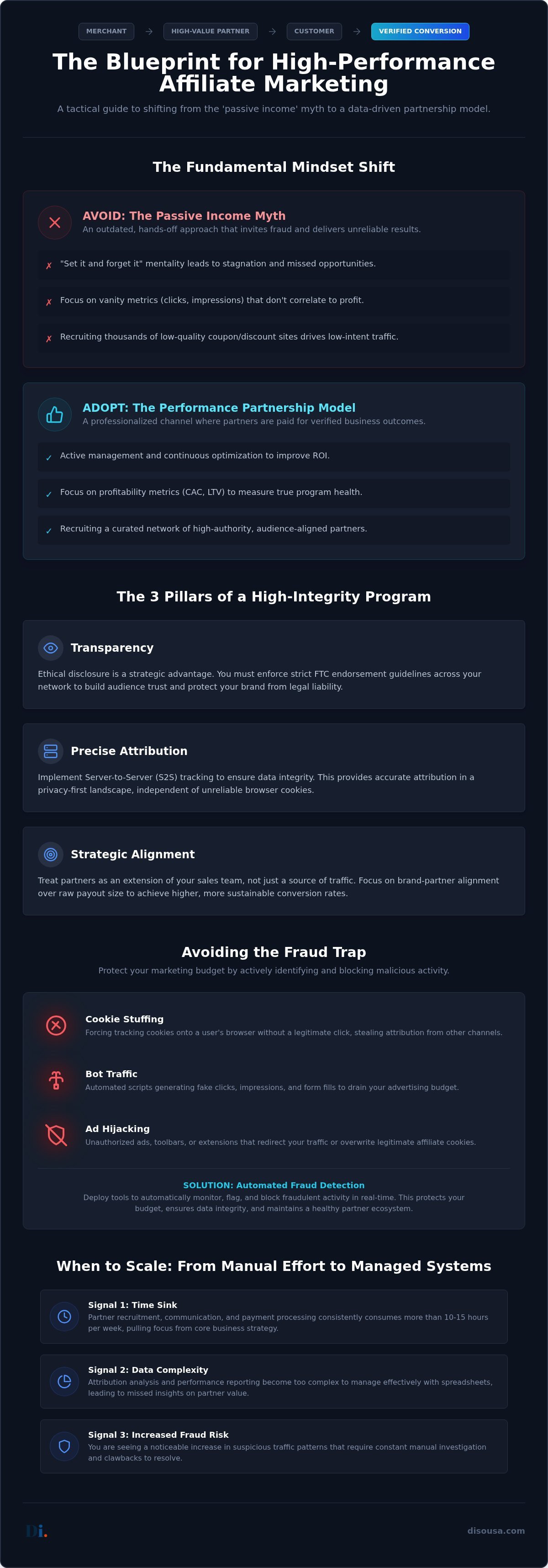
In 2026, the industry is moving toward quality over quantity. Brands no longer benefit from thousands of low-tier partners who drive accidental clicks or low-intent traffic. Success now requires a curated ecosystem built on three pillars: transparency, precise attribution, and strategic alignment. You’re looking for partners who act as an extension of your sales team, not just a source of anonymous traffic.
To better understand this concept, watch this helpful video:
The Merchant-Affiliate-Customer Relationship
The relationship is a three-way value exchange that must remain balanced to survive. The merchant gains a customer; the affiliate earns a commission for their influence; and the customer receives a vetted recommendation. Ethical disclosure isn’t just a legal checkbox anymore. It’s a strategic advantage that builds trust with an increasingly skeptical audience. In 2026, the Performance Partnership model is defined as a data-driven, transparent collaboration where compensation is strictly tied to pre-defined, high-value user actions.
Setting Realistic KPIs for 2026
Don’t get distracted by vanity metrics like total clicks or impressions. You need to focus on Customer Acquisition Cost (CAC) and Lifetime Value (LTV) to determine if your program is actually profitable. Establishing a baseline conversion rate depends heavily on your niche, but you should expect higher conversion from high-intent partners than from broad-reach discount sites. For a deeper dive into these fundamentals, check out our Affiliate Marketing Easy Guide. Mastering these metrics is a core part of how to do the affiliate marketing the right way while maintaining a healthy bottom line.
Building Your Strategic Foundation: Niche, Data, and Compliance
Most guides focus on the affiliate side of the equation, suggesting high-commission niches regardless of brand safety. For a merchant, building a strategic foundation means identifying a high-intent vertical where your brand maintains a clear competitive advantage. This isn’t about chasing the highest payouts; it’s about finding the right partners who reach your specific audience. Establishing these guardrails early is a critical component of how to do the affiliate marketing the right way.
Selecting the Right Vertical
Evaluate market saturation versus actual demand. In 2026, brand-partner alignment is more valuable than mere payout size. If your partner’s audience doesn’t trust their recommendations, your conversion rate will suffer regardless of the traffic volume. Focus on niches where your product solves a documented pain point. You can find a more detailed breakdown of this approach in our Affiliate Marketing for Brands: A Strategic Framework.
Compliance and integrity are non-negotiable. Legal standards like GDPR and CCPA are the baseline, not the ceiling. You must enforce strict FTC endorsement guidelines across your entire network. This protects your brand from liability and ensures that every recommendation is transparent to the end-user. Relying on first-party data allows you to optimize partner performance without infringing on user privacy. It also provides the insights needed to refine your commission structures based on actual customer quality.
Infrastructure and Tracking Protocols
Standard link-based tracking is insufficient in a post-cookie world. You need server-to-server (S2S) tracking to maintain data integrity and ensure accurate attribution. Implementing multi-touch attribution rewards partners for every stage of the funnel they influence, rather than just the final click. This creates a fairer ecosystem for content creators who drive early-stage awareness. Before you launch, ensure your technical stack is ready with this checklist:
- Verify S2S tracking is firing correctly across all conversion points.
- Establish a clear first-party data collection strategy for partner insights.
- Audit partner sites for proper disclosure placement and brand alignment.
- Configure automated alerts for unusual traffic spikes that might indicate fraud.
If you’re unsure about your technical readiness, evaluating professional online marketing services can help bridge the gap between high-level strategy and technical execution. Professionalized systems ensure that your data is clean and your ROI is accurately reported from day one.
The Mechanics of High-Value Partner Recruitment
Recruiting partners is often treated as a volume game, but a high-performance ecosystem relies on precision. You don’t need a massive directory of low-quality coupon sites that cannibalize your organic traffic. Instead, focus on a small group of high-authority partners who align with your brand’s core values. Ten strategic partners who command real influence in your niche will consistently outperform 1,000 generic affiliates. This focused approach is central to how to do the affiliate marketing the right way.
Identifying Strategic Partners
We use audience overlap tools to determine exactly where your potential customers are engaging with content. You should prioritize partners whose existing audience matches your ideal customer profile. Micro-influencers often provide higher conversion rates because their followers view them as trusted subject matter experts. They bridge the gap between broad awareness and specific intent. To understand how these partners amplify your reach, you can review our guide on how to promote your content online. This ensures your recruitment efforts are grounded in actual data rather than guesswork.
Moving beyond flat commissions is necessary for long-term retention. I recommend implementing tiered reward systems that increase based on performance milestones. Performance bonuses for specific high-value outcomes, such as first-time buyers or long-term subscriptions, keep partners motivated. This structure shifts the relationship from a simple transaction to a professionalized growth partnership. You’re rewarding the quality of the customer, not just the volume of the traffic.
Developing the Partner Brief
A successful partnership requires a clear brief that outlines the ‘why’ behind your product. You should provide partners with standardized brand guidelines to maintain consistent messaging. This prevents brand dilution and ensures that every affiliate-generated asset looks professional. A sample outreach sentence that prioritizes mutual value might look like this: ‘We’ve identified a significant overlap between our technology and your audience’s current challenges, and I’d like to discuss a performance-based partnership that rewards your authority in this space.’ This approach respects their intelligence and values their time while demonstrating how to do the affiliate marketing the right way. We also provide partners with high-converting assets to act as a bridge, making it easier for them to integrate your brand into their existing content naturally.
Avoiding the Fraud Trap: Integrity and Ethical Standards
Fraud isn’t just an operational annoyance; it’s a direct tax on your performance budget. If you want to know how to do the affiliate marketing the right way, you must prioritize data integrity over raw volume. Cookie stuffing, ad hijacking, and bot traffic are the most common ways unethical actors siphon off your margins. Transparency in traffic sources is no longer a optional feature. In 2026, it’s a non-negotiable requirement for any partner entering your ecosystem. We’ve seen too many brands ignore these red flags in favor of vanity metrics, only to realize their “growth” was entirely fabricated.
Cookie stuffing involves placing tracking cookies on a user’s device without a legitimate click, essentially stealing credit for organic sales. Ad hijacking occurs when affiliates bid on your brand keywords, driving up your own search costs while claiming a commission on traffic you would have received anyway. Bot traffic produces thousands of fake clicks that never convert, which skews your data and makes optimization impossible. Implementing automated fraud detection tools is the only way to protect your spend at scale, but these tools must be paired with a rigorous ‘Blacklist’ protocol to remove offenders immediately.
Spotting Red Flags in Partner Data
Look for conversion rates that seem impossible. If a partner reports a 40% conversion rate on cold traffic, they’re likely using unethical tactics. Suspicious traffic spikes from geographic regions where you don’t even operate are another clear signal of bot activity. While AI tools help filter the noise, manual audits remain essential in a landscape flooded with automated misinformation. This skepticism is similar to the critical eye needed when debunking the myths freelance artists still believe about their own industry. You have to look at the hard data, not the polished pitch, to find the truth.
Maintaining Brand Safety
Set clear boundaries on where and how your brand is promoted to avoid appearing on low-quality or controversial sites. Every partner must use clear affiliate disclaimers to satisfy legal requirements and maintain customer trust. Dealing with unethical partners quickly prevents long-term damage to your network’s credibility. Our policy is simple: we maintain a zero-tolerance stance toward traffic fraud, and any verified violation results in immediate termination and commission forfeiture. To ensure your program is built on a foundation of integrity, consider a professional audit of your affiliate marketing operations to identify and eliminate hidden fraud before it scales.
Scaling Operations: From Manual Effort to Managed Systems
Scaling a program is where most brands lose their grip on quality. It’s easy to manage five partners on a spreadsheet, but managing 500 requires a professionalized infrastructure. If your affiliate channel is still treated as an in-house side project for a junior marketer, you’re likely leaving significant revenue on the table. Moving to a dedicated affiliate manager or an Outsourced Program Management (OPM) agency is the logical next step for any brand serious about how to do the affiliate marketing the right way. This transition allows you to focus on high-level strategy while experts handle the daily logistical grind.
The Path to Professional Management
Evaluating the ROI of outsourced management involves looking beyond the monthly retainer. Professional managers bring established relationships with top-tier influencers and high-authority media houses that you simply can’t access through a generic signup form. They provide the strategic oversight needed to ensure your program doesn’t become a haven for low-value traffic. For a deeper look at how these decisions impact your bottom line, review our A Functional Assessment of Online Marketing Services. Professional management unlocks exclusive networks and ensures your program terms remain competitive without eroding your margins.
Your affiliate data shouldn’t exist in a silo. We integrate this performance data into your wider email and performance marketing stack to create a unified view of the customer journey. This allows you to see how an affiliate-driven lead interacts with your email sequences or retargeting ads. Periodic program audits are essential to keep the system running efficiently. You must schedule regular intervals for these specific tasks:
- Refresh creative assets to prevent banner blindness among your partners’ audiences.
- Prune dead links and outdated landing pages to protect the user experience.
- Update program terms to reflect shifts in your margin or competitive landscape.
- Audit partner traffic sources to ensure continued alignment with brand safety standards.
Future-Proofing Your Program for 2027 and Beyond
The rise of AI-driven search is fundamentally changing how users discover products. To survive this shift, you must build direct-to-partner relationships that transcend specific platforms. High-authority content will always have a place, but the delivery method is evolving. If you focus on how to do the affiliate marketing the right way today, you’ll have the data integrity and partner loyalty needed to pivot when 2027 brings new technical challenges. We prioritize transparency and performance to ensure your ecosystem remains resilient against algorithm updates. Learn more about Disousa’s performance-based marketing strategies to see how we can professionalize your digital growth operations.
Transitioning to a Professionalized Affiliate Ecosystem
Building a sustainable program requires moving beyond the “passive income” mindset. Success depends on treating affiliates as professional partners rather than automated traffic sources. By implementing server-to-server tracking and rigorous fraud detection, you protect your margins and ensure every conversion is verified. This tactical framework is the only reliable method for how to do the affiliate marketing the right way in a competitive landscape. Focus on high-authority recruitment and data-driven alignment to turn your affiliate channel into a predictable growth engine.
Scaling these operations manually often leads to diminishing returns and security risks. You can scale your brand through professional affiliate management with Disousa. We specialize in performance-based affiliate growth and global strategic partnership management. Our approach prioritizes data-driven conversion optimization to ensure your marketing spend produces measurable results. You have the blueprint; now it’s time to execute with precision. Establishing these systems today ensures your brand remains resilient and profitable as the digital market evolves.
Frequently Asked Questions
Is affiliate marketing still profitable in 2026?
Affiliate marketing remains highly profitable as a performance-based channel for brands that prioritize high-quality partnerships. The shift toward data integrity and better attribution has removed much of the low-value noise from previous years. Brands that focus on strategic alignment and verified outcomes see sustainable ROI. It’s no longer about volume but about the quality of the customer acquired through trusted influencers and niche sites.
How much does it cost to start an affiliate marketing program the right way?
Costs vary based on whether you use a third-party platform or build a private system. You’ll need to budget for tracking software, initial partner recruitment, and creative asset development. Many brands also invest in a dedicated manager or an agency to handle technical setup and compliance. Professionalized systems that support server-to-server tracking generally require a higher initial investment to ensure data accuracy from day one.
What is the difference between an affiliate network and a private program?
An affiliate network acts as a marketplace that connects merchants with a pre-existing pool of affiliates, handling tracking and payments for a fee. A private program is hosted by the brand itself, offering more control over partner selection and data privacy. Private programs often attract higher-tier partners because they offer direct communication and customized terms. Networks are better for rapid reach; private programs are superior for brand safety.
Can I do affiliate marketing without a website?
You can perform affiliate marketing through social media, email lists, or video platforms, but having a central website is highly recommended for long-term authority. For merchants, hosting a dedicated affiliate portal on your site is essential for professional recruitment. It provides a central hub for brand guidelines and creative assets. While affiliates can use diverse channels, the merchant’s infrastructure must be grounded in a secure, owned web property to maintain tracking integrity.
How do I prevent affiliate fraud in my program?
Preventing fraud requires a combination of automated detection tools and manual data audits. You should implement software that flags suspicious traffic spikes, impossible conversion rates, and geographic anomalies. Establishing a clear protocol for immediate termination of unethical partners is also necessary. This proactive stance is part of how to do the affiliate marketing the right way, ensuring your budget only pays for legitimate, verified customer actions rather than bot traffic.
What are the legal requirements for affiliate disclosures in 2026?
Legal requirements in 2026 focus on clear and conspicuous disclosures as mandated by global regulatory bodies. Every partner must explicitly state their relationship with your brand before the user clicks a tracking link. These disclosures should be placed in close proximity to the recommendation and must be easy for a consumer to understand. Compliance is not just a legal necessity; it’s a strategic move to maintain brand trust and avoid expensive penalties.
How do I find high-quality affiliates for my specific niche?
Finding high-quality affiliates involves using audience overlap tools and monitoring industry-specific content creators. You should look for partners who already command authority in your niche and whose audience matches your ideal customer profile. Direct outreach that emphasizes mutual value is more effective than mass recruitment. This ensures you build a network of high-performance partners rather than a directory of low-intent sites that don’t drive real business value.
What is the average commission rate for affiliate marketing?
Commission rates are determined by your specific margins and the competitive landscape of your vertical. You’ll find that digital services often provide higher percentages than physical retail due to lower overhead costs. The best approach is to calculate your maximum acceptable Customer Acquisition Cost and work backward to find a sustainable rate. This ensures you remain attractive to partners and is a key part of how to do the affiliate marketing the right way.
Disclaimer
**Disclosure:** Some articles on this website may contain affiliate links. This means we may earn a commission if you purchase a product or service through certain links, at no additional cost to you. We only recommend products, tools, and services that we believe provide value to our readers.
**Disclaimer:** The information provided on this website is for educational and informational purposes only and should not be considered financial, legal, tax, or professional advice. While we strive to keep our content accurate and up to date, we make no guarantees regarding completeness, reliability, or results obtained from using the information provided. Always conduct your own research and consult qualified professionals before making business, financial, or investment decisions.
