
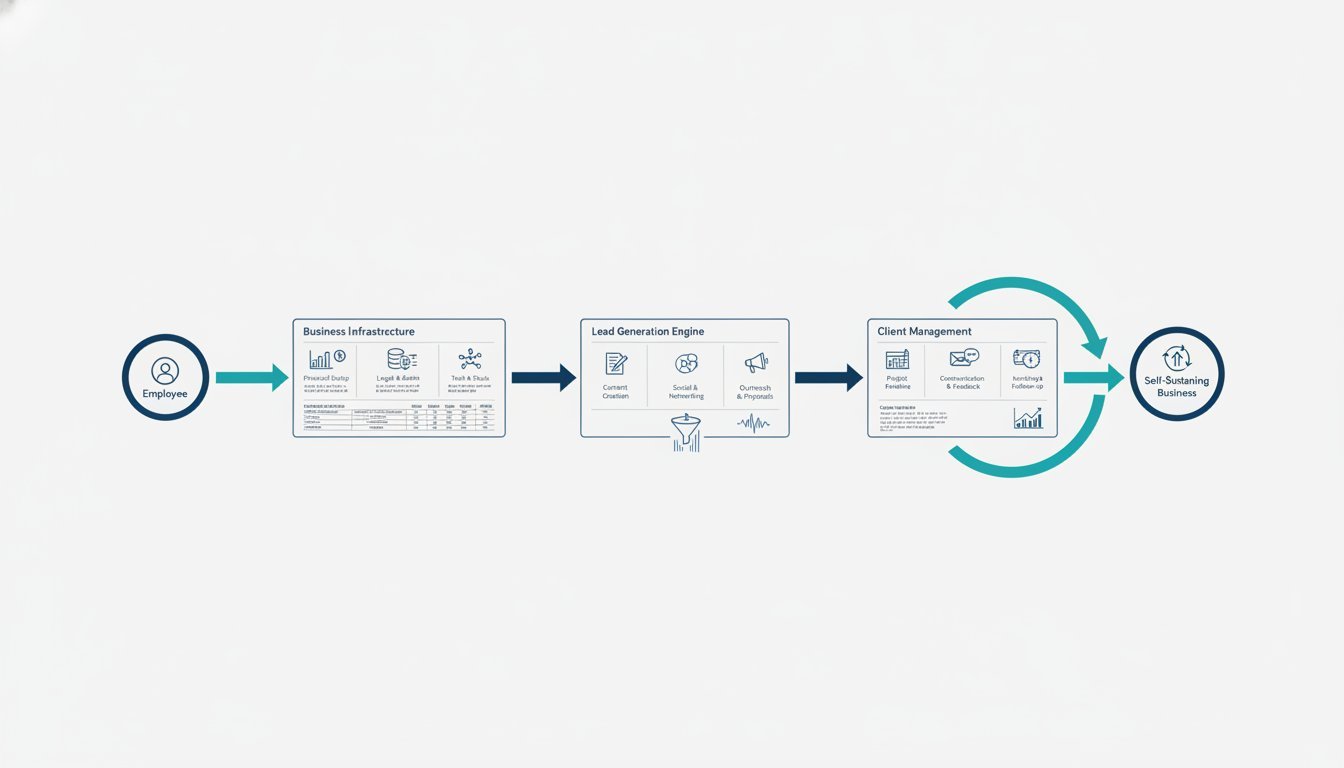
Most professionals treat freelancing as a simple job change, but it’s actually the launch of a micro-agency that requires a robust marketing and operations framework. You likely understand the frustration of being an expert in your field while feeling overwhelmed by the administrative burden of running a business. It’s common to worry about income instability and the lack of a clear system for finding new clients. You want the freedom of self-employment without the constant stress of the “feast or famine” cycle.
This briefing provides a tactical roadmap for transitioning from traditional employment to a self-sustaining business model. We’ll examine the specific mechanics of how to become a freelancer and how it works when you treat your skills as a scalable service. This guide moves past surface-level advice to focus on predictable lead generation and logistical reality. You’ll learn how to implement email marketing and SEO strategies to ensure your business remains profitable and organized from day one.
Key Takeaways
- Shift from an employee to an owner-operator mindset by treating your work as a B2B service business.
- Master the functional mechanics of how to becoming a freelancer or how it works by establishing a legal and financial foundation.
- Replace unpredictable referrals with a systematic lead generation engine to ensure a steady flow of new business.
- Calculate your true hourly rate by accounting for overhead and taxes to ensure your business remains profitable.
- Identify the natural ceiling of solo work and prepare a roadmap for transitioning into a high-value consulting role.
The Operational Reality: How Freelancing Actually Works
Freelancing is often misunderstood as a simple lifestyle choice or a way to escape the office. In reality, it’s a professional B2B service-based business model. You’re no longer just a worker; you’re an owner-operator responsible for every department, from sales to fulfillment. This shift requires moving away from the employee mindset of trading time for a paycheck. Instead, you must adopt a model of trading specialized results for high-margin fees. Understanding how to becoming a freelancer or how it works at a fundamental level means recognizing that your clients are strategic partners, not managers.
The promise of “total freedom” is a common marketing hook, but the operational reality is more nuanced. You trade a single supervisor for multiple stakeholders, each with their own deadlines and expectations. Successful freelancers thrive by managing these relationships through clear contracts and communication systems. Without these structures, the freedom you seek quickly turns into administrative chaos. You must be prepared to handle lead generation, accounting, and project management alongside your actual craft.
To better understand this concept, watch this helpful video:
The Shift from Task-Taker to Solution-Provider
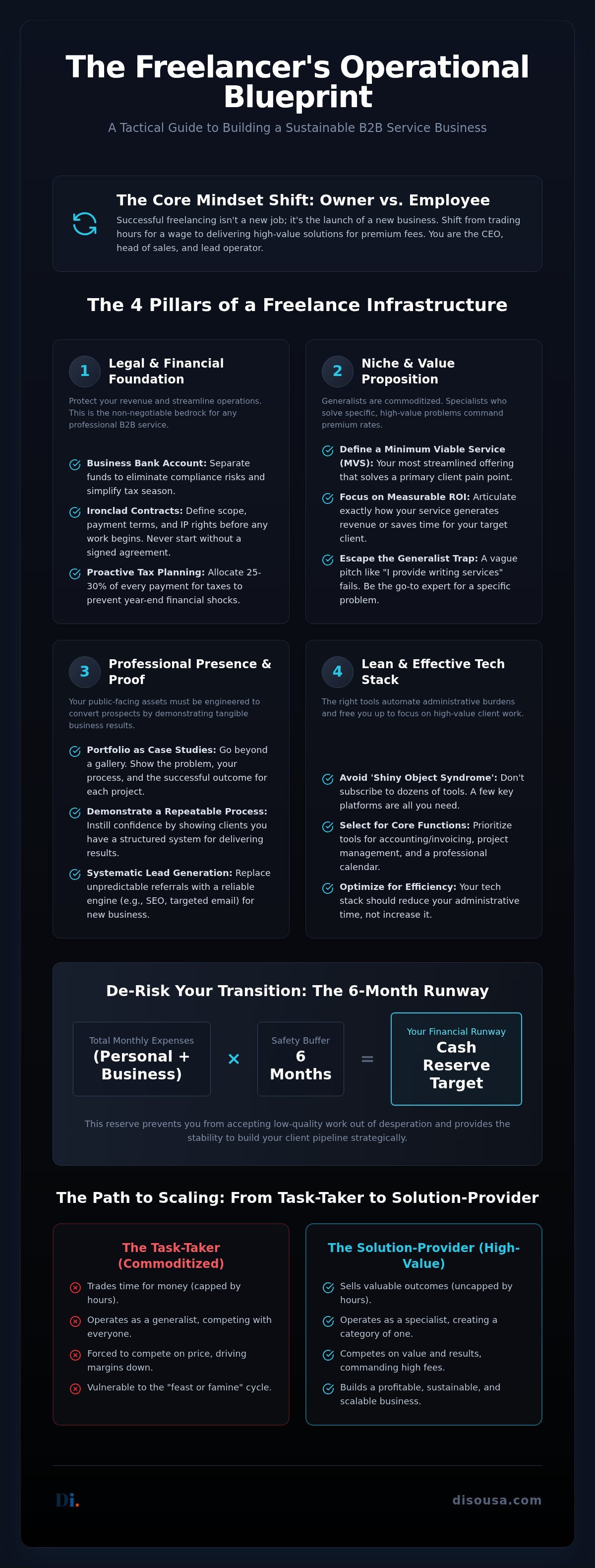
In the 2026 gig economy, generalists are being commoditized by AI and global competition. Specialists who solve specific, high-value problems earn significantly more because they provide a measurable ROI. You must define a Minimum Viable Service (MVS) to gain traction. This is the most streamlined version of your offering that solves a primary client pain point effectively. For a deeper look at the industry, read this briefing on the unfiltered truth about freelance careers. Transitioning from a task-taker to a solution-provider is the only way to protect your profit margins long-term.
De-risking the Transition
Financial security is the foundation of a sustainable business. Calculate your runway by totaling your monthly personal and business expenses, then multiply that sum by six. This cash reserve prevents you from taking low-quality clients out of desperation. Many professionals utilize a hybrid model, treating their business as a side-hustle to validate their niche before resigning. This approach allows you to test your marketing systems while maintaining a steady income. It’s also an ideal time for identifying and debunking common freelance myths that often lead to early burnout. Truly understanding how to becoming a freelancer or how it works requires this level of logistical preparation.
Establishing Your Infrastructure: The 4 Pillars of a Freelance Business
Building a freelance business is a logistical exercise, not just a career shift. You’re constructing the infrastructure that allows you to bill clients, protect your time, and scale your income. If you want to understand how to becoming a freelancer or how it works when your business starts to scale, you have to treat these four pillars as the non-negotiable foundation of your operations. Without this framework, you’re just a person with a hobby who occasionally gets paid.
Legal and Financial Setup
Start by opening a dedicated business bank account immediately. Mixing personal and professional funds is a major compliance risk that makes tax season a nightmare. In 2026, global freelancers must also account for varying tax jurisdictions and digital service regulations. Contracts are your primary defense mechanism; they define the scope of work and ensure you retain or transfer intellectual property rights correctly. Never start work without a signed agreement. It protects your revenue and sets professional boundaries from the first day.
The second pillar is defining your niche and value proposition. A vague pitch like “I provide writing services” fails because it doesn’t speak to a specific business outcome. You need to articulate exactly how your service generates revenue or saves time for your target client. The third pillar is your professional presence. Your portfolio shouldn’t just be a gallery of past work. It needs to be a collection of case studies that prove your process delivers consistent results. Finally, your tech stack must be lean. Avoid “shiny object syndrome” and only invest in tools that directly impact your output or billing efficiency.
The Tech Stack for Solo Operations
Your time is your most valuable inventory. Use project management tools to track deadlines and time-tracking software to ensure your projects are actually profitable. International payment gateways are essential for handling cross-border transactions without losing a massive percentage to hidden fees. You can leverage online marketing services to automate administrative overhead like lead nurturing and appointment setting. This keeps you focused on high-value work rather than manual data entry.
Understanding how to becoming a freelancer or how it works in a professional capacity means moving beyond the “gig” mentality. Integrating these systems early prevents the administrative overwhelm that kills most new businesses before they gain momentum. If you’re ready to professionalize your approach, you can examine our freelancer growth frameworks to streamline your initial setup and focus on what you do best.
The Lead Generation Engine: How to Acquire Clients Systematically
Most new freelancers fail because they rely on “hope marketing.” They wait for referrals that never come or dry up after the first few months. If you want a sustainable business, you must build a systematic lead generation engine. This is the core of how to becoming a freelancer or how it works when you move beyond a hobbyist mindset. You need a mix of inbound and outbound strategies to keep your pipeline full. Treating your business like a brand means ensuring you’re visible to the people who actually have the budget to hire you.
Inbound Strategy: Content and Authority
Inbound marketing turns your expertise into a magnet for high-quality clients. By building a blog focused on solving specific business problems, you improve your SEO and demonstrate your value before a prospect even speaks to you. It’s about building authority in a specific niche. Once you have content, you need to know how to promote your content online to reach the right decision-makers. LinkedIn serves as your professional landing page. It’s not a resume; it’s a sales tool. Your profile should highlight the results you deliver rather than just the titles you’ve held in the past. This creates a passive stream of inquiries from qualified prospects who already trust your capability.
Outbound Strategy: Strategic Outreach
Outbound marketing gives you direct control over your growth. You don’t wait for the phone to ring; you initiate the conversation. A successful cold email is brief. It focuses on the prospect’s specific pain points rather than your own credentials. You can also create a “lead magnet,” such as a tactical checklist or a short white paper, to capture email addresses from decision-makers. This allows you to use email marketing to nurture relationships over time. Exploring various ideas on how to make money online can reveal performance-based partnerships that expand your reach beyond traditional job boards. These systems ensure that you aren’t starting your sales process from scratch every month. You’re building an asset that produces predictable leads, which is the only way to achieve true financial independence in a freelance model.
Pricing and Contractual Frameworks: Securing Your Revenue
Pricing is not just about picking a number. It is about protecting your profitability and ensuring your business survives the inevitable fluctuations of the market. To understand how to becoming a freelancer or how it works at a professional level, you must master the financial mechanics of your operation. You have three primary levers: hourly, project-based, and value-based pricing. Each has its place, but your goal should be to move away from trading time for money as quickly as possible.
You must calculate your “True Hourly Rate” before sending your first invoice. This number is not just your take-home pay. It includes self-employment taxes, software subscriptions, health insurance, and non-billable time spent on marketing or admin. If you want to earn a specific net income, your gross billable rate often needs to be 30% to 50% higher to cover these operational costs. Ignoring this reality is the fastest way to burnout.
Moving from Hourly to Value-Based Pricing
Hourly billing creates a fundamental conflict of interest because it penalizes you for being efficient. If you can solve a problem in two hours that takes others ten, you shouldn’t be paid less for your expertise. Value-based pricing shifts the conversation to the client’s ROI. Frame your services as an investment that generates revenue or saves time. During negotiations, focus on the cost of the client’s problem. This allows you to charge high-ticket fees based on the impact you deliver rather than the minutes you spend at a desk.
Payment Terms and Cash Flow Management
Cash flow is the lifeblood of your solo operation. I recommend the 50/50 rule: collect a 50% upfront deposit to secure the project and the remaining 50% before final delivery. This ensures you aren’t working for free and covers your overhead during the project. Standardize your invoicing cycle and use automated reminders to handle late payments without awkward manual follow-ups. Since freelance income can be seasonal, building an emergency fund that covers at least three months of expenses is non-negotiable. This cushion gives you the power to walk away from “bad fit” clients who don’t respect your terms.
Managing “Scope Creep” requires rigid contract language. Your agreement must explicitly define what is included. If a client requests extras, refer to the contract and issue a change order with a new fee. This protects your margins and maintains professional boundaries. If you’re ready to professionalize your offer, you can use our functional assessment of online marketing services to see how top-tier consultants structure their pricing and contracts for maximum growth.
Scaling Beyond the Solo Model: From Freelancer to Consultant
Every solo operator eventually hits a ceiling. You only have a set number of billable hours available each week. This is the inflection point where you must decide between remaining a technician or becoming a true business owner. Understanding how to becoming a freelancer or how it works at a professional scale involves decoupling your income from your manual labor. You achieve this by shifting from high-volume execution to high-value strategy.
The Consultant Transition
Transitioning into a consulting role means you’re paid for your perspective and specialized knowledge. You can productize your expertise into frameworks or workshops that deliver results without requiring your constant presence. Building a referral network with other specialized freelancers allows you to pass off execution tasks while maintaining a strategic oversight role. You should also consider integrating affiliate marketing frameworks into your revenue model. This creates a secondary income stream that rewards you for recommending the tools and services you already trust. It’s a low-overhead way to increase your margins without increasing your workload.
Outsourcing is the next logical step for growth. You don’t need to hire a full team immediately. Start by delegating low-value administrative tasks to virtual assistants or specialized agencies. This frees you to focus on lead generation and high-level client strategy. By automating your administrative overhead, you transform your business from a job you own into an asset that functions independently. This shift is essential if you want to move past the “feast or famine” cycle and build long-term wealth.
Next Steps for the 2026 Freelancer
The freelance market in 2026 requires continuous adaptation. You must stay proficient in AI and automation tools to maintain your competitive edge. These technologies shouldn’t replace your craft. They should augment your efficiency and allow you to handle more complex client problems. Regularly evaluate the long-term viability of your niche to ensure you aren’t specializing in a sunset industry. If your market is shrinking, use your existing infrastructure to pivot into adjacent, high-growth sectors.
Consistency is your only true competitive advantage. The mechanics of how to becoming a freelancer or how it works are relatively straightforward, but execution is where most fail. Success comes from showing up every day to run your marketing systems and deliver exceptional value. Focus on building a resilient business model that can withstand market shifts while providing the financial independence you set out to achieve. This is a tactical briefing, and your next move is to implement the first pillar of your infrastructure.
Operationalizing Your Freelance Growth
Transitioning to self-employment requires more than just technical skill; it demands a functional business framework. You’ve now seen that success depends on treating your output as a B2B service rather than a series of tasks. By establishing a legal foundation, automating your lead generation, and shifting toward value-based pricing, you move from a technician to an owner-operator. This guide has detailed the mechanics of how to becoming a freelancer or how it works when you prioritize profitability and professional systems over simple gig work.
Your next step is to refine your marketing and operations to ensure long-term sustainability. We provide expert-led marketing briefings and strategic frameworks for digital growth grounded in a performance-based methodology. These tools are designed to help you avoid common administrative pitfalls and focus on high-impact work. Explore our functional assessment of online marketing services to scale your business.
Building a self-sustaining business is a marathon of consistent execution. You have the blueprint; now it’s time to implement these systems and secure your financial independence. Success is inevitable when you align your specialized skills with a professional operational strategy.
Frequently Asked Questions
Is freelancing stable enough to be a full-time career in 2026?
Freelancing is a stable career choice if you treat it as a business rather than a series of gigs. Stability comes from diversified lead sources and a robust pipeline. Professionals who use automated outreach report more consistent income than those in traditional roles. You must prioritize sales and marketing as much as your core craft to ensure long-term viability and growth.
How do I determine my starting rates as a new freelancer?
Determine your rates by totaling your personal expenses, business overhead, and tax obligations, then adding a profit margin. This “True Hourly Rate” ensures you don’t lose money on projects. You should also research industry standards to ensure your pricing reflects the ROI you deliver. Value-based pricing is the most effective way to scale once you have proven results.
What are the most in-demand freelance skills right now?
High-ROI skills like email marketing, SEO, and AI automation are currently in high demand. Businesses prioritize service providers who can directly impact their bottom line. If your skills help a company generate more revenue or save significant time, you can charge premium fees. Specializing in a narrow niche makes you more valuable than a generalist who offers broad services.
How do I handle taxes and insurance when working for myself?
You handle taxes by setting aside 25% to 30% of every invoice into a dedicated business savings account. It’s essential to consult a tax professional to understand your specific local obligations. For insurance, prioritize professional liability and health coverage to protect your assets. Separating your personal and business finances from day one is a non-negotiable requirement for compliance and financial clarity.
Can I start freelancing while still working a full-time job?
You can start as a side-hustle to validate your niche and build a portfolio. This hybrid approach helps you understand how to becoming a freelancer or how it works in practice without risking your primary income. Once your freelance revenue covers 75% of your living expenses and you have a six-month reserve, you can safely transition to full-time business ownership.
What happens if a client refuses to pay for my work?
A signed contract is your primary tool for resolving non-payment issues. If a client refuses to pay, stop all current work and send a formal late payment notice. Utilizing a 50/50 payment structure ensures you have already covered your costs before the project concludes. If internal follow-ups fail, you may need to utilize small claims court or a collection service to recover funds.
How much money should I save before going full-time freelance?
You should save a minimum of six months of total expenses before resigning from your job. This “runway” provides a buffer for seasonal fluctuations and the initial time needed to scale your lead generation engine. Having this cash reserve prevents you from making desperate business decisions or accepting low-paying clients who don’t fit your ideal profile or respect your professional boundaries.
Do I need a website to become a successful freelancer?
You don’t necessarily need a complex website to start, but you do need a professional digital presence. A high-converting LinkedIn profile or a simple one-page portfolio can suffice for initial outreach. However, a dedicated website eventually becomes necessary to host your authority content and improve your SEO. It functions as your 24/7 sales representative and central hub for all professional client inquiries.
Disclaimer
**Disclosure:** Some articles on this website may contain affiliate links. This means we may earn a commission if you purchase a product or service through certain links, at no additional cost to you. We only recommend products, tools, and services that we believe provide value to our readers.
**Disclaimer:** The information provided on this website is for educational and informational purposes only and should not be considered financial, legal, tax, or professional advice. While we strive to keep our content accurate and up to date, we make no guarantees regarding completeness, reliability, or results obtained from using the information provided. Always conduct your own research and consult qualified professionals before making business, financial, or investment decisions.
