
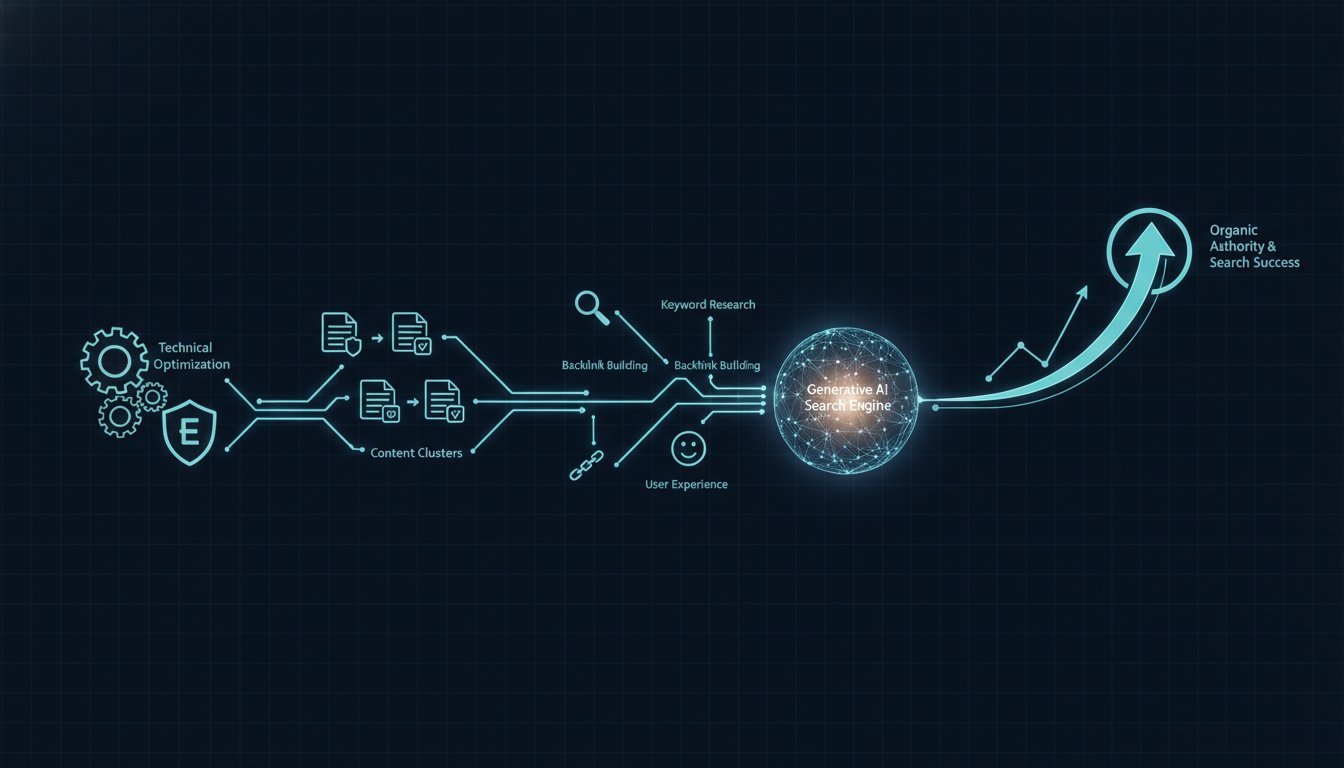
Google AI Overviews now appear in more than 25% of search results as of May 2026. This shift, alongside the 45% reduction in low-quality content since 2024, indicates that traditional shortcuts no longer function. Understanding how does SEO works and how to master it requires a move away from superficial tactics toward a focus on technical authority. This guide provides a direct briefing on the mechanics of modern search, prioritizing logistical reality over marketing hype.
You may feel overwhelmed by conflicting reports regarding AI and search obsolescence. It is common to experience frustration with slow results or unclear tracking. I will provide a repeatable framework for ranking content and building organic authority. This blueprint covers the integration of SEO into a broader marketing strategy. We will examine how to optimize for both human intent and generative engines, providing you with the exact steps required to maintain a competitive digital presence.
Key Takeaways
- Shift your strategy from isolated keywords to topical clusters and entity-based authority to align with modern search mechanics.
- Treat technical optimization and Core Web Vitals as a non-negotiable entry fee for visibility and user engagement.
- Follow a structured 5-step blueprint to understand how does SEO works and how to master it through an iterative operational process.
- Integrate SEO into your broader performance marketing ecosystem to drive targeted traffic for email and affiliate growth.
- Prioritize E-E-A-T signals to build sustainable organic authority that remains resilient against AI-driven algorithm updates.
Understanding the Mechanics: How Modern SEO Works in 2026
SEO is the process of optimizing a digital ecosystem to be the most authoritative answer for specific queries. To understand what is search engine optimization in 2026, you have to look at it as a logistical reality. It’s the technical and strategic alignment of your assets with search engine infrastructure. You aren’t just trying to rank a page; you’re building a foundation for targeted traffic generation that supports your entire performance marketing stack.
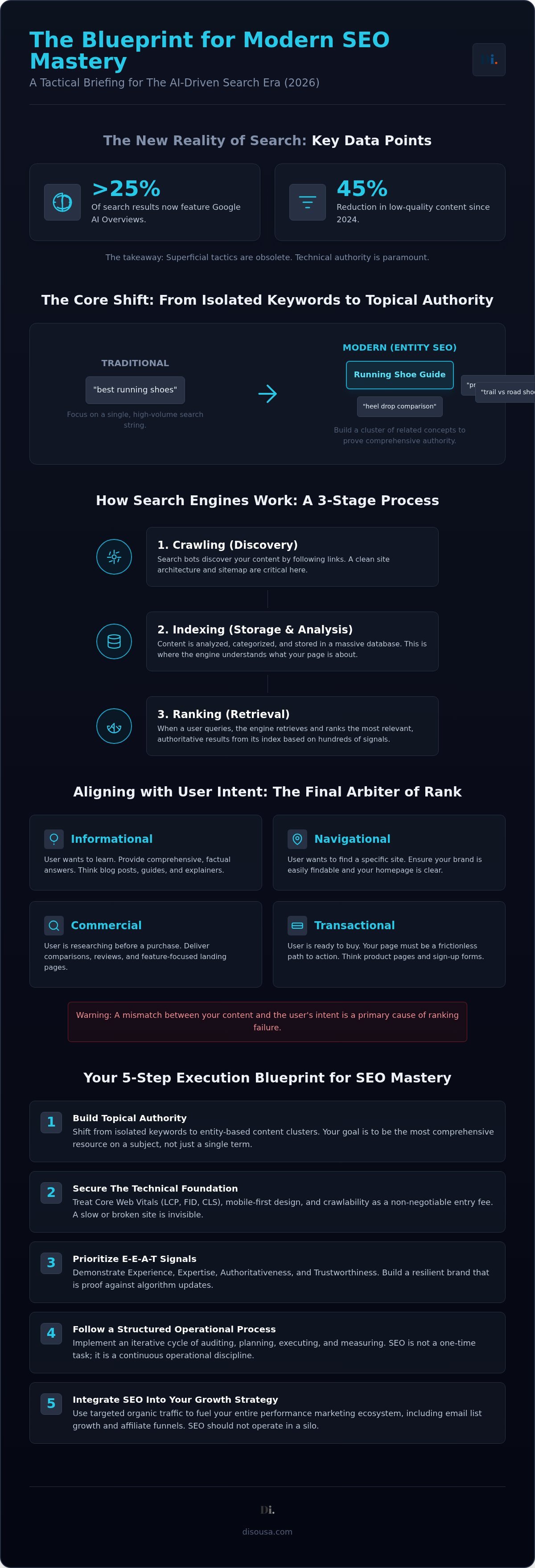
The current search landscape prioritizes entities and topical clusters over isolated keyword phrases. Mastery requires a complete shift from gaming the system to providing the best possible answer for the user. The process operates in three distinct stages: crawling, which is the discovery of your content; indexing, where that content is stored; and ranking, which is the final retrieval based on relevance and authority. Learning how does SEO works and how to master it starts with ensuring your site is accessible and valuable at each of these stages.
To better understand this concept, watch this helpful video:
The Shift from Keywords to Entities
Google’s Knowledge Graph now identifies real-world objects and the relationships between them. This means search engines don’t just see a string of text; they see concepts. Semantic search requires you to write for topics rather than just repeating a specific search string. If your content mentions “affiliate marketing,” the engine expects to see related entities like “conversion rates” and “commission structures” to confirm your authority. Entity SEO is the mapping of relationships between concepts. By building these connections, you signal to the algorithm that your digital ecosystem is a reliable source of information.
User Intent: The Final Arbiter of Rank
Ranking fails when your content format doesn’t match what the searcher actually wants. We categorize intent into four primary buckets to ensure alignment. Informational intent involves users seeking knowledge. Navigational intent focuses on finding a specific site. Commercial intent happens when users research options before a purchase. Finally, transactional intent is for users ready to buy right now. If a user has transactional intent but you provide a 3,000 word essay without a clear path to action, your rankings will drop. This alignment is a core part of A Functional Assessment of Online Marketing Services (2026). You must deliver the exact utility the user expects to see.
The Technical Foundation: Building for Crawlability and Speed
Technical SEO is the entry fee for digital visibility. You can produce high-quality content, but it remains invisible if the underlying infrastructure is broken. Search engines rely on a clean technical foundation to crawl and index your site effectively. This is a critical step in understanding how does SEO works and how to master it. Without speed and stability, your site fails the initial discovery phase. Bots don’t wait.
Core Web Vitals and Performance Standards
Google uses Core Web Vitals to measure user experience. These aren’t just developer metrics; they are functional business indicators. Largest Contentful Paint (LCP) measures loading performance. First Input Delay (FID) tracks interactivity. Cumulative Layout Shift (CLS) assesses visual stability. High scores in these areas correlate directly with better conversion rates in performance marketing. Users abandon slow sites. I recommend using PageSpeed Insights to audit your baseline and identify bottlenecks. Building a framework for SEO mastery requires prioritizing these technical signals to ensure your content reaches the intended audience.
Mobile-first indexing is the current standard. Google primarily uses the mobile version of your content for indexing and ranking. If your site doesn’t perform flawlessly on handheld devices, your desktop rankings will suffer. Additionally, your site architecture must utilize a logical hierarchy. This structure allows you to distribute authority, or link juice, effectively across your pages. A shallow architecture ensures that both users and bots can reach any page within three clicks.
Crawl Budget and Indexing Efficiency
Your crawl budget is the number of pages a search bot crawls on your site during a specific timeframe. You must guide these bots to your high-value pages using XML sitemaps and a robots.txt file. Indexing efficiency drops when bots waste time on thin content or duplicate pages. Cleaning up technical debt is essential for anyone learning how does SEO works and how to master it. If you are just beginning to build your platform, reviewing an Easy Way How to Start a Blog in 2022 can provide a baseline for setting up a clean structure from day one. To improve your overall performance, you can analyze our online marketing services to see how technical health drives ROI.
Strategic Content: Moving Beyond Keyword Stuffing to Entity Authority
Modern search engines have moved past simple pattern matching. In 2026, ranking for a single term requires you to establish authority over the entire subject. This is a core component of how modern SEO works. If you want to rank for “performance marketing,” you can’t just repeat the phrase. You must provide a comprehensive digital ecosystem that covers tracking, attribution, and strategy. This shift is essential for anyone learning how does SEO works and how to master it effectively.
The E-E-A-T Framework for Professional Content
Google evaluates content based on Experience, Expertise, Authoritativeness, and Trustworthiness. Experience is particularly vital now. It requires you to prove you’ve actually performed the work or tested the product you’re writing about. You can showcase this through detailed case studies or original data. Author bios should clearly state your credentials; external citations must link to reputable primary sources to build trustworthiness. E-E-A-T is a human-evaluated signal that AI tries to replicate. To secure high-value rankings, your content must feel like it was written by a practitioner, not a generic generator.
Building Topical Clusters
Mastery involves moving away from isolated articles. You need to structure pillar pages that act as central hubs for a topic, supported by multiple specific articles. This creates a topical cluster. For example, a pillar page on affiliate growth should link to detailed posts about commission structures and recruitment. This hierarchy tells search engines you are an authority in the niche. Once you’ve built this cluster, you must learn how to promote your content online to gain the external signals needed for growth.
Backlinks remain a significant ranking factor, but the rules have changed. In 2026, quality and relevance far outweigh sheer volume. A single link from a high-authority industry publication is worth more than hundreds of low-quality directory links. This focus on relevance is mirrored in our Affiliate Marketing for Brands: A Strategic Framework for Performance Growth, where we emphasize strategic partnerships over mass-market reach. Internal linking also plays a functional role. It allows you to guide users and bots through your content hierarchy, ensuring your most important pages receive the most authority.
The Mastery Framework: A 5-Step Execution Blueprint
Mastery is not a one-time setup. It is a recurring operational process that requires constant refinement. If you treat SEO as a “set and forget” task, your competitors will eventually erode your authority. To truly understand how does SEO works and how to master it, you must implement a structured cycle of auditing, research, and optimization. I’ve broken this down into five distinct phases that we use to ensure sustainable growth.
- Phase 1: Technical Audit and Infrastructure Repair.
- Phase 2: Intent-Based Keyword and Entity Research.
- Phase 3: Content Production and Topical Clustering.
- Phase 4: Authority Building and Strategic Outreach.
- Phase 5: Performance Tracking and Data-Driven Optimization.
Phase 1 & 2: Audit and Research
You can’t build a high-performing ecosystem on a broken foundation. Your first step is to identify “leaks” in your technical setup. I use Google Search Console to find crawl errors, 404s, and indexing issues that prevent search bots from reaching your content. Once your infrastructure is stable, move to research. You aren’t just looking for high-volume terms. You’re looking for “keyword gaps” where your competitors are currently outperforming you on authority. Map your existing content to the four types of user intent. If you find pages that don’t serve a clear purpose, you should either rewrite them or remove them to preserve your crawl budget. Phase three then involves taking these insights to build out the topical clusters required for authority.
Phase 4 & 5: Growth and Analysis
Authority building has evolved significantly. Traditional link building is often indistinguishable from spam. Digital PR has replaced it as the gold standard for authority. This involves earning mentions in reputable industry publications by providing original data or expert commentary. It’s harder to execute, but the resulting links carry much more weight with search algorithms. You must track your progress using specific KPIs. Organic sessions and keyword rankings are leading indicators, but conversion rate is the metric that matters for ROI. Search Console should be your primary source of truth. It provides direct data from the source, showing you exactly how users discover your site. This data-driven approach is essential for anyone learning how does SEO works and how to master it in a competitive market. If you’re ready to scale your results, you can explore our online marketing services to see how we apply this framework to drive measurable growth.
Operational Success: Integrating SEO into Your Growth Strategy
SEO does not exist in a vacuum. It must support your email and affiliate marketing efforts to be truly effective. I view SEO as a performance-based asset rather than a vanity metric like total impressions. It serves as the foundation for targeted traffic generation. This traffic fuels your lead nurturing funnels and scales your affiliate partnerships by providing a steady stream of qualified users. Understanding how does SEO works and how to master it involves moving beyond the search engine results page and looking at how that traffic converts across your entire ecosystem.
SEO and Lead Nurturing Integration
You can use SEO to capture top-of-funnel (TOFU) awareness for your email lists. Searchers are often looking for specific solutions to logistical problems. By providing those solutions through authoritative content, you can move a user from a search query to a subscription. This is the blueprint for turning a one-time visitor into a long-term lead. Integrating search data into your broader strategy ensures that your content isn’t just sitting on a server; it’s actively driving revenue. For a deeper look at this integration, see our strategic framework for performance growth. It’s about capturing intent at the source and maintaining that relationship through direct channels.
The Future of SEO: AI and SGE
Search Generative Experience (SGE) and AI Overviews are changing traditional click-through rates. As of May 2026, AI Overviews appear in over 25% of searches. Google’s May 6, 2026 AI update specifically adjusted link visibility within these summaries. Master-level SEO now focuses on being the primary source for AI-generated answers. You do this by maintaining high E-E-A-T and providing structured, authoritative data that AI assistants can easily parse. GA4 now tracks this via the AI Assistant channel, allowing you to measure exactly how much traffic originates from chatbots and assistants. This transparency is vital for adjusting your strategy in real-time.
Mastery is the result of consistent, data-backed execution. You don’t achieve organic authority through shortcuts or hacks. It requires a technically sound infrastructure, a deep understanding of user intent, and a content strategy that serves both humans and crawlers. I recommend focusing on SEO as a performance asset because it provides the most sustainable ROI in digital growth. By following the steps in this guide, you can integrate search success into a broader performance marketing ecosystem that remains resilient against algorithm shifts. This methodical approach is the only way to ensure long-term visibility in an increasingly complex search environment.
Execute Your Search Mastery Roadmap
Search success in 2026 relies on a shift from isolated tactics to a cohesive digital ecosystem. You’ve seen that technical health is the non-negotiable entry fee, while E-E-A-T and topical clusters establish your actual authority. Understanding how does SEO works and how to master it requires you to treat organic visibility as a performance asset rather than a vanity metric. It must drive targeted traffic that feeds your lead nurturing funnels and scales your affiliate marketing partnerships.
Mastery is an iterative process of auditing, research, and data-driven optimization. I recommend using Search Console as your primary source of truth to track conversion rates and organic sessions. This logistical approach ensures you aren’t guessing but making decisions based on reality. You can scale your organic growth with Disousa’s Performance Marketing Strategies. We are specialists in performance-based growth with global expertise and a data-driven approach to conversion optimization. You have the blueprint; now it’s time to implement it.
Frequently Asked Questions
How long does it realistically take to master SEO?
You can typically grasp the core operational framework within 6 to 12 months of consistent execution. True mastery involves navigating multiple algorithm updates and seeing long-term results across different niches. I recommend focusing on the 5-step blueprint mentioned earlier in this guide. It isn’t a one-time certification; it’s the result of managing live digital ecosystems. You’ll need at least a year of data to understand seasonal trends and competitive shifts.
Can AI tools like ChatGPT do my SEO for me in 2026?
AI tools can assist with research and drafting, but they cannot manage your SEO strategy autonomously in 2026. Search engines now prioritize E-E-A-T and original experience. AI-generated text often lacks the real-world testing required for high-value rankings. You should use AI for logistical tasks like summarizing data or generating schema. Human oversight remains mandatory to ensure your content provides the best answer for specific queries.
What is the difference between SEO and SEM?
SEO focuses on organic visibility, while SEM includes both organic search and paid advertising like PPC. SEO is a long-term asset that builds sustainable authority over time. SEM provides immediate traffic through paid placements, but it stops the moment you stop spending. I view SEO as the prerequisite for high-performing online marketing services because it lowers your customer acquisition costs by providing targeted traffic without a per-click fee.
Is technical SEO more important than content in 2026?
Both are critical, but technical SEO is the non-negotiable entry fee for ranking. If your site doesn’t pass Core Web Vitals or mobile-first indexing, even the best content remains invisible. Content establishes your topical authority once you’ve cleared the technical hurdles. I suggest prioritizing a technical audit first to ensure your infrastructure is ready. Learning how does SEO works and how to master it means balancing these two pillars equally.
How much should a business invest in SEO to see a real ROI?
Investment levels vary based on your industry’s competitive density and your existing authority. You should expect to invest consistently for at least 6 to 9 months before seeing a significant ROI. This budget should cover technical maintenance, high-quality content production, and strategic outreach. SEO is a performance-based asset. I focus on conversion rates and lead quality rather than vanity metrics to ensure your spend translates into measurable revenue growth.
Do I need a dedicated SEO agency to achieve mastery?
You don’t necessarily need an agency, but you do need dedicated expertise. Small operations can manage SEO internally if they follow a repeatable framework. However, as you scale into global markets, the technical complexity often requires specialized support. An agency provides the data-driven approach and global coverage needed for digital growth. If you choose to keep it in-house, ensure your team has the tools to track GA4’s new AI Assistant channel.
What are the most common SEO mistakes that lead to Google penalties?
The most common mistakes include manipulative link schemes and low-quality AI-generated spam. Google’s March 2026 spam update specifically targeted these tactics. Using “SEO-first” content that provides no real utility will also trigger quality signals that lead to ranking drops. I recommend focusing on transparency and original data to avoid these penalties. Honesty regarding your strategy helps you avoid expensive mistakes that can take months to recover from.
How does SEO work for local businesses versus global brands?
Local SEO prioritizes geolocation and Google Business Profile accuracy, while global SEO focuses on topical authority and entity relationships. For local businesses, fresh content and user sentiment are key. Global brands must build comprehensive topical clusters to dominate a niche across different regions. Understanding how does SEO works and how to master it across these scales requires a flexible strategy. Both rely on a foundation of targeted traffic generation to succeed.
Disclaimer
**Disclosure:** Some articles on this website may contain affiliate links. This means we may earn a commission if you purchase a product or service through certain links, at no additional cost to you. We only recommend products, tools, and services that we believe provide value to our readers.
**Disclaimer:** The information provided on this website is for educational and informational purposes only and should not be considered financial, legal, tax, or professional advice. While we strive to keep our content accurate and up to date, we make no guarantees regarding completeness, reliability, or results obtained from using the information provided. Always conduct your own research and consult qualified professionals before making business, financial, or investment decisions.
