

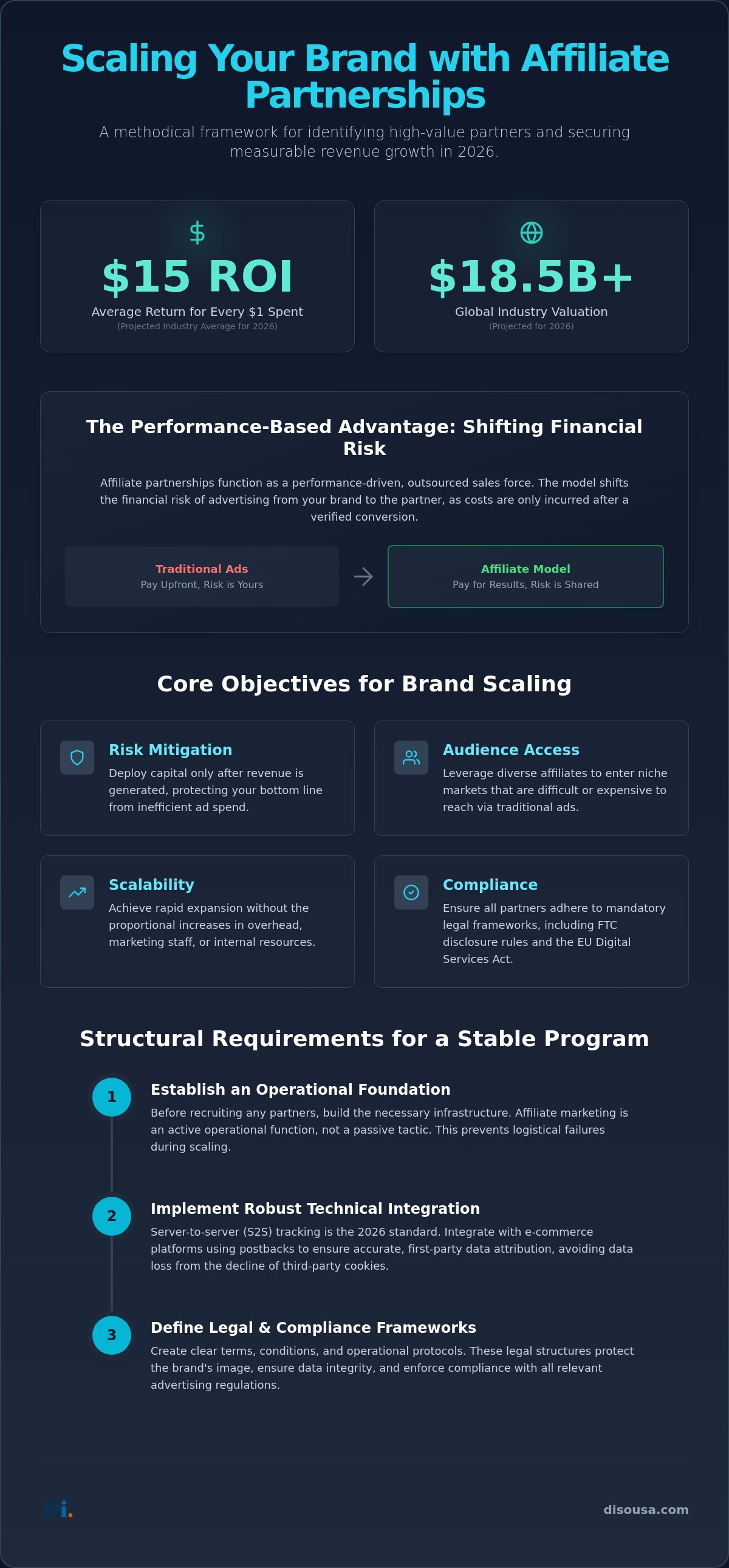
Statistics show it’s common for brands to achieve an average return of $15 for every $1 spent on affiliate marketing in 2026. This data suggests a high level of efficiency for organizations that maintain a structured approach. Many businesses currently face high costs for traditional customer acquisition. There’s also a persistent difficulty in tracking the actual return on investment from influencer campaigns. Many managers worry that unverified partners will cause brand dilution over time.
To grow brand through affiliate partnerships, an organization must transition from tactical recruitment to a functional operational framework. This article provides a methodical analysis of the structural requirements and protocols needed to scale brand visibility through performance-based networks. It offers a clear system for identifying high-value partners and securing measurable growth in revenue. The following sections detail the logistical requirements for 2026, including compliance with new e-commerce laws and FTC disclosure rules. This framework ensures that brand expansion is supported by a stable and transparent infrastructure.
Key Takeaways
- The function of performance-based models in shifting financial risk is defined.
- Structural requirements and legal frameworks to grow brand through affiliate partnerships are identified.
- Criteria for selecting performance models and attribution standards are established.
- Protocols for proactive partner recruitment and brand alignment are outlined.
- Procedures for integrating affiliate traffic with internal lead nurturing systems are provided.
Defining the Functional Role of Affiliate Partnerships in Brand Expansion
Affiliate partnerships are performance-based arrangements. Third parties earn commissions for driving specific actions such as sales or lead generation. This model works by shifting the financial risk of advertising from the brand to the partner. Advertising costs are not paid until results are achieved. Payments are issued only after a successful conversion is verified. A functional assessment reveals that these partnerships act as an outsourced sales force. Organizations grow brand through affiliate partnerships by leveraging the established reach and trust of diverse affiliates. In 2026, brands using these models see an average ROI of $15 for every $1 spent. This efficiency makes the model a standard requirement for digital infrastructure. It’s a reliable system for expansion. For a foundational understanding, an affiliate marketing overview provides a technical history of these compensation methods.
To better understand this concept, watch this helpful video:
The Distinction Between Affiliate Marketing and Standard Partnerships
Affiliate models rely on automated tracking and specific performance metrics. These systems provide immediate data on partner contributions through server-side tracking and first-party data. Standard partnerships often involve broader collaborations without direct attribution. These might include co-branded content or general PR activities. Methodical brands utilize both types of arrangements. This ensures visibility across the entire digital landscape while maintaining strict data integrity. The integration of these models allows for a more resilient marketing mix. It’s a structured approach. Every action is tracked. Information regarding these protocols is found in this strategic framework for performance growth.
Core Objectives for Brand Scaling
The primary objective is increasing market penetration without upfront media spend. This preserves capital for other operational needs. Traffic sources are diversified to reduce reliance on paid search or social ads. This diversification is a defensive measure against rising platform costs. Fixed commission structures are used to grow brand through affiliate partnerships while maintaining specific cost-per-acquisition (CPA) targets. In 2026, the global affiliate marketing industry is valued at over $18.5 billion. This valuation supports the use of performance-based scaling for global brand reach. The following objectives are prioritized during program development:
- Risk Mitigation: Capital is only deployed after revenue is generated. It’s a method that protects the bottom line.
- Audience Access: Diverse affiliates provide entry into niche markets that are difficult to reach via traditional ads.
- Scalability: The model allows for rapid expansion without proportional increases in overhead or internal staff.
- Compliance: Adherence to the EU Digital Services Act and FTC disclosure rules is mandatory for all partners.
Success requires a focus on logistical reality. The brand’s presence is expanded through methodical coordination with high-value partners. Goals are met.
Structural Requirements for Affiliate Program Development
Developing an affiliate program requires a stable operational foundation. It’s not a passive marketing tactic. To grow brand through affiliate partnerships, a brand must implement specific technical and legal structures. These systems ensure data integrity and protect the brand’s professional image. Infrastructure must be established before any partner recruitment begins. This methodical preparation prevents logistical failures as the program scales.
Technical integration with existing e-commerce or lead generation platforms is mandatory. Tracking pixels and server-to-server (S2S) postbacks provide the necessary data for accurate attribution. With the 2026 industry shift toward first-party data, server-side tracking has become the standard requirement. It avoids the data loss associated with the decline of third-party cookies. Effective affiliate marketing strategies prioritize this infrastructure to ensure every conversion is recorded. Accurate tracking is the only way to verify that commissions are paid for legitimate results. The system must be tested to confirm it handles high traffic volumes without latency.
Technical Infrastructure and Tracking Protocols
Infrastructure must include robust fraud detection systems. These tools monitor for click fraud and cookie stuffing in real time. Cookie duration is a key logistical decision for program managers. A 30-day window is common for standard consumer goods. However, a 90-day window is often used to maintain partner motivation for products with longer buyer journeys. These settings must be locked into the tracking software to ensure consistent reporting for all participants. Selecting the right platform is a critical step; a detailed affiliate marketing software comparison provides a functional framework for evaluating tracking integrity and reporting depth across leading solutions.
Administrative and Legal Foundations
Standardizing affiliate agreements protects brand equity. These documents define prohibited traffic sources and brand usage guidelines. In 2026, compliance with the EU Digital Services Act and FTC disclosure rules is a legal necessity. Written contracts are mandatory under California SB988 if compensation exceeds specific thresholds. IRS rules also mandate 1099-NEC filings; failing to file results in a $340 penalty per form. Methodical brands grow brand through affiliate partnerships by establishing these financial and legal safeguards early to avoid regulatory scrutiny.
Resource allocation for management is a primary requirement. Partners require technical support and updated marketing assets to remain effective. Successful programs are managed by dedicated professionals who monitor partner activity and compliance. For those beginning this process, an affiliate marketing easy guide provides the necessary logistical steps. Engaging a methodical management service can ensure these structural requirements are met without straining internal resources. This proactive approach ensures the program remains a reliable revenue driver.
Performance Models and Attribution Standards
Selecting the correct performance model depends on the brand’s specific conversion goals. This decision dictates the financial structure of the program. Cost Per Action (CPA) remains the standard for direct e-commerce sales. Organizations grow brand through affiliate partnerships by setting specific commission rates for completed purchases. In 2026, standard starting rates for e-commerce and direct-to-consumer brands range from 10% to 15%. For electronics, margins typically limit these rates to 5% or 10%. Cost Per Lead (CPL) is utilized for service-based brands or high-ticket items that require long-term nurturing. In financial services, these leads are often valued between $50 and $200 each. Attribution logic determines which partner receives credit when multiple touchpoints are involved in a single customer journey. A technical analysis of affiliate marketing ROI benchmarks and calculation methodologies provides further context for setting these performance targets accurately.
Evaluating CPA vs. CPL Models
CPA models provide immediate return on investment. Capital is only deployed after a transaction is finalized. This model is efficient for products with short sales cycles. It doesn’t require complex lead management. However, it may limit top-of-funnel reach because partners focus only on high-intent traffic. CPL models support long-term brand building and email list growth. This approach is common in the health and wellness sector. Subscriptions in this niche can command commissions between 20% and 50%. Disousa recommends a hybrid approach for brands targeting global markets. This ensures both immediate revenue and a growing database of potential customers. Integrating online marketing services allows these leads to be processed through internal retention systems.
The Impact of Attribution Logic on Partner Retention
Last-click attribution is the industry standard. It awards 100% of the commission to the final touchpoint. This model is simple to implement but often overlooks early-stage influencers who initiate the research phase. First-click attribution rewards the partner who introduced the consumer to the brand. This encourages top-of-funnel content creation. Linear or weighted attribution models provide a more equitable distribution of commissions. These models are increasingly necessary as buyer journeys become longer. In 2026, the industry is shifting toward multi-touch attribution to better understand the customer journey. This shift is driven by the decline of third-party cookies and the move to server-side tracking. Fair compensation is essential to grow brand through affiliate partnerships. It prevents partner churn. A methodical approach to attribution ensures that all contributors are rewarded based on their actual impact on the conversion path. Accuracy is prioritized.
Protocols for Partner Recruitment and Management
Partner recruitment must be a proactive and methodical process. It’s not a passive task. A brand must identify partners that align with its professional image. Vetting procedures are mandatory to ensure compliance with the new e-commerce law effective July 1, 2026. This law requires affiliates to provide identity verification to service providers. It also mandates that affiliates refuse to market on platforms violating national security or public order laws. To grow brand through affiliate partnerships, managers must select segments that offer the highest conversion probability while maintaining legal safety. This selection is based on data rather than intuition.
To streamline this vetting process in specialized sectors, managers often utilize a digital asset marketplace directory to identify reputable platforms and educational resources. This ensures that the selection of partners is grounded in industry standards and verified data.
Identification of High-Value Affiliate Segments
Specific segments are targeted based on their audience alignment and traffic quality. Content creators and bloggers within specific niches provide access to engaged communities. These partners are effective for categories like lifestyle, health, or technology. Comparison and review websites are also essential. They capture high-intent search traffic from consumers who are in the final stages of the research process. Loyalty and cashback portals drive significant volume during promotional periods. These segments are evaluated based on their ability to deliver consistent results. They must not dilute brand equity through low-quality placements. In 2026, statistics show 35.5% of affiliate marketers prefer organic social media traffic. Another 22.8% use email marketing as their primary source. These data points guide the selection of partners who utilize diverse traffic methods. Information on how partners can utilize these channels is found in this guide on how to promote your content online.
Operational Management and Communication
Operational management requires established communication protocols. Deployment of monthly newsletters provides affiliates with necessary promotional assets and campaign updates. These updates include approved graphics and updated tracking links. This ensures that the brand message remains consistent across all partner platforms. Tiered commission structures are implemented to reward top-performing partners. This encourages long-term retention and higher performance levels. Direct outreach is utilized for high-level strategic collaborations with key accounts. These partners often require customized terms or exclusive offers to maximize their reach. Performance is monitored through regular audits. Ongoing performance reviews allow for the optimization of the affiliate mix. Low-performing or non-compliant partners are removed to preserve program integrity. This methodical approach is the most effective way to grow brand through affiliate partnerships over the long term. It’s a logistical reality. Organizations looking to scale can contact Disousa for managed affiliate solutions that prioritize these operational protocols. Using a professional service ensures that vetting and management are handled with precision. It also helps in maintaining compliance with the EU Digital Services Act and FTC disclosure requirements.
Functional Integration with Online Marketing Systems
Affiliate partnerships are not isolated operations. They function as a component of a broader digital infrastructure. Traffic from these sources is integrated with other marketing channels to ensure consistency. Organizations grow brand through affiliate partnerships by aligning these external efforts with internal sales systems. This coordination prevents data silos. It allows for a unified view of the customer journey. Data integrity is maintained through server-side tracking. This ensures that attribution is accurate across all touchpoints. All processes are documented.
Synergy Between Affiliate and Email Marketing
Affiliate traffic is used to build a robust email database. This process involves capturing visitor information at the point of entry or after a conversion event. Once captured, these leads are processed through lead nurturing email campaigns. This integration maximizes the lifetime value of every referred customer. Long-term conversion rates are assessed to determine the quality of different affiliate segments. In 2026, 22.8% of affiliate marketers utilize email as their primary traffic source. This alignment ensures that the brand maintains a direct connection with the audience. It reduces the risk of losing contact if an affiliate partnership is terminated. Retention is prioritized. Every lead is tracked.
Performance data from affiliate campaigns informs other acquisition strategies. Search terms used by high-converting affiliates are integrated into SEO and paid search protocols. This data sharing reduces the cost of keyword discovery. It identifies profitable niches without additional research spend. The results are used to optimize internal content. Bidding strategies are adjusted based on real-world conversion data. This methodical approach ensures that all marketing spend is optimized. The global affiliate industry is valued at $18.5 billion in 2026. This scale requires precise cross-channel integration. Results are verified.
Managed Solutions for Scaling Operations
Managed services ensure that digital growth strategies are structurally aligned. An affiliate marketing for brands specialist manages the logistical requirements of global programs. This includes overseeing technical integration and partner compliance. Outsourcing these tasks allows the organization to focus on core business milestones. Technical management is handled by experts to ensure data accuracy and security. A functional assessment of program health is conducted through regular reporting and data analysis. This methodical oversight is required to grow brand through affiliate partnerships effectively. It provides a stable framework for expansion. Program managers monitor for click fraud and cookie stuffing. They ensure that all partners adhere to the FTC disclosure rules. This preserves the professional image of the brand during rapid scaling. Efficiency is maintained.
Implementing a Scalable Affiliate Infrastructure for 2026
Scaling requires a transition from tactical partner recruitment to a functional framework. This involves the deployment of robust tracking protocols and the establishment of legal compliance. Organizations grow brand through affiliate partnerships by prioritizing data integrity and proactive management. Performance models such as CPA or CPL must align with specific conversion targets to ensure capital efficiency. The 2026 landscape demands strict adherence to disclosure rules and identity verification for all partners. These protocols protect brand equity during periods of rapid growth. It’s a logistical necessity for modern organizations.
Integration with internal marketing systems ensures that traffic is funneled into lead nurturing protocols. This maximizes the lifetime value of every referred customer. Disousa provides performance-based growth strategies and global affiliate management expertise. These systems are supported by integrated email marketing systems to ensure structural alignment across all digital channels. This approach prepares the organization for the logistical realities of global scaling. Access Disousa’s functional assessment of affiliate marketing services to verify program readiness. A methodical approach ensures that brand expansion is sustainable and data-driven. Success is achieved through preparation.
Frequently Asked Questions
How do affiliate partnerships differ from influencer marketing?
Affiliate partnerships focus on specific performance metrics like sales or lead generation. Influencer marketing often prioritizes brand awareness and visibility. Affiliate models utilize automated tracking for direct attribution. Influencer campaigns may involve flat fees without guaranteed results. Both models can overlap, but the compensation structure remains the primary distinction. Success is measured by conversions rather than impressions.
What is the typical commission rate for an affiliate program?
Commission rates are determined by industry margins and product types. In 2026, standard rates for ecommerce brands start between 10% and 15%. SaaS products often offer recurring commissions of 20% to 30%. Health and wellness subscriptions can reach 50% for initial signups; those looking to enter this high-growth sector can discover Deluchiz World to explore specialized skincare and wellness commission structures. Electronics brands maintain lower rates, typically between 5% and 10%, due to tighter margins. These rates are fixed to ensure cost-per-acquisition targets are met.
Can a brand manage an affiliate program in-house?
A brand can manage a program in-house if it allocates sufficient resources for recruitment and administrative tasks. This requires a dedicated manager to oversee partner compliance and technical infrastructure. A detailed comparison of in-house vs outsourced affiliate program management and affiliate marketing agency pricing can help determine which model aligns with the organization’s operational capacity. Managed solutions are often preferred to grow brand through affiliate partnerships while maintaining focus on core business milestones. These services provide expertise in global scaling and regulatory adherence. Technical management is a mandatory requirement.
How long does it take to see results from affiliate partnerships?
Measurable results typically materialize within a three to six month period. This timeframe allows for the recruitment of high-value partners and the development of their promotional content. Search engine indexing of affiliate reviews also requires time. Initial data is used to optimize the partner mix and refine commission structures for long-term growth. Consistency is required for the program to reach maturity.
What are the risks associated with affiliate marketing?
Risks include click fraud, cookie stuffing, and potential brand dilution from low-quality partners. Regulatory scrutiny is also a factor. Violations of the EU Digital Services Act or FTC disclosure rules lead to financial penalties. Methodical vetting and real-time monitoring systems are used to mitigate these operational and legal risks. Program managers must monitor for non-compliant traffic sources daily.
How do you track sales from different affiliate partners?
Sales are tracked using unique affiliate identifiers and tracking pixels. Server-to-server postbacks provide a more reliable method for data attribution in 2026. This technical setup ensures that every conversion is recorded accurately. It allows managers to verify which partner initiated the transaction and which touchpoints were involved in the customer journey. First-party data is prioritized over third-party cookies. Brands evaluating their current setup should consult a thorough affiliate marketing software comparison to identify platforms that best support server-side tracking and accurate attribution reporting.
Is affiliate marketing suitable for B2B brands?
Affiliate marketing is highly effective for B2B brands using lead generation models. These brands often pay a fixed Cost Per Lead for qualified prospects. This strategy allows organizations to grow brand through affiliate partnerships by accessing niche professional audiences. It supports long-term sales cycles that require extensive nurturing via email marketing systems. The model shifts financial risk away from the brand.
What is the role of an affiliate network vs. a private program?
Affiliate networks provide a centralized platform for recruitment and payment processing. They offer immediate access to a large pool of established partners. Private programs are hosted on a brand’s own infrastructure. These programs provide greater control over partner vetting and avoid the transaction fees associated with third-party networks. The choice depends on the brand’s technical capacity and scaling requirements. Organizations evaluating these options should also consider the broader operational trade-offs between internal management overhead and affiliate marketing agency pricing when determining the most cost-efficient structure for long-term growth.
Disclaimer
**Disclosure:** Some articles on this website may contain affiliate links. This means we may earn a commission if you purchase a product or service through certain links, at no additional cost to you. We only recommend products, tools, and services that we believe provide value to our readers.
**Disclaimer:** The information provided on this website is for educational and informational purposes only and should not be considered financial, legal, tax, or professional advice. While we strive to keep our content accurate and up to date, we make no guarantees regarding completeness, reliability, or results obtained from using the information provided. Always conduct your own research and consult qualified professionals before making business, financial, or investment decisions.
