
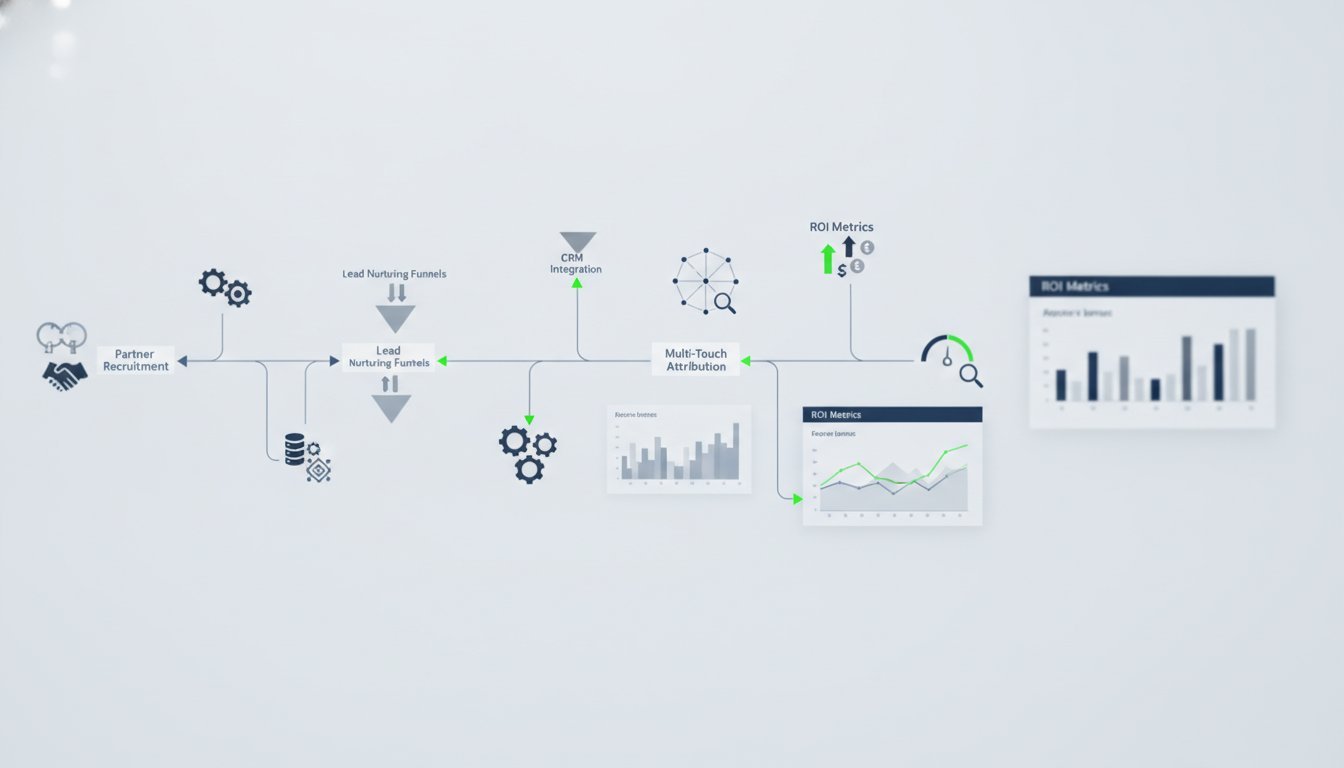
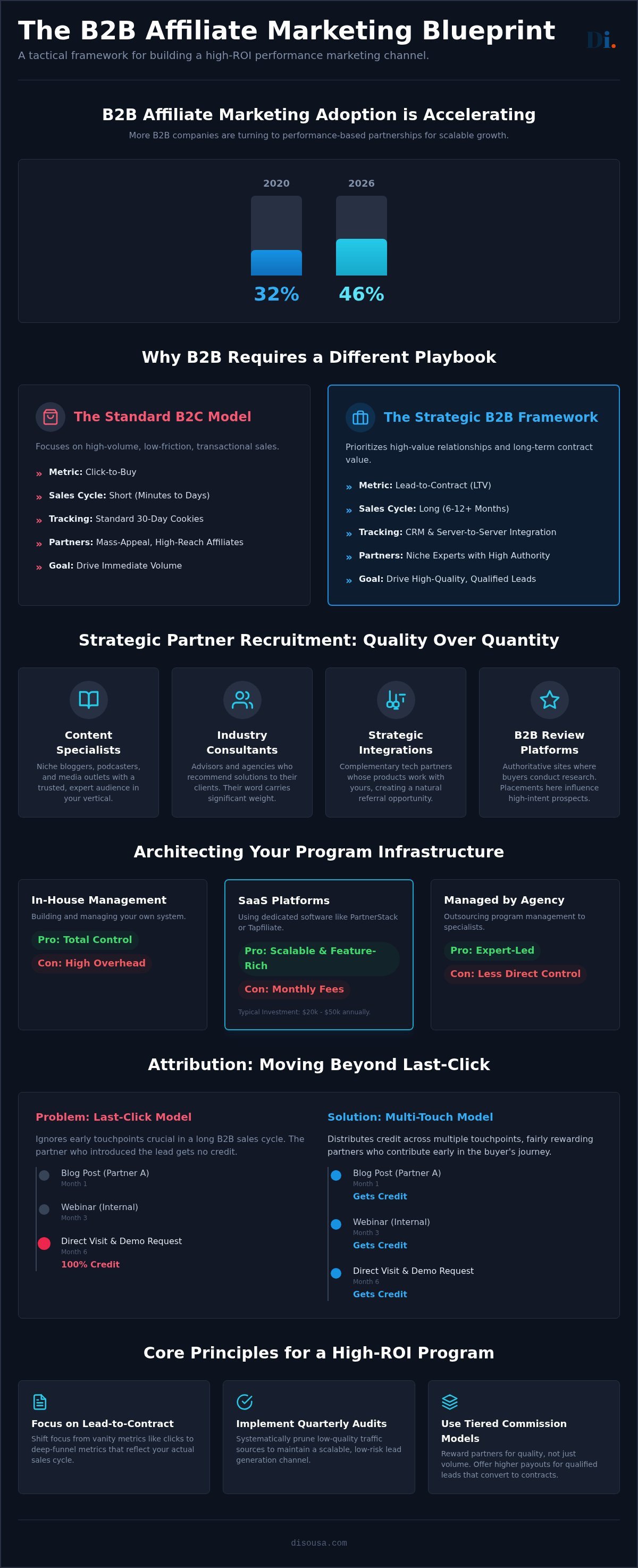
As of early 2026, 46% of B2B companies have adopted affiliate marketing to drive growth. This is a significant increase from 32% in 2020. You likely agree that a standard B2B affiliate marketing strategy needs more precision than a basic B2C program. You’ve probably dealt with long sales cycles that break tracking cookies or generic affiliates that send poor leads. It’s difficult to attribute value correctly when a deal takes months to close across multiple touchpoints.
I’ve designed this guide as a tactical blueprint to help you build a high-ROI program that aligns with complex sales cycles. You’ll learn how to create a scalable lead generation channel that delivers higher LTV and predictable acquisition costs. We’ll cover multi-touch attribution models, rigorous partner vetting, and the operational steps required to scale your program. This briefing provides the exact framework you need to move from experimental partner sets to a predictable, performance-based revenue stream.
Key Takeaways
- Learn why effective B2B programs shift focus from simple click-tracking to lead-to-contract metrics that reflect your actual sales cycle.
- Identify the technical infrastructure needed for a high-performance B2B affiliate marketing strategy, focusing on deep-funnel CRM integration.
- Discover the four specific types of high-value B2B partners and the outreach protocols required to treat them as strategic business assets.
- Use bridge pages and top-of-funnel assets to transition affiliate traffic into your ecosystem for long-term email nurturing.
- Implement a quarterly audit framework to prune low-quality traffic sources and maintain a scalable, low-risk lead generation channel.
Why B2B Affiliate Marketing Requires a Different Playbook
B2B affiliate marketing is a performance-based partnership model, not a simple transactional channel. While the foundational principles of Affiliate marketing remain the same, the execution in a B2B environment requires a complete departure from consumer-facing tactics. Standard B2C programs focus on high-volume, low-friction “click-to-buy” interactions. In contrast, your B2B affiliate marketing strategy must prioritize “lead-to-contract” metrics. You’re paying for the entry point into a long-term relationship, not a one-off purchase.
Trust is the primary currency here. B2B buyers don’t make $50,000 decisions based on a banner ad. They rely on industry experts, consultants, and peers. This means your partner selection process must favor authority over reach. A single recommendation from a respected niche consultant is worth more than 10,000 clicks from a generic tech blog. If the partner doesn’t have the professional standing to influence a boardroom, they won’t drive revenue for your brand.
The B2B Sales Cycle Challenge
The biggest hurdle in B2B is time. Most enterprise sales involve 6 to 12 month decision windows and at least half a dozen stakeholders. If you’re using standard 30-day cookie windows, you’re essentially telling your partners you won’t pay them. By the time a lead converts to a paying client, the original tracking has likely vanished. We solve this by moving beyond browser-based cookies. You need server-to-server tracking and CRM integration to follow the lead through the entire funnel. Customer Lifetime Value (LTV) should be your ultimate metric. It’s the only way to accurately measure if a partner is bringing in the right kind of business over the long haul.
Lead Quality vs. Lead Volume
Incentivizing raw lead volume is a dangerous game in B2B. If you pay for every form fill, you’ll end up with a CRM full of junk leads that waste your sales team’s time. Instead, set payout milestones at “Qualified Lead” stages. This might mean a small payout for a discovery call and a larger one for a signed contract. It forces partners to vet their own traffic before sending it to you. This approach is part of a broader Affiliate Marketing for Brands: A Strategic Framework that prioritizes ROI over vanity metrics. High-quality partners respect this transparency because it protects the integrity of their own brand while ensuring you both win on the final sale.
Architecting Your Program: Infrastructure and Attribution
Building a successful B2B affiliate marketing strategy requires more than just a signup page. It requires a technical foundation that can bridge the gap between a partner’s referral and a final contract signed months later. If you don’t have the right plumbing in place, you’ll lose data, frustrate your partners, and fail to prove ROI to your stakeholders. You need a system that integrates directly with your CRM to track leads through every stage of the sales funnel.
Your commission structure must also reflect the reality of high-ticket sales. In 2026, many B2B SaaS programs offer 10% to 20% of recurring revenue for the first year, while others prefer a one-time bounty of 100% to 200% of the first month’s revenue. I recommend a transparent, tiered model. This rewards partners who bring in higher-quality leads and keeps your acquisition costs predictable. If you’re looking for an operational partner to handle these technical complexities, we can help you manage your performance-based frameworks effectively.
Choosing Your Management Infrastructure
You have three main paths: in-house management, SaaS platforms, or specialized agencies. Managing everything in-house gives you total control but often leads to high operational overhead. For most, a SaaS platform like PartnerStack or Tapfiliate is the better choice. PartnerStack is specifically built for B2B ecosystems with plans starting at $1,000 per month, while Tapfiliate offers a more accessible entry point for mid-market firms. For a deeper look at how these fit into your broader tech stack, see our A Functional Assessment of Online Marketing Services. Research shows that brands typically invest between $20,000 and $50,000 annually in program management to ensure accuracy and partner satisfaction.
Advanced Attribution Models for B2B
Standard last-click attribution is insufficient for B2B. It ignores the partner who introduced the prospect to your brand six months before the sale. You should consider a multi-touch or linear attribution model that gives credit to various touchpoints. This is especially important when tracking offline conversions or sales-assisted closes where a tracking link isn’t present at the final moment of purchase. For a detailed breakdown of how these models work in a SaaS context, this B2B affiliate marketing guide provides excellent technical context. Post-view attribution tracks when a lead views a high-value asset, such as a technical whitepaper, and eventually converts without clicking a direct affiliate link. By rewarding these top-of-funnel interactions, you encourage partners to create the deep-dive content that B2B buyers actually read.
Strategic Partner Recruitment: Quality Over Quantity
A common mistake in any B2B affiliate marketing strategy is chasing volume over relevance. While B2C brands might thrive with thousands of coupon sites, your B2B program will die there. You don’t need a massive network; you need a curated group of partners who already have the ear of your ideal customer. Recruiting the wrong partners leads to “affiliate spam,” which damages your brand and clogs your CRM with low-intent leads. We focus on high-authority partners because their recommendation carries the weight of a professional endorsement.
The vetting process must be rigorous. I recommend looking at three specific criteria to ensure the partner aligns with your goals:
- Traffic Relevance: Does their audience match your Ideal Customer Profile (ICP)?
- Domain Authority: Do they have the SEO standing to rank for high-intent keywords?
- Audience Trust: Are they seen as a neutral expert or just another ad-heavy blog?
If a potential partner doesn’t understand your technical value proposition, they can’t sell it. The ultimate B2B affiliate is often a Subject Matter Expert (SME). These are individuals whose professional reputation is built on their expertise. When they recommend your tool, their audience listens because the SME has already done the hard work of building trust.
The B2B Affiliate Persona Map
I categorize high-value partners into four distinct personas. First, complementary SaaS providers. These partners offer tools that sit next to yours in a customer’s tech stack. Second, industry consultants and agency owners. These are high-trust referrers who often act as outsourced decision-makers for their clients. Third, niche content publishers and podcasters who own the educational space in your industry. Finally, the individual power users who have a platform. Each of these requires a different approach to ensure you Grow Brand Through Affiliate Partnerships effectively.
The Recruitment Workflow
Stop using automated blast campaigns. They don’t work for high-ticket partnerships. Your outreach should be a personalized briefing. A successful B2B affiliate marketing strategy relies on treating these partners as an extension of your own sales team, not as simple vendors. Once they’re on board, provide them with a “B2B Enablement Kit.” This isn’t just a folder of banners. It should include deep-dive case studies, slide decks they can use in presentations, and high-resolution logos. You’re giving them the tools to represent your brand at a boardroom level. If you make it easy for them to look like an expert while talking about your product, your conversion rates will reflect that effort.
Integrating Affiliates into the B2B Sales Funnel
A sophisticated B2B affiliate marketing strategy doesn’t end when a partner generates a click. In high-ticket environments, that click is just the start of a journey that might last six months. You need a bridge page to facilitate a warm hand-off between the partner’s content and your sales ecosystem. Instead of dropping traffic on a generic homepage, you should send prospects to a dedicated, co-branded landing page. This maintains narrative consistency and prevents the high bounce rates that occur when a prospect feels they’ve been dropped into a cold sales environment.
I recommend using affiliates to drive top-of-funnel (TOFU) asset downloads, such as technical whitepapers or gated research. This allows you to capture lead data much earlier in the decision-making process than a “Request a Demo” button would. You must track the “Assisted Conversion” value of these partners. Even if they aren’t the final touchpoint before a contract is signed, their role in seeding the lead into your funnel is vital. We reward these top-of-funnel assists to keep high-trust partners motivated through the long sales cycles we discussed earlier.
Synergy with Email Marketing
Once a lead is captured via an affiliate-driven asset, they must enter a specialized nurture sequence. You should build affiliate-specific paths that acknowledge the referral source while moving the prospect toward a discovery call. This transition is delicate; you’re moving the lead from the partner’s voice to your own. For more on coordinating these promotional efforts, see our briefing on how to promote your content online effectively. This integration ensures that no high-value lead is lost during the hand-off from the partner’s ecosystem to your internal sales team.
The Content Strategy for Affiliates
I’ve found that comparison reviews and “Best of” lists are the most effective formats for B2B partners. These capture prospects who are already in the evaluation phase and looking for objective peer guidance. Co-branded webinars also provide a high-trust environment for educating potential buyers without the pressure of a direct sales pitch. Problem-solution case studies outperform simple feature lists because B2B buyers prioritize risk mitigation and proven business outcomes over technical specifications. If you’re ready to optimize this funnel, we can help you build an integrated performance framework that converts partner traffic into signed contracts.
Audit, Optimization, and Scaling for ROI
A successful B2B affiliate marketing strategy is never a “set it and forget it” operation. You need a rigorous quarterly operational audit to ensure your partners align with your evolving business goals and compliance requirements. In 2026, brands and creators share legal liability for non-compliance with FTC guidelines, which now carry potential fines of over $51,000 per violation. Your audit should verify that all partners use clear disclosures like “#ad” and avoid vague terms that could trigger regulatory scrutiny. Beyond legal safety, this is your time to prune low-quality traffic sources that clog your CRM without contributing to revenue.
Scaling requires you to identify your high-performers and move them into tiered commission structures. While the average B2B SaaS commission is approximately 22.5% of first-year revenue, you can use performance bonuses to reward partners who exceed specific lead-to-MQL thresholds. This transition often marks the point where you move from a self-managed program to a fully managed model, allowing for deeper strategic oversight and more aggressive growth. If you’re managing this in-house, ensure you’re utilizing a Data-Driven Evaluation of Affiliate Marketing ROI to justify the increased spend to your leadership team.
Key Performance Indicators (KPIs) to Monitor
You must look beyond clicks to measure true program health. The Lead-to-MQL (Marketing Qualified Lead) conversion rate is your most important metric, as it proves the affiliate is reaching the right audience. You should also track the Average Deal Value (ADV) of affiliate-referred customers; if these clients consistently spend less than your organic leads, your partner mix may need adjustment. Finally, monitor your Partner Engagement Rate. A program with 500 affiliates is worthless if only five are actively promoting your products. Aim for a healthy distribution of active partners across your different persona groups.
Optimization Tactics for 2026
Optimization in 2026 relies heavily on technical precision. AI-augmented affiliate management has reached 67% adoption this year, primarily used for partner discovery and real-time fraud detection. You should use these tools to identify anomalous traffic patterns before they impact your budget. Additionally, continue A/B testing your affiliate-specific landing pages to find the messaging that resonates best with referred traffic. Small lifts in conversion rates on these bridge pages can lead to significant changes in your overall acquisition costs. By combining AI-driven oversight with constant creative testing, you ensure your program remains a predictable and scalable revenue driver.
Scaling Your Performance Ecosystem
Executing a modern B2B affiliate marketing strategy requires moving away from vanity metrics and toward deep-funnel accountability. Success in 2026 hinges on vetting high-authority partners and implementing multi-touch attribution that respects the 6 to 12 month sales cycle. By bridging the gap between a referral and an automated email nurture sequence, you turn a risky lead source into a predictable growth engine. You aren’t just buying clicks; you’re building a sustainable partnership network that delivers measurable ROI.
At Disousa, we manage these technical complexities so you don’t have to. We offer global coverage for brands scaling worldwide and bring specific expertise in complex B2B attribution and email integration. Our data-driven approach to performance marketing ensures your spend translates into high-value leads and higher LTV. If you’re ready to build a framework that actually works for high-ticket sales, Download our B2B Affiliate Strategy Blueprint or contact us for a managed consultation. You have the blueprint. It’s time to start building.
Frequently Asked Questions
Is affiliate marketing effective for high-ticket B2B services?
Affiliate marketing is highly effective for high-ticket B2B when you prioritize authority over raw traffic volume. Research indicates that 74% of brands generate between 11% and 30% of their total revenue through affiliate channels. For high-ticket services, success comes from partnering with industry consultants and subject matter experts who already have the trust of your target decision-makers, rather than generic coupon sites.
How do you track B2B affiliate sales with long conversion windows?
Standard browser cookies often fail during a 6 to 12 month sales cycle, so you must implement server-to-server tracking or direct CRM integration. This allows you to attach a partner ID to a lead record in your own database. By using first-party data, you can accurately credit a partner for a sale that closes months after the initial referral, even if the prospect switches devices or clears their cache.
What is a typical commission rate for B2B affiliate programs?
B2B SaaS commission rates typically range from 10% to 20% of recurring revenue, often capped at the first year. For high-ticket services, the average payout is $187 per qualified lead. Some programs utilize a one-time bounty (CPA) of 100% to 200% of the first month’s revenue. We recommend a tiered structure that increases rewards as partners hit higher volume or quality milestones.
How do I find high-quality B2B affiliates in a niche industry?
A successful B2B affiliate marketing strategy relies on identifying partners who are already selling to your ideal customer profile. Look for complementary SaaS providers, agency owners, and niche content publishers. I suggest starting with personalized outreach to your existing professional network and industry influencers. These partners value high-touch relationships and professional enablement kits over automated, low-context recruitment campaigns.
Can I run an affiliate program and an in-house sales team simultaneously?
You can run both, but you must establish clear rules of engagement to prevent channel conflict. I recommend using affiliates to drive top-of-funnel leads and asset downloads, which your in-house sales team then nurtures toward a close. This “sales-assisted” model ensures partners are rewarded for their influence while your internal team maintains control over the final contract negotiations and pricing.
What are the biggest mistakes to avoid in B2B affiliate marketing?
The biggest mistake is incentivizing raw lead volume, which often leads to a CRM full of low-intent data. You must also ensure strict compliance with FTC disclosure guidelines. As of 2026, brands share legal liability for non-compliant affiliate content, with potential fines exceeding $51,000 per violation. Ensure your partners use clear labels like “#ad” rather than vague terms like “partner” or “collab.”
Should I use an affiliate network or a private platform for B2B?
For B2B, a private platform or a SaaS-specific solution like PartnerStack or Tapfiliate is generally superior to a generic consumer network. These platforms provide the deep-funnel tracking and CRM integrations necessary for complex attribution. They also offer better tools for managing the high-touch recruitment and long-term relationship management that high-ticket B2B partnerships require for sustainable growth.
How do I prevent affiliate fraud in a B2B lead generation program?
You can prevent fraud by tying commissions to “Qualified Lead” milestones rather than simple form submissions. If a partner only gets paid when a lead passes an MQL filter or attends a discovery call, the incentive for bot traffic disappears. Additionally, 67% of programs now utilize AI-augmented management tools to monitor traffic patterns and detect anomalous referral behavior in real-time before payouts occur.
Disclaimer
**Disclosure:** Some articles on this website may contain affiliate links. This means we may earn a commission if you purchase a product or service through certain links, at no additional cost to you. We only recommend products, tools, and services that we believe provide value to our readers.
**Disclaimer:** The information provided on this website is for educational and informational purposes only and should not be considered financial, legal, tax, or professional advice. While we strive to keep our content accurate and up to date, we make no guarantees regarding completeness, reliability, or results obtained from using the information provided. Always conduct your own research and consult qualified professionals before making business, financial, or investment decisions.
