
Global affiliate spend is projected to reach $19.4 billion in 2026, yet a significant portion of that capital is wasted on partners who never actually promote the brands they join. It is a common reality for many programs where the “silent partner” rate stays high because the affiliate partner activation techniques in place are too manual or inconsistent. If you feel like your recruitment ROI is stalling because you can’t get new signups to move, you’re not alone. Most managers struggle to bridge the gap between a successful application and the first conversion.
I’ve designed this guide to help you eliminate this friction by building a tactical activation engine. You’ll learn how to move partners from “onboarded” to “active” using a structured 30-day operational blueprint. We’ll walk through the specific steps needed to shorten the time to first sale, automate the onboarding process, and increase the long-term value of every partner you recruit.
Key Takeaways
- Identify the ‘Activation Gap’ and remove the friction points that prevent new recruits from making their first sale.
- Deploy a 30-day operational sprint that uses specific affiliate partner activation techniques to turn passive signups into revenue generators.
- Balance immediate financial bonuses with long-term strategic assets like co-branded landing pages for better partner retention.
- Use email automation and CRM integration to deliver a scalable onboarding experience that doesn’t require manual intervention.
- Reclaim lost ROI by implementing a data-driven strategy to re-activate dormant partners through targeted product launch hooks.
The Activation Gap: Why Recruited Partners Stay Silent
The Activation Gap is the operational dead zone between the moment a partner is approved and the moment they generate their first revenue-generating event. Many brands treat recruitment as the finish line, but it’s actually just the starting block. When you ignore this gap, you end up with a database full of silent partners who drain administrative resources without contributing to the bottom line. Implementing specific affiliate partner activation techniques transforms this period from a passive wait into a managed, high-value sprint.
Silent partners aren’t just a nuisance; they’re a hidden cost in your marketing budget. You’ve already spent money on recruitment software, outreach hours, and vetting. If that partner never clicks a link, your ROI on that acquisition is zero. Activation must be viewed as a managed process rather than a passive event that happens on the partner’s timeline. Without a clear framework, your most talented recruits will likely remain inactive indefinitely.
Three primary friction points usually cause this silence:
- Lack of Assets: Partners don’t have the banners, copy, or product data they need to launch a promotion immediately.
- Technical Confusion: The affiliate doesn’t understand how to generate their unique tracking links or navigate your specific dashboard.
- Low Immediate Incentive: There’s no “quick win” or bonus to encourage them to move your brand to the top of their promotional calendar.
The Psychology of the New Affiliate
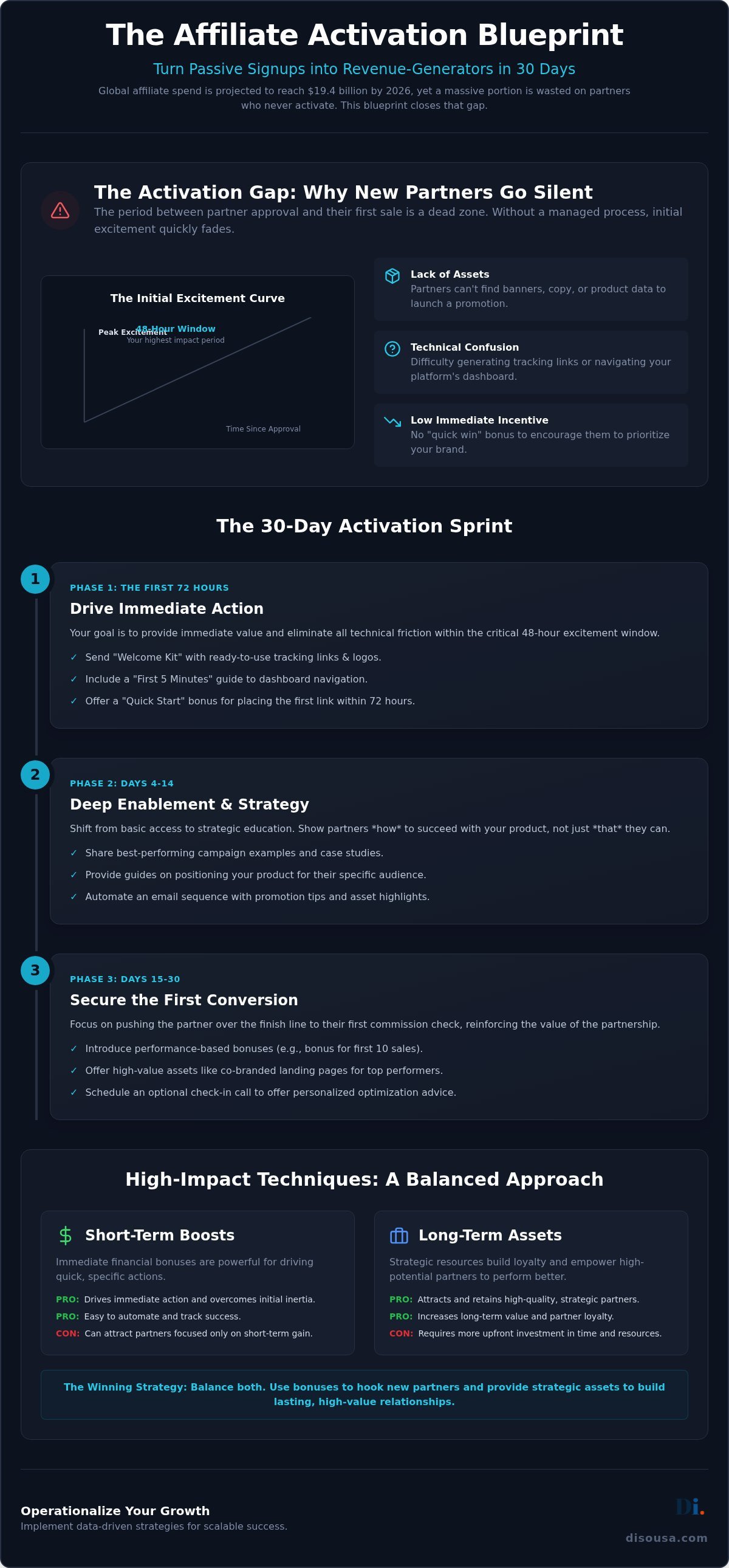
New partners experience an “initial excitement curve” that typically peaks at the moment of approval. This energy is fragile and usually drops off sharply after the first 48 hours. If they don’t have a clear path to their first promotion within this window, they drift toward other opportunities. Most affiliates also face “Choice Overload” because they belong to dozens of programs at once. They’ll naturally prioritize the brand that makes their job the easiest and most profitable. The first 14 days represent your critical Activation Window where your support has the highest impact.
Quantifying the Cost of Inactivity
Every dormant partner represents a sunk cost. Beyond software fees, the real damage is the opportunity cost of lost market share. If a high-potential partner stays silent, you’re losing the compounding data and revenue they could have generated. It’s vital to distinguish between low-quality recruits who were never a fit and under-activated high-potential partners who simply need better direction. Understanding foundational affiliate marketing principles shows that partnerships are performance engines, not just entries in a database. To build a program that scales, you need to move beyond simple recruitment and focus on a strategic framework for performance growth. Using affiliate partner activation techniques ensures your recruitment spend translates into active, high-value contributors.
The 30-Day Activation Blueprint: A Step-by-Step Sprint
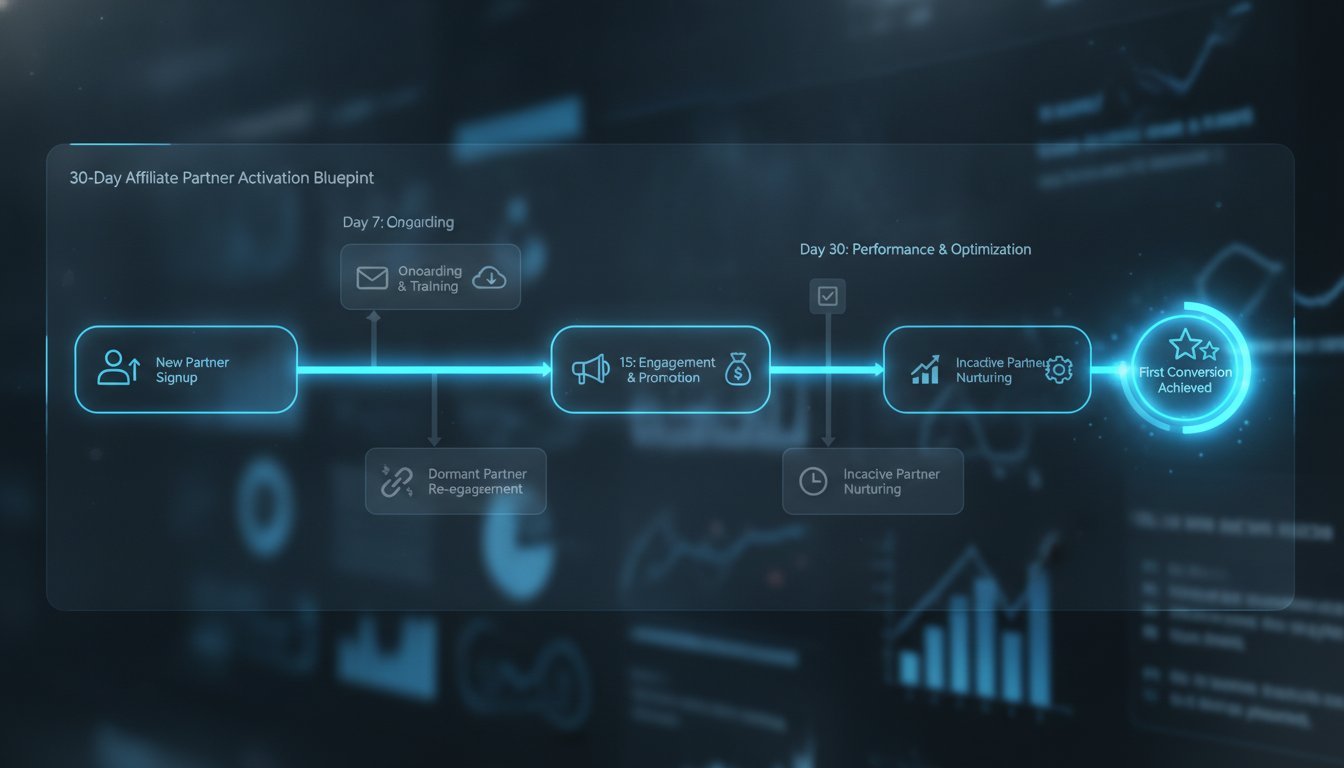
Most affiliate managers treat activation as a single event, usually a welcome email that gets buried in an inbox. To actually move the needle, you need to view the first month as a high-intensity sprint. This 30-day blueprint is designed to transition a partner from a passive signup to a performance-driven asset. By applying these structured affiliate partner activation techniques, you eliminate the guesswork for your partners and create a repeatable path to their first commission check. This process relies on automated triggers to maintain momentum without requiring constant manual oversight from your team.
Phase 1: The First 72 Hours
Speed is the only metric that matters in the first three days. Your goal is to provide immediate value and reduce technical friction. Every approved partner should receive a “Welcome Kit” that includes their unique tracking links, high-resolution logos, and a “First 5 Minutes” guide. This guide should show them exactly where to find their links and how to generate custom deep links for specific products. To drive immediate action, implement a “Quick Start” bonus. This is a small, one-time financial incentive for partners who place their first link or banner within 72 hours of approval. If you’re unsure how your current stack measures up, you can review our assessment of online marketing services for a clearer picture of modern operational standards.
Phase 2: Deep Enablement and Strategy
From day 4 to day 14, the focus shifts from access to education. Partners often stay silent because they don’t know how to position your product. You should provide “Ready-to-Post” content templates for social media and email sequences that they can copy and paste. This reduces the creative burden on the partner. For top-tier potential recruits, schedule a brief 15-minute strategy briefing to align on goals. Teaching them how to promote your content online effectively ensures they use the right channels for your specific niche. This phase is about building the partner’s confidence in your brand’s conversion potential.
Phase 3: The Conversion Push
The final two weeks of the sprint are dedicated to performance. Use “Milestone Bonuses” to reward the first five leads or sales. This creates a tangible goal that feels achievable. During this period, provide direct feedback on the quality of their initial traffic. If a partner is sending clicks but no conversions, help them optimize their landing page or call-to-action. For those who have already let the 30-day window slip, the focus shifts to re-activating dormant partners through specific re-engagement sequences. Once a partner hits their first conversion, transition their status in your CRM from “New” to “Active” to trigger your long-term retention workflows. Using these affiliate partner activation techniques ensures that your recruitment efforts result in actual revenue rather than just a bloated database.
High-Impact Activation Techniques: Bonuses vs. Resources
Choosing between cash incentives and strategic tools is the central dilemma of partner activation. While financial bonuses provide an immediate spike in interest, they often lack the staying power of high-value resources. You need to balance these affiliate partner activation techniques to ensure you aren’t just buying temporary attention but building a sustainable performance engine. Cash gets them in the door, but the right infrastructure keeps them producing. We’ll look at how to deploy these incentives without eroding your margins or attracting low-quality traffic.
Financial Incentives: When and How to Use Them
Flat-fee activation bonuses work well for lower-ticket items, whereas percentage bumps for the first 30 days are more effective for high-ticket SaaS or complex services. To protect your margins, you should always set minimum performance thresholds for these payouts. For example, a bonus might only trigger after a partner generates their first three sales or hits a specific revenue milestone. You can also gamify the process by offering a “First Sale” prize. This creates a sense of competition and urgency that encourages partners to move your brand to the top of their promotional calendar immediately after approval.
Resource-Based Enablement
Financial spikes eventually level off. To sustain growth, you must provide resources that make the partner’s job easier and more profitable. A “Partner Media Kit” should go beyond simple logos; it needs to include pre-approved copy, audience demographic data, and competitive intelligence that explains exactly why your brand wins against your rivals. Providing co-branded landing pages is another high-impact move that improves conversion rates by maintaining a seamless journey for the user. For a deeper look at how your current toolset compares to industry standards, you can refer to our Online Marketing Services Assessment to benchmark your resource offerings.
Tiered commission models act as a long-term activation lever by rewarding partners as they scale their volume. This “earn-your-way-up” structure keeps high-potential affiliates engaged far beyond the initial 30-day window. Additionally, you can use “Limited Time Offers” (LTOs) specifically for new partners to create artificial urgency. An exclusive commission bump that expires exactly 21 days after approval forces the partner to prioritize your campaigns. This combination of immediate pressure and long-term scaling potential ensures that the momentum you build during onboarding doesn’t stall out after the first week.
Operationalizing the Tech Stack for Scalable Activation
If you’re still manually emailing every new affiliate, you’re not running a program; you’re running a hobby. To scale, your affiliate partner activation techniques must be baked into your infrastructure. This starts by integrating your affiliate platform directly with your main CRM. When these systems talk to each other, you can stop guessing who is active and start seeing a unified view of the partner’s lifecycle. We use this data to move beyond tracking just the final sale and start monitoring the micro-conversions that lead up to it.
Micro-conversions, like link clicks or asset downloads, are your best leading indicators. A partner who downloads your media kit within 24 hours is statistically more likely to convert than one who just lets the account sit. By tracking these small actions, you can identify which partners are leaning in and which ones need a nudge. Your partner portal should serve as the central hub for this self-service activation, providing everything from tracking links to training videos without your team having to lift a finger.
Automating the Onboarding Flow
Automation doesn’t mean being impersonal. I recommend setting up trigger-based emails that fire based on specific inactivity. For example, if a partner has an “Account Created” status but “No Clicks” after 48 hours, they should receive an automated prompt offering a technical walkthrough. You can personalize these sequences based on the partner’s niche or audience size to make the advice feel relevant. While I often point new recruits toward an affiliate marketing easy guide to get their bearings, your automated flow should focus on immediate tactical wins that lead to that first sale.
Data-Driven Monitoring
You need to spot “Dormancy Signals” before a partner completely disengages. A sudden drop in portal logins or a week with zero link clicks is a red flag that requires an intervention. Use A/B testing on your welcome sequence to see which subject lines or incentives drive the highest initial engagement rates. One simple trick is to give partners visibility into a leaderboard within their dashboard; seeing how others are performing often drives a healthy sense of competition that keeps them active. If you want to scale your program without the manual headache, you can work with us to build your activation engine and automate these complex workflows.
Re-activating Dormant Partners: The ‘Second Chance’ Strategy
Even with a rigorous 30-day sprint, some affiliates will inevitably lose momentum. You need to distinguish between “dormant” partners, who have a history of production but stopped, and “dead” partners who never engaged. Dormant accounts are often your best source of incremental revenue because they already understand your value proposition. Identifying why they stopped is just as important as recruitment. I recommend conducting “Partner Exit Interviews” via automated surveys to find program weaknesses; you might discover your commission rates have fallen behind competitors or your creative assets are simply outdated for 2026 standards.
A “We Miss You” campaign shouldn’t be a generic plea for attention. Instead, use a major product launch or a seasonal promotion as a specific re-activation hook. You’re offering a fresh reason to promote your brand. If you don’t have a new product, consider a temporary commission “booster” for the first five sales they generate after returning. This creates immediate urgency. When you apply these affiliate partner activation techniques to a list of proven producers, the ROI is often higher than starting from scratch with cold recruits.
The Re-engagement Sequence
Your re-activation flow should be a structured, three-step process. Start with the “New Opportunity” email, highlighting updated assets or a limited-time commission bump. If they don’t respond, move to “Personal Outreach” for high-potential accounts. A direct note from a manager can uncover specific friction points that a bot might miss. The final step is the “Final Notice.” You must be willing to deactivate accounts that show zero engagement over a six-month period. This keeps your program lean and ensures your resources are focused on partners who actually contribute to the bottom line.
Pruning for Performance
Keeping 1,000 inactive partners in your database isn’t a sign of a healthy program; it’s a data liability. Inactive accounts skew your conversion metrics, making your program look less efficient than it actually is. It also increases administrative bloat and platform costs. A lean, highly active partner list is easier to manage and allows you to provide better support to your top producers. By removing the “dead weight,” you gain a clearer picture of your true performance and can make better decisions about where to invest your marketing spend. If you want to move beyond basic recruitment and build a high-performance engine, you should scale your program with Disousa’s strategic framework. Using these affiliate partner activation techniques ensures that every partner in your database has a clear path to production.
Turn Your Passive Partnerships into Performance Engines
The gap between recruiting a partner and seeing their first sale is where most affiliate programs lose their potential ROI. By treating the first 30 days as a tactical sprint, you move beyond passive onboarding and start driving real performance. Successful managers use affiliate partner activation techniques that balance immediate financial incentives with long-term strategic resources. This approach ensures that your partners don’t just sign up; they actually promote your brand with confidence and clarity.
Scaling this process requires a tech stack that monitors micro-conversions and automates re-engagement. When you prioritize data-driven optimization and prune inactive accounts, you create a lean program focused on high-value results. If you’re ready to stop managing a database and start leading a performance engine, we can help. Our team focuses on expert partner management and performance-based growth strategies to maximize your program’s efficiency. You can build a scalable affiliate engine with Disousa and start seeing documented ROI optimization today. It’s time to turn your dormant signups into active revenue streams.
Frequently Asked Questions
What is a good affiliate activation rate for a B2B program?
A healthy B2B activation rate typically falls between 15% and 25%. This means roughly a quarter of your approved partners should generate at least one click or lead within their first 30 days. If your rate stays below 10%, it’s a clear signal that your onboarding process lacks the immediate tactical triggers needed to move a partner from signup to action.
How long should I wait before considering an affiliate partner dormant?
You should classify a partner as dormant after 60 consecutive days of zero activity. This includes a lack of portal logins, link clicks, or asset downloads. Once a partner hits this 60-day window, they should automatically move from your standard newsletter list into a specific re-engagement sequence designed to uncover their friction points or lack of interest.
Should I offer a signup bonus to every new affiliate partner?
No, you shouldn’t offer a bonus for the act of signing up alone. Instead, tie bonuses to a performance milestone, such as a “First Sale” prize within the first 30 days. Using affiliate partner activation techniques that prioritize performance-based rewards ensures you attract partners who intend to promote you, rather than those just seeking a quick payout with no effort.
What are the most effective promotional materials for new affiliates?
Ready-to-post social media templates and pre-written email sequences are the most effective materials because they eliminate the partner’s creative burden. High-performing partners also value “insider” competitive intelligence that helps them position your brand against rivals. In 2026, static banners are far less effective than short-form video scripts or custom co-branded landing pages that maintain a seamless user journey.
How can I automate the affiliate activation process without losing the personal touch?
Use segmentation in your email automation to deliver messages based on the partner’s niche or platform. You can maintain a personal feel by referencing their specific audience type or providing a direct manager’s contact for high-potential accounts. Automation should handle the repetitive delivery of links and assets while you focus your manual outreach on strategy for your top-tier recruits.
What should be included in a standard affiliate welcome kit?
A standard kit must include unique tracking links, high-resolution logos, a brand style guide, and a “Quick Start” one-sheet. You should also provide a clear breakdown of the commission structure and a calendar of upcoming promotions. Providing these affiliate partner activation techniques in a single, accessible portal prevents the technical confusion that often leads to early partner dormancy.
How do I handle partners who sign up but never click a link?
Trigger a technical check-in email after 72 hours of inactivity to ensure they aren’t having trouble navigating your dashboard. If they remain inactive after 14 days, send a limited-time commission boost to create urgency. If there is still no activity after the 30-day sprint, move them to a low-priority bucket to prevent them from skewing your active program data.
Is it worth re-activating partners who haven’t made a sale in over a year?
It’s only worth the effort if they were high-volume producers in the past or if you’ve launched a new product that fits their audience. For partners who never generated a single sale, your time is better spent on new recruitment or optimizing your current active roster. Prioritize “dormant” high-potential accounts over “dead” accounts that have never engaged with your tracking links.
Disclaimer
**Disclosure:** Some articles on this website may contain affiliate links. This means we may earn a commission if you purchase a product or service through certain links, at no additional cost to you. We only recommend products, tools, and services that we believe provide value to our readers.
**Disclaimer:** The information provided on this website is for educational and informational purposes only and should not be considered financial, legal, tax, or professional advice. While we strive to keep our content accurate and up to date, we make no guarantees regarding completeness, reliability, or results obtained from using the information provided. Always conduct your own research and consult qualified professionals before making business, financial, or investment decisions.
