

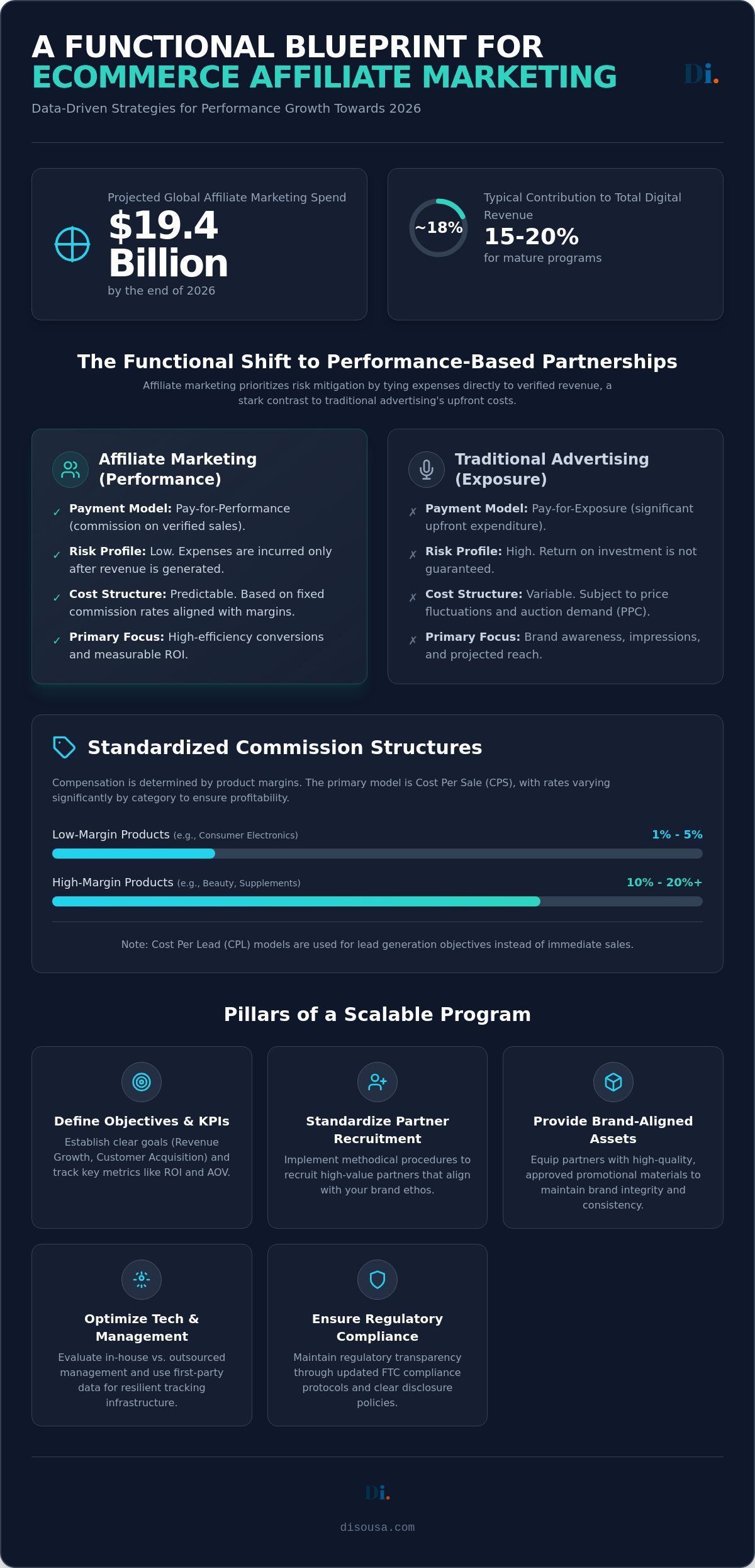
Global spending on affiliate marketing is projected to reach $19.4 billion by the end of 2026. This projection indicates a continued reliance on performance-based channels for digital revenue growth. A standardized affiliate marketing strategy for ecommerce is necessary to manage these investments effectively. Many brands report difficulty in maintaining consistent ROI across diverse marketing channels. The management of large partner volumes often results in administrative inefficiencies. There is also a documented risk of brand dilution when high-quality standards are not enforced during the recruitment phase.
This article serves as a professional reference for establishing and scaling high-performance affiliate operations. It provides a functional blueprint for the recruitment of high-value partners. A standardized compensation framework is introduced to ensure logistical clarity and financial predictability. The content focuses on data-driven methods for scaling ROI while maintaining brand integrity. This framework outlines the transition from passive program management to a methodical, automated system for 2026.
Key Takeaways
- Identify the functional shift from traditional advertising to performance-based partnership models for scalable growth.
- Establish a functional affiliate marketing strategy for ecommerce using measurable KPIs and margin-based commission structures.
- Evaluate the logistical requirements of in-house management versus outsourced agency operations and tracking infrastructure.
- Apply standardized procedures for partner recruitment and the development of brand-aligned promotional materials.
- Maintain regulatory transparency through updated FTC compliance protocols and AI-driven partner discovery methods.
The Role of Affiliate Marketing in Ecommerce Growth
Affiliate marketing is defined as a performance-based growth channel where external partners promote a brand’s products in exchange for a commission. This model represents a functional shift from traditional advertising to partnership-driven sales. Traditional media buying often requires significant upfront expenditure without a guaranteed return on investment. An affiliate marketing strategy for ecommerce prioritizes risk mitigation. Expenses are only incurred when a specific transaction is verified. This ensures that marketing budgets are allocated based on actual revenue generation rather than projected reach.
To better understand this concept, watch this helpful video:
The operational framework of this model relies on a clear relationship between the merchant, the affiliate, and the consumer. The merchant provides the digital infrastructure and product fulfillment. The affiliate utilizes their own platforms to distribute promotional content. The consumer completes the purchasing process via a unique tracking link. This system creates a transparent environment where each party’s role is clearly defined. Data-driven tracking ensures that every referral is attributed correctly to the responsible partner.
Defining the Performance-Based Partnership Model
In this model, merchants reward partners for tangible business outcomes. These outcomes typically include completed sales, but can also include lead submissions or app installations. There is a clear distinction between affiliate marketing and standard influencer sponsorships. Influencer agreements often focus on brand awareness and involve flat fees paid before content is published. In contrast, affiliates function as an external sales force. They are incentivized by commissions to focus on conversion rather than general engagement. This structure is grounded in standard administrative terminology and focuses on logistical results.
Why Ecommerce Brands Prioritize Affiliate Channels in 2026
Ecommerce brands prioritize these channels due to high Cost-Per-Acquisition (CPA) efficiency. Compared to Pay-Per-Click (PPC) models, affiliate marketing offers more predictable costs. PPC platforms often experience price fluctuations based on auction demand. A functional affiliate marketing strategy for ecommerce maintains fixed commission rates that are aligned with product margins. The depreciation of third-party cookies has also increased the relevance of this channel. Affiliate tracking infrastructure has evolved to use first-party data and server-side tracking. These methods provide higher resilience against browser privacy changes. For further analysis, see the Affiliate Marketing for Brands: A Strategic Framework for Performance Growth reference.
Strategic Components of a Functional Affiliate Framework
An effective affiliate marketing strategy for ecommerce requires the merchant to act as a primary architect of the program infrastructure. Business objectives must be established before partner recruitment begins. These objectives typically focus on revenue growth, customer acquisition, or inventory clearance. Key performance indicators (KPIs) include the return on investment (ROI) and the average order value (AOV). For mature programs, affiliate marketing contributes approximately 15-20% of total digital revenue. Program managers must ensure that these KPIs are monitored through a centralized tracking system to maintain data integrity. This methodical approach prevents the logistical issues associated with unorganized partner networks.
Commission Structures and Compensation Protocols
Compensation terms are determined by specific product margins and customer acquisition goals. Cost Per Sale (CPS) is the primary model used in ecommerce. Commission rates generally range from 5% to 20% of the order value. Low-margin items, such as consumer electronics, typically offer 1-5%. High-margin categories, including beauty and supplements, often provide 10-20% or more. Cost Per Lead (CPL) is utilized when the objective is lead generation rather than immediate transactions. Tiered commission structures are implemented to reward partners who achieve high sales volumes. This method incentivizes top performers without increasing the baseline cost for the entire network. Hybrid commission models combine fixed fees with performance-based percentages to secure high-value placements while ensuring measurable results.
Selecting High-Value Affiliate Partner Archetypes
Selecting the correct partner archetypes ensures that the program aligns with brand standards. Content publishers and review sites provide high-intent traffic through editorial reviews. Micro-influencers offer targeted engagement within specific niche communities. Loyalty and cashback sites operate at the bottom of the conversion funnel to facilitate the final purchase. These partners are effective for conversion but require careful management to prevent margin erosion. A functional affiliate marketing strategy for ecommerce categorizes these partners by their specific contribution to the customer journey. For a baseline understanding of partner roles, refer to the Affiliate Marketing Easy Guide.
Compensation terms must also comply with current legal requirements. Transparency is maintained by adhering to the FTC Endorsement Guides. These regulations require that any material connection between a brand and an affiliate is clearly disclosed to the consumer. Brands that prioritize these structural elements often see more sustainable growth. Organizations seeking to refine these logistical components may utilize professional affiliate marketing services to manage these complex frameworks.
Evaluating Affiliate Management and Infrastructure Models
Infrastructure selection is a critical component of a functional affiliate marketing strategy for ecommerce. Management is typically divided into two categories: in-house operations or outsourced agency management. In-house models require the merchant to hire dedicated staff and manage software subscriptions directly. This provides maximum control over brand messaging and partner communication. Outsourced program management (OPM) utilizes third-party experts to handle recruitment and administrative tasks. OPM models are often preferred by brands seeking to scale quickly without increasing internal headcount. These agencies provide established relationships with high-value publishers, which reduces the time required for program launch.
The choice between affiliate networks and direct tracking software impacts the logistical reality of the program. Networks like ShareASale provide a centralized marketplace for partner discovery. These platforms handle technical tracking and automated commission payments. ShareASale involves a setup fee of $625 and a minimum deposit of $125 for initial commissions. Other network providers utilize custom pricing models that typically involve a network access fee and a revenue share of approximately 30% of the affiliate commission. Direct tracking software allows brands to host their own programs. This removes network fees but increases the administrative burden of managing individual partner contracts and tax documentation. Merchants must evaluate whether the network’s discovery tools justify the recurring overrides and platform fees.
Direct vs. Network-Based Program Management
Established networks provide immediate access to vetted partners and standardized reporting interfaces. This is functionally beneficial for brands entering the affiliate space. A transition to direct-to-brand software is usually triggered by high revenue volumes. When network fees exceed the cost of dedicated software and administrative labor, a self-hosted model becomes more cost-effective. A Functional Analysis of Outsourced Affiliate Program Management details how these transitions are managed. Brands must also consider the technical support provided by networks, which is often superior to self-managed software solutions.
Technical Requirements for Tracking and Attribution
Server-to-server tracking is now a standard requirement for data accuracy. This method ensures that conversions are recorded even when browser-based cookies are blocked by privacy settings. Multi-touch attribution models are utilized to distribute credit across various touchpoints in the customer journey. This prevents the last-click bias that often undervalues top-of-funnel content creators. First-party tracking cookies are implemented to maintain attribution data directly on the merchant’s domain for improved reliability. All tracking implementations must prioritize transparency to remain compliant with the FTC’s Endorsement Guides. Current trends also indicate a shift toward shorter cookie durations, such as 7-day windows, to align with updated privacy regulations like ITP 2.3.
Executing a Scalable Ecommerce Affiliate Strategy
Partner Recruitment and Vetting Procedures
Fraud prevention is a necessary component of the vetting process in 2026. Digital infrastructure is monitored for suspicious activity such as cookie stuffing or click injection. Automated tools are used to flag high-volume traffic from non-compliant sources. Manual audits of affiliate sites are conducted periodically to verify the placement of promotional links. These procedures protect the merchant’s marketing budget from illegitimate commission claims. Verified partners are then integrated into the communication workflow for ongoing performance monitoring.
The development of brand-aligned creative assets is essential for conversion optimization. Affiliates are provided with high-converting landing pages that are optimized for mobile devices. These pages ensure a consistent user experience from the referral link to the checkout process. Exclusive discount codes are also implemented to improve tracking accuracy. These codes allow for attribution even when tracking links are stripped by browser security settings. Standardized assets reduce the creative burden on partners and ensure brand consistency across external platforms. Brands looking to build a repeatable recruitment pipeline can reference the detailed affiliate outreach strategies outlined in the Affiliate Partner Recruitment Blueprint for 2026 to filter for quality partners and automate key stages of the onboarding process.
Platforms like Discount Coupons Press support this strategy by aggregating verified promotional codes for SaaS and retail brands, helping to maintain a consistent user experience and improve conversion rates.
Content Standards for Conversion Optimization
Effective distribution depends on the utilization of diverse content formats. Merchants provide partners with pre-approved banner ads, product data feeds, and email templates. These materials are updated regularly to reflect current inventory and seasonal promotions. For specific distribution tactics, refer to the guide on How to Promote Your Content Online. Providing these resources ensures that affiliates have the necessary tools to generate measurable sales without deviating from the brand’s aesthetic standards.
Scaling successful partnerships is based on data-driven performance evaluations. Partners who consistently meet or exceed ROI targets are eligible for higher commission tiers. Ongoing communication is maintained to identify new promotional opportunities. High-performance affiliates are often granted early access to new product launches. This methodical scaling ensures that the program remains profitable as partner volume increases. Brands seeking to implement these scalable procedures can utilize expert affiliate marketing services to manage complex recruitment and onboarding workflows.
Advanced Optimization and Regulatory Compliance Standards
Advanced optimization for an affiliate marketing strategy for ecommerce in 2026 involves the integration of artificial intelligence for program scaling. Manual discovery of partners is replaced by automated systems that evaluate publisher authority and historical conversion data. These systems utilize machine learning to predict which partners will deliver the highest lifetime value. Communication with large volumes of affiliates is managed through automated messaging protocols. This ensures that essential program updates and promotional materials are distributed without delay. This methodical approach allows merchants to maintain focus on internal milestones rather than administrative maintenance.
Integrating AI for Automated Program Management
Machine learning is utilized for predictive performance modeling based on historical transaction data. This allows merchants to allocate higher commissions to partners with a proven ability to acquire new customers. Routine administrative tasks, such as commission adjustments and partner vetting, are handled by automated workflows. These workflows reduce the margin for human error and increase operational efficiency. AI-driven systems provide real-time analysis of traffic patterns to identify and block fraudulent activities before commissions are paid.
Maintaining Transparency and Compliance in 2026
Regulatory compliance is a functional necessity to avoid substantial financial penalties. The Federal Trade Commission (FTC) issues fines ranging from $51,744 to $53,088 per violation for improper disclosures. Affiliates must use clear and conspicuous terms like “#ad” or “Sponsored by [Brand]” to describe material connections. Vague hashtags such as “#collab” or “#partner” aren’t considered sufficient under current standards. Merchants are responsible for monitoring partner content to ensure adherence to these guidelines and general brand standards. A Data-Driven Evaluation of Affiliate Marketing ROI in 2026 provides a framework for measuring the impact of these compliance protocols on overall program performance.
ROI analysis in complex ecommerce environments requires a multi-touch attribution approach. This method accounts for the influence of various partners across the entire customer journey. Strategic alignment is achieved when affiliate goals are synchronized with overarching brand visibility targets. This ensures that performance-based sales don’t occur at the expense of long-term brand equity. Global affiliate marketing spend is projected to reach $19.4 billion by the end of 2026. Maintaining a clear affiliate marketing strategy for ecommerce allows brands to capture a portion of this growth while mitigating logistical risks.
Establishing Operational Readiness for 2026
The implementation of a functional affiliate marketing strategy for ecommerce depends on the integration of standardized recruitment and compensation protocols. Merchants must prioritize technical infrastructure that supports server-to-server tracking and automated partner discovery. These components ensure that program growth remains sustainable while maintaining strict brand standards. Regulatory compliance remains a primary administrative requirement to mitigate the risk of financial penalties. A methodical transition to these advanced models allows brands to manage increased partner volumes without compromising operational efficiency.
Disousa specializes in the management of performance-based affiliate partnerships. Global coverage is provided for brands seeking to scale operations across multiple regions. Focus is maintained on data-driven ROI optimization through the functional assessment of marketing channels. Organizations are invited to request a functional assessment of your affiliate marketing strategy to identify specific opportunities for improvement. Proper preparation ensures that digital revenue targets are met with logistical precision. A structured approach to partnership management supports long-term commercial stability.
Frequently Asked Questions
What is the standard commission rate for ecommerce affiliate programs?
Standard commission rates for ecommerce typically range from 5% to 20% of the total order value. Low-margin categories such as consumer electronics often provide 1-5% commissions. High-margin sectors including beauty or supplements frequently offer 10-20% to attract high-value partners. Direct-to-consumer brands often establish a starting point of 10-15% for new customer orders. A functional affiliate marketing strategy for ecommerce aligns these rates with specific product margins to ensure program profitability.
How do I identify high-quality affiliate partners for my brand?
High-quality partners are identified through a systematic evaluation of domain authority and audience relevance. Vetting procedures include a detailed analysis of content quality and historical traffic patterns provided by the publisher. Merchants prioritize partners who maintain editorial standards consistent with the brand’s professional image. This methodical selection process prevents the inclusion of low-quality sites that often result in brand dilution. Standardized onboarding sequences are utilized to verify that all new participants understand brand guidelines.
Is an affiliate network or a direct program better for a new brand?
Established affiliate networks are generally more effective for new brands due to their built-in discovery tools and technical infrastructure. These platforms provide immediate access to vetted publishers and handle automated commission payments. Direct programs are typically reserved for mature brands with high revenue volumes that justify the administrative cost of a self-managed system. Networks reduce the initial technical burden of launching a performance-based channel. They also provide a centralized interface for reporting and partner communication.
How can I prevent affiliate fraud in my ecommerce store?
Affiliate fraud is prevented through the implementation of automated monitoring tools and manual audit protocols. These systems flag suspicious activities such as cookie stuffing and click injection in real-time for administrative review. Standardized vetting procedures ensure that only legitimate publishers are admitted to the program during the recruitment phase. Monitoring traffic sources for non-compliant behavior protects the marketing budget from illegitimate commission claims. Regular audits of affiliate content verify that all promotional links are placed correctly.
What technical infrastructure is required to track affiliate sales?
Modern tracking infrastructure requires server-to-server integration and first-party cookies for data accuracy. These methods ensure that conversions are recorded even when browser-based tracking is restricted by privacy settings. Multi-touch attribution models are utilized to distribute credit across all relevant touchpoints in the customer journey. This technical setup provides a reliable foundation for scaling a high-performance affiliate marketing strategy for ecommerce. Reporting interfaces must provide real-time access to transaction data for both the merchant and the affiliate.
How does affiliate marketing impact my brand’s organic SEO?
Affiliate marketing primarily impacts organic SEO through increased brand visibility and overall traffic volume. Standard affiliate links utilize “nofollow” or “sponsored” attributes according to current search engine guidelines. This means they don’t directly pass link equity to the merchant’s domain. However, the increased brand mentions and editorial coverage provided by high-quality publishers can indirectly improve search engine rankings. A functional program focuses on these visibility benefits and the resulting increase in branded search queries from consumers.
What are the current FTC disclosure requirements for affiliates in 2026?
The FTC mandates clear and conspicuous disclosure of any material connection between an affiliate and a brand. Standardized terms like “#ad” or “Sponsored by [Brand]” must be used to ensure transparency for the consumer. Vague identifiers such as “#partner” or “#collab” are not considered sufficient under current regulatory standards. Failure to comply can result in fines ranging from $51,744 to $53,088 per violation. Merchants are responsible for monitoring their partners to ensure all promotional content includes these required disclosures.
Can I manage an affiliate program in-house or should I outsource it?
In-house management provides maximum control over brand messaging but requires dedicated internal staff and technical resources. Outsourced program management (OPM) utilizes external experts to handle recruitment and administrative tasks. Brands seeking global coverage and rapid scaling often choose OPM models to leverage established publisher relationships. The choice depends on the organization’s current focus on internal milestones versus the need for specialized external expertise. Many brands utilize a hybrid approach where internal managers oversee the work of an OPM agency.
Disclaimer
**Disclosure:** Some articles on this website may contain affiliate links. This means we may earn a commission if you purchase a product or service through certain links, at no additional cost to you. We only recommend products, tools, and services that we believe provide value to our readers.
**Disclaimer:** The information provided on this website is for educational and informational purposes only and should not be considered financial, legal, tax, or professional advice. While we strive to keep our content accurate and up to date, we make no guarantees regarding completeness, reliability, or results obtained from using the information provided. Always conduct your own research and consult qualified professionals before making business, financial, or investment decisions.
