

Standard affiliate models fail when the price point exceeds $1,000. Implementing affiliate marketing for high-ticket services requires a transition from simple link tracking to a multi-stage attribution framework. You can’t treat a professional service engagement like a one-click consumer purchase. Most programs struggle because they ignore the technical complexity of long sales cycles and the necessity of maintaining brand integrity during the partner handoff.
I recognize the difficulty of finding qualified partners who can represent a professional brand without resorting to low-quality tactics. It’s frustrating to manage a channel that produces high traffic but fails to deliver a measurable ROI. This article provides a functional briefing on the procedures required to manage high-value affiliate partnerships for professional services. We’re moving past the marketing theory to focus on the logistical reality of scaling your operations.
I’ve outlined the specific frameworks you need to track lead progression and ensure compliance with 2026 regulatory standards. You’ll find a blueprint for vetting partners based on technical competency rather than just audience size. This is a practical tool designed to help you build a reliable, scalable partnership model that functions as an extension of your internal team.
Key Takeaways
- Define the financial parameters for success by aligning commission structures with the specific complexity and overhead of professional service sales.
- Implement a multi-stage attribution model for affiliate marketing for high-ticket services to accurately track leads across extended sales cycles.
- Integrate affiliate channels directly with your internal sales department to maintain brand integrity and ensure high-quality lead handoffs.
- Identify the specific service sectors in the 2026 economy that offer the highest potential for scalable and sustainable affiliate growth.
- Utilize professional management frameworks to automate compliance monitoring and reduce the operational burden on your core team.
Defining High-Ticket Affiliate Marketing for Professional Services
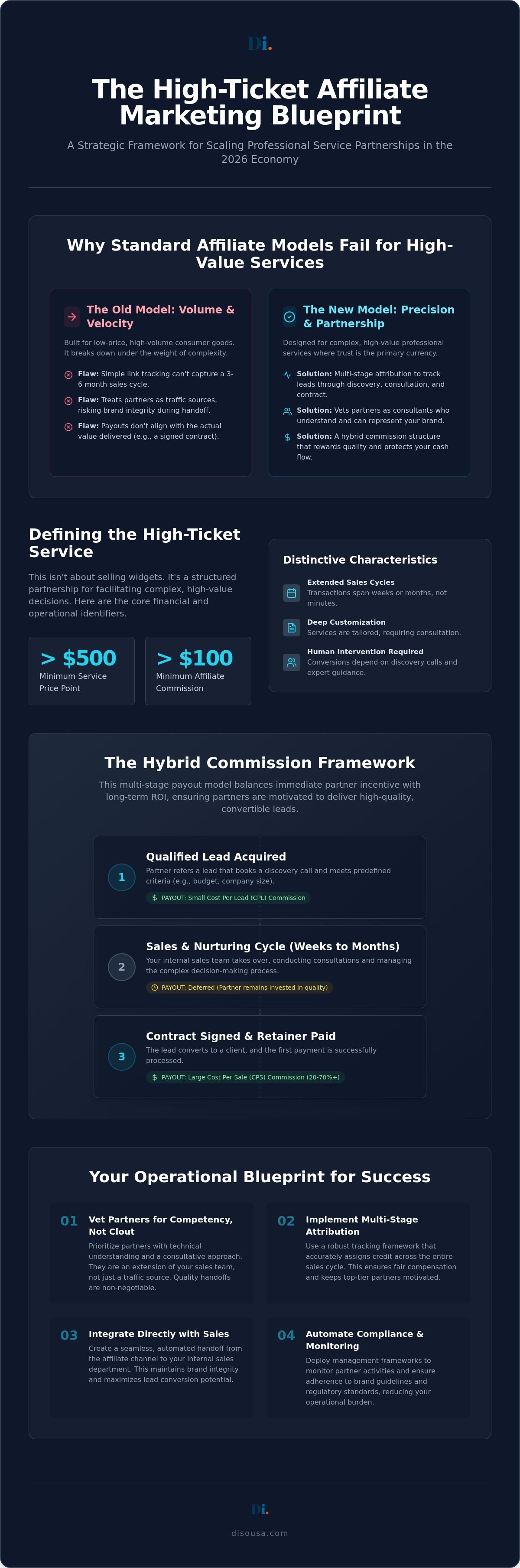
In the 2026 service economy, high-ticket affiliate marketing isn’t about volume. It’s about precision. We define a high-ticket service as any offer where the price point exceeds $500 and the affiliate commission is at least $100. Affiliate marketing for this sector requires a different operational mindset than selling physical goods. You aren’t just moving units. You’re facilitating a complex decision-making process where trust is the primary currency. High-value service partners act as consultants, not just traffic sources.
To better understand how these high-value models function in practice, watch this briefing on making high-ticket affiliate marketing work:
Distinctive Characteristics of High-Value Service Offers
High-ticket services are those requiring significant financial and time commitments. Unlike a standard e-commerce transaction, these offers usually involve deep customization. A partner doesn’t just sell the service; they qualify the lead. Conversion often requires human intervention, such as a discovery call or a technical consultation. This means your affiliates must understand your service delivery as well as your internal sales team does. It’s a heavy lift. The complexity of these services dictates a longer sales cycle, often spanning weeks or months.
The Economic Rationale for Service-Based Affiliate Programs
Acquisition costs for professional services are often volatile. Traditional paid search results in high Customer Acquisition Costs (CAC) that can quickly erode your margins. By implementing affiliate marketing for high-ticket services, you shift the financial risk to the partner. You only pay when a specific milestone, like a signed contract or a paid retainer, is met. This protects your cash flow. It allows for aggressive scaling without the upfront ad spend risk.
I recommend reviewing a strategic framework for performance growth to see how these models integrate with existing marketing departments. In 2026, SaaS commissions for high-ticket offers often range from 20% to 70%. These rates reflect the high lifetime value (LTV) of the clients being referred. Using a performance-based model ensures your marketing spend is always tied to actual revenue. It’s a logical move for any service brand looking to maintain lean operations while growing their market share.
Structural Frameworks for High-Ticket Commission Models
Standard affiliate models break when the sales cycle lasts three to six months. When implementing affiliate marketing for high-ticket services, your payout structure must account for this lag. High-value services often involve multiple touchpoints before a contract is signed. If you pay only on the final sale, you risk losing high-quality partners who can’t afford to wait half a year for a payout. Conversely, paying for every lead without vetting will drain your budget. You need a framework that balances partner incentive with your own cash flow protection.
Lead-Based vs. Performance-Based Payouts
I recommend a hybrid approach for service environments. Cost Per Lead (CPL) works well if you have a rigorous automated vetting process. You might pay a small fee when a lead books a discovery call, provided they meet specific criteria like budget or company size. The bulk of the commission should remain tied to the Cost Per Sale (CPS). This ensures the partner stays invested in the lead quality rather than just the quantity. It’s a tactical way to manage expectations for lead quality while keeping your affiliate’s interest through the long sales process.
If you’re unsure how to structure these stages, looking into a functional assessment of online marketing services can help clarify where your specific sales touchpoints occur.
Recurring Revenue and Lifetime Value Calculations
For retainer-based services, the payout logic changes. You shouldn’t just look at the first month’s revenue. Calculating affiliate payouts for these services requires a deep understanding of your retention rates. The Lifetime Value (LTV) should dictate the maximum allowable commission for a service lead. If a client typically stays for two years, you can afford a higher upfront commission or a smaller recurring percentage. You’ll need specialized tracking software that supports multi-year attribution to ensure partners are credited correctly for renewals or upsells that happen long after the initial click.
Compliance and Transparency
Trust is maintained through transparent reporting and legal compliance. In 2026, the FTC has intensified enforcement regarding affiliate disclosures. Fines for non-compliance can reach $53,088 per violation. You must provide your partners with clear disclosure guidelines and monitor their content regularly. Both the brand and the affiliate are held jointly liable. Beyond legalities, partners need a real-time dashboard to see where their leads sit in your sales pipeline. If they can’t see the progress, they’ll stop sending traffic. Clarity in your reporting is just as important as the commission percentage itself.
Evaluating High-Ticket Service Sectors for Affiliate Growth
When evaluating your sector, it’s useful to apply an affiliate marketing for brands strategic framework to ensure the economics align with your delivery costs. The goal is to find partners who already have the trust of your target audience. You aren’t looking for broad reach. You’re looking for deep relevance. If your service requires a high degree of technical customization, your affiliates must be capable of explaining those nuances to a sophisticated buyer.
Enterprise Software and SaaS Frameworks
B2B software implementation is a primary driver for high-ticket growth. Affiliates in this space often act as consultants or technical advisors. They don’t just recommend a tool; they explain how it integrates into a client’s existing stack. In 2026, standard commission rates for enterprise SaaS range from 20% to 70% of the sale. These high rates reflect the difficulty of the sale and the high lifetime value of the customer. There’s also a significant trend toward promoting subscription-based services. This provides affiliates with recurring monthly commissions, which helps you retain high-performing partners for the long term.
Professional Consulting and Certification Programs
The creator economy is valued at over $250 billion in 2026. This has fueled massive demand for high-end business coaching and certification programs. These services often use webinar-based funnels to convert leads. You should recruit subject matter experts who can provide genuine endorsements based on their own professional results. These partners often prefer a commission structure that rewards them for the total contract value rather than just the initial deposit. Recruitment should focus on quality over quantity. One partner with a deep, specialized audience is worth more than fifty generic influencers. This is especially true for affiliate marketing for high-ticket services where a single referral can be worth thousands of dollars.
Procedures for Executing a High-Ticket Sales Strategy
Launching affiliate marketing for high-ticket services requires more than just a tracking link. It demands a full integration into your existing sales pipeline. You must treat your affiliates as an external extension of your internal team. This involves setting up clear communication channels between your partners and your sales department. When a high-value lead is referred, your sales team needs the specific context of that referral to close the deal effectively. I’ve seen programs fail because the sales team didn’t understand the affiliate’s role in the lead’s journey.
A functional assessment of online marketing services can help you identify where these handoffs should occur. The onboarding process must be standardized. Every partner should receive a handbook that outlines your service’s unique value propositions and brand guidelines. This ensures that the representation of your brand remains consistent, regardless of the affiliate’s individual style. We focus on creating a repeatable process that reduces friction for both the brand and the partner.
Partner Recruitment and Vetting Standards
You can’t afford to have low-quality partners representing a high-value service. Vetting must be rigorous. I recommend a three-step audit: a background check on their previous promotional history, a brand alignment review of their current content, and a technical interview. You need partners who understand the consultative nature of high-ticket sales. A partner handbook is essential for maintaining this standard. It should include pre-approved copy, disclosure requirements, and a clear explanation of your sales cycle milestones.
Technical Infrastructure for Tracking and Attribution
High-ticket services usually have long sales cycles that exceed standard cookie durations. You need software that supports server-to-server tracking and integrates directly with your CRM. This allows you to track a lead from the initial click through to the final signed contract. Follow these steps to set up a multi-stage tracking funnel:
- Install the primary tracking pixel on your landing page to capture the initial referral data and affiliate ID.
- Configure your lead capture forms to pass the affiliate ID into a hidden field in your CRM.
- Set up a postback URL or webhook that triggers when the lead status changes to “closed-won” in your internal records.
- Verify that the conversion data matches between your affiliate platform and your financial reporting to ensure accurate payouts.
If you need assistance managing these technical requirements, you can contact Disousa for affiliate marketing management to ensure your infrastructure is scalable and compliant.
Optimizing High-Ticket Affiliate Operations with Disousa
Managing affiliate marketing for high-ticket services internally often creates significant operational friction. The logistical reality of vetting partners, monitoring compliance, and managing multi-stage attribution can overwhelm a standard marketing department. Disousa functions as a technical manager for these programs. We provide the digital infrastructure and administrative oversight required to scale performance-based channels without increasing your internal headcount. Our focus is on the delivery of essential status updates and measurable lead generation results.
Professional management ensures that your affiliate channel remains aligned with your broader business goals. We don’t just recruit partners; we evaluate their impact on your margins and ROI using data-driven frameworks. This methodical approach allows you to maintain brand integrity while pursuing aggressive growth. You can see how this fits into a larger strategy by reviewing our strategic framework for performance growth.
Managed Affiliate Services for Scalable Growth
Outsourcing the recruitment and management of high-value partners reduces the risk of brand dilution. I’ve seen brands struggle when they allow unvetted affiliates to represent their professional services. Disousa implements rigorous vetting standards to ensure every partner has the technical competency to handle complex sales. We provide global service coverage, allowing you to scale into new markets with a consistent operational blueprint. Our role is to handle the background work so your internal team can focus on closing the leads we generate.
Integrating Email Marketing with Affiliate Performance
High-ticket leads rarely convert on the first touch. You need a functional protocol for lead nurturing. Disousa integrates email marketing solutions directly into the affiliate sales cycle. We use automated sequences to maintain audience engagement during long decision-making periods. This personalized communication ensures that lead quality remains high until the prospect is ready for a sales call. Our approach to conversion optimization is grounded in empirical results. We focus on the science of the sale, utilizing precise terminology and technical tracking to move prospects through your funnel.
If you’re ready to transition from a manual process to a managed system, I recommend starting with our easy guide to affiliate marketing. It provides a foundational look at how we structure these partnerships for maximum efficiency. We value substance over flashiness. Our goal is to provide you with a reliable, guarded expert presence that prioritizes readiness and accuracy in every campaign.
Scaling Your High-Ticket Partnership Model
I have outlined the frameworks required to transition from a generic referral setup to a professional partnership model. Success in affiliate marketing for high-ticket services depends on your ability to implement multi-stage attribution and rigorous partner vetting. We’ve established that technical infrastructure and CRM integration are the essential backbones of any scalable service-based system. You can’t rely on standard consumer-level tracking for $1,000+ service engagements; you need a system that survives long sales cycles.
Integrating automated email sequences and professional oversight allows you to protect brand integrity while maintaining a consistent volume of qualified leads. I recommend prioritizing partners who possess the specific subject matter expertise to bridge the gap between a prospect’s problem and your high-value solution. This methodical approach ensures your marketing spend remains tied directly to measurable ROI and global business goals. It’s about building a channel that functions as a predictable revenue engine rather than a source of random traffic.
If you’re ready to implement these procedures, you can contact Disousa for professional affiliate program management. We provide expert management of performance-based affiliate programs, comprehensive email marketing, and global reach for brand expansion. I’m confident these procedures will help you build a more resilient and profitable partnership channel.
Frequently Asked Questions
What is considered a high-ticket service in affiliate marketing?
A service is classified as high-ticket when the price point exceeds $500 and the affiliate commission is at least $100 per sale. In the 2026 service economy, these offers typically involve professional consulting, enterprise software, or specialized technical solutions. These services differ from standard products because they often require a longer decision-making process and significant time commitment from the client.
How much commission is standard for high-ticket services?
Standard commission rates for professional services and SaaS typically range from 20% to 70% of the total sale value. These percentages are higher than retail rates because they reflect the high lifetime value of the customer and the complexity of the sales process. You should determine your specific payout based on your service margins and the cost of human intervention required to close the lead.
How do you track affiliate sales for services with long sales cycles?
You must implement server-to-server tracking and multi-stage attribution to manage cycles that last several months. Standard browser cookies often expire before a high-value contract is signed, so your system must link the affiliate ID to the lead’s profile in your CRM. This ensures that the partner receives credit for the eventual conversion regardless of how much time has passed since the initial click.
Can I use affiliate marketing for B2B professional services?
What are the risks of high-ticket affiliate marketing for service brands?
The primary risks include brand dilution from low-quality promotions and legal liability for non-compliant disclosures. The FTC mandates clear disclosures for all affiliate relationships, with potential fines reaching $53,088 per violation in 2026. You are jointly liable for your partners’ actions. I recommend rigorous vetting and regular compliance audits to protect your brand from these financial and reputational hazards.
How do I find affiliates who can sell expensive services?
Focus your recruitment on subject matter experts, industry consultants, and niche content creators rather than broad-market influencers. You need partners who understand the technical nuances of your offer and can provide genuine, expert endorsements. Look for individuals who already provide advisory services to your target audience, as they have the necessary trust to facilitate high-value referrals.
Is a CRM necessary for high-ticket affiliate programs?
A CRM is essential for tracking the progression of high-value leads from the initial referral to the final signed contract. You can’t manage affiliate marketing for high-ticket services using basic spreadsheet tracking or simple affiliate software. Your CRM must capture the affiliate ID and update the affiliate platform when a lead reaches specific milestones, such as booking a call or paying a retainer.
What is the difference between high-ticket products and high-ticket services in marketing?
The main difference lies in the conversion process and the requirement for customization. High-ticket products are often standardized and can sometimes be sold through a purely digital funnel. Services almost always require human intervention, such as a discovery call or a technical consultation, to finalize the scope of work. This makes the partnership more about lead qualification than direct unit sales.
Disclaimer
**Disclosure:** Some articles on this website may contain affiliate links. This means we may earn a commission if you purchase a product or service through certain links, at no additional cost to you. We only recommend products, tools, and services that we believe provide value to our readers.
**Disclaimer:** The information provided on this website is for educational and informational purposes only and should not be considered financial, legal, tax, or professional advice. While we strive to keep our content accurate and up to date, we make no guarantees regarding completeness, reliability, or results obtained from using the information provided. Always conduct your own research and consult qualified professionals before making business, financial, or investment decisions.
