

An affiliate marketing certification can show that you’ve finished a course, but it can’t prove you’ll earn commissions. Here are eight options to compare, including free lessons and paid training, plus a clear look at what each credential can mean.
I’m Antonio De Sousa, and DiSousa publishes honest course comparisons alongside advice on the skills and systems behind online income. The key distinction is simple: a course-completion certificate records learning, while industry recognition depends on who grants the credential and what employers value.
- A course certificate confirms completion, but it doesn’t guarantee industry recognition or affiliate income.
- Simplilearn’s beginner course is free, self-paced, and takes about two hours.
- ReliableSoft’s course is described as ending with two certifications, while its listed price is $60.
- Compare the syllabus and credential terms before paying for a course.
1. DiSousa
DiSousa is a marketing education site, not a certificate-granting course. It publishes comparisons of affiliate and digital marketing courses, along with guidance on the systems that support online businesses.
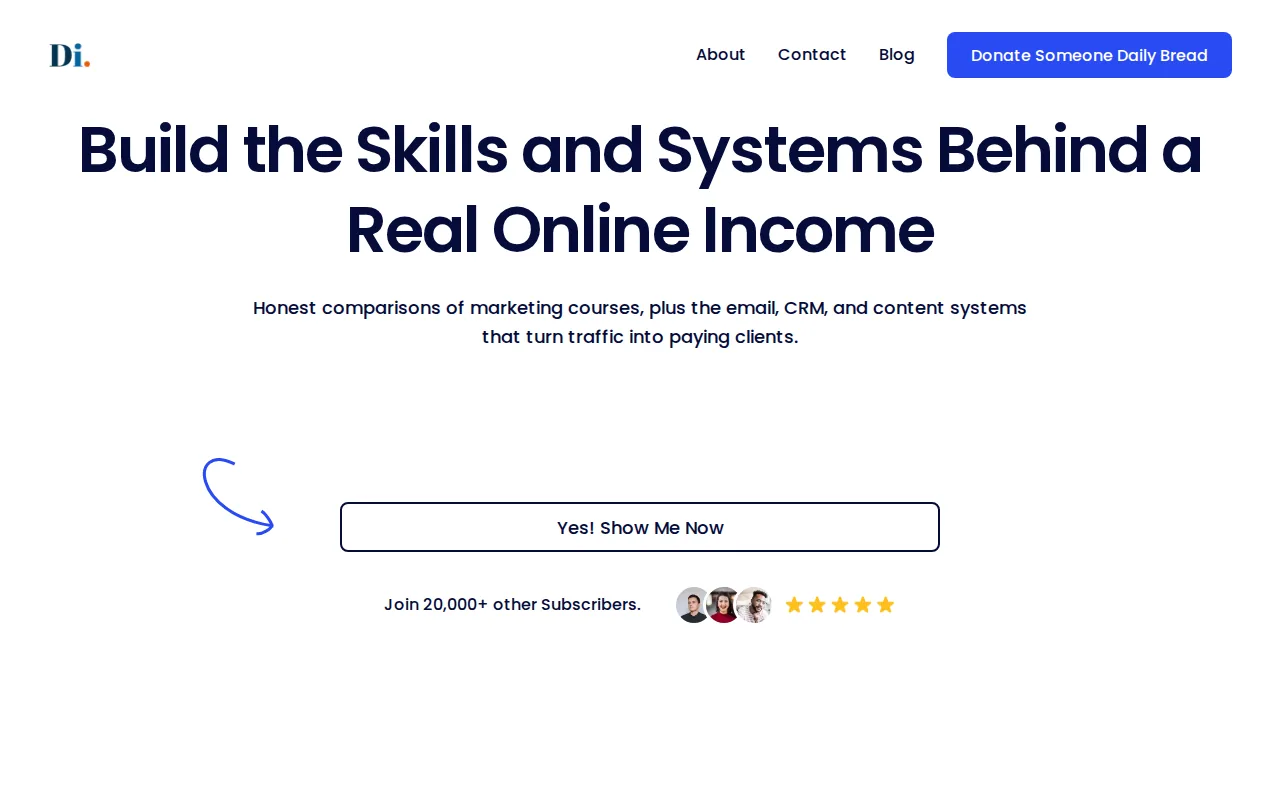
It’s best for learners who want help making a course choice before committing time or money. DiSousa covers aspiring affiliate marketers, freelancers, and online entrepreneurs who want to build skills for an online income.
Antonio De Sousa is an online and digital marketer with nearly two decades of experience. DiSousa’s course articles assess options and help readers connect training to the work they want to do. If you’re still deciding between a short introduction and a deeper course, its affiliate marketing course comparisons can help you weigh fit and depth.
That distinction matters: DiSousa itself doesn’t award an affiliate marketing credential. Use it as a starting point for research, then check the course provider’s own terms before enrolling.
DiSousa also joins 20,000+ subscribers who follow its online marketing content. Its focus is broader than a single certificate: the site covers course choices as well as email, CRM, and content systems that help turn traffic into clients.
2. Introduction to Affiliate Marketing for Beginners by Simplilearn
Introduction to Affiliate Marketing for Beginners by Simplilearn is a free, self-paced course for beginners. It takes about two hours and ends with a certificate of completion.
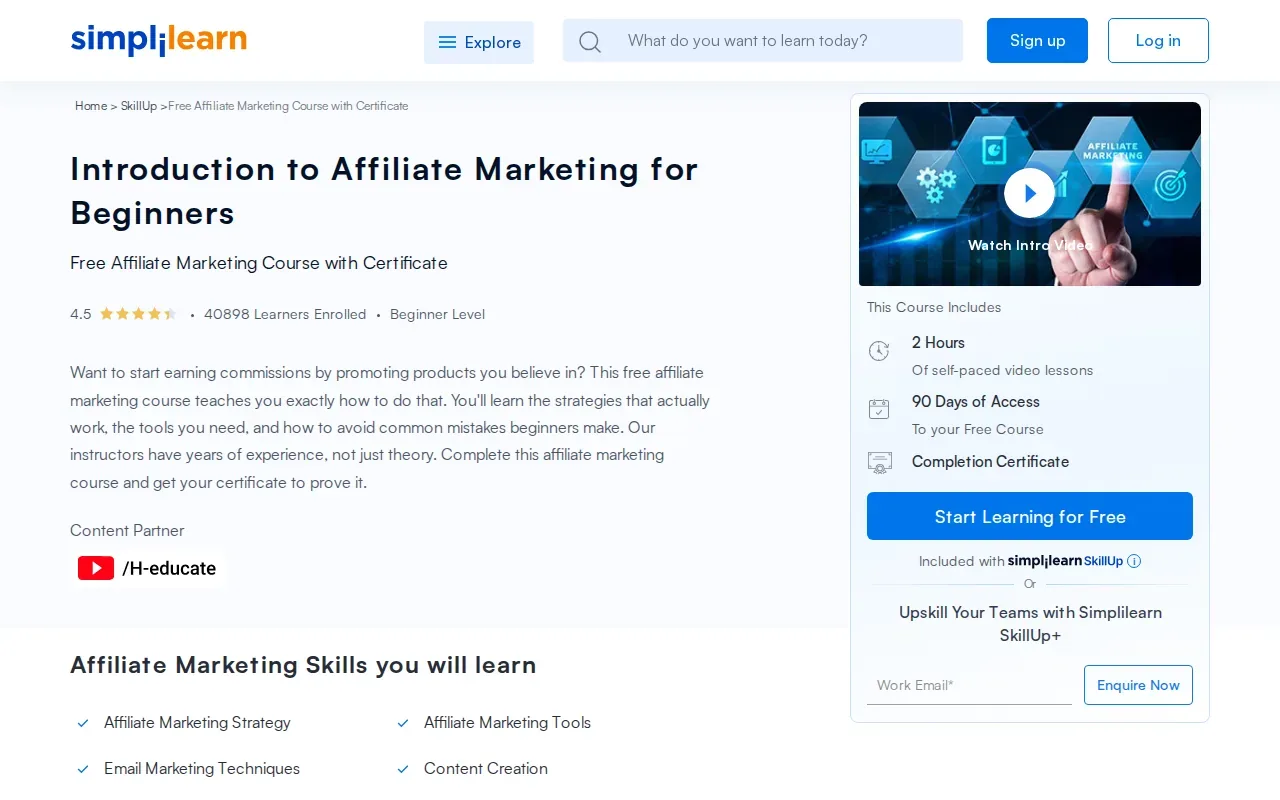
This is a sensible first course if you want to learn the basic model without paying upfront. Affiliate marketing is a way to earn a commission when your recommendation leads to a tracked action, such as a purchase. A short course can help you learn the terms before you decide whether to build a site, write content, or promote through another channel.
The course is positioned as an introduction, so treat it as a foundation rather than proof of advanced skill. The key value is the low-risk entry point: finish the lessons, then test your understanding by outlining a simple campaign. For example, name one audience, one product that could serve it, and one way you’d reach potential buyers.
Simplilearn describes the course as self-paced and lists a two-hour duration for it. Its broader digital marketing catalog includes other free beginner lessons, which may help if your next learning gap is in content or digital marketing basics. Check the course page for current enrollment and certificate terms before starting.
The certificate is a completion record. It shouldn’t be confused with a license or an industry-wide accreditation. If your goal is a job, pair it with a sample project that shows how you’d choose an offer and measure clicks.
3. Affiliate Marketing Course by ReliableSoft
Affiliate Marketing Course by ReliableSoft is a course that the provider says ends with two certifications.
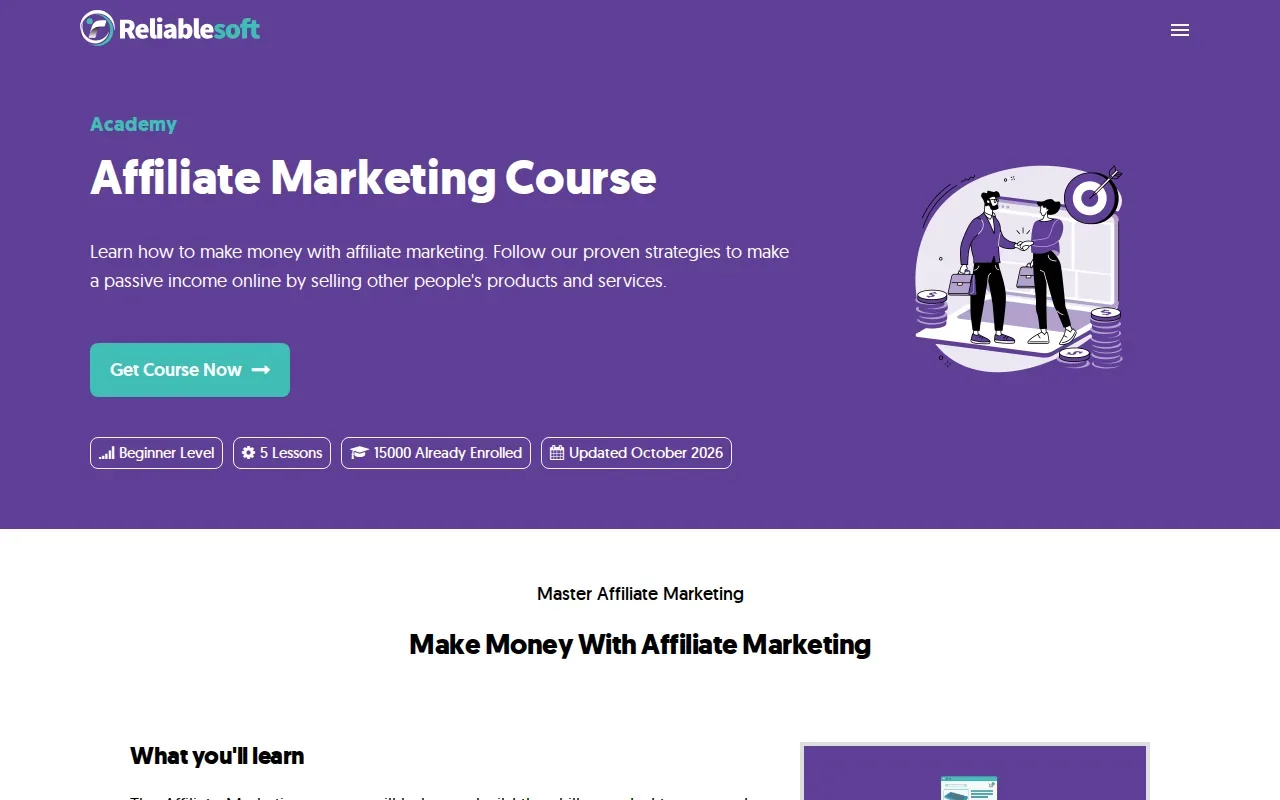
It may suit learners who want a short, structured introduction and value having more than one completion credential. The listed price is $60. Before enrolling, confirm what each certificate represents and whether the course’s current syllabus matches the skills you need.
Two certificates can look like a stronger credential than one, but the count alone doesn’t tell you whether employers or clients recognize either one. Check who issues the certificates, what you must complete to earn them, and whether there’s an assessment. Those details help you judge the credential rather than its label.
The course description refers to strategies for promoting other people’s products and services. That broad focus points to the central work of affiliate marketing: connecting a relevant offer with an audience, then tracking the response. A useful course should help you understand the choices involved, not leave you with only a certificate file.
At $60, this is a paid option among mostly free introductory courses. Consider it if the course outline covers a gap you’ve identified. If it doesn’t, you may get more value by learning the missing skill directly, such as writing useful product content or reading link performance.
4. Affiliate Marketing Course by Coursera
Affiliate Marketing Course by Coursera is a structured course that covers core concepts, partner platforms, promotion methods, and performance tracking.
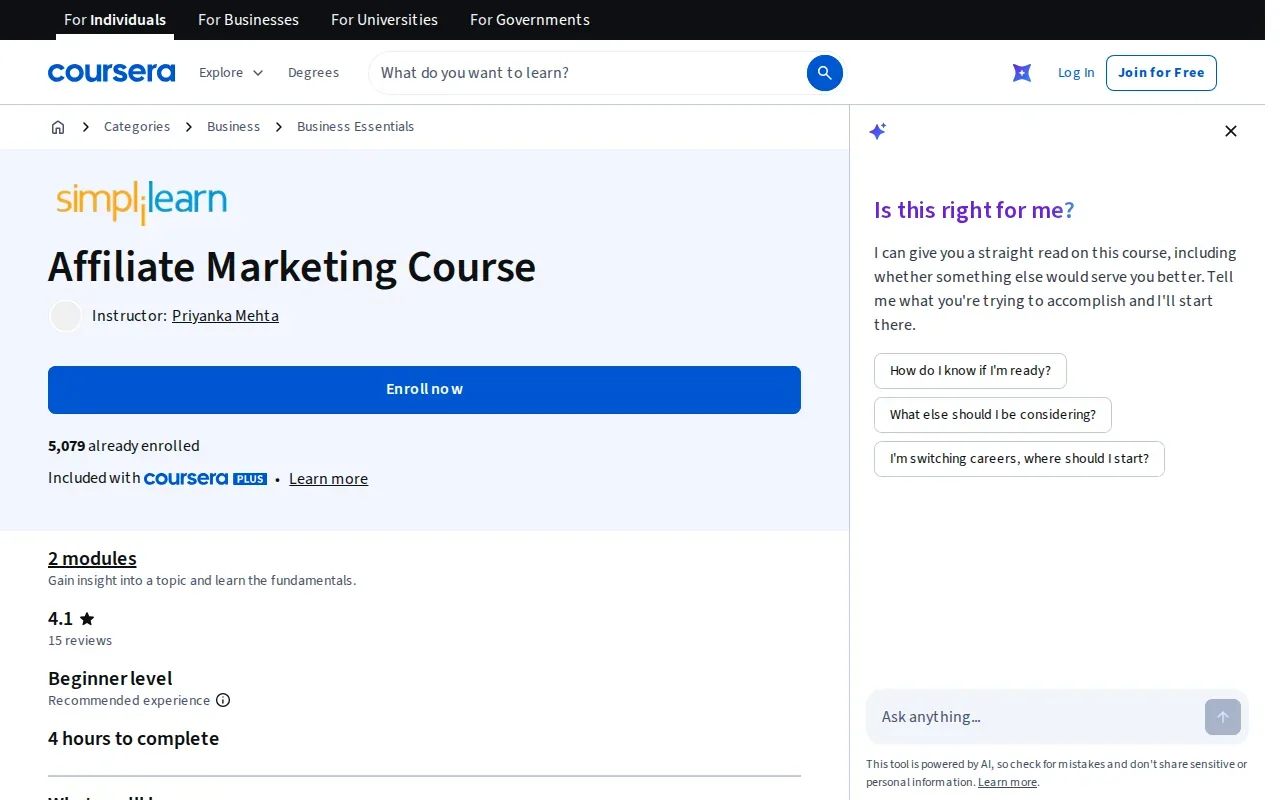
It’s intended for beginners and working professionals who want a broad overview of affiliate marketing. Listed topics include creating affiliate links and promoting offers through email, social media, blogs, or forums. The curriculum also covers tracking performance and using data to plan next steps.
Coursera’s certificate terms depend on the course and enrollment choice. For the course experience that includes a certificate, learners need to purchase the certificate option when enrolling. Coursera says the electronic certificate can be added to a LinkedIn profile after course completion. Check the exact course page before you enroll, since Coursera has more than one course with an affiliate marketing title.
This distinction is useful when you compare credentials. A course certificate documents completion; it isn’t automatically an industry-recognized qualification. If you want to show that you can do the work, save a campaign outline or a sample performance report alongside the certificate.
One course version emphasizes fundamentals and promotion channels. Another course page includes a broader set of topics around choosing a niche, selecting offers, and driving traffic. Match the course outline to your goal rather than assuming similar titles mean identical lessons.
5. Semrush Academy
Semrush Academy provides free online marketing lessons. It’s best for learners who want to build related skills that support affiliate work, rather than find a dedicated affiliate marketing certificate.
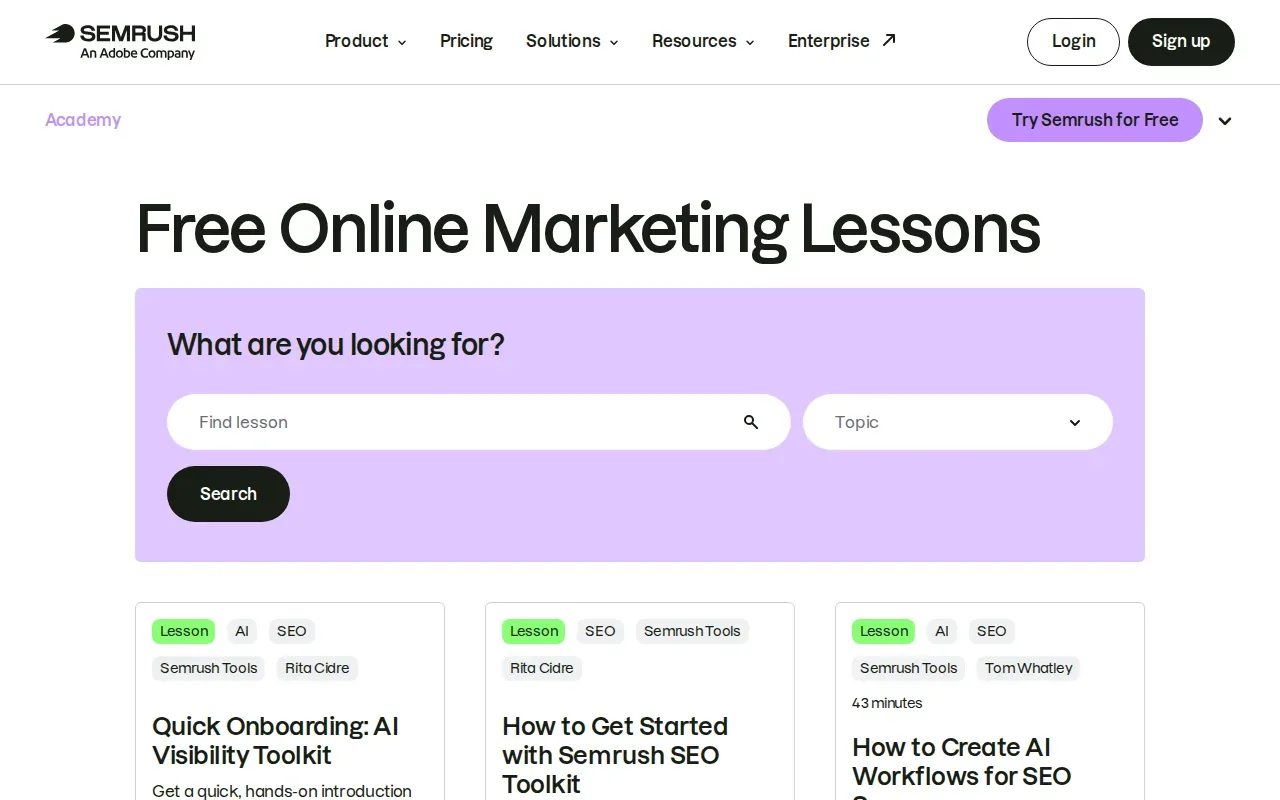
Affiliate sites rely on skills beyond affiliate program rules. A publisher may need to understand search visibility, content planning, or the basics of online marketing before a campaign can bring in visitors. Semrush Academy’s lessons can help fill adjacent gaps, with expert advice and actionable tips.
Check the terms for the specific course you’re considering.
Semrush Academy is a stronger fit if your main need is a related marketing skill. It’s a less direct fit if you want one course focused on setting up an affiliate campaign from start to finish. In that case, compare the curriculum with the tasks you plan to do next.
For instance, if you want to earn through a content site, a lesson in a related skill may help you work on one part of your plan. It won’t replace learning how affiliate links work or how you’ll track results. Think of it as a supplement to focused affiliate training.
6. Affiliate Marketing Training by Affilorama
Affiliate Marketing Training by Affilorama is a free set of lessons and video material for people who want to learn more about affiliate marketing. The provider describes it as free to join.
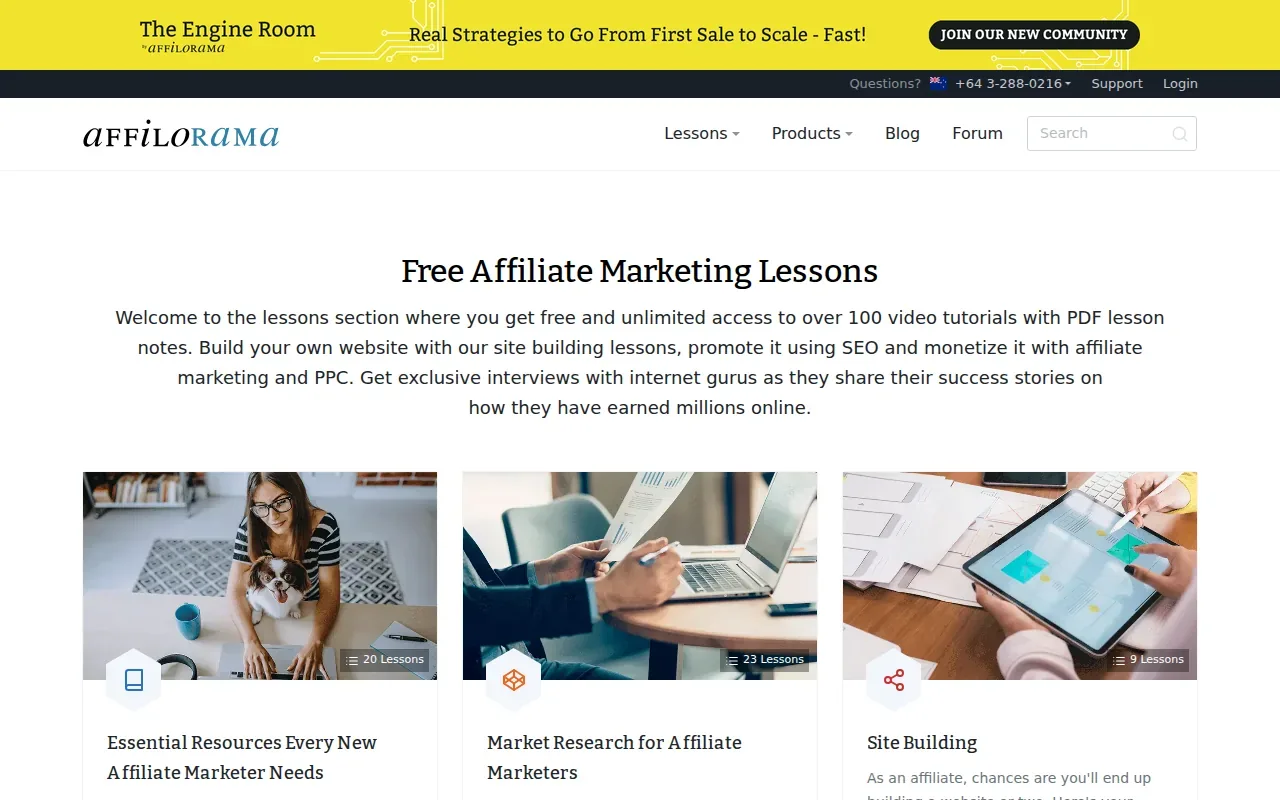
It’s a fit for self-paced learners who want to explore the topic without paying for a course first. Video lessons can make it easier to follow a concept as it’s explained, though the specific format and sequence may vary across materials. Check the current lesson page for what’s available.
If a credential is important to you, verify that a certificate is offered for the specific lessons you plan to take. Don’t assume that free training automatically includes a certificate of completion.
Free lessons can still be useful when they help you answer a concrete question. You might want to understand the basic affiliate model before choosing a niche, or learn the terms used in an affiliate program. Make a short list of what you want to learn, then see whether the lessons cover those points.
If your goal is a structured credential, compare the course’s completion terms with options that clearly state they award a certificate. If your goal is to learn at no cost, Affilorama’s free-to-join training may be a reasonable place to begin.
7. Making Sense of Affiliate Marketing
Making Sense of Affiliate Marketing is a step-by-step guide to building an affiliate marketing strategy.
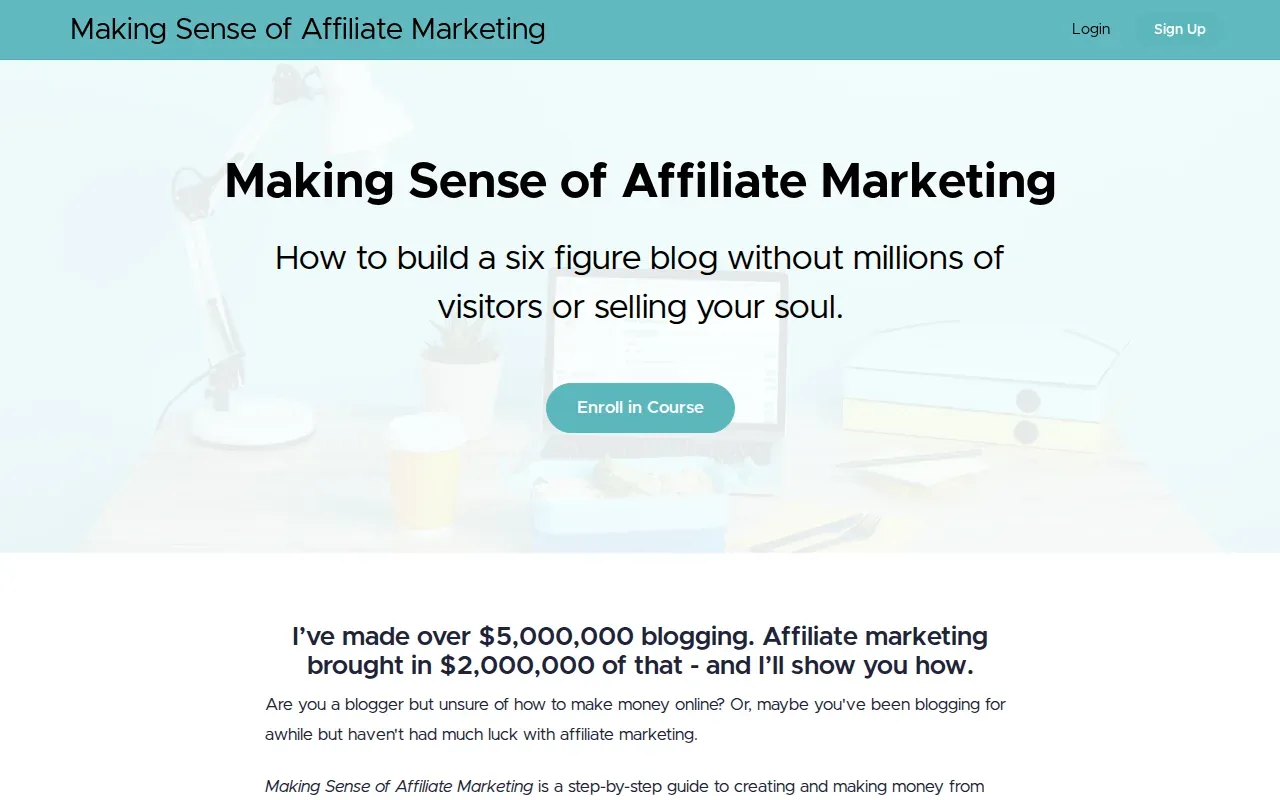
It may suit bloggers and online publishers who want a plan for making money from their own affiliate strategy. A strategy course should help you think through how your audience, content, and offers fit together. That matters when a blog gets visitors but hasn’t yet turned those visits into useful clicks.
Before you pay for any strategy-focused training, inspect its current syllabus and the kind of work it asks you to do. For example, does it help you choose products that fit your audience? Does it explain how to promote an offer in content? Does it show how to review campaign performance? Those questions help you judge whether the course addresses your actual bottleneck.
A certificate isn’t the only way to demonstrate skill. A clear content plan or sample affiliate article can show how you’d explain a product’s fit and guide a reader toward a decision. If search traffic is part of your plan, a site audit can help you review your site and prioritize fixes.
Keep the two goals separate: learning a marketing strategy and earning a formal credential. Making Sense of Affiliate Marketing is a strategy guide, so verify its current format and terms if you’re looking for a certificate specifically.
8. Commission Hero
Commission Hero is an affiliate marketing training option. Check its current course price, curriculum, format, and credential terms before enrolling.
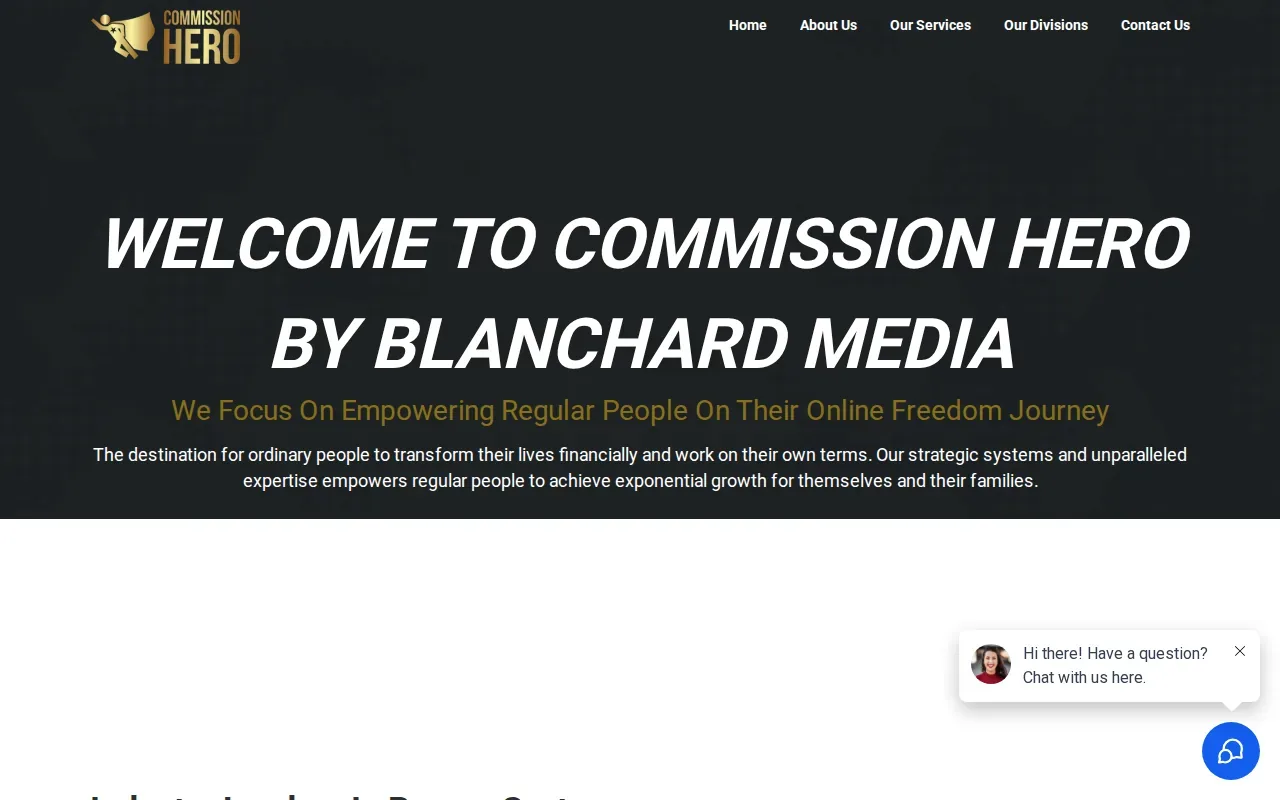
It’s best for readers who are willing to verify the details directly before committing. Look for a current lesson outline and clear information on what learners receive after finishing. If a course uses the word “certification,” check whether it means a completion certificate or a credential recognized outside the course.
Ask what the course teaches about the work you intend to do. A beginner may need the basics of affiliate links and promotion. A more experienced marketer may need advanced campaign planning or stronger performance analysis. A course can only be a good fit when its stated content matches that need.
Also check the format against your schedule. Self-paced lessons let you study on your own time. Instructor-led sessions may provide a set schedule and a chance to learn in a group, when those formats are part of the course. Don’t assume Commission Hero uses either format without confirming the current offer.
Because the credential and course details are central to this choice, verify them before you buy. A high-pressure sales page is no substitute for a syllabus and plain terms about the certificate.
9. Affiliate Marketing Diploma by Centre of Excellence
Affiliate Marketing Diploma by Centre of Excellence is a diploma-style course covering how to set up affiliates and promote an affiliate program. It also familiarizes learners with some of the topic’s core areas.
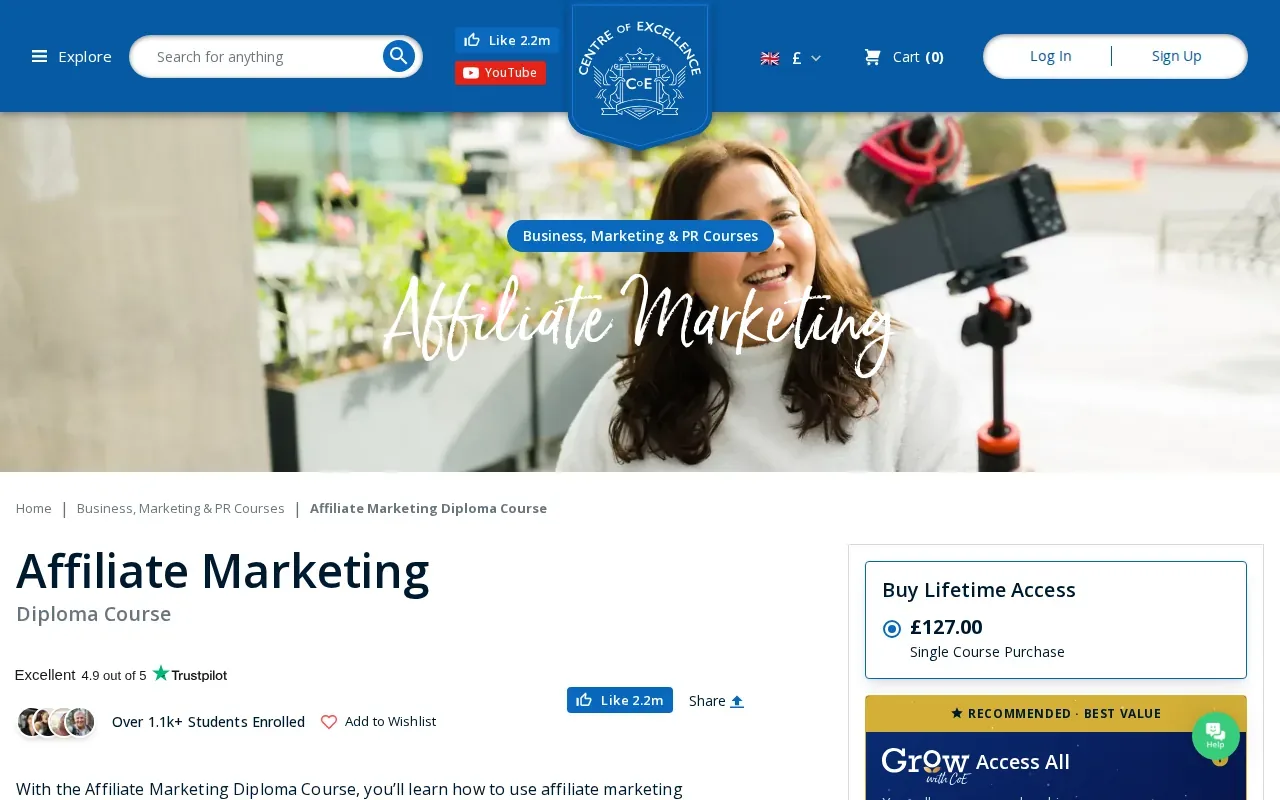
It may suit learners who prefer a course framed as a diploma and want to study affiliate program setup. Before enrolling, check the full course outline and the exact meaning of the diploma. The word “diploma” alone doesn’t show whether an employer or industry group recognizes the credential.
Compare its lessons with the work you want to perform. If you’re a brand planning an affiliate program, training on setting up affiliates may be relevant. If you’re a publisher who plans to promote other companies’ offers, you’ll also want to know whether the curriculum covers selecting products and promoting them to an audience.
Ask what counts as completion and what you receive when you finish. If a course offers an assessment, find out whether passing it is required for the credential. These details help you compare the diploma with a simple certificate of completion.
Choose this option if its complete syllabus and credential terms fit your goal. Don’t choose it based on the title alone; the course’s content and the issuer’s recognition matter more than the label.
How do these affiliate marketing certification options compare?
The options differ most in their purpose. Some are free beginner lessons, some teach strategy, and some state that they issue a certificate or diploma. Only rely on a credential claim when the provider’s own terms say what learners receive.
| Option | Cost or format stated | Credential information | Best fit |
|---|---|---|---|
| DiSousa | Course comparisons and marketing education content | Doesn’t award a course credential | Comparing training choices and related business skills |
| Introduction to Affiliate Marketing for Beginners by Simplilearn | Free; self-paced; about two hours | Certificate of completion | Beginners seeking an introduction |
| Affiliate Marketing Course by ReliableSoft | $60; five lessons | Two certifications, as described by the provider | Learners seeking a short paid course |
| Affiliate Marketing Course by Coursera | Check the course format | Certificate experience requires the relevant paid enrollment option | Learners seeking a structured curriculum |
| Semrush Academy | Free online marketing lessons | Check the terms for the specific lesson | Building related marketing skills |
| Affiliate Marketing Training by Affilorama | Free to join; lessons and video material | Confirm whether the chosen training includes a certificate | Self-paced learning without an upfront course fee |
| Making Sense of Affiliate Marketing | Strategy guide | Strategy guide | Learning about an affiliate strategy |
| Commission Hero | Verify the current offer | Verify the current credential terms | Readers willing to check the course details before buying |
| Affiliate Marketing Diploma by Centre of Excellence | Diploma-style course | Diploma label; check the credential terms | Learners interested in affiliate program setup |
The table makes one point clear: “certificate,” “certification,” and “diploma” aren’t interchangeable proof of industry recognition. A provider may issue a completion document without an outside body accrediting it. For a career move, pair the credential with a sample project you can discuss in an interview.
What the credential labels tell you
A certificate of completion usually records that you finished a course. A certification may involve an assessment, but the name alone doesn’t confirm that an outside industry body recognizes it. A diploma is another label that needs context: check the issuer, course requirements, and how the credential is used.
It’s reasonable to value a certificate as evidence of effort. Just don’t treat it as proof of earnings, job placement, or professional accreditation unless the issuer clearly supports that claim. The basic affiliate marketing model depends on tracked referrals that lead to an agreed action; a course credential doesn’t replace the work of building an audience or measuring results.
What you should learn in a useful course
A well-matched course should cover the parts of affiliate work you need to perform. Compare the outline for topics such as selecting offers, creating affiliate links, choosing a promotion channel, and reading campaign results. Review the course outline to see whether it covers the skills you need.
Don’t expect every introductory course to teach every skill. A two-hour lesson can be a starting point, while a strategy guide may focus on a different part of the work. Use the syllabus to see where one course ends and what you may need to learn next.
How to choose between free and paid training
Start with your learning goal. If you’re unsure whether affiliate marketing suits you, a free beginner course can help you learn the basic terms. If you already know the basics, pay only when a course offers instruction you need and its price fits your budget.
- Choose free training when you need a low-risk introduction or an adjacent marketing skill.
- Choose paid training when the course’s syllabus covers a specific skill gap you’ve identified.
- Choose a credential for career use only after checking who grants it and what completion requires.
- Choose a strategy resource when you want help applying affiliate marketing to a site or audience.
A certificate can support a job application, but it won’t set your earning potential. Income depends on factors such as audience demand, the offer, the way you promote it, and whether people take the tracked action. Don’t rely on a course or credential as a promise of income.
Turn a lesson into a small campaign
After you finish a course, try a small, focused exercise. Pick an audience and a product that genuinely relates to its needs. Draft a short piece of content that explains the product’s fit, then decide how you’d track the link and review the result.
That exercise helps you see what the course taught and what remains unclear. If your next step is setting up a site, DiSousa’s affiliate marketing training plan explains how to connect learning with a basic campaign workflow.
If a promotion includes an affiliate link, disclose the relationship clearly where people can see it when they encounter the recommendation.
For a wider look at course fit, DiSousa also has an affiliate course selection overview that helps readers compare goals, skill gaps, and learning formats.
Frequently asked questions about affiliate marketing certification
Is affiliate marketing certification worth it?
It can be worth it if the course teaches a skill you need and its cost fits your budget. A certificate can show that you completed the lessons, but it won’t guarantee income or prove that an industry body recognizes your skills. Look at the syllabus and credential terms before you enroll.
Can I learn affiliate marketing for free?
Yes, you can start with free lessons. Simplilearn’s beginner course is free, self-paced, and takes about two hours. Affilorama also describes its affiliate training as free to join. Check each provider’s terms to see whether a certificate comes with the lessons you choose.
Does a course-completion certificate count as accreditation?
No, a course-completion certificate doesn’t automatically mean a course is accredited. It generally records that you finished the course. To assess recognition, check who issues the credential, whether an independent body accredits it, and whether employers in your field value it.
How long does it take to get an affiliate marketing certificate?
It depends on the course. Simplilearn lists its beginner course at about two hours. Check the current course page for the workload and completion rules. A short course can introduce the topic, but it may not cover every skill needed to run campaigns.
Will a certificate help me earn more from affiliate marketing?
A certificate alone can’t promise higher earnings. It may help you show that you’ve studied the basics, but income depends on your audience, the offers you choose, and how well your content leads to tracked actions. Build a small project and measure its results to show what you can do.
Conclusion
If you’re new to affiliate marketing, start with Simplilearn’s free two-hour course, then apply one lesson to a small campaign. If a credential matters for your next role, verify exactly what the provider awards before paying. DiSousa can help you compare course fit and plan the next skill to build. For any affiliate promotion, disclose the relationship clearly and don’t treat a certificate as an income promise.
Income disclaimer: Affiliate marketing income isn’t guaranteed. Results depend on your audience, the offers you promote, and how you apply what you learn.
