
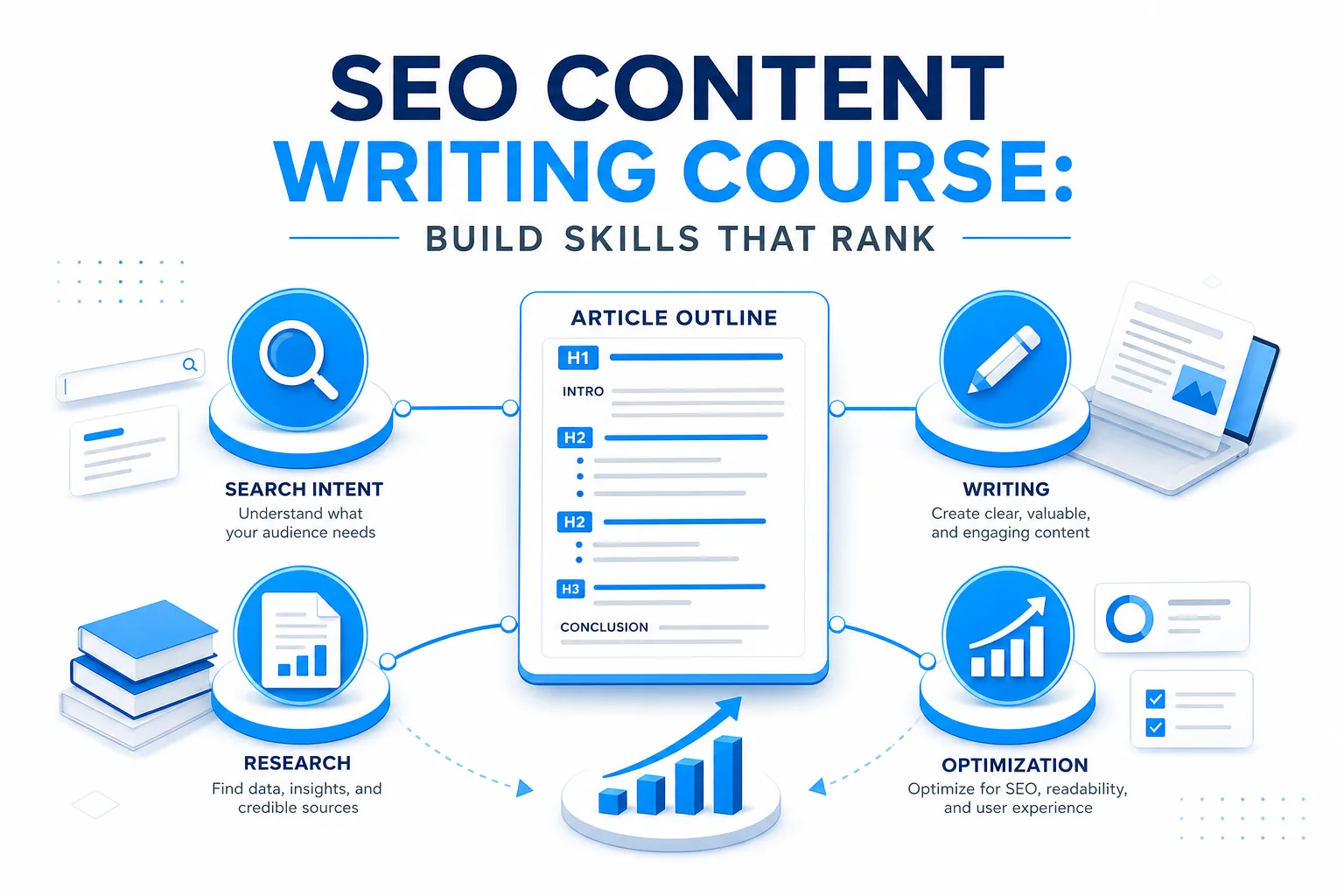
An SEO content writing course should teach you to match a searcher’s goal, write a clear answer, and improve it with on-page SEO. I’ll show you how to spot the skills you need, choose training that fits, and turn each lesson into work samples you can share.
- Choose a course by the skills and work it helps you complete, not by its certificate alone.
- Useful SEO writing starts with search intent, then moves into research, structure, writing, and review.
- A finished article brief and a revised draft make stronger portfolio samples than a course badge by itself.
- Track changes in impressions, clicks, and reader actions over time rather than expecting instant rankings.
Step 1: Identify the SEO writing skills you need to learn
Start by listing the work you want to do, then compare that list with what you can do now. SEO content writing is the work of making useful pages that answer search questions and are easy for people and search engines to understand. It combines research, clear writing, and page-level optimization.
That definition matters because “SEO writing” can mean different things in different courses. One program may focus on keyword research. Another may teach content planning or how to revise a draft. A broader SEO course may include technical site checks that a writer won’t use in every assignment.
Write down your next goal. Maybe you want to write blog posts for your own affiliate site. Perhaps you want to offer SEO articles to clients. Or you might already write well and need to understand how search intent shapes a page. Each goal calls for a different skill mix.
Check your starting point
Pick one page you’ve written, or draft a short sample if you’re new. Review it against these questions:
- Can you say who the page is for and what question it answers?
- Did you research the topic before choosing a heading structure?
- Does each section add information, or does it repeat the same point?
- Can a reader scan the title and headings to find the answer they need?
- Do you know how you would judge whether the page helped its intended reader?
Mark each answer as “yes,” “not yet,” or “unsure.” “Unsure” is useful. It points to a gap worth testing before you buy a long course.
Keyword research is one common gap. A keyword is a word or phrase people type into a search engine. Research helps you see how people phrase a need and whether one page can answer it. But a list of phrases isn’t a content plan. You still need to judge what the searcher wants.
Search intent is the reason behind a query. Someone searching for a definition likely wants a plain explanation. Someone comparing courses wants details that help them choose. A writer who ignores intent may produce a polished page that answers the wrong question.
On-page optimization means improving parts of a page so its subject and structure are clear. This can include a descriptive title, useful headings, a clear meta description, and relevant internal links. These elements support the reader’s experience. They aren’t a substitute for a page that answers the question well.
Copywriting basics matter too. A writer needs to make ideas easy to follow, use a suitable tone, and show the reader what to do next when that fits the page. If you’re writing for a business, you may also need to connect the article to a product, service, or email signup without forcing a sales pitch into every paragraph.
Build your learning list around the gaps you found. For example, if your draft has good ideas but no clear structure, start with intent and outlining. If it reads well but has no search focus, study keyword research and page optimization. If you can write and optimize but struggle to get paid work, add portfolio and client skills.
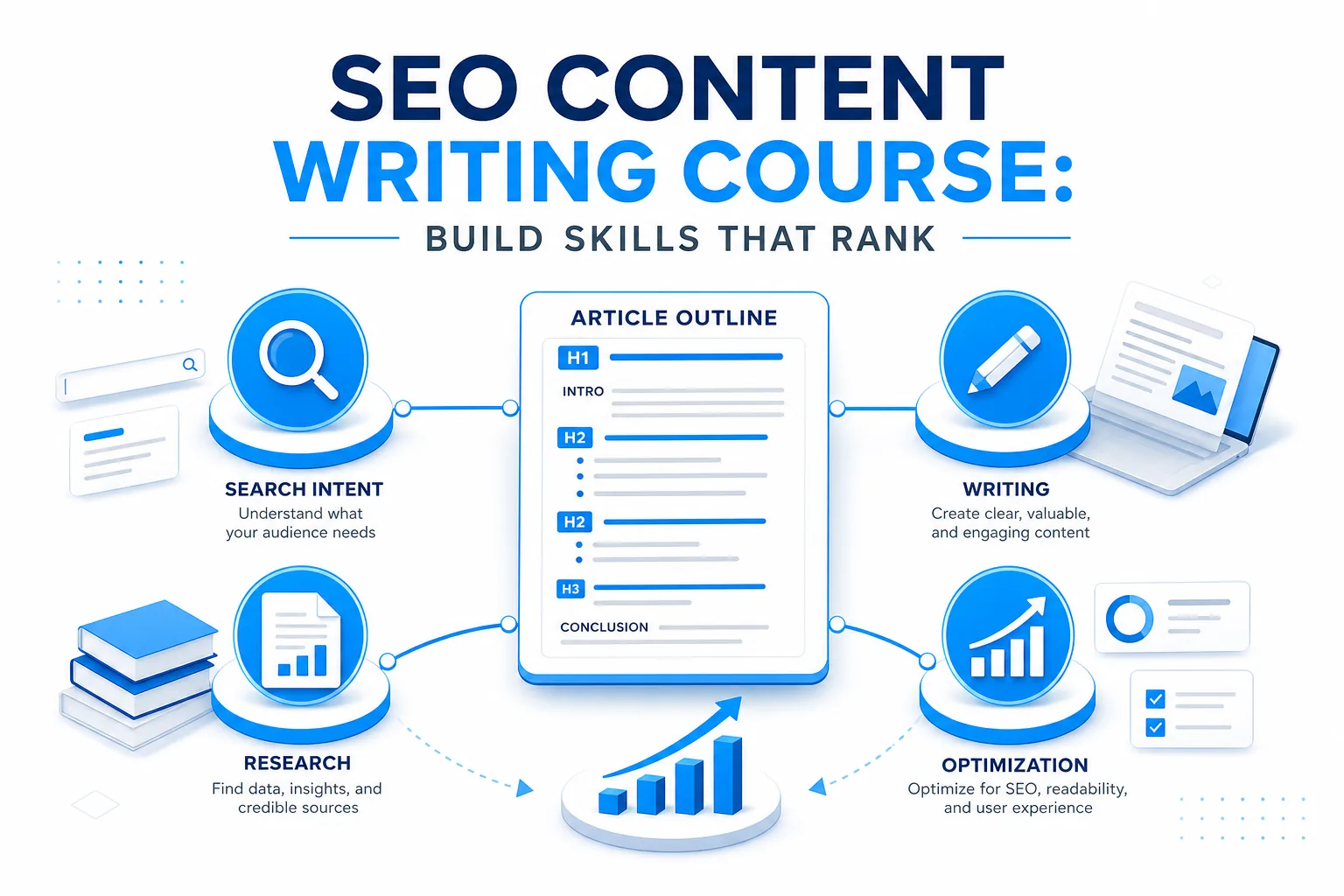
Turn each gap into a result you can check. “Learn SEO” is too broad. “Write a brief that names the reader, intent, main answer, and supporting sections” gives you a task you can finish and review.
DiSousa publishes course comparisons and learning guides for people building online work. Its SEO copywriting course comparison can help you separate general search writing from conversion-focused copy, which aims to prompt a reader to take an action.
By the end of this step, you should have a short skill list, one sample to assess, and a clear reason for taking a course. Keep that list beside you as you compare training.
Step 2: Compare course formats, curriculum, and credentials
Choose a course by checking whether its lessons match your skill gaps, whether its format suits your schedule, and whether it asks you to produce usable work. A certificate can show completion. It doesn’t prove by itself that you can research or write a strong page.
Course formats affect how you learn. Self-paced lessons let you pause and repeat a topic. On-demand videos can fit around work, though watching isn’t the same as practice. A live or one-to-one format may let you ask questions directly, while short mobile lessons can suit small breaks in a busy day.
Make a simple comparison before enrolling. Use information the course provider states, and write down your own questions where the course details don’t answer them. Don’t treat missing information as proof that a program is poor. Treat it as a reason to verify what you’ll get before paying.
| What to compare | What to look for | How to test the fit |
|---|---|---|
| Skill coverage | Intent, keyword research, content structure, writing, and on-page checks | Match each lesson to a gap from Step 1 |
| Learning format | Self-paced, video, mobile lessons, or direct instruction | Choose a format you can keep using each week |
| Practice | Briefs, drafts, revisions, quizzes, or other applied work | Ask what you’ll finish and how you’ll review it |
| Credential | Certificate of completion or a stated certification | Check what completing the course actually confirms |
| Next use | Portfolio sample, work process, or tool-based task | Decide how you’ll apply the lesson after class |
Curriculum details help you tell a focused writing course from a broad SEO overview. For example, a course that covers technical audits may be useful if you want wider SEO skills. If your immediate goal is to write blog content, check that you’ll still get enough time for research, outlines, drafts, and editing.
A broad SEO course may suit a learner who wants a general foundation, while a writer seeking focused practice should inspect how much time goes to writing tasks.
When comparing courses, check whether their outlines cover the skills you want to develop and whether they include relevant practice. Course cost alone can’t tell you what you’ll learn. Compare lesson topics, practice work, access terms, and the stated credential before making a decision.
Credential language deserves a close read. A “certificate of completion” usually means you finished the lessons or required tasks. A certification may include an assessment or another stated standard. Don’t infer employer recognition from the word “certificate.” Look for a clear description of the assessment and the organization that issues it.
Format is part of the value too. If you have short windows of study time, short lessons may help you make steady progress. If you need to discuss a difficult topic, a course with a way to ask questions may fit better. Pick for the routine you can sustain, not the routine you wish you had.
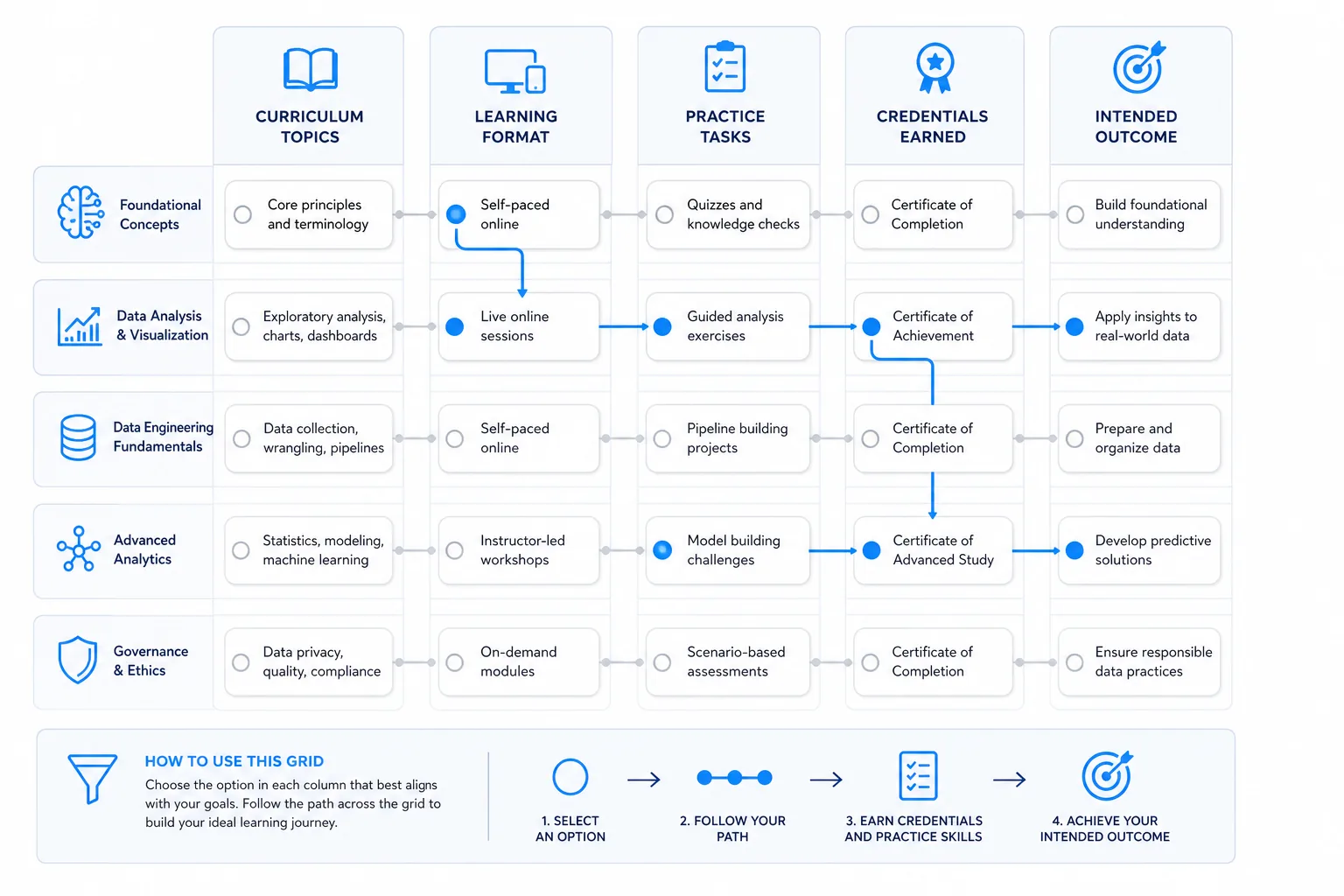
Before you enroll, write down three checks: the skill you want, the work you expect to complete, and how you’ll use it afterward. If a course fits those checks, its format and badge become easier to judge.
DiSousa’s guide to content marketing certification choices can help if you’re weighing a general content credential against writing-specific training. Keep the goal in view: a credential can support your profile, but the ability to explain and show your work is what makes it useful.
There’s also a useful supporting resource for people who want to explore writing assistance: DiSousa’s AI content writer page covers a related part of the content workflow. Treat any writing aid as support for research and drafting, then check every claim and make the final text your own.
By now, you should have a short course shortlist and a reason for each choice. Next, use your new skills to plan one article before you draft it.
Step 3: Build a search-focused brief and article outline
A content brief is a short plan that tells a writer who the page serves, what it needs to answer, and how the information should be organized. It keeps research and writing focused. You can use one for a course assignment, a client draft, or a page on your own site.
Start with the reader. Write one sentence that describes the person’s need without inventing a detailed persona. For this article, that might be: “A beginner wants to learn which SEO writing skills to study before choosing a course.” This sentence gives the brief a real job.
Then define the query’s likely intent. Read the words in the search phrase and ask what a useful result would let someone do. A search for a course often signals that the reader wants training options, curriculum guidance, or a way to build skills. Decide which of those your page will serve. Don’t try to answer every related question in one article.
Research the topic with care. Note recurring questions, terms that need a plain definition, and points where advice differs. If you’re using search results for research, look at the page types and the questions they answer. Don’t copy a competitor’s structure or rewrite its sentences. The job is to understand the reader’s task and provide your own clear answer.
Separate facts from recommendations in your notes. A fact might be a course’s stated lesson count or format. A recommendation might be that a learner should choose a self-paced class if they need flexible study time. Keep the fact tied to its source, and explain the reason behind your advice.
Build the outline around the order in which the reader needs information. A beginner may need a definition first, then skill gaps, course criteria, a practice task, and a way to assess progress. A course comparison page may need a different structure. The outline should fit the query, not a fixed template.
Make every heading earn its place
For each planned heading, write the answer you expect to give in one plain sentence. If you can’t state the answer, research more or remove the heading. This simple test catches sections that exist only because a keyword tool suggested them.
Use headings that tell the reader what comes next. “Keyword research” is a topic label. “Choose phrases that match the reader’s question” gives the writer a task and the reader a clearer promise. Keep headings short enough to scan.
Plan the role of examples before drafting. An example should make a point easier to understand, not decorate the page. For instance, a brief about a page on beginner email marketing might name the audience, the question, and the intended next step. It shouldn’t claim that a certain course or tool improves results unless you can support that claim.
Use the outline to spot repeated ideas. If three sections all promise to explain keyword intent, keep the strongest one and give the others distinct jobs. One might define intent. Another could show how it changes an outline. Repetition often signals that the brief needs sharper boundaries.
Set the page’s basic on-page elements in the brief. Draft a working title that names the subject. Note the main question the introduction should answer. Add a plan for a useful meta description, which is a short summary that may appear in search results. Don’t promise a result the page can’t deliver.
Internal links belong in the plan when they help the reader take a sensible next step. A new writer might link from a course guide to a related certification resource. A page about a specific writing process might link to a deeper tutorial. Pick links because they help, not because the site has a link target to fill.
Also decide what evidence the article needs. A claim about a course should come from its official course page or another reliable source. A claim about your own process should reflect what you really do. If you have no data for a claim, remove it or phrase it as a question to verify.
For a practice assignment, keep the brief to one page. Include the reader, query, intent, core answer, supporting points, planned headings, source notes, and next step. That is enough structure to guide a draft without writing the article in advance.
Once you have the outline, read it as if you were in a hurry. Can you tell what the page will answer? Does the order make sense? Is there a section that belongs in a separate article? Make those edits before you start drafting. It’s faster to move a heading than to rebuild a full article.
By now, you should have a brief with a clear reader, purpose, evidence plan, and outline. Use it as a working guide, not a script. If your research changes what the page needs to say, update the plan.
Step 4: Write, edit, and optimize a useful article
Draft the answer before you polish the page. Use the brief to stay on topic, but write for a person who wants a clear answer. An SEO writing course can teach useful checks, yet you still need to make choices about what to explain and what to leave out.
Start with the main answer. If the reader wants to compare course formats, say what to compare near the top. Then explain the choices in the order that helps them decide. Don’t hold the useful point until the final paragraph.
Build each section around one clear idea. State it, explain it, then add an example or source where needed. If a paragraph contains several separate claims, split it. Readers should be able to scan the page without losing the thread.
Use keywords as clues, not commands. A target phrase can show you how people describe a topic. It doesn’t need to appear in every heading or paragraph. Use related language where it sounds natural, and don’t repeat a phrase just to reach a count.
Write the first draft without stopping to perfect every sentence. Then edit for meaning. Ask whether each paragraph answers the heading and whether a reader can act on the advice. Cut points that repeat an earlier section or make a claim without support.
Review the page in passes
A focused edit works better than trying to fix everything at once. Use separate passes:
- Meaning: Check that the article answers the query and stays within its scope.
- Structure: Check the order of headings and remove repeated sections.
- Clarity: Replace vague phrases with specific instructions or examples.
- Evidence: Check facts against their sources and remove claims you can’t support.
- On-page details: Review the title, headings, links, and meta description.
Read the draft aloud. You’ll hear long sentences, awkward transitions, and phrases that sound like course notes rather than human speech. Then read it on a phone-sized screen if possible. A heading that looks fine on a wide monitor may feel like a wall of text on a small screen.
Optimize for clarity before using an SEO content editor or writing assistant. Some courses teach platform-specific workflows. No score should replace your own judgment.
When you use an optimization tool, treat its suggestions as prompts to review. If it flags a missing topic, ask whether that topic helps the reader. If it suggests a phrase, decide whether it fits the sentence. Don’t add unrelated details just to satisfy a tool.
Check titles and meta descriptions for accuracy. A title should describe the page, not make a claim the article can’t support. A meta description should summarize the useful point and invite the right reader. Search engines may display different text, so write the page itself to stand on its own.
Links should also have a clear job. Internal links can take readers to a related page on the same site. Outbound links can support a factual statement with a reliable source. Use descriptive link text so the reader knows what they’ll find before they follow it.
Before publishing, check the page for basic errors. Make sure headings follow a sensible order. Confirm that links work. Review the page title and meta description. Check that the text doesn’t claim a course guarantees rankings, jobs, or income unless reliable evidence supports that exact claim.
After publishing, don’t rewrite the page every day because it hasn’t moved immediately. Give the page time to collect useful signals, then review the results against its purpose. If the query changes or the page misses a key question, update the brief and revise with a reason.
By now, you should have a useful draft, a clear edit trail, and a page you can explain. Keep the brief and revisions together. They show how you work, not only what the final page looks like.
Step 5: Measure progress and turn practice into career opportunities
Measure progress by checking whether your work improves and whether readers take the next step the page was designed to support. A certificate can document study, but a portfolio sample can show your thinking. Build both only when they serve your goal.
For your own site, record a starting point before making changes. Note the page’s topic and purpose. Then track suitable search and reader signals over time, such as impressions, clicks, and actions that matter to the page. One week of movement is not enough to prove a lasting pattern.
Search impressions show that a page appeared in search results. Clicks show that people chose it. Those signals answer different questions. If impressions rise but clicks stay low, review how the title and description set expectations. If people click but leave quickly, check whether the page answers the query near the top.
Don’t treat rank as the only measure. A page can help a reader compare options, join an email list, or move to a related guide. The best measure depends on the job of the page. Define that job before you publish, or you won’t know what success should look like.
For a client assignment, agree on the goal before writing. A page meant to answer a support question needs a different measure than a page meant to attract potential customers. Ask what the client wants the reader to understand or do. Then make sure the brief and reporting plan reflect that goal.
Keep a simple record of each practice piece. Save the brief, source notes, first draft, final version, and a short note about what you changed. If you later revise the page, note why. This record gives you a way to explain your decisions in a client call or job interview.
Build samples that show your process
A useful portfolio doesn’t need a pile of similar articles. Choose samples that show different skills. One can show a clear beginner explanation. Another can show a detailed course comparison. A third might show how you turned a messy topic into a brief and outline.
For each sample, explain the assignment in a few lines. Say who the intended reader was, what question the page answered, and how you approached the work. Don’t invent traffic results or client outcomes. If you have actual performance data and permission to share it, describe the time period and what changed.
If you don’t have client work yet, make a clearly labeled practice sample. Choose a topic you understand well enough to research responsibly. Cite facts. Show a finished brief beside the article, or add a short note about your editing choices. Never present a mock project as paid client work.
Coursework can become a portfolio piece when the rules allow it. Check the course terms before sharing assignments. If you can’t publish the work, use the skill to make a separate sample on another topic. The goal is to show your ability without passing off someone else’s material as your own.
SEO writing can lead to several kinds of work. A writer may take on blog articles, website pages, or content briefs. A content editor may review structure and clarity. A content strategist may plan topics and map them to business goals. Some freelancers combine writing with research or content operations. These roles vary by employer and client, so read the actual task list in job ads.
Prepare for interviews by talking through your choices. A hiring manager may ask how you chose a topic, how you checked intent, or what you changed after review. Use one sample to explain your process. Be clear about what you did and what you would test next.
When applying for freelance work, make your pitch specific to the assignment. Refer to the page type or audience the client needs. Share one relevant sample and explain why it fits. A broad claim that you can write about every topic is less useful than evidence that you understand this task.
DiSousa serves people building online work through course comparisons and content about marketing systems. If your next goal is paid writing, its freelance writing course guide gives you a related path to consider alongside SEO practice. Focus first on samples that match the work you want to pitch.
For your next project, choose one article and track one improvement at a time. Perhaps the brief needs a clearer reader. Perhaps the draft needs stronger headings. Record the change, then check whether it made the page easier to use. That gives you a learning loop you can repeat.
By now, you should have a way to review progress and a plan for turning practice into work samples. The next step is simple: finish one piece, make it easy to inspect, and use it to start a focused conversation about your skills.
Frequently Asked Questions
What should an SEO content writing course teach?
An SEO content writing course should teach search intent, keyword research, content structure, clear writing, and on-page checks. It should also give you a way to practise, such as building a brief or revising a draft. Check that the lessons match your goal. A broad SEO course may cover useful topics beyond writing, but it may spend less time on writing practice.
Can I learn SEO content writing for free?
Yes, you can start learning SEO content writing with free lessons and official course resources. Some free courses also provide a certificate, so check the provider’s course page for the current terms. Pair lessons with your own practice: create a brief, write a sample, and revise it. Free study can build skills, though it may not include personal feedback.
Is a certificate necessary for SEO writing jobs?
No, a certificate isn’t the only way to show that you can write for search. A relevant portfolio sample can show how you research a topic, structure an answer, and edit a page. A credential may support your profile, especially when an employer asks for one. Read the job requirements and choose training that produces evidence you can share.
How long does it take to learn SEO content writing?
There isn’t one set timeline because courses vary in length and learners bring different writing skills. You can learn the basics through focused study, then improve through repeated briefs, drafts, and edits. Estimate your study time from the course’s stated lesson length and your weekly schedule. Leave room for practice, since watching lessons alone won’t build a portfolio.
How do I get my first SEO writing client?
Start with a sample that matches the kind of assignment you want. Make the brief and final draft easy to review, then explain your choices in a short pitch. Look for work that fits your topic knowledge and current skills. Don’t promise rankings or traffic you can’t control. Ask what the client needs, agree on the page’s goal, and define the work before starting.
Conclusion
Choose training that matches a clear skill gap and helps you finish work you can review or share. Then make one brief, draft the article, and revise it using the process above. That finished sample will give you a better basis for your next course or client decision than a badge alone.
Income disclaimer: Learning SEO writing does not guarantee clients, employment, traffic, or income. Results depend on your skills, market, effort, and other factors.
