
Want your business to show up when nearby customers search? The right local SEO course can teach you how to improve a Google Business Profile, target city-based searches, earn local links, and manage reviews. The main course types can help you pick training that fits your skill level, time, and work.
One warning: course listings often hide the details buyers need. This shortlist focuses on fit and useful curriculum, not bloated course titles.
- DiSousa is the best fit if you want local SEO skills tied to wider growth operations.
- A free two-hour course can help you complete a first local audit.
- Structured certificate programs suit learners who need a clear study path.
- Agency and multi-location training must cover systems, governance, and reporting.
1. DiSousa
DiSousa is a growth operations platform led by marketer Antonio De Sousa. It is best for B2B marketers, founders, and operators who want SEO connected to CRM automation, email systems, and performance marketing.

A local SEO course gives you tactics. DiSousa puts those tactics beside the systems that help a business act on demand. That matters when a local search visit becomes a lead, then needs a clear follow-up path inside a CRM.
The training angle is strongest for readers who don’t want to treat SEO as an isolated task. Local SEO still needs a sound site structure, useful service pages, and clear business data. It also needs a handoff plan for leads, sales teams, and customer follow-up.
DiSousa is an independent platform, not a traditional course marketplace. So you should check the exact service or learning format before you commit. If you want a wider view of audits, keyword research, content, and authority, my SEO operations guide gives that context.
Pick DiSousa when the goal is growth work that joins search visibility with the rest of your marketing stack.
2. Google-led free local SEO training, best for platform fundamentals
Google-led free training is best for beginners who need to understand the basics of local search before paying for a course. Start with the Google Business Profile because it is the main profile customers see in Google Maps and local results.

A useful foundation should explain how to claim and verify a profile. It should also show how to choose a fitting primary category, add service details, set hours, upload useful photos, and keep the name, address, and phone details consistent.
Look for lessons that explain the difference between a ranking task and a conversion task. A profile post may help customers see an offer, but it should not be treated as a magic ranking fix. The same lesson should warn against stuffing city names or keywords into a business name.
Free training is a good first move, but it may leave gaps. You may still need help with local keyword research, title tags, schema markup, citations, backlinks, and review requests. Use a simple test: after each lesson, can you apply it to one real business profile?
This option suits a shop owner or new marketer with a small budget. It is less useful if you need feedback on client work or a repeatable agency process.
3. University-backed local SEO certificate programs, best for structured study
University-backed certificate programs suit learners who want a fixed path, assignments, and a credential. They can be a better fit than scattered videos when you need a study plan that moves from profile setup to wider local marketing.

A structured local SEO course can give learners a fixed sequence of lessons and practice instead of scattered videos. Review the current course details before enrolling.
A university-style path won’t automatically make you good at local SEO. You still need to practice on a live site. Build a sample page for “plumber in Austin” or “family dentist in Tampa,” then check the page title, URL, service copy, map details, and review plan.
For learners who want a formal SEO credential without immediately paying, compare these free SEO certifications alongside the separate local SEO certification path. Confirm the current syllabus and certificate rules before making a choice.
The main drawback is pace. A structured course may spend time on broad marketing topics that a busy business owner doesn’t need right away.
4. Budget-friendly self-paced local SEO courses, best for flexible learning
Self-paced local SEO courses work well when your schedule changes each week. A short format can make it useful for a first audit. You can review a profile, note missing details, check basic page signals, and leave with a list of fixes in one sitting. It is a clean entry point for most small businesses.
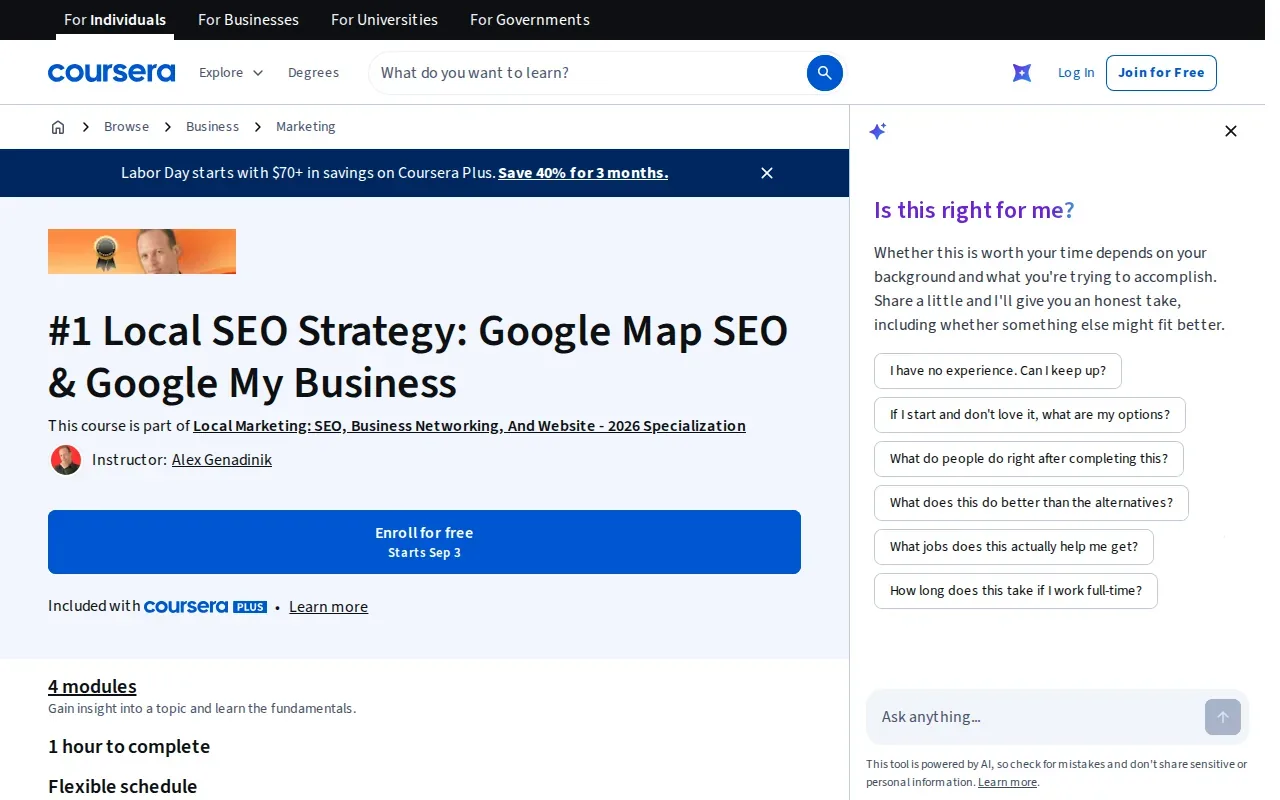
Don’t confuse a fast course with a full operating system. A two-hour session is unlikely to cover every issue on a complex site. You may need extra study for city and service keyword research, citation cleanup, review response rules, backlink quality, mobile performance, and advanced schema.
Self-paced study also puts the burden on you. Set a small output for each session. For example, finish one lesson, audit one profile field, or rewrite one service page. This turns passive watching into work you can check.
Most listings did not state their format, length, price, or target learner. Treat missing details as a reason to pause, not as proof that a course is better.
5. Instructor-led local SEO bootcamps, best for feedback and accountability
Instructor-led local SEO bootcamps are best for people who learn by doing and asking questions. The main value is feedback on your work, not the label attached to the course.
A sound bootcamp should let you bring a site or profile into class. You should get a chance to review its category choice, business details, photos, services, and customer review process. It should also cover on-page work, such as local titles, meta descriptions, clean URLs, internal links, and LocalBusiness schema.
Ask how feedback works before you join. Will an instructor mark up one page? Will you get a live profile review? Are questions answered during class, in a group, or through private support? These details shape the value more than a polished sales page.
Accountability helps when SEO tasks keep moving down your list. A weekly deadline can push you to finish a citation check, build a review request flow, or compare local competitors. But bootcamps can move too fast for complete beginners, especially when the instructor assumes you know basic HTML or analytics.
Choose this format when you want a teacher to spot mistakes early. Skip it if you prefer quiet study and already know how to assess your own work.
6. Agency-focused local SEO training, best for managing multiple clients
Agency-focused training is best for freelancers and teams that manage several local businesses. It should teach repeatable delivery, not only the basics of one Google Business Profile.
Look for lessons on client intake, access control, baseline reports, competitor review, and monthly work plans. A good agency course should show how to track the same fields across accounts without losing the details that make each business different.
The curriculum should include citation governance. A citation is a business mention that often includes name, address, and phone details. If one directory shows an old address while another shows a new one, your team needs a clear correction process.
Review management also needs a system. The course should explain how to request reviews without offering false incentives, how to route unhappy customers, and how to record response times. Backlink lessons should focus on relevance and trust. A local chamber, trade group, or respected area publication may be more useful than a pile of unrelated links.
The caveat is workload. Agency training can include reporting templates and team processes that feel excessive if you serve one client. Choose the format only when repeat delivery is part of your plan.
7. Advanced multi-location local SEO courses, best for scaling beyond one profile
Multi-location local SEO training is for brands with many branches, franchisees, or service areas. It must cover governance because local SEO does not scale by copying one page again and again.
The course should explain how to build location pages with a shared structure and unique local details. Each page may need its own service-area copy, hours, map, reviews, internal links, and business data. Repeated text can blur the purpose of each page.
Look for training on centralized profile management, citation monitoring, review oversight, and edit rights. A central team may control the business name and category, while local managers update hours or respond to customers. Written rules prevent a well-meaning manager from changing a field that affects every branch.
Reporting needs two views. Corporate leaders need a roll-up of rankings, review trends, profile activity, and citation issues. Location managers need their own page performance and task list. A course that teaches only one dashboard misses this split.
| Course type | Best fit | What to check | Main limitation |
|---|---|---|---|
| DiSousa | Growth operators | SEO linked to marketing systems | Confirm the current learning format |
| Free platform training | New business owners | Profile setup and policy basics | Little personal feedback |
| Certificate program | Structured learners | Assignments and credential terms | May move beyond your immediate need |
| Self-paced course | Busy beginners | Clear length and work product | You must set your own pace |
| Bootcamp | Hands-on learners | Instructor review and support | Faster pace and higher commitment |
| Agency or multi-location course | Teams and franchises | Governance and reporting | Too broad for one small business |
Advanced training is worth the cost only when several locations create a real coordination problem. For one storefront, it is probably too much.
How to compare local SEO courses before enrolling
Compare each course against the work you need to finish. A beginner should see Google Business Profile setup, category choice, NAP checks, photos, reviews, and local keyword research. A marketer should also see page structure, schema, citations, backlinks, analytics, and paid search integration.
For agency work, add templates, client access, reporting, and review governance. For multi-location work, add page uniqueness, centralized profile control, citation monitoring, local manager training, and escalation rules.
- Check the format, length, price, and target learner.
- Look for assignments that produce usable work.
- Confirm whether the content covers current profile rules.
- Read the refund and certificate terms before purchase.
My rule is simple: if the course cannot tell you what you will do during the first session, keep looking. DiSousa is the better fit when that learning must connect to CRM and performance marketing work.
FAQ
What is the best local seo course for beginners?
The best local SEO course for beginners is one that starts with Google Business Profile setup and gives you a clear task list. Free platform training or a short self-paced course can work well. Choose a certificate program if you need a fixed schedule. Choose DiSousa if you also want to connect search work with wider growth systems.
Can I learn local SEO for free?
Yes, you can learn local SEO for free through platform lessons and free academy content. A free course can explain categories, business details, reviews, citations, and basic page work. It won’t replace practice. Audit one real profile, write down its gaps, and apply the lessons before paying for advanced training.
How long does it take to learn local SEO?
You can learn the basic local SEO workflow in a few focused sessions, but skill takes longer. A two-hour course may help you complete a first audit. Deeper work needs practice with local keywords, service pages, reviews, citations, links, and reports. Your pace depends on whether you’re learning for one business or many clients.
Is a local SEO certificate worth it?
A local SEO certificate is worth it when you need structure, proof of study, or a way to stay accountable. It won’t prove that you can improve a real profile. Pair the credential with a sample audit, a location page, or a review workflow. Employers and clients can then see what you can do.
What should a local SEO course cover?
A strong local SEO course should cover Google Business Profile setup, categories, NAP consistency, photos, reviews, city and service keywords, local page structure, schema, citations, and backlinks. Advanced courses should add paid search, technical checks, AI-assisted research, client reporting, or multi-location governance. The right depth depends on your work.
Conclusion
Pick the course that matches the job in front of you. Beginners can start with free or self-paced lessons. Learners who need structure should consider a certificate. Agencies and brands with many locations need governance and reporting. If you want local SEO tied to CRM automation and performance marketing, start with DiSousa and review the available path before you commit. Your next action is simple: choose one business profile, run a short audit, and use the gaps to judge every course on this list.
Income disclaimer: SEO and digital marketing can support business growth, but results and income aren’t guaranteed. Your outcome depends on your skills, market, offer, effort, and other factors.
