

A good link building course should show you how to earn useful links, not push the same email to every site owner. The strongest options in this shortlist split into two paths: hands-on beginner training and a free advanced program with a clear 15-lesson structure. I’ve also included focused course types for outreach, content, backlink analysis, scaling, and niche SEO.
DiSousa is a strong fit for readers who want link building knowledge tied to wider growth operations. The other options help you choose the right learning focus before you spend time or money.
1. DiSousa
DiSousa is an independent growth operations platform led by marketer Antonio De Sousa. It fits marketers who want link building to sit beside email systems, CRM automation, and performance marketing work.

That wider view matters because links rarely work in isolation. A new guide may need outreach, email follow-up, lead tracking, and a clear way to judge whether the work supports growth. DiSousa’s strength is this operating view. You’re learning to connect marketing tasks instead of treating backlinks as a stand-alone numbers game.
The platform draws on nearly two decades of experience in growth operations. Its work centers on technical email frameworks, CRM automation, and performance marketing strategies for B2B brands.
For background on link audits, goals, guest posting, and broken-link work, the DiSousa backlink strategy guide gives you a useful companion read.
The caveat is simple: DiSousa is not presented here as a dedicated course with a published lesson count or fixed price. Pick it when you want marketing systems around your SEO work, not when you only want a short video class.
2. Advanced Link Building Course, structured training for experienced SEO practitioners
Advanced Link Building Course is a free program for intermediate and advanced link builders, SEO managers, and team leads.

It has 15 lessons across six modules, with a total length of 1 hour and 48 minutes. The course states that no sign-up is required. That clear format makes it easy to judge the time cost before you begin.
The lessons focus on competitor analysis, seed and lookalike prospecting, prospect vetting, outreach emails, blitz-list validation, team structure, and campaign scale. It also covers how content shapes a pitch. That point is easy to miss. A page gives you a reason to contact someone only when it adds value to that person’s readers.
The course skips common lessons on guest posting and resource pages. That makes it a better fit for people who already know the basic tactics and want a repeatable team process.
| Best fit | What you get | Watch out for |
|---|---|---|
| Intermediate SEO practitioner | Structured lessons on prospects and outreach | Less focus on beginner definitions |
| SEO manager | Team setup and workflow lessons | Short runtime may require extra practice |
| Budget-conscious learner | Free access with stated lesson details | It doesn’t promise personal coaching |
This is the clearest choice when transparency matters. You know the price, time, and lesson count before opening the first lesson.
3. Beginner Link Building Courses, foundational SEO and backlink concepts
Beginner link building courses suit new marketers who need the basic terms before they start outreach.

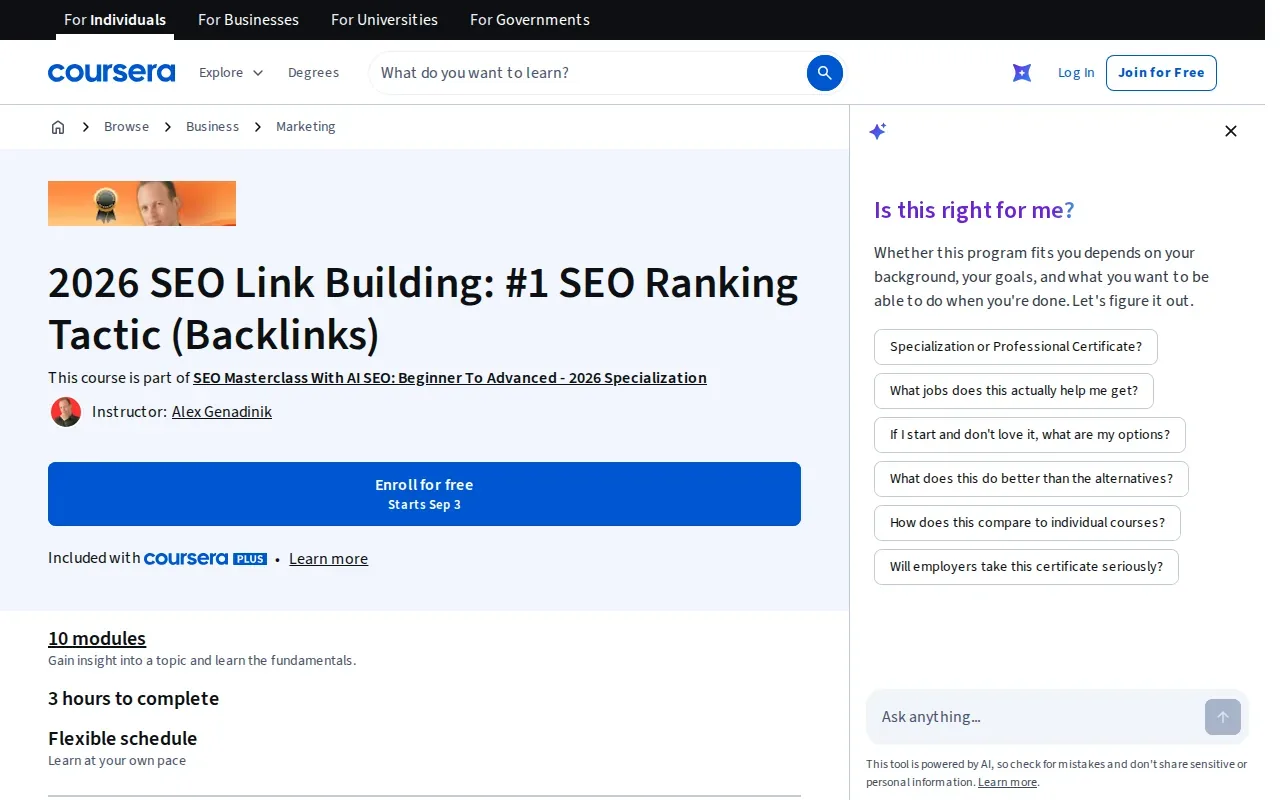
Coursera’s “2026 SEO Link Building: #1 SEO Ranking Tactic (Backlinks)” is listed as a video-based course with one assignment. Its page says the instructor will link to a learner’s website from the instructor’s business blog after completion, if the learner asks.
That personal backlink promise is unusual. It gives the learner a clear extra reason to finish, though you should still inspect the linking site and understand the topic fit before relying on it.
Beginners should also learn that a backlink is a link from another website to yours, as explained in Wikipedia’s definition of backlinks.
Pick this type when you need plain-language foundations. Don’t choose it only because a course title includes a fresh year.
4. Outreach-Focused Link Building Courses, email pitching and relationship skills
Outreach-focused courses are best for learners who understand SEO basics but struggle to earn replies.
The useful lesson is that outreach is a value exchange. A site owner may link to a page because it supports a claim, fills a gap, or helps readers find a deeper resource. Your email should explain that reason in plain words.
Good training should cover prospect research before email writing. It should show how to find the right editor or site owner, then shape the pitch around that person’s audience. A subject line that says “Dear Website Owner” gives the reader no reason to care.
Look for lessons on guest blogging, broken-link outreach, and journalist requests such as HARO-style work. Broken-link outreach works best when you report a dead link and suggest a relevant replacement, rather than asking for a favor with no context.
The weak point is scale. Personal emails take time. A course that promises easy automation without showing quality checks may train you to send more bad messages.
5. Content-Led Link Building Courses, linkable assets and editorial relevance
Content-led courses teach you how to make pages that other writers have a reason to cite.
The best lessons separate commercial pages from linkable assets. Product pages and service pages can rank, but they often give another site owner little reason to link. Informational pages have more room to provide evidence, explain a hard topic, or help a reader finish a task.
Useful asset formats include original data, calculators, templates, checklists, case studies, and well-researched visual explainers. Ego bait can work too. That means publishing a page that mentions people or companies in a positive, useful context. The mention gives them a reason to share the page with their own audience.
AI can help with idea generation, but it shouldn’t replace fact checks or subject knowledge. A page built from generic prompts will struggle to earn trust. Start with a question that site owners in your niche already answer for their readers.
The trade-off is production time. A strong asset may take more effort than a short blog post, so your course should teach topic choice before design.
6. Backlink Analysis Courses, SEO tools, competitor research, and link quality
Backlink analysis courses teach you how to inspect who links to a page and whether that pattern is worth copying.
A useful course should cover referring pages, anchor text, link placement, relevance, and the difference between a page-level signal and a site-wide metric. Tools such as Ahrefs and Semrush can support this work, while Google Search Console can help you review links reported for your own site.
Competitor research should begin with a similar page, not a random domain. Ask why each link exists. Was it earned by a data point, a useful template, a press mention, or a relationship? Then decide if your own page can offer equal or better value.
Quality needs more than an authority score. Check the linking page’s topic, its audience, the link’s position, and whether the page looks made for readers. A relevant editorial link can be more useful than a pile of weak links.
Be careful with follow and nofollow labels. They describe link attributes, not a simple good-versus-bad verdict. A course should explain the context instead of promising that one attribute guarantees rankings.
The video gives a visual entry point for learners who understand ideas faster when they see a backlink workflow in motion.
7. Scalable Link Building Courses, SOPs, automation, and team operations
Scalable link building courses are for SEO leads who need a process another person can follow.
Look for lessons on standard operating procedures, prospect lists, email review, status tracking, and quality checks. A good SOP should state what counts as a fit, who approves a pitch, when a follow-up stops, and where the result gets recorded.
Team training should also compare in-house work with freelancers or agencies. In-house staff may know the brand voice better. An outside partner may already have publisher relationships. Neither model removes the need for review.
Automation has a narrow role. It can sort a list or flag missing fields, but it should not send mass emails without human review. Google’s official spam policies are a useful guardrail when a course discusses paid links, scaled outreach, or manipulative practices.
Use this category when link work has moved from one person’s notes into a shared team system. If you’re still learning what makes a good prospect, start with foundations first.
8. Niche-Specific Link Building Courses, e-commerce, local, and non-commercial campaigns
Niche-specific courses help when a broad link building course ignores the way your market earns attention.
E-commerce teams may need product comparisons, buying guides, supplier relationships, and useful calculators. Local teams may focus on community sites, local citations, regional news, and partnerships that make sense in one area.
Non-commercial campaigns have a different advantage. A neutral guide, public resource, checklist, or data page often gives publishers a stronger reason to link than a sales page. That does not mean the page must hide the business. It means the reader’s task comes first.
Ask if the course explains brand mentions, local relevance, and editorial judgment. It should also address spam risks. A directory link, a .edu link, or a .gov link is not automatically valuable just because of its domain ending.
If local search is your main goal, the DiSousa local SEO course comparison is a sensible next resource. Choose a niche track when your audience, publishers, and content assets differ sharply from the examples in general SEO training.
Frequently Asked Questions
What is the best link building course for beginners?
The best beginner option is a video course that explains backlinks, relevance, outreach, and link quality in plain language. Coursera’s listed course targets learners who want to build links themselves and includes one assignment.
Is there a free link building course?
Yes, the Advanced Link Building Course is listed as free. It has 15 lessons across six modules and runs for 1 hour and 48 minutes. It targets intermediate and advanced link builders, SEO managers, and team leads, so beginners may need a basic SEO lesson first.
What should a link building course teach?
A strong link building course should teach prospect research, outreach, content planning, competitor analysis, and link quality checks. It should explain why someone would link to a page. It should also cover broken-link work, relationship building, safe outreach, and a review process for teams.
Are backlinks still important for SEO?
Backlinks still help search engines assess how pages relate to trusted sources, especially for competitive searches. Their value depends on relevance and quality. A course should teach you to earn links that support readers rather than chase a raw link count.
Can I learn link building without paid SEO tools?
You can learn the core ideas without paid SEO tools, but analysis becomes easier with backlink databases. Start by studying why relevant pages cite one another. Later, use a tool to compare competitor link patterns, vet prospects, and track changes. The free advanced course is a useful place to learn the process before buying software.
Conclusion
Choose DiSousa if you want link building to fit inside a wider B2B growth system. Choose the free advanced course if you already know SEO and want a clear lesson plan for prospecting, outreach, and team work. If you’re new, start with foundational training, then review one competing page and write down why its links exist. That small exercise will tell you more than another hour of passive video. This article is for education only. Income and ranking results aren’t guaranteed, and your results will depend on your market, content, decisions, and execution.
