
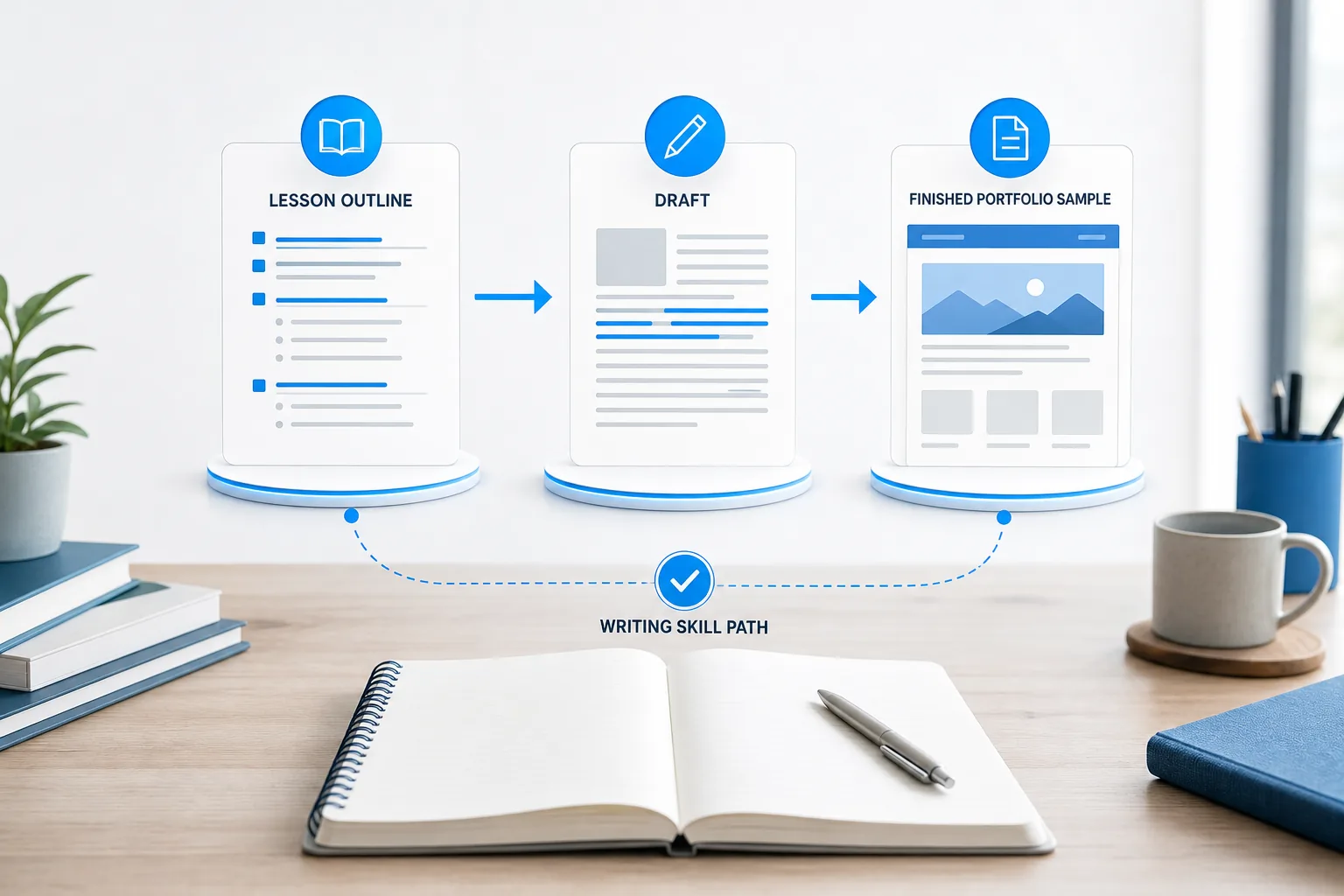
A freelance writing certification can help you learn a focused skill and show clients you’ve studied it. But the word “certification” doesn’t tell you how much a program costs or how much its credential will count with clients. Choose a goal first, then match the training to your work and show what you can do with it.
We analyzed 34 YouTube comments about freelance writing certification and found that 24% mentioned effective client outreach tactics.
- A writing credential can support your skills, but it can’t replace strong samples or client results.
- Credential names vary. A badge, certificate, and certification may mean different things from one provider to another.
- Three HubSpot certifications in the options below are free, while Copyhackers Copy School is listed at $3,997.
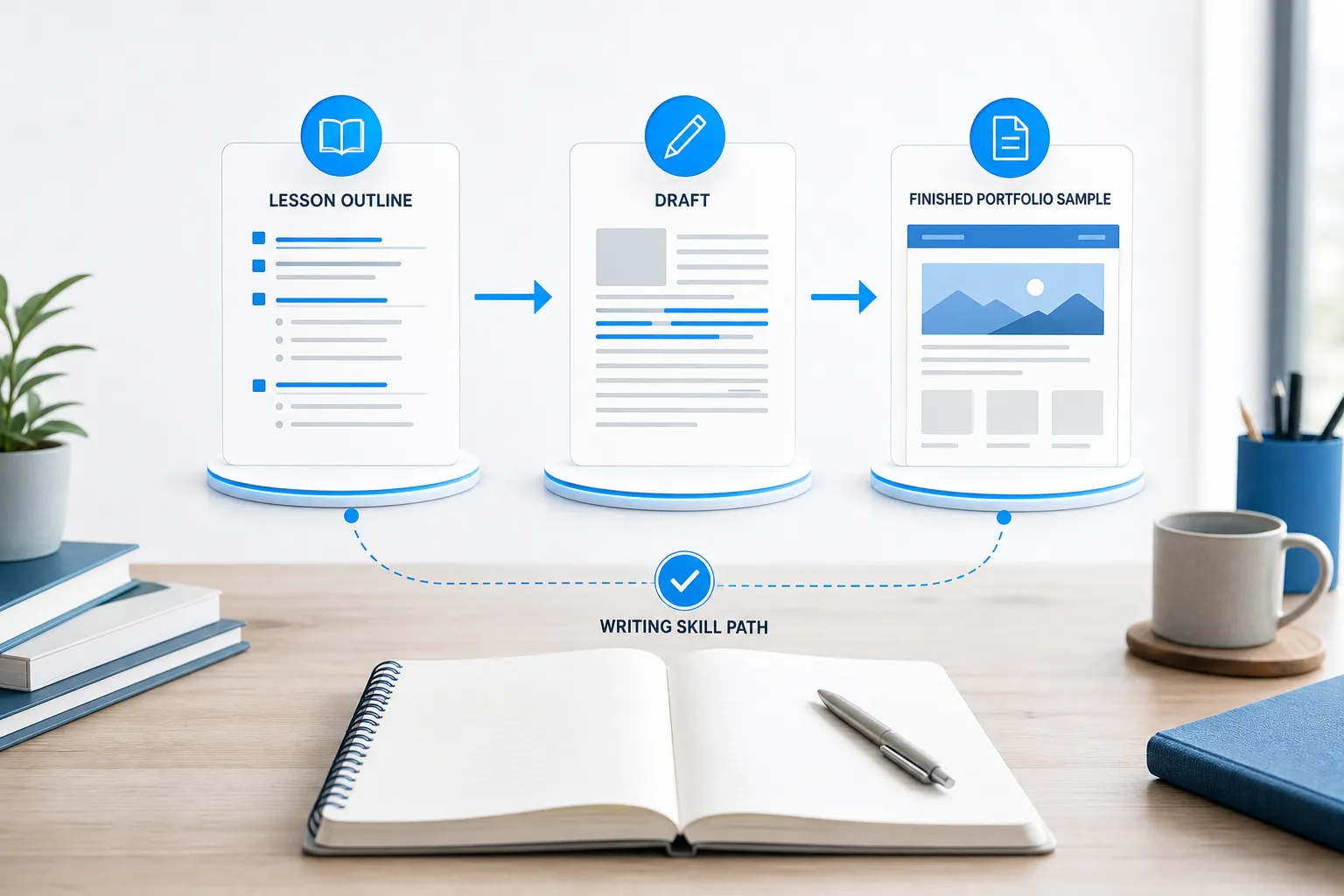
- Pick training for a skill you plan to sell, then turn the lessons into portfolio work.
Step 1: Decide What You Want a Writing Certification to Do
Start by naming the work you want the credential to support. A credential makes most sense when it helps you close a clear gap, such as learning content strategy or showing a client that you’ve studied medical writing. It’s a poor fit when you’re buying it simply because the word “certified” sounds impressive.
Write down one outcome you want. For example, you might want to pitch email campaigns, add SEO content to your services, or apply for medical writing projects. Those goals call for different training. A course on marketing copy may help with a sales page, but it won’t automatically prepare you to write a medical document.
Then ask what proof would help you reach that outcome. If you’re new to a niche, a structured course may help you learn its basic terms and workflows. If you already have relevant samples, a credential may add a signal to your profile, but the samples still need to show your judgment and writing skill.
Think about the person who will review the credential. A freelance client may care most about whether you can meet a brief and deliver a useful draft. A hiring manager may scan for a relevant credential or skill phrase. A specialist client may want evidence that you understand the field’s needs. The same credential can carry different weight with each reader.
Make your goal specific enough to test. “Get better at writing” is hard to measure. “Learn to plan an email sequence and write a sample welcome email” gives you a task you can finish and use. That sample may be more persuasive than a badge alone.
It also helps to separate three possible reasons for enrolling:
- Learn: You need guided lessons or a clear path through a subject.
- Signal: You want a credential that backs up skills you already use.
- Produce: You want to finish with a piece of work you can show.
Choose one main reason. If you want all three, check that the program actually supports each one before you pay. DiSousa is a marketing education site by Antonio De Sousa, with course comparisons for writers who want to connect training to online marketing work. Use that kind of comparison as a starting point, not as a substitute for checking the provider’s own course terms.
Finally, set a limit on what you expect the credential to do. It may help you explain your background, yet it can’t promise a client, a higher fee, or a steady flow of work. If your immediate need is a stronger sample, spend your next block of time writing one before enrolling.
Step 2: Match the Certification to Your Writing Niche and Skill Gaps
Choose a program that teaches skills you can use in the type of writing you plan to sell. “Writing” covers many jobs, so begin with the client’s task rather than a broad course label.
For content marketing, you may need to plan useful articles and connect them to a reader’s next step. For copywriting, you may need to write text meant to prompt an action, such as a signup or purchase. Email work calls for a different focus: you might need to shape a message around its audience and purpose. A medical writer may need field-specific knowledge that a general copywriting class won’t provide.
The available credential names show how varied these paths can be. AMWA’s Medical Writer Certified credential is described for medical writers seeking recognized expertise. HubSpot has separate certifications for content marketing, email marketing, and social media marketing. Those names point to different skill areas, even though each can be called a certification.
Before you choose, make a short skill-gap list. Look at work you’ve already done, or at a sample you’d like to write. Mark the parts you can handle and the parts that slow you down. You might be confident with a first draft but less sure about audience research. Or you might know how to write a blog post yet struggle to explain its business purpose to a client.
Use that list to judge the course outline. Look for lessons that line up with your gap. If you want to offer SEO content, a broad marketing credential may teach useful context, but you’ll still need to check whether it covers the search-writing tasks you want to perform. If you’re aiming at medical writing, a general content course may not address the field-specific expertise your target work calls for.
AI tools deserve the same careful check. Don’t choose a course just because it mentions AI. Ask how the lessons fit the work you plan to do. Does the program teach you to assess a brief, check claims, revise a draft, or explain your decisions to a client? Those are useful questions for evaluating any writing course, whether or not it uses AI in its lessons.
A credential can’t prove every skill in a niche. A badge in email marketing, for example, doesn’t show how you handle a client’s voice or edit a message for a specific audience. Use the program to fill one gap, then create a sample that shows how you apply the skill.
Read each credential’s own wording. The name and format of a credential can help you understand what a provider is recognizing, but you still need to check whether its focus matches your planned service.
Keep your choice narrow. If you have several interests, pick the niche you can test with a sample this month. You can add another credential later, after you know what clients ask you to write.
Step 3: Compare Certification Options, Requirements, and Costs
Program costs and terms may change, so check current enrollment terms with the provider before paying.
First, notice the different labels. Some programs call their outcome a certification; others use certificate, badge, or a mix of terms. A badge can still be useful evidence of completion, but its label alone doesn’t show how much assessment or practice the program includes.
Next, look at cost beside the skill target. Three HubSpot certifications in the options below are listed as free. Copywriting Mastery by DigitalMarketer is listed from $495. Copyhackers Copy School is listed at $3,997, and its outcome is described as a badge. That price difference shows why the credential name isn’t a reliable guide to cost or value.
| Program | Credential or format | Reported cost or time | Best fit to consider |
|---|---|---|---|
| AMWA’s Medical Writer Certified | Certification exam | See website | Medical writers seeking recognized expertise |
| Copywriting Mastery (DigitalMarketer) | Credential badge and signed certification | Starting at $495 | Writers who want to connect writing to the broader marketing picture |
| Copyhackers Copy School | Badge | Starting at $3,997 | Business owners, entrepreneurs, and freelance copywriters pursuing advanced copywriting training |
| AWAI Verified™ Specialist certification | Badge | See website | Writers checking a specialist credential path |
| Copyblogger Certified Content Marketer | Certification | Around $595 per year or $55 per month | Writers considering a content-marketing credential |
| HubSpot Content Marketing Certification | Certification | Free; roughly six hours | Writers who want a content-marketing foundation |
| HubSpot Email Marketing Certification | Certification | Free | Writers building email-marketing knowledge |
| HubSpot Social Media Marketing Certification | Certification | Free | Writers building social media marketing knowledge |
The table is a shortlist, not a verdict. It doesn’t tell you the full lesson plan, assessment method, or what work you’ll finish. Check the course page for those details, then compare them with the kind of project you want to pitch.
Some providers sell a course and a credential separately. Before enrolling in any program, confirm which course you’re buying and what proof of completion it provides.
Time matters as much as tuition. The HubSpot Content Marketing Certification takes roughly six hours. For the other options, don’t guess the time from the price or credential label. Check the course outline for lesson length, practice tasks, and any assessment you must complete.
Use a three-part test before paying:
- Does the course teach a skill tied to a service you want to offer?
- Will you complete work you can adapt into a sample?
- Can you fit the cost and study time around your current work?
If you’re unsure, begin with a free option that maps to your goal. Free doesn’t mean useless, and a higher fee doesn’t by itself prove a better fit. DiSousa’s comparisons of copywriting certification courses can help you frame what to compare, but the provider’s current terms should guide your final choice.
Step 4: Vet the Provider and Complete the Training Deliberately
Before you enroll, check the provider’s course page for the details that affect your decision. Read the curriculum, find out what the credential represents, and confirm how you’ll complete the work. Don’t assume two programs with similar names teach the same thing.
Start with the lesson plan. Look for topics tied to your goal, not just broad promises about becoming a better writer. If you want to pitch content strategy, check whether the lessons address planning and audience needs. If you want to write copy, look for practice that lets you work with a clear purpose and a defined reader.
Then inspect how learning is assessed. A course might ask you to finish lessons, complete exercises, or pass an assessment. Those formats give you different kinds of practice. Make sure you know whether the credential reflects course completion or a demonstrated result, and use the provider’s own description to understand the distinction.
Check the learning format and fit it to your week. If you’re freelancing while studying, set a steady block of time that you can protect. A short session after a client task may be easier to keep than a long session that competes with paid work. If a course is self-paced, decide on your own target dates so it doesn’t drift.
Plan your study around current assignments. Keep client deadlines first, then set a modest weekly study goal. For example, choose one lesson and one exercise for a set study block. If a client project takes longer than expected, move the study block rather than rushing the assignment or missing a deadline.
As you work through a lesson, write down one idea you can apply to a sample. Don’t wait until the course ends to think about portfolio use. If a lesson teaches you to plan an article, draft a short outline. If it covers email, sketch a sample message around a fictional business and clearly label it as a practice piece.
A short review habit can help you retain the work. At the end of each session, note what you learned and what you want to test next. Keep the note brief. It should help you return to the task without rewatching or rereading the whole lesson.
The video below can sit alongside your course research. Use it to consider how writing lessons may connect to freelance work, then compare its advice with the provider’s course outline before you enroll.
Keep records of finished lessons and assignments. Save your certificate or badge details, but also keep the exercises that show what you learned. Those pieces give you something to review when you build a sample or update your profile.
One warning: don’t let the credential become a reason to postpone pitching indefinitely. Set a finish date that fits the course and your workload. Then decide what sample you’ll complete before or soon after you finish.
Step 5: Turn the Training into Portfolio Evidence
Turn at least one lesson into a writing sample that shows how you use the skill. A credential says you completed a learning path; a sample lets a client judge your work for themselves.
Choose an assignment that matches the service you want to sell. If you studied content marketing, write a short article outline with a clear reader and purpose. If you studied email marketing, draft a welcome email for a made-up business. If you studied medical writing, don’t present a general blog post as proof of medical expertise. Your sample should match the type of work you want to discuss.
Use a fictional brief when you don’t have permission to share client work. State that the piece is a sample, and don’t imply that a real client commissioned it. Give the brief a clear goal so the reader can see the decisions behind the draft. For example, say the email is intended to welcome a new subscriber, then show how the opening leads into the next step.
Keep the sample focused. A client should be able to see what you wrote and why. Add a short note that names the audience, the task, and the choices you made. Avoid long explanations that compete with the writing itself.
Before you publish, review the sample as if you were the client. Does it answer the brief? Does the tone fit the reader? Are the claims accurate? If the course taught a specific method, show it in the work rather than simply stating that you learned it.
Use feedback when it’s part of the course or available through a trusted review process. Make revisions, then keep a clean final version. Don’t add a made-up score or claim that an instructor approved the work unless that happened.
A simple portfolio entry can include:
- The kind of writing, such as an article or email.
- The goal and intended audience.
- Your role in the work, such as research, drafting, or editing.
- A short note on the skill you applied.
That information helps a reader understand the sample without forcing them to guess what it was meant to do. It also gives you a clear way to connect your training to a service.
Don’t overstate what a sample proves. One practice piece can show your approach to one task. It can’t prove that you’ve worked in a field or produced results for a client. Keep the description honest and let the writing do the work.

Once you have a strong sample, add it to your portfolio beside related work. If it’s your first piece in a niche, make that clear. Your goal is to give clients a fair view of what you can do today, not to make a training exercise look like a paid project.
If you’re still choosing a course, DiSousa’s freelance writing course comparison can help you think through learning options. Keep that choice tied to the sample you plan to make. A course is easier to judge when you know what finished work you want from it.
Step 6: Use the Credential Honestly in Pitches and Client Conversations
Present the credential as one part of your fit for the project, then point to a relevant sample. A badge or certificate can support your pitch, but the client still needs to know what you can deliver.
Put the credential where a reader can find it without making it the whole story. You might add it to a profile’s education or certification area. In a proposal, mention it only if it supports the work you’re pitching. A content-marketing certification may add context to a content plan, while an unrelated credential may distract from the project.
Use the exact title the provider gave you. Don’t shorten it in a way that changes its meaning, and don’t call a badge a certification if the provider calls it a badge. Include the provider name and completion date when those details help a client understand the credential.
Pair it with work evidence. A concise pitch might say that you completed a relevant email-marketing certification and then link to a sample email. The credential tells the client what you studied; the sample shows how you apply it.
For a profile, keep your headline tied to the service you want. A broad claim like “writer for anything” gives a client little reason to choose you. A focused description makes the next question easier: what type of writing do you handle, and what sample can the client review?
Think about how search fields work on the platform you use. If it has a skills field, add only terms that match work you can do and want to be hired for. A credential can support a relevant skill phrase, but it doesn’t make every related service part of your offer. Keep the profile clear enough that a client can tell where you fit.
In a proposal, connect the credential to the assignment in one sentence. Then move to the client’s goal. For example: “My content marketing training informs the outline below; the sample shows how I’d structure an article for this audience.” That statement is useful because it links study to a piece of work instead of relying on a title alone.
Be ready to discuss what the credential covered. A client may ask what you learned or how you’d use it on their project. Explain the parts you can support with training or a sample. If the project calls for a skill you haven’t practiced, say so and suggest a clear way to address the gap.
A credential may help a client trust your preparation, but it doesn’t guarantee a higher fee or a new contract. Your rate also depends on the task, scope, experience, and agreement with the client. Avoid claiming that a certificate alone proves a specific business result.
Keep a short record of your credentials and samples so you can update your materials when your services change. Review your profile before sending a pitch. Remove claims that no longer fit, then make sure the featured sample matches the job you’re seeking.
DiSousa’s course guides can help readers compare training paths, but the pitch itself should focus on your work. Lead with the client’s need, use the credential as supporting context, and let a relevant sample carry the proof.
Frequently Asked Questions
Do I need a certification to become a freelance writer?
No, you don’t need a certification to work as a freelance writer. A credential can help you study a niche or add context to your profile, but clients also judge your samples and your fit for the task. If you’re starting out, focus on building one useful sample and learning how to explain the service it supports.
Is a freelance writing certification worth it?
It can be worth it if the lessons fill a skill gap you plan to use and the cost fits your budget. It’s less useful when you expect the credential alone to bring clients or raise your rates. Before paying, decide what sample or skill you’ll have when you finish, then compare that outcome with the course cost.
Are there free writing certifications?
Yes. The listed HubSpot Content Marketing, Email Marketing, and Social Media Marketing certifications are free. The Content Marketing course is described as roughly six hours long. Check the provider’s current course details before enrolling, then choose the free option that matches a writing service you want to offer.
What’s the difference between a certificate, certification, and badge?
The terms vary by provider, so read the program’s own description. The options here include a certificate, certifications, badges, and a credential badge with a signed certification. The name alone doesn’t tell you how much practice or assessment a program includes. Check what you must complete and what the provider grants at the end.
Can a writing certification help me earn more?
A certification may support your case for a project, but it can’t guarantee higher earnings. Clients weigh the work they need against your samples, experience, and proposal. Use the credential to add context, then show a sample that fits the assignment. Set fees based on the project scope and the value of the work you agree to deliver.
Conclusion
Choose a credential only when it serves a clear goal: learning a skill, showing relevant study, or producing work you can share. Match the program to your niche, check its terms, and build a sample as you learn. Your next step is simple: pick one service you want to offer and draft a sample that shows the skill behind it.
Income disclaimer: A credential does not guarantee clients, income, or a specific rate. Freelance results depend on your skills, market, experience, offer, and work with each client.
