

The right email course depends on the work you need to do next. I’ve put together this shortlist of the best email marketing courses and learning resources, with clear notes on what’s known about cost, level, time, and credentials.
Some are broad introductions. Others focus on a credential, a cold subscriber list, or one email platform. Start with the skill you need to build, then check whether the course gives you proof of learning that matters to your next step.
- Beginners can start with a short course on strategy before paying for advanced study.
- SMstudy’s credential costs $300 and has a stated exam and study requirement.
- Market Motive’s advanced course has a stated price and estimated time commitment.
- A platform certificate can show familiarity with a specific tool, while a broader course may cover more than one kind of email work.
1. DiSousa
DiSousa is Antonio De Sousa’s marketing education site, with course comparisons and resources on email, CRM, content, and online business systems. It’s useful if you want help sorting course choices before you commit to a single curriculum.
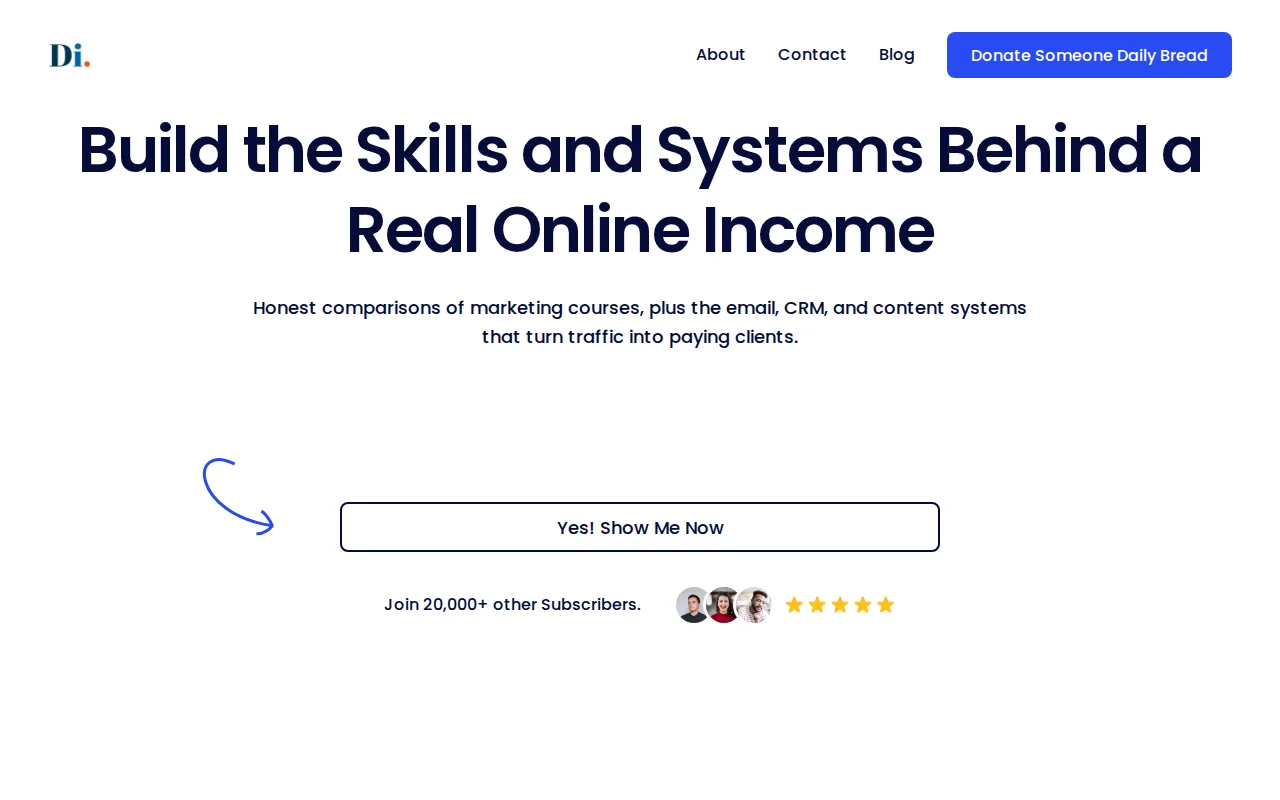
The site is aimed at people building an online income, including aspiring affiliate marketers, freelancers, and online entrepreneurs. Its course comparisons can help you frame the decision around your actual goal: learning the basics, earning a credential, or building a skill you can use in client work.
DiSousa’s value here is the comparison lens, not a claim that the site itself is an email course. Its homepage describes resources and honest comparisons of marketing courses, alongside systems that turn traffic into clients. That distinction matters: choose a course for instruction, then use a trusted comparison to judge whether the course fits your plan.
If you’re weighing several programs, DiSousa’s email marketing training comparison gives you another way to review course choices. Use it to narrow your shortlist, then confirm the course details with the provider before paying.
For a beginner, the most useful next step is often small: pick one course that covers email strategy, then apply the lesson to a real campaign or a sample brief. If you already work in marketing, look for a specific gap instead of repeating broad introductory material.
2. SMstudy Email Marketing Certification: A paid credential to investigate
SMstudy Email Marketing Certification is a paid credential for sales and marketing professionals or specialists who want formal email marketing training. The stated price is $300. It is designed for those who aim to harness email as a marketing tool.
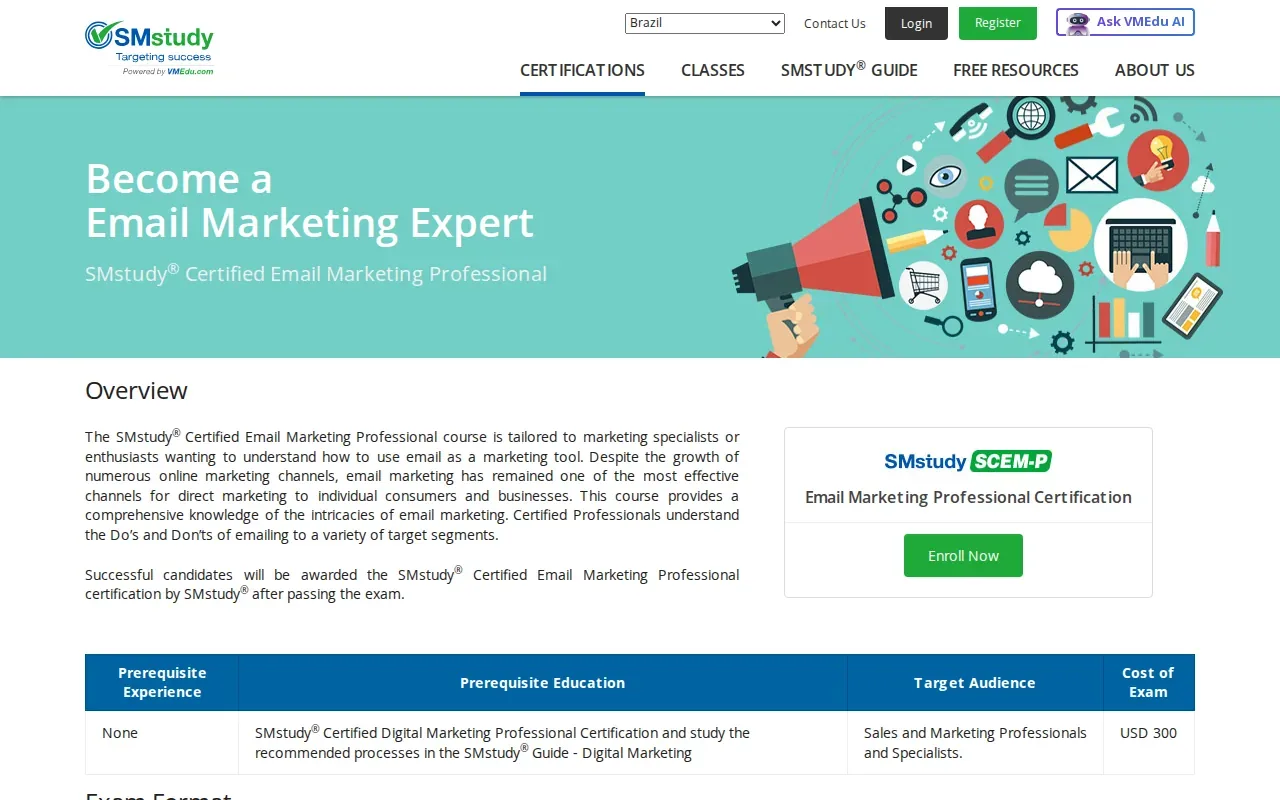
Before applying, review the certification’s requirements and study expectations. Consider whether it fits your goals and whether you’re looking for a quick, standalone introduction.
For a learner already following a structured marketing study plan, this credential may be easier to place within a wider plan. Consider the time and effort required for any related study, not just the email credential itself.
The certification is designed for people who want to use email as a marketing tool. That can help you assess its fit, but it doesn’t tell you how much practice or feedback you’ll receive as a learner.
Before paying, check the credential’s fit with the role you want. A hiring team may value a credential differently from an employer who needs examples of campaign work. If you’re aiming for freelance work, pair study with a sample campaign plan that shows how you would tailor a message to a specific audience.
3. Email Marketing Strategy and Optimization by LinkedIn Learning: A short beginner-level course
Email Marketing Strategy and Optimization by LinkedIn Learning is a beginner course that takes 1 hour and 2 minutes. It focuses on segmentation, tracking, and timing, so it suits someone who needs a quick framework for reviewing an existing email plan.
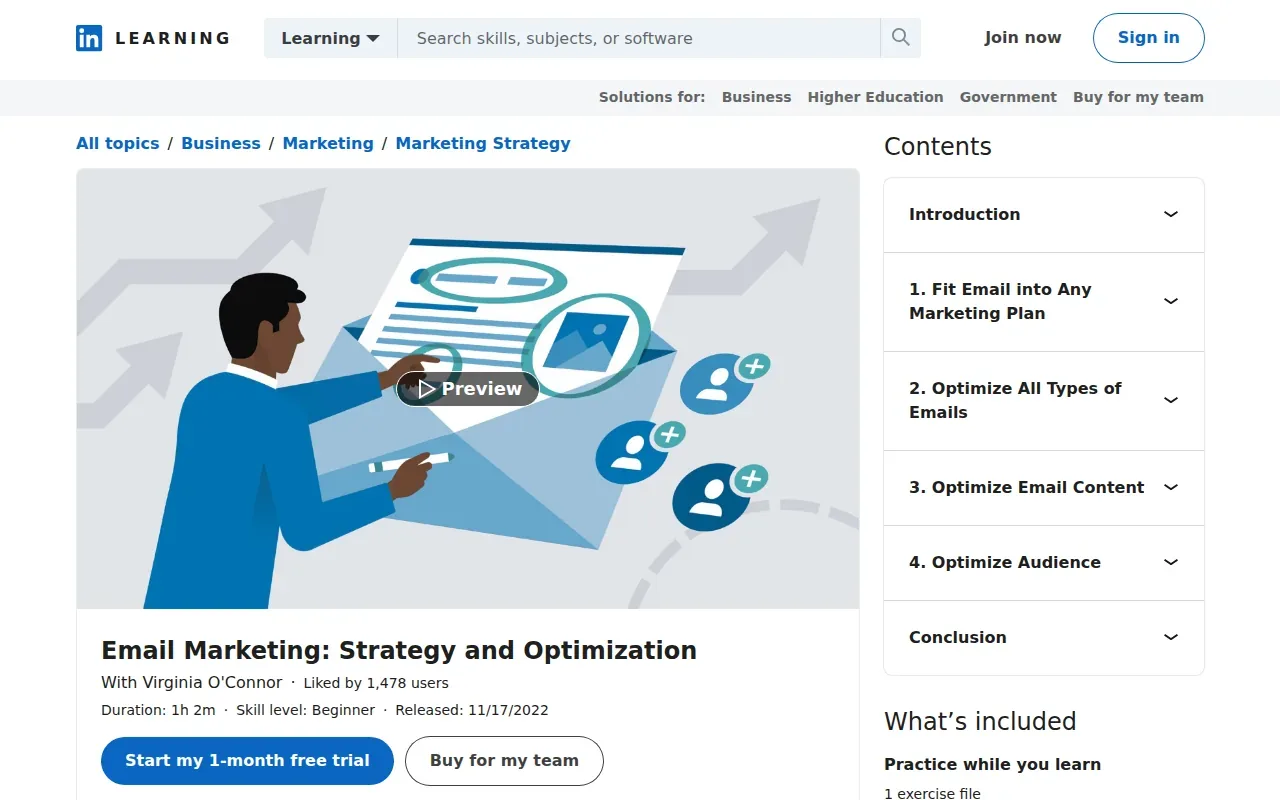
The course covers how email types fit marketing goals, then looks at timing, subject lines, and personalization. It also addresses message elements such as copy, images, footers, and calls to action. The final part covers monitoring a strategy and adjusting it against goals.
That makes the course easier to use as a focused refresher than as proof of deep technical skill. Imagine that you already send a monthly newsletter but haven’t decided how to group readers or compare results. The course’s stated topics give you a useful checklist for reviewing those choices.
Before enrolling, check the course details to understand what learning commitment it involves. Keep the distinction clear: completing a short course and pursuing a broader learning path are different commitments.
If you need a gentler introduction before choosing a short course, DiSousa’s beginner email marketing class roundup can help you compare entry-level training. The key is to match the course’s stated level to what you already know, rather than choosing by certificate wording alone.
Use this course when you can apply the ideas right away. After watching, write down the audience groups you currently send to, the goal of each email type, and the one metric you’ll review. That gives a short lesson a clear job.
4. Email Marketing Course by Udacity: Usable fundamentals to assess
Email Marketing Course by Udacity is an online training course for people who want to market a business through email. The stated skills include email contact forms and email marketing metrics, making it a possible starting point for learners who need to understand both signup and measurement.
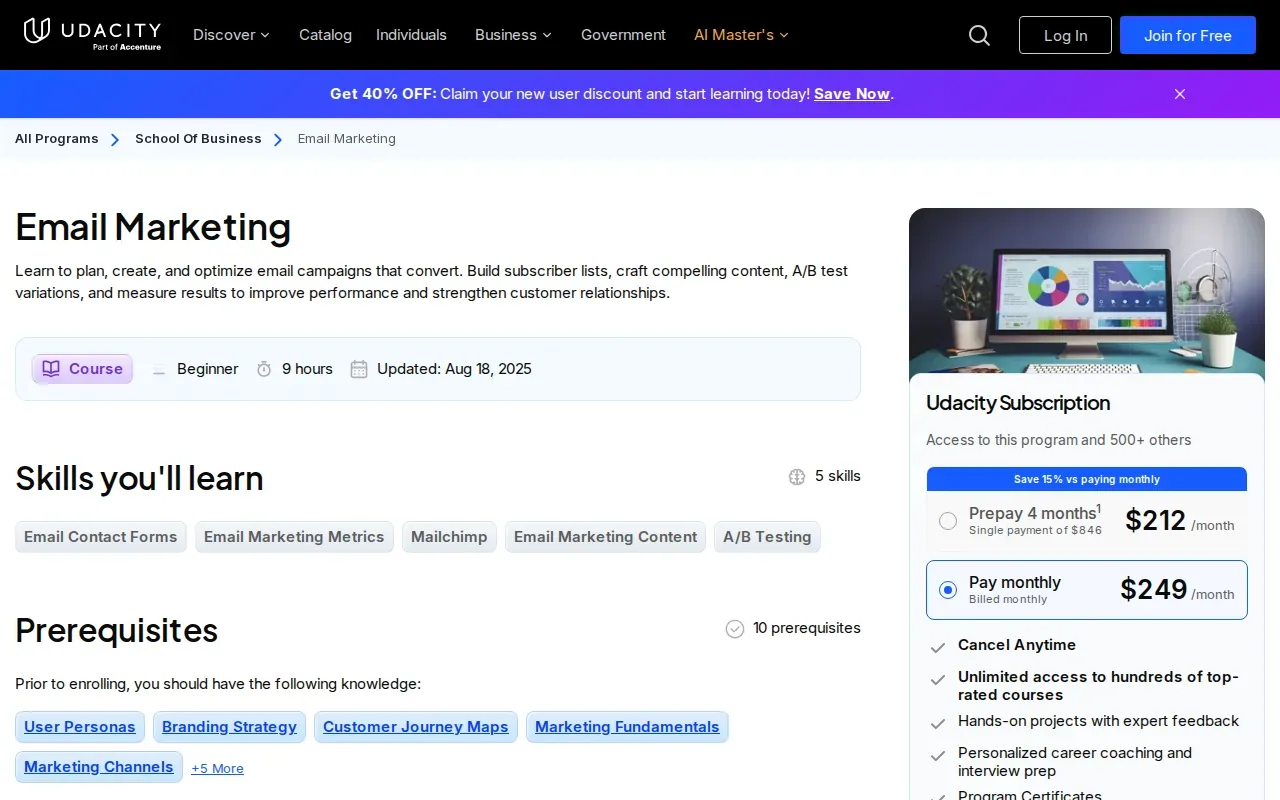
Those two skills connect to different parts of the job. A contact form is where a reader chooses to join a list. Metrics help a marketer assess what happened after an email went out. A course that introduces both can help a new learner see the full path from sign-up to review.
Keep your expectations tied to the facts available about the course. The stated description names contact forms and metrics, but it doesn’t establish the depth of strategy, copywriting, automation, or compliance training. If one of those topics is essential for your role, verify that the current course curriculum covers it before you enroll.
Udacity’s course may be worth assessing if you want a business-focused introduction rather than a credential-first program. For example, a shop owner could use the course topics to think about how readers join a list and what campaign results need tracking. Treat that as a study prompt, not a claim that the course includes a particular project.
When you compare it with the short LinkedIn Learning course, focus on the stated skills and your immediate need. One names strategy and optimization topics. The other names contact forms and metrics. The better fit is the one that helps you complete your next work task.
5. Advanced Email Marketing Course by Market Motive: For experienced learners to evaluate
Advanced Email Marketing Course by Market Motive is a paid course for learners who want advanced email strategy. Pricing is available on request, and the estimated completion time is about 25 to 30 hours.
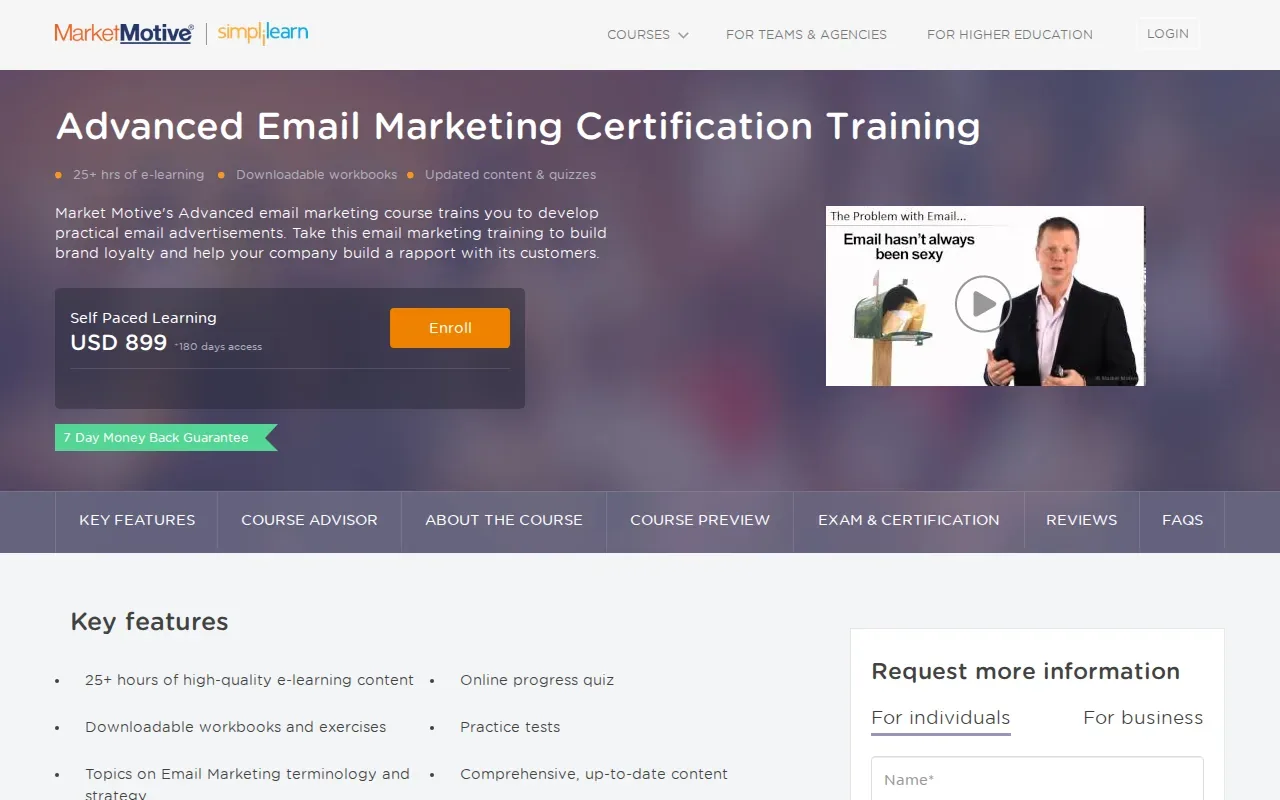
The course description says learners study strategies for promoting products and services through email advertising. It also names goals such as building trust, loyalty, and brand awareness. Market Motive says learners receive a certificate of completion from its parent institute, Simplilearn.
The amount of study time makes this a larger commitment than a one-hour introductory class. That can suit a marketer who already knows the basics and wants a longer course of study. It may be too much for someone who only needs a quick introduction to segmentation or campaign metrics.
The provider says there are no prerequisites, while noting that a basic working knowledge of HTML, internet use, and office software can help learners. It also says students may benefit from taking a foundational course first. That is useful context if you’re deciding whether “advanced” describes your current level.
Market Motive lists downloadable workbooks and end-of-chapter quizzes alongside video lessons. The page also says the course includes an exam and that a second attempt is available without an added charge if a learner doesn’t pass the first time. Those details may matter if you prefer structured study with checkpoints.
One caution: a certificate of completion shows that you finished a course, but its value in hiring depends on the employer and the role. If you’re using the course to support a job search, keep a separate record of work you can discuss, such as how you’d choose a segment or judge a campaign result.
6. Email Marketing Strategy Warm Up a Cold List by LinkedIn Learning
Email Marketing Strategy Warm Up a Cold List by LinkedIn Learning focuses on re-engaging subscribers who have stopped responding. It’s a narrow topic, which can be valuable when your list has gone quiet and you need to think through a careful re-engagement plan.
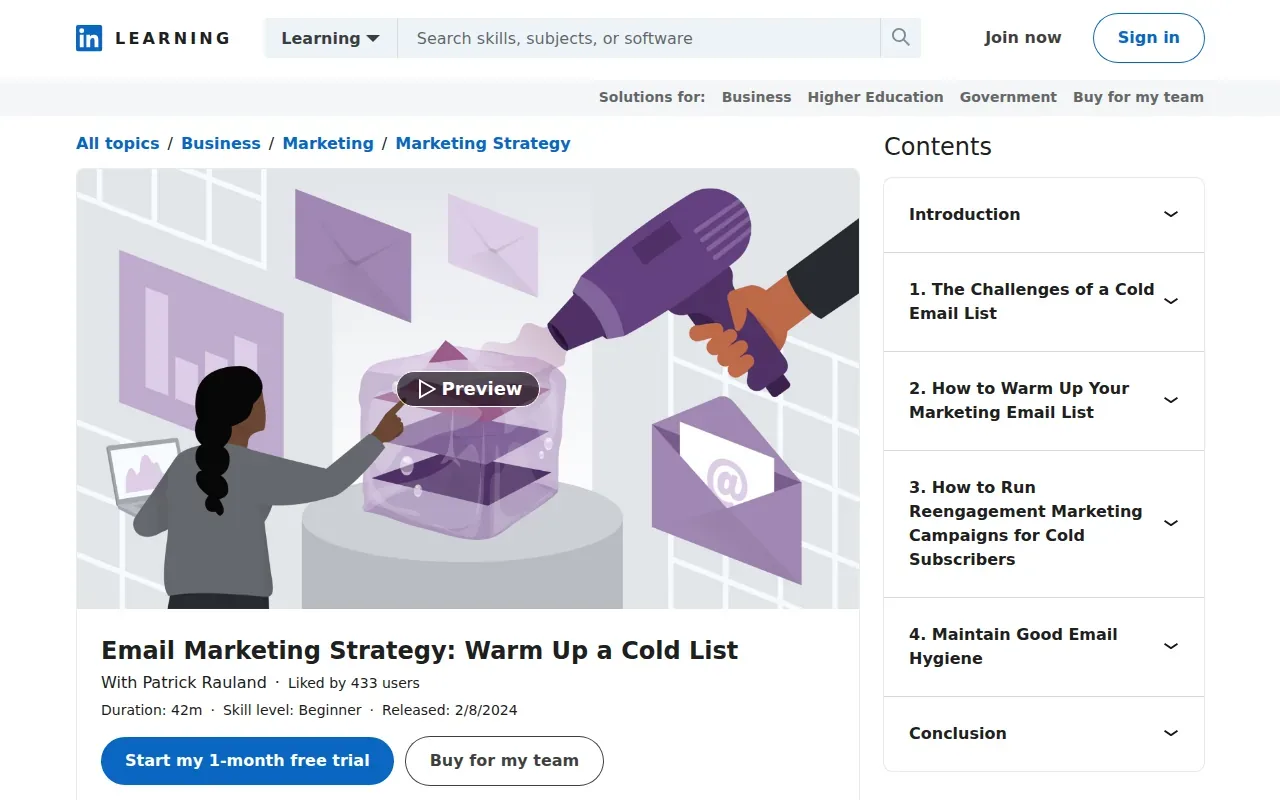
In a lesson on building a re-engagement campaign, the instructor describes a sequence that includes setting expectations, sharing strong content, inviting questions, and sending a final warning. The instructor gives a five-email example and says other campaigns can be shorter or longer. That’s an example to consider, not a rule every business should copy.
The lesson also advises that diminishing returns can occur as a sequence continues, and suggests that three to five emails may work for many businesses. Apply that guidance with care. A subscriber relationship, the reason a list went cold, and the quality of the contact data all affect how a re-engagement plan should be handled.
For a small business, the useful exercise is to define the purpose of each message before writing it. One email might explain a change in content. Another could share a useful resource. The final message should make the next step clear, including whether the subscriber wants to keep hearing from you.
This course is best viewed as a focused lesson rather than broad training in email marketing. It won’t replace a foundation in segmentation or measurement. But it can help you think through a common operational problem: how to contact inactive subscribers without sending a long, aimless string of messages.
For your own campaign, set a stop point before you begin. Review engagement after each send, then decide whether another message still gives the subscriber a reason to stay. For guidance on the wider topic, the customer win-back email framework covers a related re-engagement use case.
7. Klaviyo Product Certificate
Klaviyo Product Certificate is platform-specific training for learners who want to understand Klaviyo’s core features. The certificate guides learners through platform features and uses examples with actionable steps.
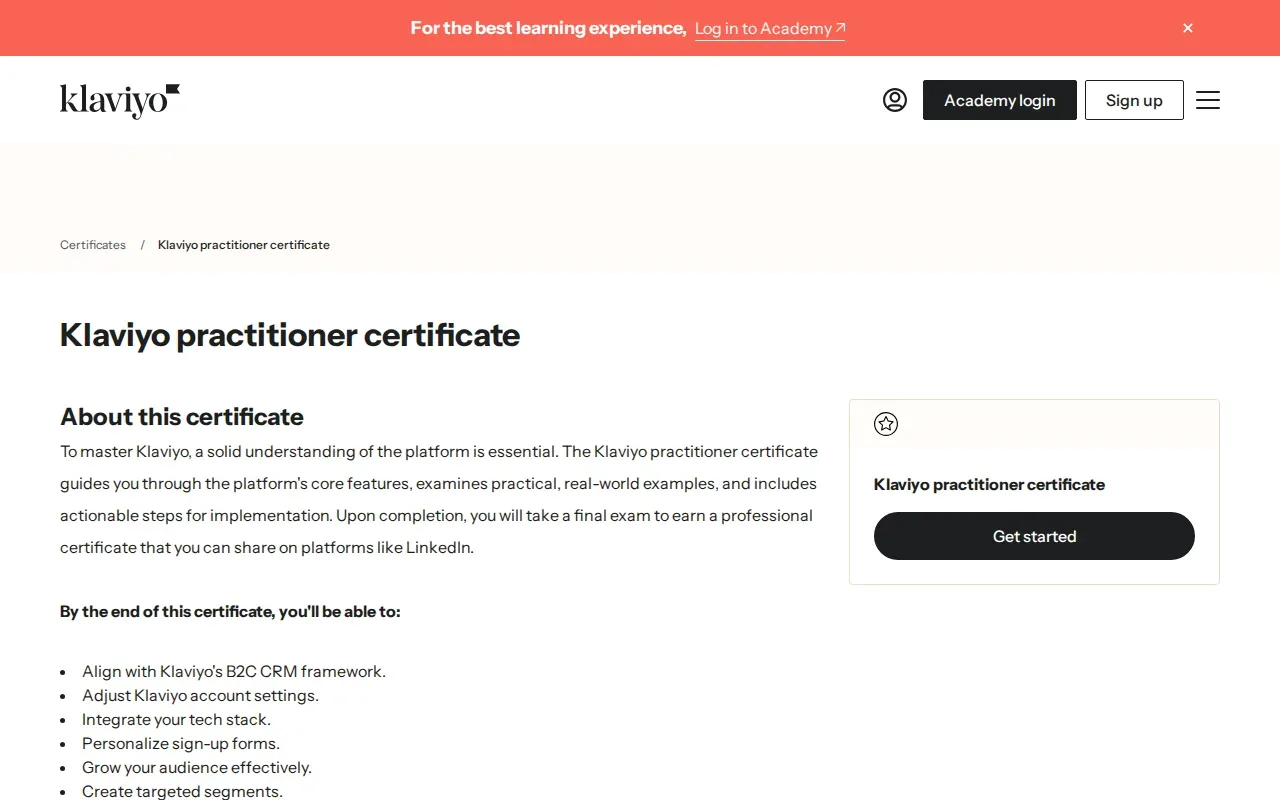
A product certificate answers a narrower question than a broad email marketing course: can you show that you’ve studied a particular platform? That can matter if your work already involves that platform or if a role asks for familiarity with its tools. It won’t, by itself, prove that you can plan a full email program across other systems.
Think about the tasks you expect to handle. If your work involves building campaigns inside Klaviyo, platform-specific learning may be directly relevant. If you’re still learning audience strategy or campaign measurement, start with those foundations and add tool training when you know which platform you’ll use.
The certificate’s focus on core features and examples makes it a reasonable option for someone who needs platform orientation. Don’t treat the certificate name as evidence of a broad marketing credential. Keep a note of which platform skills you studied, then connect those skills to the work you can demonstrate.
Platform training can also be easier to assess than a general credential. Before enrolling, compare the stated course content with the actual tasks in your job or client brief. A match between the lesson and the task gives you a clear reason to study.
8. Email Marketing by Alison
Email Marketing by Alison covers marketing, branding, and advertising principles and strategies for driving customer engagement and sales. It may suit a learner who wants a broad introduction before choosing a more focused course.
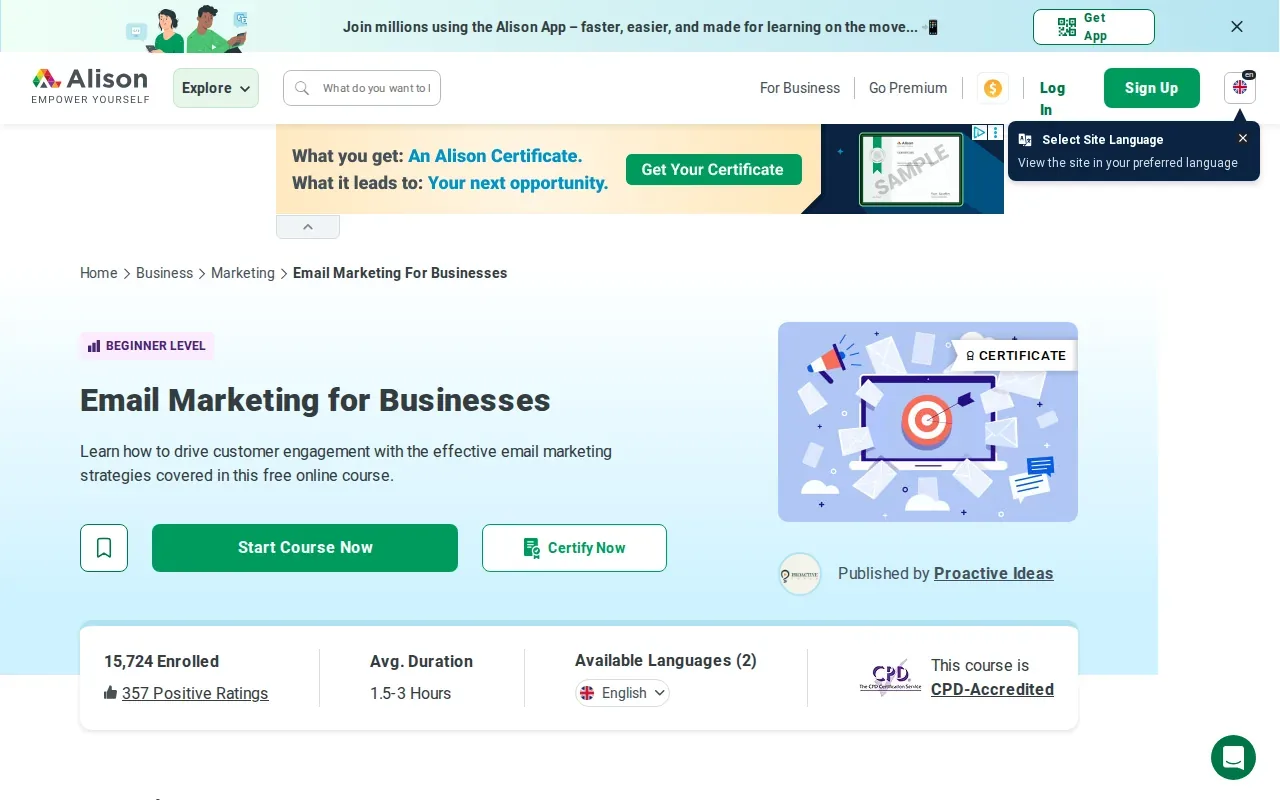
The course description connects email with the larger marketing message. That’s a useful way to think about the channel: an email shouldn’t feel detached from the brand or the reason a person joined the list. When you review any course, look for lessons that help you decide what to say and who should receive it.
Alison’s course is a candidate to check if you’re starting out and want an overview of email’s role in marketing. Review the course page as you decide whether it fits your learning goals.
For a first pass, write a simple brief before taking a broad course: who is the audience, what should the email help them do, and what would count as a useful response? This keeps your learning tied to a real task instead of leaving you with terms you can’t yet apply.
A broad introduction can be a good first rung, especially when you’re unsure whether to focus on copy, strategy, or platform skills. Once you see which part of the work interests you, move toward a course with a clearer skill focus.
How to compare these courses by skill level, cost, and usable value
Compare courses by the job you want to do after studying, not by the boldest credential label. Price and length are useful filters, but they don’t tell you whether the curriculum matches your gap.
| Course or resource | Best fit | Known cost or time | Credential or focus | Decision check |
|---|---|---|---|---|
| DiSousa | Course comparison and marketing education resources | — | Resource site, not a course credential | Use it to frame your shortlist, then confirm details with course providers. |
| SMstudy Email Marketing Certification | Those aiming to use email as a marketing tool | $300 | Email marketing certification | Check the certification requirements with the provider. |
| Email Marketing Strategy and Optimization by LinkedIn Learning | Beginners who need strategy basics | 1 hour, 2 minutes | Strategy optimization through segmentation, tracking, and timing | Check whether the course matches your strategy needs. |
| Email Marketing Course by Udacity | Learners focused on forms and metrics | — | Named skills include contact forms and metrics | Check whether its current curriculum fits your other skill needs. |
| Advanced Email Marketing Course by Market Motive | Learners ready for extended, advanced study | About 25 to 30 hours | Certificate of completion from Simplilearn | Decide whether the time commitment fits your schedule. |
| Email Marketing Strategy Warm Up a Cold List by LinkedIn Learning | Marketers working on subscriber re-engagement | — | Focused lesson on a re-engagement campaign | Use it for a cold-list problem, not as a full foundation. |
| Klaviyo Product Certificate | Learners who need Klaviyo platform skills | — | Training on platform features and examples | Choose it when platform knowledge is relevant to your work. |
| Email Marketing by Alison | Learners seeking a broad introduction | — | Marketing, branding, and advertising principles | Confirm that the current course details match your goals. |
For beginners, a short introduction can be enough to learn core terms and decide what to study next. Intermediate learners often get more value from a targeted topic, such as segmentation or re-engagement. Advanced learners should look for a longer curriculum that matches the decisions they’re expected to make.
Certification value depends on what the credential represents. SMstudy describes an email marketing certification designed for those who aim to use email as a marketing tool. Market Motive describes a certificate of completion. LinkedIn Learning’s short course focuses on strategy optimization. Those are different forms of evidence, so don’t compare the labels as though they mean the same thing.
Also consider the format you need. A short recorded lesson can fit around a busy week. A longer course may ask for sustained study. If you learn best by doing, check whether the provider describes exercises, workbooks, or other tasks. Don’t assume a certificate course includes feedback or mentorship unless the provider says so.
For email compliance, course scope matters. Rules differ by region and audience, so make sure your training covers the laws that apply to your audience.
There’s also a fair alternative to training: hiring a specialist. If you need a team to run campaigns rather than learn to run them yourself, an outside specialist may be worth considering. Learning and outsourcing solve different problems, so decide which one your business needs now.
For a deeper credential comparison, DiSousa’s email marketing certification roundup can help you think about what a certificate does and doesn’t prove. Then check the course’s official terms and curriculum before making a purchase.
Frequently asked questions
What is the best email marketing course for beginners?
The best starting course is the one that matches your current gap and gives you a manageable first lesson. Email Marketing Strategy and Optimization by LinkedIn Learning is marked beginner level and takes 1 hour and 2 minutes. Alison’s course covers broad marketing principles. Compare their stated topics with the task you need to handle first.
Are email marketing courses worth paying for?
Paid training can be worth it when the curriculum fits a skill you need and the cost matches your budget. SMstudy lists its certification at $300, with prerequisite study and an exam. A higher price alone doesn’t prove a better fit.
Do email marketing certificates help you get a job?
A certificate can show that you completed a course or passed an exam, but it can’t promise a job. Employers may also want to see how you think through a campaign, choose an audience, or assess results. Pair a credential with work samples or clear examples of tasks you’ve completed, when you have them.
How long does it take to learn email marketing?
There’s no single timeline because course scope varies. The LinkedIn Learning strategy course takes 1 hour and 2 minutes, while Market Motive estimates 25 to 30 hours for its advanced course. Those times describe course study, not the time needed to gain experience applying the ideas to live campaigns.
Should I take a general course or platform-specific training?
Take a general course when you need foundations such as strategy or audience segmentation. Choose platform training when your work calls for a specific tool, such as the Klaviyo Product Certificate. If you’re new to the field, learn the core decisions first, then add platform skills once you know which system you’ll use.
Conclusion
For a focused first lesson, consider the beginner LinkedIn Learning course. For a formal credential, weigh SMstudy’s prerequisites and exam before spending $300. If you’re building an online business and want help comparing your learning options, start with DiSousa’s course resources and choose one skill to work on next.
Income disclaimer: Learning a skill or earning a certificate does not guarantee income, employment, or business results. Outcomes depend on individual effort, experience, market conditions, and other factors.
