
Freelance Portfolio Examples: 15 Platforms for 2026

Looking for a portfolio that actually lands gigs? Below are 15 freelance portfolio examples that show real work, clear positioning, and the kind of detail clients love. I’ll walk you through each niche, point out what makes the showcase click, and give a few pro tips you can apply right now.
Designer Portfolio Examples: Behance, Dribbble, and Personal Sites
Designers often gravitate toward community‑focused platforms because they double as showrooms and networking hubs. Behance is a niche hub that feeds built‑in traffic to portfolios, letting freelancers tap an audience that’s already hunting for design talent. The site also supports multimedia uploads, so you can display everything from UI mockups to motion graphics in one place.
Dribbble focuses on UI/UX and offers an active job board and recruiter access.
Personal sites give you total control. By hosting your own domain, you can shape every pixel, add a blog, and integrate SEO tools that help prospects find you via Google. A minimalist layout keeps the focus on your work while a custom about page builds trust.
A simple pattern works well on a personal site: three strong projects on the home page and one short paragraph that says who you help and what you specialize in.
One caveat: community platforms like Behance and Dribbble rely on their own search algorithms, so a well‑optimized personal site can outrank them for niche queries if you follow basic SEO best practices.
If you work in art or illustration, read The Unfiltered Truth About Freelance Art Careers before you choose a platform.
Designers who want a hybrid approach can embed their Behance feed on a personal site, getting the best of both worlds, community traffic plus a branded domain.
Developer Portfolio Examples: GitHub Pages, Vercel, and Toptal
Developers need a portfolio that proves code quality and deployment chops. GitHub Pages offers free static‑site hosting straight from a repo, which instantly signals version‑control proficiency to recruiters.
Vercel takes things a step further with automatic deployments for Next.js and other modern frameworks. Its global CDN means your demo loads fast everywhere, a subtle proof point for performance‑focused clients.
Toptal is a curated network that showcases top‑tier freelancers to premium clients. Getting accepted adds a badge of credibility that can tip the scales on high‑budget contracts.
Here’s a quick way to combine them: host your source on GitHub, connect the repo to Vercel for instant builds, and then add a Toptal badge on the about page. The stack shows you can write, test, and ship at scale.
One limitation: free tiers on GitHub Pages and Vercel impose bandwidth caps. If you expect heavy traffic from a viral case study, consider upgrading to a paid plan.
Developers who need to showcase backend work can add a link to a live API demo hosted on a deployment platform; just keep the demo short and focused.
Writer Portfolio Examples: Medium, Substack, and Ghost
Writers have three natural homes for published work. Medium gives you a built‑in audience and a clean reading experience, plus the platform’s engagement‑based payout can double as social proof.
Substack flips the script: you own the subscriber list, and each post lives in a newsletter inbox. That ownership lets you demonstrate email‑marketing chops while still showcasing long‑form pieces.
Ghost offers full control with no transaction fees. You can host your own site, add SEO metadata, and integrate analytics without handing over revenue.
One way to combine them: link your most-read Medium article, add a Substack sign-up, and keep deeper case studies on a Ghost blog. That mix shows you can write for platforms, build an audience and handle the tech side.
Writers building samples before landing client work can turn writing training into portfolio evidence by creating a sample that demonstrates a specific skill.
A drawback of Medium is that you can’t export the full readership data, so you may need to supplement with a separate analytics dashboard if a client asks for traffic numbers.
Photographer Portfolio Examples: SmugMug, Zenfolio, and 500px
Photographers need high‑resolution galleries that load quickly. SmugMug offers unlimited storage and built‑in print fulfillment, so you can sell prints directly from the site while keeping the portfolio clean.
Zenfolio adds marketing automation tools like client proofing galleries and email follow‑ups, which help you turn a browsing session into a booked shoot.
500px doubles as a creative community and a licensing marketplace. Being active there shows you work among peers, and the licensing option shows you can monetize images beyond client work.
You can also split the work: SmugMug for the main gallery, Zenfolio for client proofing, and 500px for your strongest shots. That lets you highlight different strengths without cluttering a single site.
One thing to watch: Zenfolio is a paid service, so compare its plans before you build your proofing workflow around it.
Digital Marketer Portfolio Examples: Webflow, Wix, and Notion
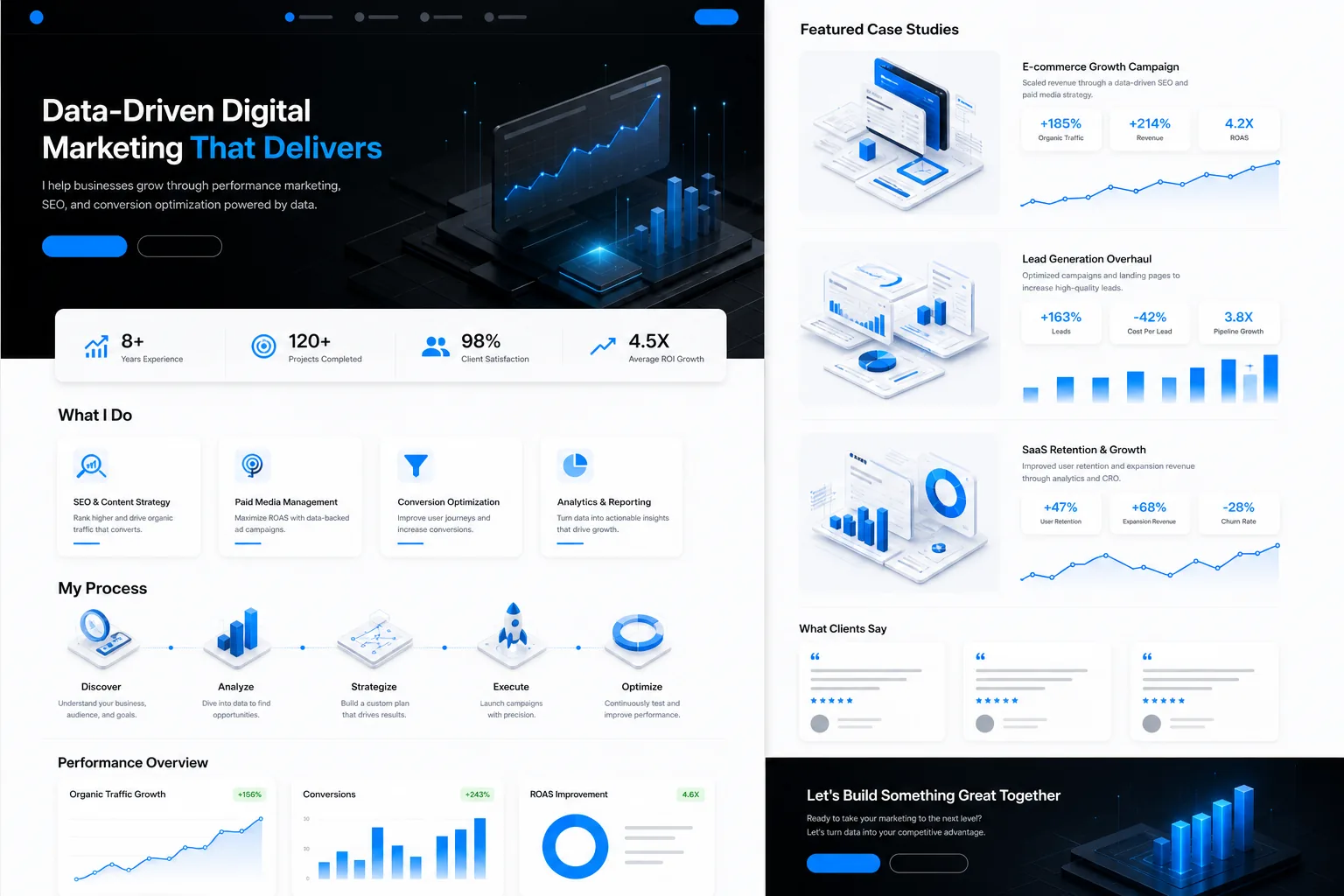
Marketers need to prove ROI, so a portfolio that shows campaigns, dashboards, and copy snippets works best. Webflow’s visual builder lets you craft interactive case studies with scroll‑triggered animations, while still giving you full CMS control for blog posts and client results.
Wix offers an extensive template library and an AI‑assisted design wizard, which can speed up the creation of a clean, mobile‑responsive site when you’re short on time.
Notion isn’t a traditional website builder, but its database‑driven pages let you build a living “evidence pack.” You can embed screenshots of ad dashboards, link to analytics reports, and keep everything behind a simple shareable URL.
A marketer can mix them too: Webflow for the main case studies, Wix for a quick services page, and Notion for a downloadable summary of campaign results.
Beware of Wix’s limited export options, if you ever want to migrate, you may need to rebuild pages manually.
Pro Tips for Making Your Freelance Portfolio Useful to Clients
Keep the homepage focused on a single value proposition. State who you serve and the main benefit in one sentence, then back it up with 3‑5 curated projects.
Use mockup frames that match the client’s industry, a SaaS dashboard mockup for a tech writer, a retail storefront screenshot for an e‑commerce photographer. It helps prospects visualize your work in their context.
Tag each project with the skill you used (e.g., “UX research”, “SEO audit”, “Email copy”), so a client can scan for the exact service they need.
Update the portfolio quarterly. Remove stale pieces, add fresh results, and refresh any broken links. A stale portfolio signals neglect.
Finally, include a short “How I work” section that outlines your process in 3 steps. Clients love to see a clear workflow before they reach out.
Conclusion
If you want a portfolio that converts, start with a clear value statement, showcase three strong, niche‑specific projects, and add verifiable results where possible. Build it on a platform that matches your skill set, then fine‑tune the design for speed and readability.
Next step: pick the platform that fits your niche, copy one of the examples above, and launch your site within 48 hours.
Frequently Asked Questions
What should I include in my freelance portfolio?
The core of a portfolio is 3‑5 high‑quality projects that show the problem, your solution, and measurable results. Add a brief bio, a clear services list, and contact info so prospects can reach you without hunting.
Do I need a personal domain or can I use a platform like Behance?
A personal domain gives you full control and better SEO, but platforms like Behance or Medium provide built‑in traffic and community features. Many freelancers start on a platform and later migrate to a custom domain for branding.
How often should I update my portfolio?
Refresh it at least every three months. Replace old work with recent projects, update metrics, and check that all links still work. A current portfolio signals professionalism.
Can I show spec work or unpaid projects?
Yes, as long as you label them clearly (e.g., “Concept project for a fictional fintech app”). Explain the brief, your role, and the outcome so clients understand the context.
What’s the best way to prove results without breaking NDAs?
Create a “Client‑Proof Evidence Pack” that includes redacted screenshots, anonymized metrics, and a short narrative of the process. This approach shows impact while keeping client data private.
Should I include testimonials?
Absolutely. Place one or two short quotes near relevant projects. Real names and titles add credibility, but if you need anonymity, use initials and a brief description of the client’s industry.
Sources and References
- GitHub Pages documentation
- Vercel official docs
- Medium About page

About the author